Iraq Advertising Market Size, Share & Growth Rate
The Iraq Advertising Market was estimated at USD 228 Million in 2025 and is projected to reach USD 298 Million by 2032, growing at a CAGR of 3.9% from 2026 to 2032. This growth trajectory is largely driven by the rapid increase in internet accessibility and mobile device penetration among the Iraqi population. The ongoing recovery of the economy, combined with a youthful demographic that is increasingly engaging with digital platforms, provides a fertile ground for advertising innovation and expansion.
Iraq Advertising Market Year-wise Growth Rate and Key Drivers
This graph highlights how the Iraq Advertising Market has steadily grown over the years, supported by major growth factors.
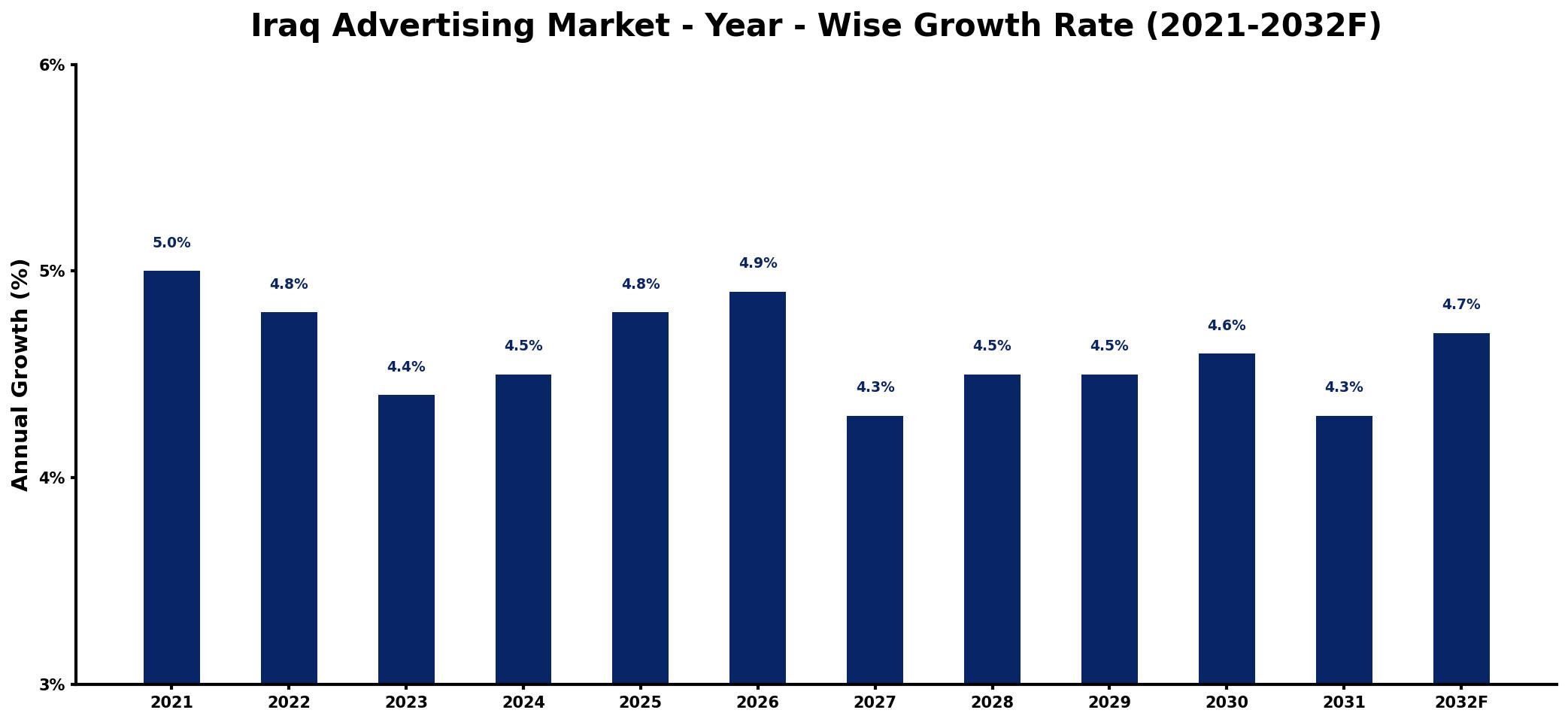
The table below presents the year‑wise growth rates along with the key drivers influencing the market
| Year | Growth Rate | Major Drivers |
| 2021 | 5.0% | Rising digital media consumption trends |
| 2022 | 4.8% | Increased mobile internet accessibility |
| 2023 | 4.4% | Growth in e-commerce platforms |
| 2024 | 4.5% | Expansion of social media usage |
| 2025 | 4.8% | Higher consumer spending patterns |
| 2026 | 4.9% | Emergence of new market players |
| 2027 | 4.3% | Investment in local content creation |
| 2028 | 4.5% | Development of influencer marketing strategies |
| 2029 | 4.5% | Strengthening of brand loyalty programs |
| 2030 | 4.6% | Adoption of innovative marketing technologies |
| 2031 | 4.3% | Diversification of revenue streams |
| 2032 | 4.7% | Enhanced cross-channel promotional efforts |
Note: Market size estimations and growth projections presented in this report are based on 6Wresearch's proprietary forecasting methodology, utilizing the latest available industry data, government publications, and primary research inputs.
Iraq Advertising Market Synopsis
The advertising landscape in Iraq is currently undergoing a significant transformation. As traditional channels like television and print remain dominant, there is a noteworthy shift toward digital advertising, reflecting global trends. Social media platforms, particularly Facebook and Instagram, are emerging as vital avenues for brand engagement, appealing to a populace keen on connectivity.
Key industries such as telecommunications, automotive, and consumer goods are fueling this growth, as brands seek to capitalize on the expanding middle class. With the nations infrastructure improvements, the demand for effective advertising strategies continues to rise, urging companies to embrace more personalized and targeted approaches in their campaigns.
Iraq Advertising Market Key Takeaways
- The market is experiencing a notable shift toward digital platforms, enhancing reach and targeting capabilities.
- Consumer engagement is increasingly influenced by local influencers, making influencer marketing a rising trend.
- The automotive and telecommunications sectors lead the charge in advertising spending in Iraq.
- Political and economic instability poses unique challenges that impact advertising strategies and investments.
- Future growth is supported by a tech-savvy youth demographic eager for innovative advertising solutions.
Evaluation of Restraints in Iraq Advertising Market
The Iraq advertising market grapples with several significant restraints. Political instability, compounded by security concerns, creates an unpredictable environment for advertisers. This volatility can deter potential investments and limit campaign reach. Furthermore, the infrastructure in many areas remains underdeveloped, which hinders access to advanced advertising technologies. Additionally, cultural and religious considerations are crucial in campaign design and execution, necessitating a careful, respectful approach that may limit creative freedom.
Iraq Advertising Market Trends
A clear trend in the Iraq advertising market is the migration toward digital channels, amplified by soaring smartphone adoption rates. Advertisers are increasingly utilizing social media not just for broad outreach but for targeted marketing, leveraging sophisticated analytics to understand consumer behavior. Video content has also gained traction, with brands turning to engaging formats to captivate viewers, responding to the growing preference for visual storytelling. Moreover, the rise of influencer marketing reflects the local population's trust in peer recommendations over traditional advertising methods.
Iraq Advertising Market Opportunities
Investment opportunities in Iraq's advertising market are promising, particularly as the economy stabilizes. The burgeoning digital landscape calls for more advanced advertising techniques, creating a demand for digital marketing firms and innovative content creators. Out-of-home advertising is gaining momentum in urban areas, while opportunities in data analytics and targeted advertising strategies are increasingly vital. Brands that adapt to the local market's unique needs and preferences stand to benefit significantly from these shifts.
Government Initiatives in the Iraq Advertising Market
The regulatory framework governing the Iraq advertising market is overseen by the Iraqi Communications and Media Commission (CMC). The government enforces strict regulations aimed at maintaining ethical standards in advertising, particularly concerning sensitive subjects like alcohol, tobacco, and gambling. Political and religious advertising is closely monitored to prevent misinformation. These measures reflect a commitment to uphold cultural integrity while encouraging fair competition, creating a landscape that promotes responsible advertising practices within the nation.
Future Insights of the Iraq Advertising Market
Looking ahead to 2026-2032, the Iraq advertising market is poised for significant expansion, driven by ongoing economic recovery and increasing digital adoption. As more businesses recognize the value of online engagement, the demand for innovative advertising solutions will continue to rise. The youthful population, with its growing internet connectivity, will be a pivotal factor in shaping advertising strategies. However, ongoing political and security challenges may influence market dynamics, necessitating agility and responsiveness from advertising firms.
Iraq Advertising Market Latest Developments (2025 - 2026)
In recent months, the Iraq advertising industry has seen an uptick in digital marketing campaigns as brands increasingly pivot to online platforms to capture consumer attention. Several initiatives have been launched to enhance the capabilities of local advertising agencies, focusing on skills development in digital marketing and data analysis. The use of localized content has gained emphasis, with brands seeking to resonate more deeply with diverse consumer groups across the country.
Iraq Advertising Market - Key Attractiveness of the Report
- 10 Years of Market Numbers
- Historical Data Starting from 2022 to 2025
- Base Year: 2025
- Forecast Data until 2032
- Key Performance Indicators Impacting the Market
- Major Upcoming Developments and Projects
Key Highlights of the Report:
- Iraq Advertising Market Outlook
- Market Size of Iraq Advertising Market, 2025
- Forecast of Iraq Advertising Market, 2032
- Historical Data and Forecast of Iraq Advertising Revenues & Volume for the Period 2022-2032F
- Iraq Advertising Market Trend Evolution
- Iraq Advertising Market Drivers and Challenges
- Iraq Advertising Price Trends
- Iraq Advertising Porter's Five Forces
- Iraq Advertising Industry Life Cycle
- Historical Data and Forecast of Iraq Advertising Market Revenues & Volume By Type for the Period 2022-2032F
- Historical Data and Forecast of Iraq Advertising Market Revenues & Volume By Television for the Period 2022-2032F
- Historical Data and Forecast of Iraq Advertising Market Revenues & Volume By Print (Newspaper and Magazine) for the Period 2022-2032F
- Historical Data and Forecast of Iraq Advertising Market Revenues & Volume By Radio for the Period 2022-2032F
- Historical Data and Forecast of Iraq Advertising Market Revenues & Volume By Outdoor for the Period 2022-2032F
- Historical Data and Forecast of Iraq Advertising Market Revenues & Volume By Internet (Search, Display, Classified, Video) for the Period 2022-2032F
- Historical Data and Forecast of Iraq Advertising Market Revenues & Volume By Mobile for the Period 2022-2032F
- Historical Data and Forecast of Iraq Advertising Market Revenues & Volume By Cinema for the Period 2022-2032F
- Iraq Advertising Import Export Trade Statistics
- Market Opportunity Assessment By Type
- Iraq Advertising Top Companies Market Share
- Iraq Advertising Competitive Benchmarking By Technical and Operational Parameters
- Iraq Advertising Company Profiles
- Iraq Advertising Key Strategic Recommendations






































