Iraq Animal Feed Enzymes Market Size, Share & Growth Rate
The Iraq Animal Feed Enzymes Market was estimated at USD 1155 Million in 2025 and is projected to reach USD 1682 Million by 2032, growing at a CAGR of 5.5% from 2026 to 2032. This growth trajectory can be attributed to several key factors, including a notable increase in livestock production, rising health standards, and the urgent demand for improved feed efficiency. Moreover, the growing recognition of the role enzymes play in enhancing animal health and productivity is steering the market towards expansion.
Iraq Animal Feed Enzymes Market Year-wise Growth Rate and Key Drivers
This graph highlights how the Iraq Animal Feed Enzymes Market has steadily grown over the years, supported by major growth factors.
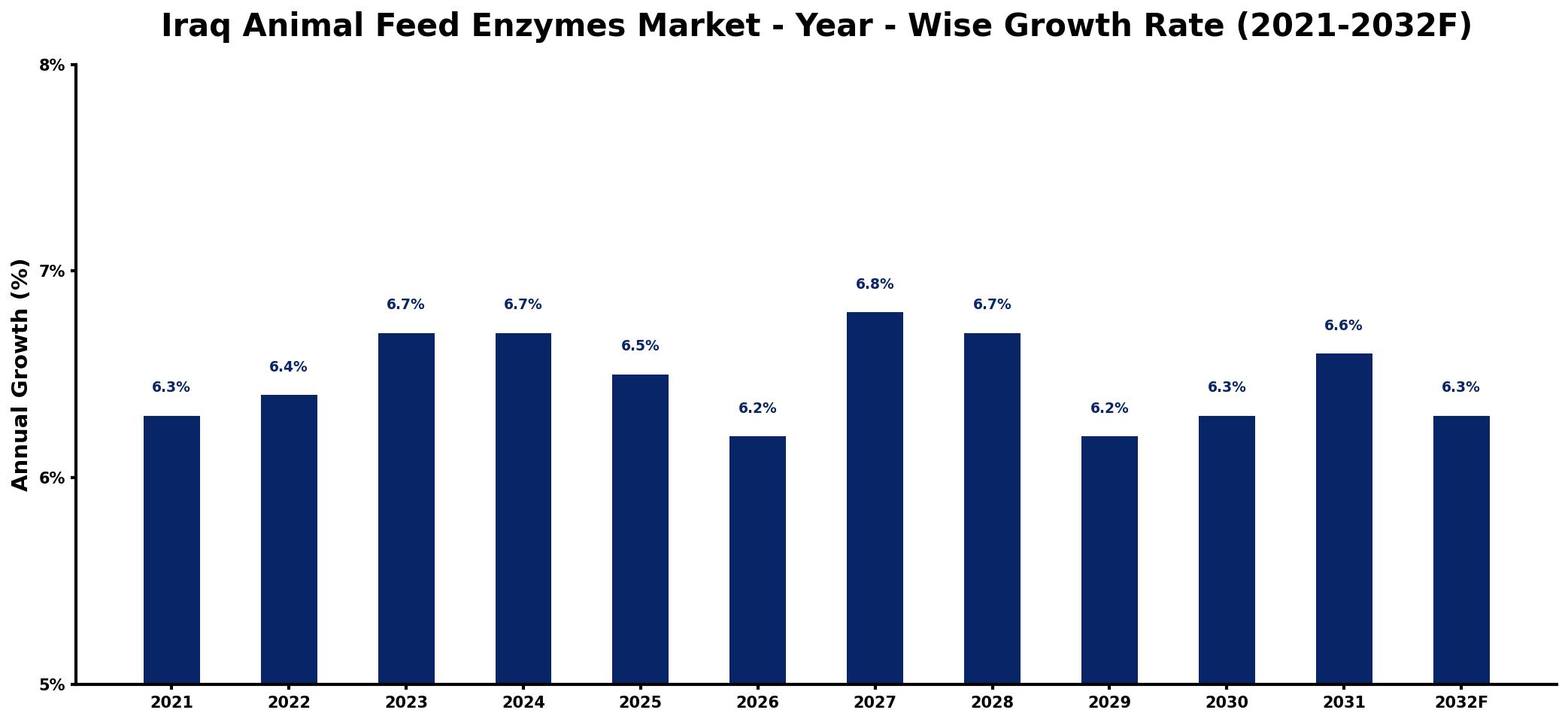
The table below presents the year‑wise growth rates along with the key drivers influencing the market
| Year | Growth Rate | Major Drivers |
| 2021 | 6.3% | Rising livestock production levels |
| 2022 | 6.4% | Increased demand for protein sources |
| 2023 | 6.7% | Expansion of poultry farming sector |
| 2024 | 6.7% | Growing aquaculture industry investments |
| 2025 | 6.5% | Higher livestock health awareness |
| 2026 | 6.2% | Emerging organic farming practices |
| 2027 | 6.8% | Technological advancements in farming |
| 2028 | 6.7% | Increased export opportunities available |
| 2029 | 6.2% | Rising consumer health consciousness |
| 2030 | 6.3% | Growing demand for sustainable practices |
| 2031 | 6.6% | Investment in agricultural innovations |
| 2032 | 6.3% | Strengthening local supply chains |
Note: Market size estimations and growth projections presented in this report are based on 6Wresearch's proprietary forecasting methodology, utilizing the latest available industry data, government publications, and primary research inputs.
Iraq Animal Feed Enzymes Market Synopsis
Recently, the Iraq Animal Feed Enzymes Market has gained momentum due to a heightened awareness of animal nutrition among farmers. As more livestock producers embrace modern farming practices, the demand for high-quality feed solutions continues to grow. Looking ahead, the market is set to evolve, propelled by advancements in enzyme technology and a broader acceptance of innovative feed solutions tailored to diverse animal species.
Despite its current upward trajectory, the market faces challenges that could temper growth. Limited awareness among smaller farmers and concerns over raw material prices remain critical issues. Nevertheless, the overarching trend towards sustainable agriculture and enhanced livestock health promises a robust future for the Iraq Animal Feed Enzymes Market.
Iraq Animal Feed Enzymes Market Key Takeaways
- The market is projected to grow significantly, reaching USD 1682 Million by 2032.
- Increased awareness and education on the benefits of feed enzymes are driving demand.
- There is a notable shift towards multi-enzyme formulations for enhanced efficiency.
- Sustainable farming practices are influencing the adoption of enzyme technologies.
- Investment opportunities are ripe for innovative solutions tailored to local livestock needs.
Evaluation of Restraints in Iraq Animal Feed Enzymes Market
Several restraints challenge the Iraq Animal Feed Enzymes Market, including limited awareness of feed enzymes among local farmers and manufacturers. This lack of understanding can hinder the widespread adoption of these products. Additionally, inadequate infrastructure and variability in raw material quality contribute to inconsistencies in product effectiveness. Political instability and economic uncertainty also pose risks, affecting investment and growth potential in the sector.
Iraq Animal Feed Enzymes Market Trends
Current trends in the Iraq Animal Feed Enzymes Market reveal a growing inclination towards customized enzyme solutions designed for specific livestock species. The adoption of multi-enzyme formulations is gaining traction, as these combinations are recognized for their synergistic effects on feed digestibility and nutrient absorption. Moreover, phytase enzymes are increasingly popular due to their ability to enhance phosphorus utilization, addressing both cost and environmental sustainability concerns in animal feed production.
Iraq Animal Feed Enzymes Market Opportunities
The Iraq Animal Feed Enzymes Market offers substantial investment opportunities, particularly for companies that prioritize sustainability and innovation. As the livestock sector expands, the demand for high-quality feed solutions is expected to rise correspondingly. Collaborating with local feed producers and veterinary professionals can facilitate market penetration and enhance the effectiveness of new products. Additionally, supporting educational programs can elevate awareness and foster greater acceptance of feed enzymes across the farming community.
Government Initiatives in the Iraq Animal Feed Enzymes Market
Government initiatives play a vital role in the Iraq Animal Feed Enzymes Market, focusing on ensuring product safety and quality. The Ministry of Agriculture oversees the approval and registration processes for feed enzymes, setting stringent standards that manufacturers must comply with. Furthermore, regulations on imports help maintain quality control and protect local producers. Government support for research and development initiatives aims to bolster the efficiency and sustainability of animal feed production practices throughout Iraq.
Future Insights of the Iraq Animal Feed Enzymes Market
Looking ahead to the period from 2026 to 2032, the Iraq Animal Feed Enzymes Market is well-positioned for steady growth. The demand for effective feed solutions that enhance livestock productivity and reduce operational costs will continue to drive market dynamics. Advances in enzyme technology, alongside a stronger regulatory framework, are expected to boost product quality and safety, ensuring that both farmers and consumers benefit from improved animal health and performance.
Iraq Animal Feed Enzymes Market Latest Developments (2025 - 2026)
Recent developments in the Iraq Animal Feed Enzymes Market have highlighted an increased focus on research partnerships aimed at developing innovative enzyme solutions. Emerging distribution channels are also being explored to facilitate better access to these products for livestock farmers. Simultaneously, educational initiatives aimed at increasing awareness of the benefits of feed enzymes are gaining traction among agricultural stakeholders, fostering a more informed market landscape.
Iraq Animal Feed Enzymes Market - Key Attractiveness of the Report
- 10 Years of Market Numbers
- Historical Data Starting from 2022 to 2025
- Base Year: 2025
- Forecast Data until 2032
- Key Performance Indicators Impacting the Market
- Major Upcoming Developments and Projects
Key Highlights of the Report:
- Iraq Animal Feed Enzymes Market Outlook
- Market Size of Iraq Animal Feed Enzymes Market, 2025
- Forecast of Iraq Animal Feed Enzymes Market, 2032
- Historical Data and Forecast of Iraq Animal Feed Enzymes Revenues & Volume for the Period 2022-2032F
- Iraq Animal Feed Enzymes Market Trend Evolution
- Iraq Animal Feed Enzymes Market Drivers and Challenges
- Iraq Animal Feed Enzymes Price Trends
- Iraq Animal Feed Enzymes Porter's Five Forces
- Iraq Animal Feed Enzymes Industry Life Cycle
- Historical Data and Forecast of Iraq Animal Feed Enzymes Market Revenues & Volume By Formulation for the Period 2022-2032F
- Historical Data and Forecast of Iraq Animal Feed Enzymes Market Revenues & Volume By Dry for the Period 2022-2032F
- Historical Data and Forecast of Iraq Animal Feed Enzymes Market Revenues & Volume By Liquid for the Period 2022-2032F
- Historical Data and Forecast of Iraq Animal Feed Enzymes Market Revenues & Volume By Product for the Period 2022-2032F
- Historical Data and Forecast of Iraq Animal Feed Enzymes Market Revenues & Volume By Phytase for the Period 2022-2032F
- Historical Data and Forecast of Iraq Animal Feed Enzymes Market Revenues & Volume By Carbohydrase for the Period 2022-2032F
- Historical Data and Forecast of Iraq Animal Feed Enzymes Market Revenues & Volume By Protease for the Period 2022-2032F
- Historical Data and Forecast of Iraq Animal Feed Enzymes Market Revenues & Volume By Non starch polysaccharides for the Period 2022-2032F
- Historical Data and Forecast of Iraq Animal Feed Enzymes Market Revenues & Volume By Livestock for the Period 2022-2032F
- Historical Data and Forecast of Iraq Animal Feed Enzymes Market Revenues & Volume By Poultry for the Period 2022-2032F
- Historical Data and Forecast of Iraq Animal Feed Enzymes Market Revenues & Volume By Swine for the Period 2022-2032F
- Historical Data and Forecast of Iraq Animal Feed Enzymes Market Revenues & Volume By Ruminant for the Period 2022-2032F
- Historical Data and Forecast of Iraq Animal Feed Enzymes Market Revenues & Volume By Aquaculture for the Period 2022-2032F
- Historical Data and Forecast of Iraq Animal Feed Enzymes Market Revenues & Volume By Others for the Period 2022-2032F
- Iraq Animal Feed Enzymes Import Export Trade Statistics
- Market Opportunity Assessment By Formulation
- Market Opportunity Assessment By Product
- Market Opportunity Assessment By Livestock
- Iraq Animal Feed Enzymes Top Companies Market Share
- Iraq Animal Feed Enzymes Competitive Benchmarking By Technical and Operational Parameters
- Iraq Animal Feed Enzymes Company Profiles
- Iraq Animal Feed Enzymes Key Strategic Recommendations






































