Iraq Building Construction Market Size, Share & Growth Rate
The Iraq Building Construction Market was estimated at USD 259 Million in 2025 and is projected to reach USD 341 Million by 2032, growing at a CAGR of 4.0% from 2026 to 2032. This upward trajectory is primarily driven by a surge in government investments targeting infrastructure enhancements and the ongoing reconstruction of war-affected regions. Moreover, the burgeoning population and the accompanying demand for modern residential and commercial properties are key factors propelling market growth.
Iraq Building Construction Market Year-wise Growth Rate and Key Drivers
This graph highlights how the Iraq Building Construction Market has steadily grown over the years, supported by major growth factors.
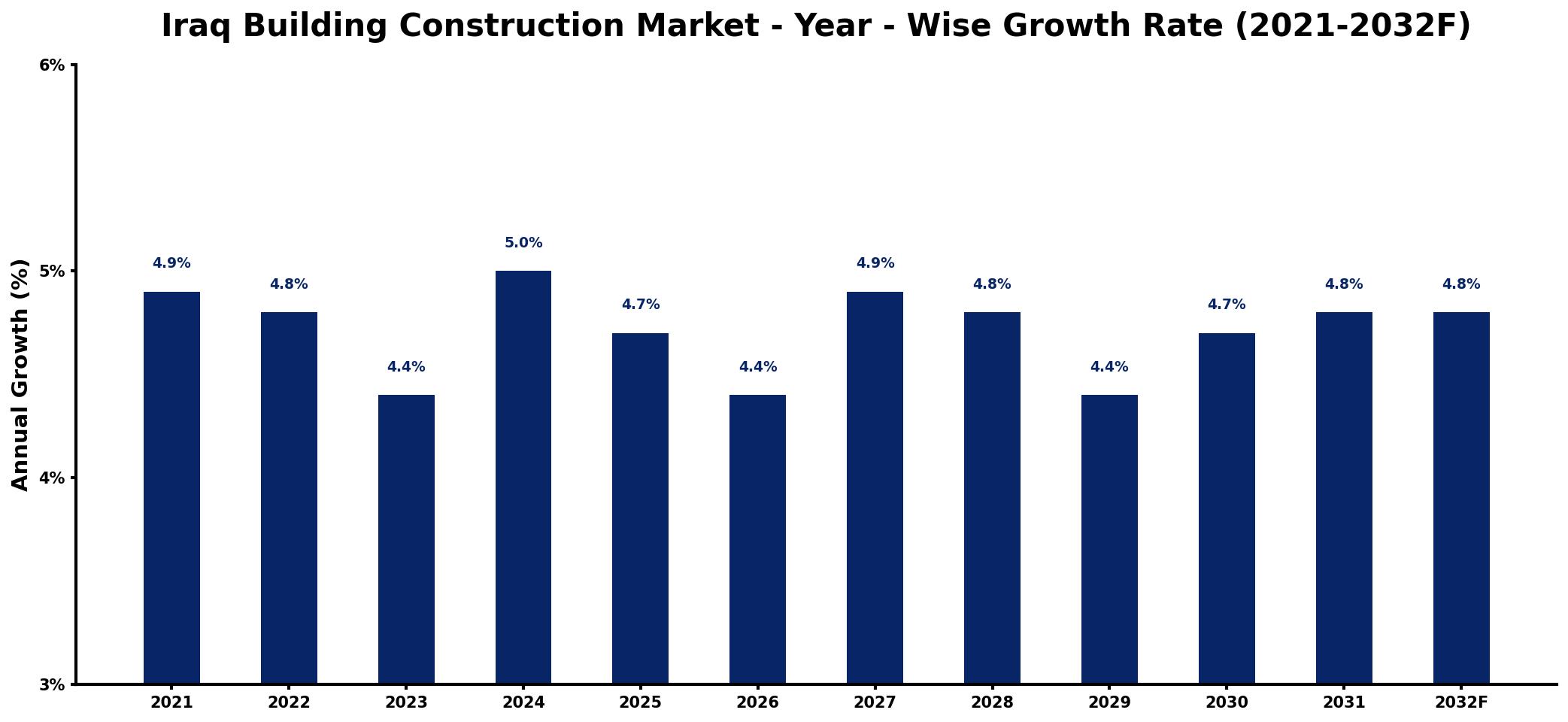
The table below presents the year‑wise growth rates along with the key drivers influencing the market
| Year | Growth Rate | Major Drivers |
| 2021 | 4.9% | Increased infrastructure development projects |
| 2022 | 4.8% | Growing urban population demands housing |
| 2023 | 4.4% | Rising foreign investments in sectors |
| 2024 | 5.0% | Expansion of renewable energy initiatives |
| 2025 | 4.7% | Government incentives for private investments |
| 2026 | 4.4% | Surge in commercial property developments |
| 2027 | 4.9% | Enhanced logistics and transportation networks |
| 2028 | 4.8% | Advancements in technology adoption rates |
| 2029 | 4.4% | Increased public-private partnership agreements |
| 2030 | 4.7% | Strengthened regional trade agreements |
| 2031 | 4.8% | Higher demand for sustainable practices |
| 2032 | 4.8% | Growth in tourism-related facilities |
Note: Market size estimations and growth projections presented in this report are based on 6Wresearch's proprietary forecasting methodology, utilizing the latest available industry data, government publications, and primary research inputs.
Iraq Building Construction Market Synopsis
Demand for housing and commercial spaces in Iraq is burgeoning, fueled by rapid urbanization and a young population. This pressing need for modern amenities is prompting significant government initiatives aimed at revitalizing infrastructure to meet these demands. The landscape is further characterized by an influx of both local and international construction firms eager to capitalize on these emerging opportunities.
Despite the optimism surrounding growth, the market is not without its complexities. The interplay of political challenges, security concerns, and bureaucratic red tape continues to complicate the execution of construction projects. Nonetheless, the commitment to rebuilding and modernization positions the Iraq Building Construction Market as a promising field for strategic investment and development.
Iraq Building Construction Market Key Takeaways
- Steady growth driven by government investments in infrastructure and reconstruction efforts.
- Increased demand for residential and commercial properties due to urbanization and population growth.
- Emerging trends in sustainable and energy-efficient construction practices gaining traction.
- Challenges related to security and bureaucratic inefficiencies persist, impacting market dynamics.
- Significant opportunities in public-private partnerships for infrastructure and real estate development.
Evaluation of Restraints in Iraq Building Construction Market
The Iraq Building Construction Market faces notable restraints that hinder its full potential. Political instability remains a dominant concern, creating uncertainty that can deter foreign investment. Additionally, security issues continue to impede progress, making project execution more challenging. Bureaucratic inefficiencies exacerbate these issues, with companies often encountering significant delays in obtaining necessary permits and navigating regulations. These factors collectively contribute to a less favorable environment for timely and quality construction delivery.
Iraq Building Construction Market Trends
The market is increasingly shifting towards sustainable practices, as more projects incorporate energy-efficient technologies and materials. This trend aligns with global demands for green building solutions and reflects a growing awareness among stakeholders of the benefits of sustainable construction. Furthermore, the use of prefabricated and modular construction techniques is gaining popularity, allowing for faster project completion times and reduced overall costs. Smart building technologies are also beginning to emerge, integrating automation and enhanced security features into new developments.
Iraq Building Construction Market Opportunities
There exists a wealth of investment opportunities within the Iraq Building Construction Market. The ongoing need for infrastructure projects, such as roads, bridges, and utilities, invites substantial public-private partnerships. Additionally, with the populations continuous growth and urban expansion, residential and commercial real estate developments present attractive prospects for investors. Companies that can navigate the challenging political landscape while delivering innovative solutions will likely thrive in this evolving market.
Government Initiatives in the Iraq Building Construction Market
Government policies are increasingly focused on stimulating growth in the construction sector through various initiatives. These include offering tax incentives and streamlining approval processes for projects, aimed at attracting foreign investment. Furthermore, the government emphasizes compliance with building codes and safety regulations, promoting high-quality standards in construction. Ongoing efforts to rehabilitate war-torn areas underline the commitment to infrastructure development and economic stability.
Future Insights of the Iraq Building Construction Market
Looking ahead to 2026-2032, the Iraq Building Construction Market appears poised for continued growth. Factors such as a young and expanding population, ongoing urbanization, and robust government-backed infrastructure initiatives are expected to drive demand. However, navigating the complexities of the political landscape and addressing security concerns will be critical for unlocking this market's full potential. Emphasizing modernization and sustainable practices will likely become integral to maintaining a competitive edge in the sector.
Iraq Building Construction Market Latest Developments (2025 - 2026)
Recent developments within the Iraq Building Construction Market have seen a notable increase in government-led infrastructure projects aimed at revitalizing key sectors of the economy. Various initiatives have emerged focusing on enhancing urban infrastructure and public facilities, showcasing a dedication to long-term stability. There is also a marked shift towards engaging more international firms, driven by the need for expertise and advanced technologies to meet evolving construction demands.
Iraq Building Construction Market - Key Attractiveness of the Report
- 10 Years of Market Numbers
- Historical Data Starting from 2022 to 2025
- Base Year: 2025
- Forecast Data until 2032
- Key Performance Indicators Impacting the Market
- Major Upcoming Developments and Projects
Key Highlights of the Report:
- Iraq Building Construction Market Outlook
- Market Size of Iraq Building Construction Market, 2025
- Forecast of Iraq Building Construction Market, 2032
- Historical Data and Forecast of Iraq Building Construction Revenues & Volume for the Period 2022-2032F
- Iraq Building Construction Market Trend Evolution
- Iraq Building Construction Market Drivers and Challenges
- Iraq Building Construction Price Trends
- Iraq Building Construction Porter's Five Forces
- Iraq Building Construction Industry Life Cycle
- Historical Data and Forecast of Iraq Building Construction Market Revenues & Volume By Type for the Period 2022-2032F
- Historical Data and Forecast of Iraq Building Construction Market Revenues & Volume By Residential for the Period 2022-2032F
- Historical Data and Forecast of Iraq Building Construction Market Revenues & Volume By Non-residential for the Period 2022-2032F
- Historical Data and Forecast of Iraq Building Construction Market Revenues & Volume By Construction Type for the Period 2022-2032F
- Historical Data and Forecast of Iraq Building Construction Market Revenues & Volume By New Construction for the Period 2022-2032F
- Historical Data and Forecast of Iraq Building Construction Market Revenues & Volume By Renovation for the Period 2022-2032F
- Historical Data and Forecast of Iraq Building Construction Market Revenues & Volume By Application for the Period 2022-2032F
- Historical Data and Forecast of Iraq Building Construction Market Revenues & Volume By Owned for the Period 2022-2032F
- Historical Data and Forecast of Iraq Building Construction Market Revenues & Volume By Rental for the Period 2022-2032F
- Historical Data and Forecast of Iraq Building Construction Market Revenues & Volume By End User for the Period 2022-2032F
- Historical Data and Forecast of Iraq Building Construction Market Revenues & Volume By Private for the Period 2022-2032F
- Historical Data and Forecast of Iraq Building Construction Market Revenues & Volume By Public for the Period 2022-2032F
- Iraq Building Construction Import Export Trade Statistics
- Market Opportunity Assessment By Type
- Market Opportunity Assessment By Construction Type
- Market Opportunity Assessment By Application
- Market Opportunity Assessment By End User
- Iraq Building Construction Top Companies Market Share
- Iraq Building Construction Competitive Benchmarking By Technical and Operational Parameters
- Iraq Building Construction Company Profiles
- Iraq Building Construction Key Strategic Recommendations






































