Iraq Chicory Market Size, Share & Growth Rate
The Iraq Chicory Market was estimated at USD 310 Million in 2025 and is projected to reach USD 413 Million by 2032, growing at a CAGR of 4.2% from 2026 to 2032. This growth trajectory is largely driven by the increasing consumer preference for natural and healthy food ingredients, as well as the rising demand for caffeine-free alternatives. As Iraq's food and beverage industry continues to evolve, the versatility of chicory in various applications—from salads to herbal teas—positions it as a key player in the health-conscious segment.
Iraq Chicory Market Year-wise Growth Rate and Key Drivers
This graph highlights how the Iraq Chicory Market has steadily grown over the years, supported by major growth factors.
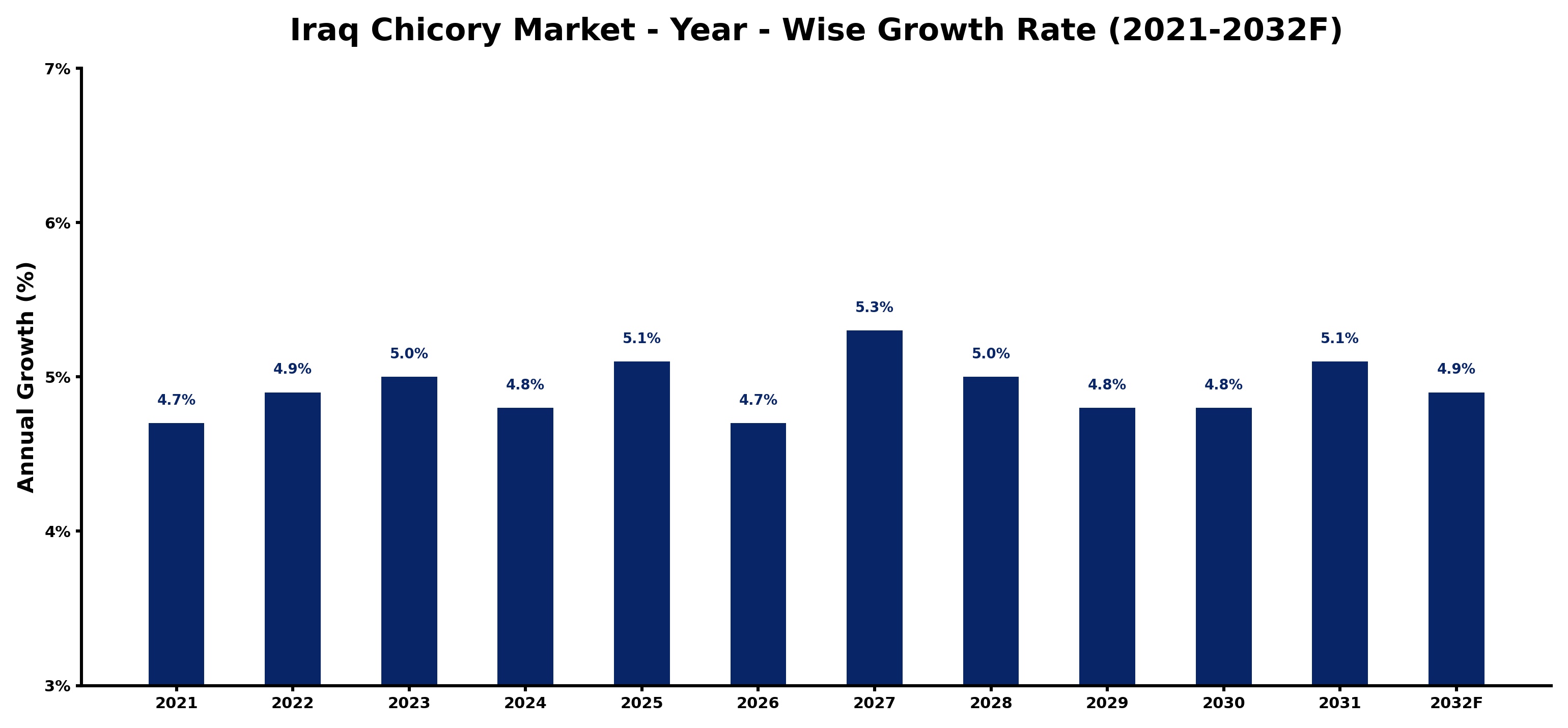
The table below presents the year‑wise growth rates along with the key drivers influencing the market
| Year | Growth Rate | Major Drivers |
| 2021 | 4.7% | Rising health consciousness among consumers |
| 2022 | 4.9% | Increased demand for natural ingredients |
| 2023 | 5.0% | Growing popularity of chicory coffee |
| 2024 | 4.8% | Expansion of organic product lines |
| 2025 | 5.1% | Increased investment in local farming |
| 2026 | 4.7% | Emergence of new chicory products |
| 2027 | 5.3% | Rising export opportunities for chicory |
| 2028 | 5.0% | Consumer interest in functional foods |
| 2029 | 4.8% | Enhanced marketing strategies attracted consumers |
| 2030 | 4.8% | Collaboration with food manufacturers expanded |
| 2031 | 5.1% | Increased availability in retail outlets |
| 2032 | 4.9% | Growing trend of plant-based diets |
Note - Market size estimations and growth projections presented in this report are based on 6Wresearch's advanced forecasting approach, validated with industry datasets as of June 2026.
Iraq Chicory Market Synopsis
In recent years, the chicory market in Iraq has gained momentum, with a burgeoning interest in plant-based diets and the health benefits associated with chicory roots and leaves. However, this enthusiasm faces the challenge of limited awareness among consumers about chicory's potential applications.
Looking forward, the market is poised for significant growth as the Iraqi population becomes more health-conscious and educated about natural ingredients. Initiatives to enhance local production and processing capabilities will further stimulate market demand and product availability, paving the way for a vibrant chicory industry.
Iraq Chicory Market Key Takeaways
- The market is projected to grow at a steady pace, driven by consumer shifts towards healthy food options.
- Chicory is increasingly recognized for its potential as a caffeine-free coffee substitute and digestive health ingredient.
- Government initiatives are fostering sustainable farming practices and supporting chicory cultivation.
- Despite its benefits, consumer awareness remains a barrier that must be addressed for market expansion.
- Investment in processing technologies and product innovations will enhance value-added chicory offerings.
Evaluation of Restraints in Iraq Chicory Market
The Iraq Chicory Market faces several constraints that hinder its growth potential. One primary limitation is the lack of consumer awareness regarding the health benefits and culinary uses of chicory. Many potential consumers remain unfamiliar with its applications in food and beverages, which restricts widespread adoption. Furthermore, sourcing and processing challenges complicate the supply chain, impacting product availability and quality. As chicory competes with other functional ingredients, these hurdles must be strategically addressed through education, marketing, and innovation to cultivate a more robust market presence.
Iraq Chicory Market Trends
A notable trend in the Iraq Chicory Market is the rising interest in functional foods that offer health benefits beyond basic nutrition. Consumers are increasingly seeking out natural ingredients that support digestive health, thereby driving demand for chicory products. Additionally, there is a growing trend towards sustainability in agriculture, prompting more farmers to consider chicory cultivation due to its low resource requirements. The expansion of e-commerce platforms is also reshaping the market, enabling easier access to chicory-based products for consumers.
Iraq Chicory Market Opportunities
Significant opportunities lie in developing value-added chicory products that cater to evolving consumer preferences. The market presents potential for innovation in product formulation, such as chicory-infused beverages and health supplements targeting specific dietary needs. Additionally, expanding export capabilities can help Iraq position itself as a supplier of chicory in the regional market. By investing in consumer education and tapping into niche markets, stakeholders can unlock new growth avenues for chicory cultivation and processing.
Government Initiatives in the Iraq Chicory Market
The Iraqi government has recognized the agricultural potential of chicory and has introduced a variety of supportive policies aimed at enhancing its market. These initiatives focus on promoting sustainable farming practices, providing technical support to growers, and improving market access for chicory products through trade agreements. Furthermore, investment in research and development of chicory cultivation techniques seeks to improve crop yield and product quality, facilitating the growth of the chicory sector within Iraq's agricultural landscape.
Future Insights of the Iraq Chicory Market
Looking ahead to 2026-2032, the Iraq Chicory Market is anticipated to undergo substantial transformation driven by evolving consumer habits and a greater appreciation for natural ingredients. As awareness grows, coupled with innovations in chicory products, the market is expected to expand significantly. The potential for chicory in health-focused applications and the demand for sustainable agricultural practices will further solidify its position in Iraq's food landscape. Stakeholders who adapt to these changes will be well-positioned to capture new market opportunities.
Iraq Chicory Market Latest Developments (May 2025 - June 2026)
Recent developments in the Iraq Chicory Market have seen increased collaboration between agricultural cooperatives and food processors to enhance product quality and market reach. Initiatives promoting local chicory cultivation are gaining traction, supported by government policies aimed at fostering sustainable practices. Additionally, the rise of online retail platforms is improving consumer access to chicory products, while local brands are beginning to innovate with new product lines that highlight chicory's health benefits, signaling a positive shift towards a more vibrant market.
Iraq Chicory Market - Key Attractiveness of the Report
- 10 Years of Market Numbers
- Historical Data Starting from 2022 to 2025
- Base Year: 2025
- Forecast Data until 2032
- Key Performance Indicators Impacting the Market
- Major Upcoming Developments and Projects
Key Highlights of the Report:
- Iraq Chicory Market Outlook
- Market Size of Iraq Chicory Market, 2025
- Forecast of Iraq Chicory Market, 2032
- Historical Data and Forecast of Iraq Chicory Revenues & Volume for the Period 2022-2032F
- Iraq Chicory Market Trend Evolution
- Iraq Chicory Market Drivers and Challenges
- Iraq Chicory Price Trends
- Iraq Chicory Porter's Five Forces
- Iraq Chicory Industry Life Cycle
- Historical Data and Forecast of Iraq Chicory Market Revenues & Volume By Product Type for the Period 2022-2032F
- Historical Data and Forecast of Iraq Chicory Market Revenues & Volume By Extracts for the Period 2022-2032F
- Historical Data and Forecast of Iraq Chicory Market Revenues & Volume By Roasted for the Period 2022-2032F
- Historical Data and Forecast of Iraq Chicory Market Revenues & Volume By Instant Powder for the Period 2022-2032F
- Historical Data and Forecast of Iraq Chicory Market Revenues & Volume By Flour for the Period 2022-2032F
- Historical Data and Forecast of Iraq Chicory Market Revenues & Volume By Form for the Period 2022-2032F
- Historical Data and Forecast of Iraq Chicory Market Revenues & Volume By Powder for the Period 2022-2032F
- Historical Data and Forecast of Iraq Chicory Market Revenues & Volume By Liquid for the Period 2022-2032F
- Historical Data and Forecast of Iraq Chicory Market Revenues & Volume By Cubes for the Period 2022-2032F
- Historical Data and Forecast of Iraq Chicory Market Revenues & Volume By Other forms for the Period 2022-2032F
- Historical Data and Forecast of Iraq Chicory Market Revenues & Volume By Application for the Period 2022-2032F
- Historical Data and Forecast of Iraq Chicory Market Revenues & Volume By Food & beverages for the Period 2022-2032F
- Historical Data and Forecast of Iraq Chicory Market Revenues & Volume By Dietary supplements for the Period 2022-2032F
- Historical Data and Forecast of Iraq Chicory Market Revenues & Volume By Feed & pet food for the Period 2022-2032F
- Historical Data and Forecast of Iraq Chicory Market Revenues & Volume By Cosmetics & personal care for the Period 2022-2032F
- Historical Data and Forecast of Iraq Chicory Market Revenues & Volume By Plant-part for the Period 2022-2032F
- Historical Data and Forecast of Iraq Chicory Market Revenues & Volume By Root for the Period 2022-2032F
- Historical Data and Forecast of Iraq Chicory Market Revenues & Volume By Leaf for the Period 2022-2032F
- Historical Data and Forecast of Iraq Chicory Market Revenues & Volume By Other plant-parts for the Period 2022-2032F
- Iraq Chicory Import Export Trade Statistics
- Market Opportunity Assessment By Product Type
- Market Opportunity Assessment By Form
- Market Opportunity Assessment By Application
- Market Opportunity Assessment By Plant-part
- Iraq Chicory Top Companies Market Share
- Iraq Chicory Competitive Benchmarking By Technical and Operational Parameters
- Iraq Chicory Company Profiles
- Iraq Chicory Key Strategic Recommendations






































