Iraq Construction and Mining Equipment Market Size, Share & Growth Rate
The Iraq Construction and Mining Equipment Market was estimated at USD 300 Million in 2025 and is projected to reach USD 398 Million by 2032, growing at a CAGR of 4.1% from 2026 to 2032. This growth trajectory is primarily fueled by a surge in infrastructure projects and increased urban development initiatives that demand advanced machinery. Additionally, the ongoing need for efficient resource extraction, particularly in the oil and gas sectors, further enhances the markets expansion.
Iraq Construction and Mining Equipment Market Year-wise Growth Rate and Key Drivers
This graph highlights how the Iraq Construction and Mining Equipment Market has steadily grown over the years, supported by major growth factors.
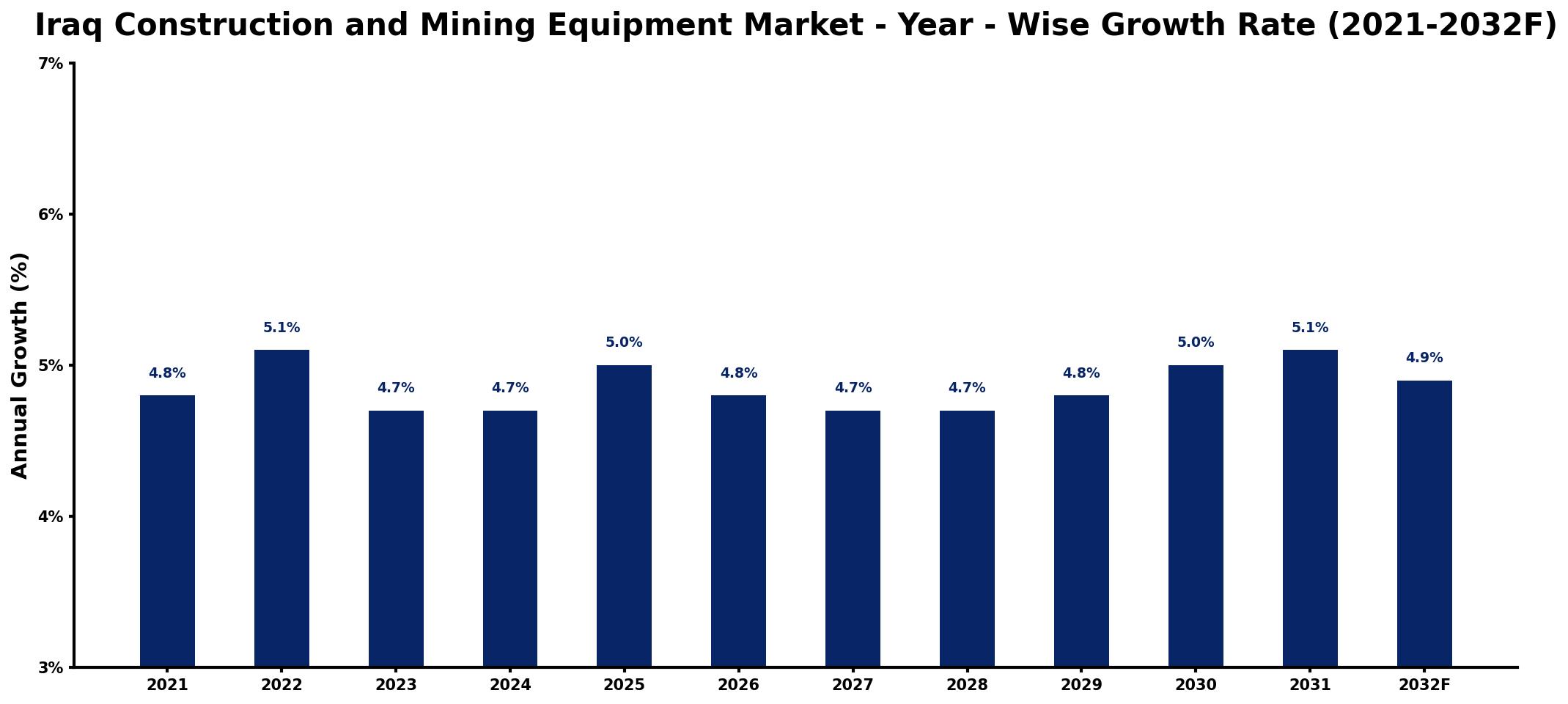
The table below presents the year‑wise growth rates along with the key drivers influencing the market
| Year | Growth Rate | Major Drivers |
| 2021 | 4.8% | Government infrastructure investment initiatives |
| 2022 | 5.1% | Rising urbanization and population growth |
| 2023 | 4.7% | Increased foreign direct investments |
| 2024 | 4.7% | Expansion of renewable energy projects |
| 2025 | 5.0% | Growing demand for residential projects |
| 2026 | 4.8% | Development of transportation networks |
| 2027 | 4.7% | growing automotive sector requirements |
| 2028 | 4.7% | Upgrading existing urban facilities |
| 2029 | 4.8% | Emergence of smart city projects |
| 2030 | 5.0% | Revitalization of industrial zones |
| 2031 | 5.1% | Enhancements in public service infrastructure |
| 2032 | 4.9% | Demand for sustainable building practices |
Note: Market size estimations and growth projections presented in this report are based on 6Wresearch's proprietary forecasting methodology, utilizing the latest available industry data, government publications, and primary research inputs.
Iraq Construction and Mining Equipment Market Synopsis
The current momentum in the Iraq construction and mining equipment market reflects a burgeoning demand for machinery amid recovering investments in infrastructure. In contrast, the future outlook indicates a steady growth phase, supported by ongoing urbanization and government initiatives aimed at enhancing the countrys industrial capabilities.
While recent years have witnessed increased activity, challenges such as political instability and infrastructural shortcomings remain critical. As a result, market players must navigate these hurdles while capitalizing on growth opportunities in automation and technology integration to sustain their competitive edge.
Iraq Construction and Mining Equipment Market Key Takeaways
- Robust government investments in infrastructure are driving equipment demand.
- Technological advancements in machinery are enhancing operational efficiency.
- The market is witnessing increased competition among domestic and international players.
- Urban development initiatives are a key growth factor for the sector.
- Fluctuating oil prices can significantly impact equipment demand and investment strategies.
Evaluation of Restraints in Iraq Construction and Mining Equipment Market
Despite the positive growth indicators, the Iraq construction and mining equipment market contends with several restraints. Political instability often disrupts long-term investments and project execution, leading to uncertainty in market performance. Furthermore, inadequate infrastructure poses significant challenges to the efficient deployment of heavy machinery, hindering the realization of optimal productivity. These factors, combined with economic volatility, particularly influenced by oil price fluctuations, can restrict the market's overall potential.
Iraq Construction and Mining Equipment Market Trends
Current trends indicate a significant shift towards the adoption of advanced technologies within the equipment sector. Automation, electrification, and the integration of digital solutions are shaping how construction and mining operations are conducted. These technological advancements not only improve efficiency but also enhance safety standards, thus attracting investment in modern equipment.
Moreover, sustainability is becoming increasingly important as companies strive to minimize their environmental footprint. Equipment manufacturers are focusing on developing eco-friendly machines, aligning with global trends towards greener construction and mining practices.
Iraq Construction and Mining Equipment Market Opportunities
There are substantial growth and investment opportunities in the Iraq construction and mining equipment market, particularly in the realm of public-private partnerships. These collaborations can facilitate large-scale projects and stimulate investments in state-of-the-art technology. Furthermore, as urban areas continue to expand, the demand for innovative machinery that can operate efficiently in varied environments will rise. Companies that focus on smart technology and sustainable practices will likely find lucrative prospects in this evolving market.
Government Initiatives in the Iraq Construction and Mining Equipment Market
The Iraqi government is implementing policies aimed at bolstering infrastructure development and enhancing industrial productivity. Regulatory measures include setting equipment standards, mandating operator training, and ensuring compliance with environmental regulations. Additionally, the government is actively providing incentives for investments in modern equipment technologies and promoting skills development programs for operators, thereby enhancing the overall capabilities of the construction and mining equipment market.
Future Insights of the Iraq Construction and Mining Equipment Market
Looking ahead to the period between 2026 and 2032, the Iraq construction and mining equipment market is poised for steady growth. The confluence of ongoing urbanization, increased government expenditure on infrastructure, and technological advancements indicates a favorable landscape for investment. As industry players continue to innovate and adapt, the market is expected to evolve, presenting new opportunities for those who can effectively respond to emerging demands.
Iraq Construction and Mining Equipment Market Latest Developments (2025 - 2026)
Recent developments in the Iraq construction and mining equipment market reflect a strategic focus on enhancing operational efficiency through advanced technology integration. Major industry players are embracing automation and data-driven solutions to streamline operations and reduce costs. Additionally, there is a growing emphasis on sustainability, with companies increasingly exploring eco-friendly alternatives in machinery manufacturing.
Iraq Construction and Mining Equipment Market - Key Attractiveness of the Report
- 10 Years of Market Numbers
- Historical Data Starting from 2022 to 2025
- Base Year: 2025
- Forecast Data until 2032
- Key Performance Indicators Impacting the Market
- Major Upcoming Developments and Projects
Key Highlights of the Report:
- Iraq Construction and Mining Equipment Market Outlook
- Market Size of Iraq Construction and Mining Equipment Market, 2025
- Forecast of Iraq Construction and Mining Equipment Market, 2032
- Historical Data and Forecast of Iraq Construction and Mining Equipment Revenues & Volume for the Period 2022-2032F
- Iraq Construction and Mining Equipment Market Trend Evolution
- Iraq Construction and Mining Equipment Market Drivers and Challenges
- Iraq Construction and Mining Equipment Price Trends
- Iraq Construction and Mining Equipment Porter's Five Forces
- Iraq Construction and Mining Equipment Industry Life Cycle
- Historical Data and Forecast of Iraq Construction and Mining Equipment Market Revenues & Volume By Product Type for the Period 2022-2032F
- Historical Data and Forecast of Iraq Construction and Mining Equipment Market Revenues & Volume By Loaders for the Period 2022-2032F
- Historical Data and Forecast of Iraq Construction and Mining Equipment Market Revenues & Volume By Dozers for the Period 2022-2032F
- Historical Data and Forecast of Iraq Construction and Mining Equipment Market Revenues & Volume By Excavators for the Period 2022-2032F
- Historical Data and Forecast of Iraq Construction and Mining Equipment Market Revenues & Volume By Crushing for the Period 2022-2032F
- Historical Data and Forecast of Iraq Construction and Mining Equipment Market Revenues & Volume By Pulverizing & Screening Equipment for the Period 2022-2032F
- Historical Data and Forecast of Iraq Construction and Mining Equipment Market Revenues & Volume By Others for the Period 2022-2032F
- Historical Data and Forecast of Iraq Construction and Mining Equipment Market Revenues & Volume By Application for the Period 2022-2032F
- Historical Data and Forecast of Iraq Construction and Mining Equipment Market Revenues & Volume By Infrastructure for the Period 2022-2032F
- Historical Data and Forecast of Iraq Construction and Mining Equipment Market Revenues & Volume By Mineral Mining for the Period 2022-2032F
- Historical Data and Forecast of Iraq Construction and Mining Equipment Market Revenues & Volume By Residential Building for the Period 2022-2032F
- Historical Data and Forecast of Iraq Construction and Mining Equipment Market Revenues & Volume By Metal Mining for the Period 2022-2032F
- Historical Data and Forecast of Iraq Construction and Mining Equipment Market Revenues & Volume By Others for the Period 2022-2032F
- Iraq Construction and Mining Equipment Import Export Trade Statistics
- Market Opportunity Assessment By Product Type
- Market Opportunity Assessment By Application
- Iraq Construction and Mining Equipment Top Companies Market Share
- Iraq Construction and Mining Equipment Competitive Benchmarking By Technical and Operational Parameters
- Iraq Construction and Mining Equipment Company Profiles
- Iraq Construction and Mining Equipment Key Strategic Recommendations






































