Iraq Decorative tile Market Summary
The iraq decorative tile market was estimated at USD 406 Million in 2025 and is projected to reach USD 560 Million by 2032, growing at a CAGR of 5.5% from 2026 to 2032.
Iraq Decorative tile Market Year-wise Growth Rate and Key Drivers
This graph highlights how the Iraq Decorative tile Market has steadily grown over the past five years, supported by major growth factors.
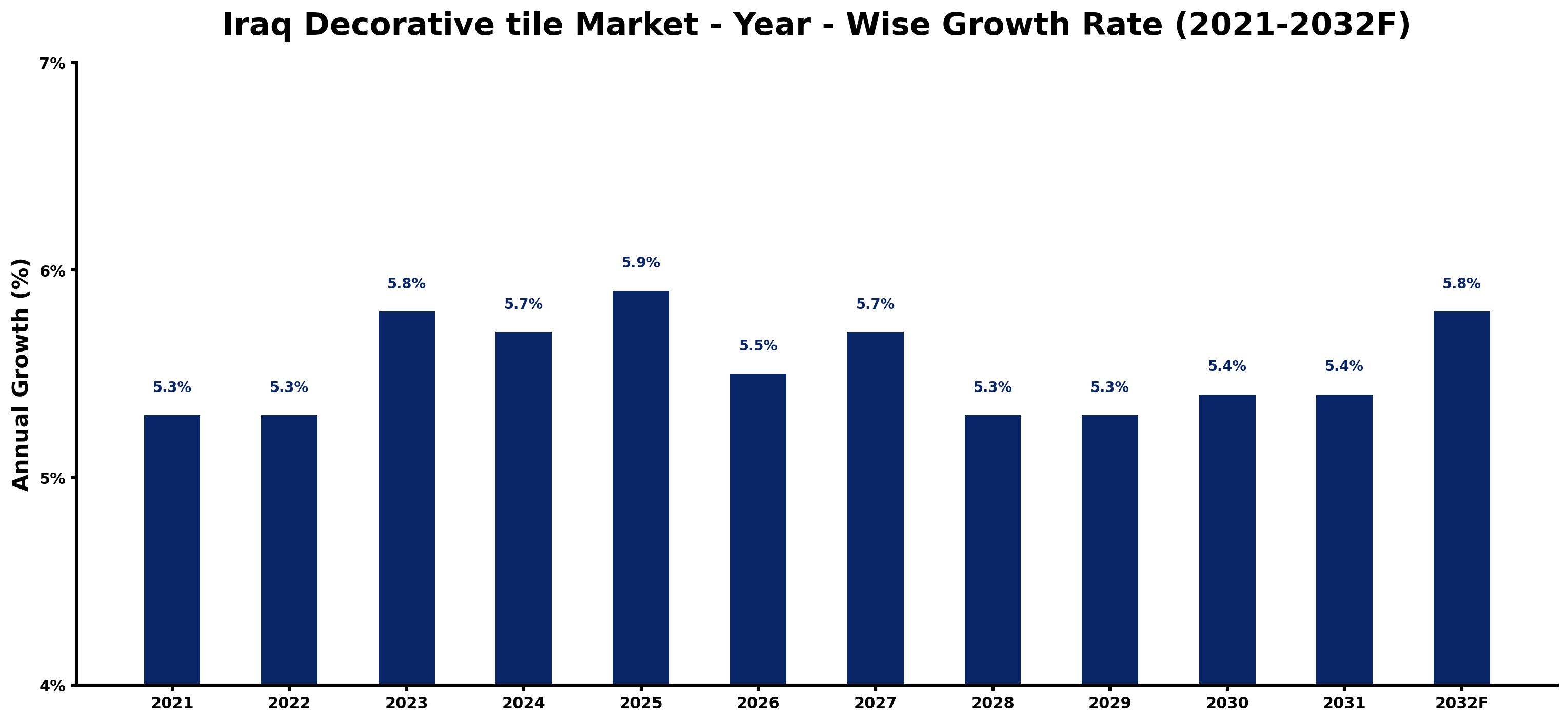
The table below presents the year wise growth rates along with the key drivers influencing the market
| Year | Growth Rate | Major Drivers |
| 2021 | 5.3% | Post-conflict reconstruction efforts emphasize aesthetic enhancements in urban environments. |
| 2022 | 5.3% | Local artisans increasingly incorporate traditional patterns into modern tile designs. |
| 2023 | 5.8% | Infrastructure developments spur demand for decorative tiles in commercial and residential spaces. |
| 2024 | 5.7% | Tourism recovery brings heightened interest in culturally themed interior designs. |
| 2025 | 5.9% | Social media influencers promote Iraqi tiles, boosting their popularity among younger demographics. |
| 2026 | 5.5% | Sustainable building practices highlight eco-friendly tile options made from local materials. |
| 2027 | 5.7% | Home renovation trends reflect a shift toward personalized and artistic interior spaces. |
| 2028 | 5.3% | International companies explore joint ventures to enhance production capabilities in Iraq. |
| 2029 | 5.3% | Local exhibitions showcase unique tile designs, attracting both national and region-wide attention. |
| 2030 | 5.4% | Government incentives for local manufacturing significantly strengthen the decorative tile sector. |
| 2031 | 5.4% | Increasing disposable incomes enable higher spending on home décor and renovation. |
| 2032 | 5.8% | Cultural heritage preservation initiatives drive interest in traditional Iraqi tile craftsmanship. |
Note - Market size estimations and growth projections presented in this report are based on 6Wresearch's advanced forecasting approach, validated with industry datasets as of June 2026.
Iraq Decorative tile Market Synopsis
The Iraq Decorative tile Market is projected to reach 5.5% and witness significant growth during the forecast period (2026-2032). This expansion is primarily driven by increasing construction activities across residential, commercial, and hospitality sectors in Iraq. As consumers place a higher emphasis on the aesthetics of interior design, the demand for decorative tiles is surging, reflecting trends in flooring, wall finishes, and various application areas.
Iraq Decorative tile Market Growth Drivers
Several key drivers are propelling the growth of the Iraq Decorative tile Market. Firstly, the ongoing urbanization process is leading to a burgeoning demand for housing and commercial spaces, consequently increasing the need for decorative tiles. Secondly, rising disposable incomes among consumers enable them to invest in home renovations, further fueling demand. Thirdly, advancements in tile manufacturing technologies have expanded the range of available designs, colors, and textures, catering to diverse consumer preferences.
- The preference for aesthetic appeal in living environments is becoming more pronounced, prompting consumers to opt for unique and artistic tile designs.
- A growing interest in sustainable and eco-friendly materials is influencing consumer choices, with many seeking tiles made from ethically sourced components.
- Social media platforms play a significant role in shaping design trends, where visually appealing tile options gain traction among consumers.
- The alignment of traditional motifs with modern aesthetics contributes to the sustained popularity of decorative tiles rooted in Iraqi culture and heritage.
- Increased investment in infrastructure and public amenities has broadened the potential for decorative tile applications in public spaces, enhancing market demand.
Iraq Decorative tile Market Trends and Opportunities
The Iraq Decorative tile Market is characterized by evolving trends that present numerous opportunities for growth. The integration of digital technologies in design processes is allowing for unprecedented customization, enabling consumers to create personalized spaces. The rising influence of global design standards encourages local manufacturers to innovate, ensuring that the decorative tiles produced meet both local and international aesthetic criteria.
- Creative collaborations between interior designers and tile manufacturers are fostering innovation, thereby enhancing product diversity.
- The growth of e-commerce platforms is opening new distribution channels, facilitating easier access to a wider variety of decorative tiles for consumers.
- Increased participation in international trade shows and expos is promoting Iraqi decorative tiles on a global scale, attracting foreign investments.
- Adopting smart technology in manufacturing processes is becoming an essential aspect of production, leading to enhanced efficiency and sustainability.
- Targeting specific consumer segments, such as luxury homeowners or commercial establishments, presents opportunities for specialized marketing strategies.
Iraq Decorative tile Market Challenges and Restraints
The growth trajectory of the Iraq Decorative tile Market is not without challenges. Political instability in the region often results in uncertainties that hamper business operations and planning. Furthermore, economic fluctuations, including currency instability and inflationary pressures, can restrict consumer spending power and, in turn, affect the demand for decorative tiles. Additionally, the limited availability of high-quality local materials necessitates imports that can inflate costs for manufacturers.
- Political uncertainty can deter foreign investments and complicate supply chain logistics, impacting the availability of essential products.
- Economic downturns may lead to reduced consumer confidence, causing potential buyers to postpone home improvement projects.
- Importing high-quality materials raises production costs, making it challenging for local manufacturers to compete with cheaper alternatives.
- The abundance of alternative flooring options can divert consumer attention from traditional decorative tiles, affecting market growth.
- Quality assurance and compliance with international standards remain critical for maintaining consumer trust and satisfaction.
Iraq Decorative tile Market Investment Opportunities
Investment opportunities within the Iraq Decorative tile Market are notably promising, primarily due to the ongoing expansion of construction activities driven by urbanization and infrastructure development. Investors can benefit from the surging demand for decorative tiles as consumers seek to elevate their interior spaces. Establishing manufacturing facilities focused on producing a diverse array of decorative tiles, including ceramic, porcelain, and mosaic tiles, presents a viable business proposition.
- Investors can focus on producing environmentally friendly tiles, aligning with the growing consumer preference for sustainable materials.
- Forming partnerships with local distributors enhances market penetration and product availability across various regions of Iraq.
- Diversifying product offerings to include customized designs can attract a broader customer base and encourage repeat business.
- Exploring niche markets, like premium decorative tiles for luxury developments, could yield higher profit margins.
- Investors may consider leveraging technology for more efficient manufacturing processes, reducing costs and improving profitability.
Iraq Decorative tile Market Government Investment and Initiatives
Government policies surrounding the Iraq Decorative tile Market are instrumental in fostering domestic production and industry growth. Measures have been introduced, including import tariffs on foreign decorative tiles, aimed at protecting local manufacturers while encouraging the development of a robust domestic industry. Furthermore, the government is implementing financial incentives for producers to enhance their competitiveness, ensuring that local products conform to quality standards.
- By promoting local manufacturing, the government aims to stimulate economic growth and job creation within the decorative tile sector.
- Investment in infrastructure improvements provides a conducive environment for the growth of the decorative tile market.
- Public spending on housing and commercial developments is expected to increase, bolstering demand for decorative tiles.
- Quality control measures are emphasized to ensure that decorative tiles meet safety and aesthetic standards, enhancing consumer satisfaction.
- The government's commitment to improving the local manufacturing landscape lays the groundwork for a sustainable decorative tile industry.
Iraq Decorative tile Market Latest Developments (May 2025 - June 2026)
Recent industry developments from May 2025 to June 2026 highlight several trends shaping the Iraq Decorative tile Market. The focus on sustainability has intensified, with manufacturers increasingly adopting eco-friendly practices in tile production. Technological advancements in manufacturing are facilitating the introduction of innovative designs, appealing to a more discerning consumer base. Furthermore, collaborations between design professionals and tile manufacturers are fostering a creative atmosphere that enhances product offerings. As urbanization continues to drive construction efforts, increased public investment in infrastructure is expected to sustain demand for decorative tiles in both residential and commercial sectors.
Iraq Decorative tile Market - Key Attractiveness of the Report
- 10 Years of Market Numbers
- Historical Data Starting from 2022 to 2025
- Base Year: 2025
- Forecast Data until 2032
- Key Performance Indicators Impacting the Market
- Major Upcoming Developments and Projects
Key Highlights of the Report:
- Iraq Decorative tile Market Outlook
- Market Size of Iraq Decorative tile Market, 2025
- Forecast of Iraq Decorative tile Market, 2032F
- Historical Data and Forecast of Iraq Decorative tile Revenues & Volume for the Period 2022-2032F
- Iraq Decorative tile Market Trend Evolution
- Iraq Decorative tile Market Drivers and Challenges
- Iraq Decorative tile Price Trends
- Iraq Decorative tile Porter's Five Forces
- Iraq Decorative tile Industry Life Cycle
- Historical Data and Forecast of Iraq Decorative tile Market Revenues & Volume By Type for the Period 2022-2032F
- Historical Data and Forecast of Iraq Decorative tile Market Revenues & Volume By Ceramic Wall Tiles for the Period 2022-2032F
- Historical Data and Forecast of Iraq Decorative tile Market Revenues & Volume By Vinyl Wall Tiles for the Period 2022-2032F
- Historical Data and Forecast of Iraq Decorative tile Market Revenues & Volume By Stone Wall Tiles for the Period 2022-2032F
- Historical Data and Forecast of Iraq Decorative tile Market Revenues & Volume By Other Types for the Period 2022-2032F
- Historical Data and Forecast of Iraq Decorative tile Market Revenues & Volume By End-users for the Period 2022-2032F
- Historical Data and Forecast of Iraq Decorative tile Market Revenues & Volume By Residential for the Period 2022-2032F
- Historical Data and Forecast of Iraq Decorative tile Market Revenues & Volume By Commercial for the Period 2022-2032F
- Historical Data and Forecast of Iraq Decorative tile Market Revenues & Volume By Application for the Period 2022-2032F
- Historical Data and Forecast of Iraq Decorative tile Market Revenues & Volume By Flooring for the Period 2022-2032F
- Historical Data and Forecast of Iraq Decorative tile Market Revenues & Volume By Wall Coverings for the Period 2022-2032F
- Historical Data and Forecast of Iraq Decorative tile Market Revenues & Volume By Other Applications for the Period 2022-2032F
- Iraq Decorative tile Import Export Trade Statistics
- Market Opportunity Assessment By Type
- Market Opportunity Assessment By End-users
- Market Opportunity Assessment By Application
- Iraq Decorative tile Top Companies Market Share
- Iraq Decorative tile Competitive Benchmarking By Technical and Operational Parameters
- Iraq Decorative tile Company Profiles
- Iraq Decorative tile Key Strategic Recommendations






































