Iraq Dermatology Drugs Market Size, Share & Growth Rate
The Iraq Dermatology Drugs Market was estimated at USD 471 Million in 2025 and is projected to reach USD 662 Million by 2032, growing at a CAGR of 5.0% from 2026 to 2032. This growth trajectory is primarily fueled by the rising prevalence of skin conditions such as acne, eczema, and psoriasis, driven by environmental factors and lifestyle changes. Additionally, an aging population increasingly requiring specialized dermatological care further supports this upward trend.
Iraq Dermatology Drugs Market Year-wise Growth Rate and Key Drivers
This graph highlights how the Iraq Dermatology Drugs Market has steadily grown over the years, supported by major growth factors.
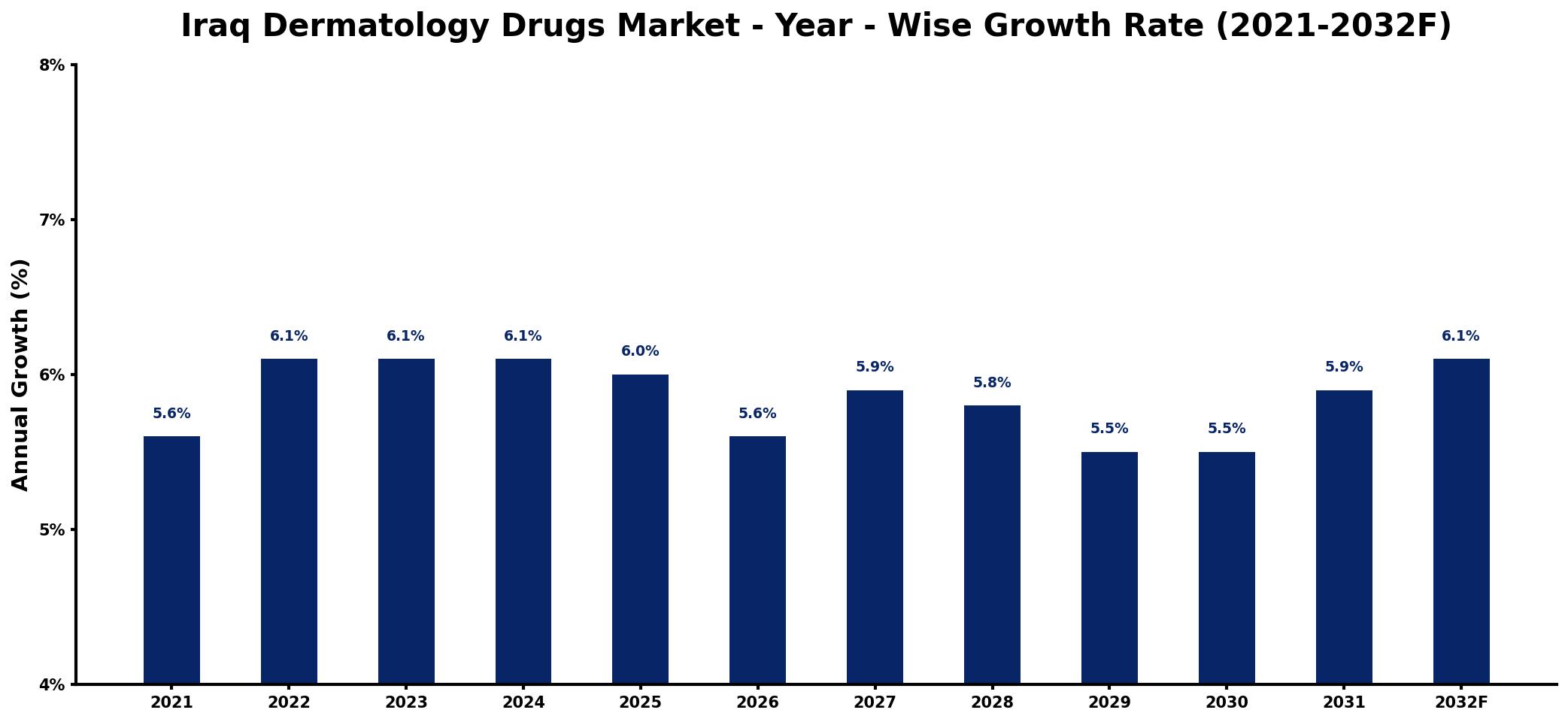
The table below presents the year‑wise growth rates along with the key drivers influencing the market
| Year | Growth Rate | Major Drivers |
| 2021 | 5.6% | Rising awareness of skin health |
| 2022 | 6.1% | Increased healthcare infrastructure investments |
| 2023 | 6.1% | Growing prevalence of skin conditions |
| 2024 | 6.1% | Expansion of telemedicine services |
| 2025 | 6.0% | Emergence of innovative treatment options |
| 2026 | 5.6% | Enhanced regulatory support frameworks |
| 2027 | 5.9% | Strengthened local manufacturing capabilities |
| 2028 | 5.8% | Boost in medical tourism initiatives |
| 2029 | 5.5% | Greater focus on preventive care |
| 2030 | 5.5% | Advancements in patient education resources |
| 2031 | 5.9% | Surge in research funding allocations |
| 2032 | 6.1% | Collaboration between healthcare sectors |
Note: Market size estimations and growth projections presented in this report are based on 6Wresearch's proprietary forecasting methodology, utilizing the latest available industry data, government publications, and primary research inputs.
Iraq Dermatology Drugs Market Synopsis
In recent years, the focus on dermatological health in Iraq has intensified, paralleling the global trend of increased awareness of skin-related disorders. The Iraqi population is becoming more proactive in seeking treatments for skin conditions, emphasizing the importance of effective dermatology drugs.
Moreover, the ongoing advancements in pharmaceutical formulations tailored for local needs indicate a robust potential for market expansion. As the healthcare system adapts, improved access to dermatological treatments is becoming increasingly pivotal in enhancing the quality of life for patients.
Iraq Dermatology Drugs Market Key Takeaways
- The market is experiencing significant growth due to heightened awareness and treatment of skin conditions.
- Environmental and lifestyle changes are major contributors to the increasing prevalence of dermatological disorders.
- Government initiatives are aimed at improving access to dermatological care, fostering market development.
- Innovative therapeutic approaches are being developed, tailored specifically for the Iraqi demographic.
- Pharmaceutical companies are encouraged to invest in this sector as the demand for effective treatments rises.
Evaluation of Restraints in Iraq Dermatology Drugs Market
Despite its promising growth, the Iraq Dermatology Drugs Market faces significant challenges that inhibit its full potential. Chief among these are issues of affordability and accessibility for patients seeking treatment. Many individuals with skin disorders struggle to obtain the necessary medications due to financial constraints or lack of availability in rural areas. Additionally, addressing the myriad skin health concerns—ranging from infections to chronic skin conditions—amidst the country's ongoing environmental and socioeconomic challenges adds another layer of complexity to the market landscape.
Iraq Dermatology Drugs Market Trends
Current trends in the Iraq Dermatology Drugs Market highlight a growing inclination toward personalized medicine and biologic therapies. These innovative treatments, specifically designed to target complex skin conditions, are gaining traction among healthcare providers. Furthermore, the integration of telemedicine into dermatological care is reshaping the patient experience, making consultations and follow-ups more convenient and accessible. This is particularly vital in Iraq, where some regions may have limited access to specialized dermatological clinics.
Iraq Dermatology Drugs Market Opportunities
There lies considerable potential for growth and investment in the Iraq Dermatology Drugs Market, especially through the development of localized pharmaceutical solutions. As the government continues to support healthcare initiatives, partnerships between local and international pharmaceutical companies could lead to the introduction of innovative treatments tailored to the Iraqi population's needs. Moreover, the increasing prevalence of dermatological issues opens doors for educational campaigns that could raise awareness and stimulate demand for effective skincare solutions.
Government Initiatives in the Iraq Dermatology Drugs Market
The Iraqi government has taken significant strides to bolster the dermatology drugs market, implementing regulatory frameworks that prioritize patient safety and medication efficacy. Public health initiatives are in place to enhance awareness about common skin disorders and promote preventive measures among the population. Additionally, the government is offering investment incentives for pharmaceutical companies willing to engage in research and development for innovative dermatological therapies that meet local needs.
Future Insights of the Iraq Dermatology Drugs Market
Looking ahead to 2026-2032, the Iraq Dermatology Drugs Market is poised for continuous growth. The increasing recognition of skin health as an essential component of overall well-being will drive demand for effective treatments. Moreover, advancements in technology, coupled with supportive government policies, are likely to pave the way for innovative solutions tailored to the challenges faced within the region. As accessibility improves and public awareness rises, the market is expected to thrive and attract further investments.
Iraq Dermatology Drugs Market Latest Developments (2025 - 2026)
In the period from & to June 2026, the Iraq Dermatology Drugs Market has seen a significant shift toward the adoption of advanced treatment methodologies, including biologics and topical therapies. There has been a notable increase in collaboration between local healthcare providers and international pharmaceutical firms, focusing on enhancing the availability of essential dermatological drugs. Additionally, ongoing public health campaigns have raised awareness about skin health, thereby stimulating demand for various dermatological products.
Iraq Dermatology Drugs Market - Key Attractiveness of the Report
- 10 Years of Market Numbers
- Historical Data Starting from 2022 to 2025
- Base Year: 2025
- Forecast Data until 2032
- Key Performance Indicators Impacting the Market
- Major Upcoming Developments and Projects
Key Highlights of the Report:
- Iraq Dermatology Drugs Market Outlook
- Market Size of Iraq Dermatology Drugs Market, 2025
- Forecast of Iraq Dermatology Drugs Market, 2032
- Historical Data and Forecast of Iraq Dermatology Drugs Revenues & Volume for the Period 2022-2032F
- Iraq Dermatology Drugs Market Trend Evolution
- Iraq Dermatology Drugs Market Drivers and Challenges
- Iraq Dermatology Drugs Price Trends
- Iraq Dermatology Drugs Porter's Five Forces
- Iraq Dermatology Drugs Industry Life Cycle
- Historical Data and Forecast of Iraq Dermatology Drugs Market Revenues & Volume By Application for the Period 2022-2032F
- Historical Data and Forecast of Iraq Dermatology Drugs Market Revenues & Volume By Acne for the Period 2022-2032F
- Historical Data and Forecast of Iraq Dermatology Drugs Market Revenues & Volume By Atopic Dermatitis for the Period 2022-2032F
- Historical Data and Forecast of Iraq Dermatology Drugs Market Revenues & Volume By Psoriasis for the Period 2022-2032F
- Historical Data and Forecast of Iraq Dermatology Drugs Market Revenues & Volume By Others for the Period 2022-2032F
- Historical Data and Forecast of Iraq Dermatology Drugs Market Revenues & Volume By Route of Administration for the Period 2022-2032F
- Historical Data and Forecast of Iraq Dermatology Drugs Market Revenues & Volume By Oral for the Period 2022-2032F
- Historical Data and Forecast of Iraq Dermatology Drugs Market Revenues & Volume By Parenteral for the Period 2022-2032F
- Historical Data and Forecast of Iraq Dermatology Drugs Market Revenues & Volume By Topical for the Period 2022-2032F
- Historical Data and Forecast of Iraq Dermatology Drugs Market Revenues & Volume By Distribution Channel for the Period 2022-2032F
- Historical Data and Forecast of Iraq Dermatology Drugs Market Revenues & Volume By Hospital Pharmacy for the Period 2022-2032F
- Historical Data and Forecast of Iraq Dermatology Drugs Market Revenues & Volume By Retail Pharmacy for the Period 2022-2032F
- Historical Data and Forecast of Iraq Dermatology Drugs Market Revenues & Volume By Online Pharmacy for the Period 2022-2032F
- Iraq Dermatology Drugs Import Export Trade Statistics
- Market Opportunity Assessment By Application
- Market Opportunity Assessment By Route of Administration
- Market Opportunity Assessment By Distribution Channel
- Iraq Dermatology Drugs Top Companies Market Share
- Iraq Dermatology Drugs Competitive Benchmarking By Technical and Operational Parameters
- Iraq Dermatology Drugs Company Profiles
- Iraq Dermatology Drugs Key Strategic Recommendations






































