Iraq Electrical Conduit Market Size, Share & Growth Rate
The Iraq Electrical Conduit Market was estimated at USD 461 Million in 2025 and is projected to reach USD 627 Million by 2032, growing at a CAGR of 4.5% from 2026 to 2032. This growth trajectory is fueled by accelerating urbanization and robust infrastructure projects, which necessitate the safe and efficient routing of electrical systems. As the construction sector expands, demand for both traditional metal conduits and innovative non-metallic alternatives is set to rise significantly.
Iraq Electrical Conduit Market Year-wise Growth Rate and Key Drivers
This graph highlights how the Iraq Electrical Conduit Market has steadily grown over the years, supported by major growth factors.
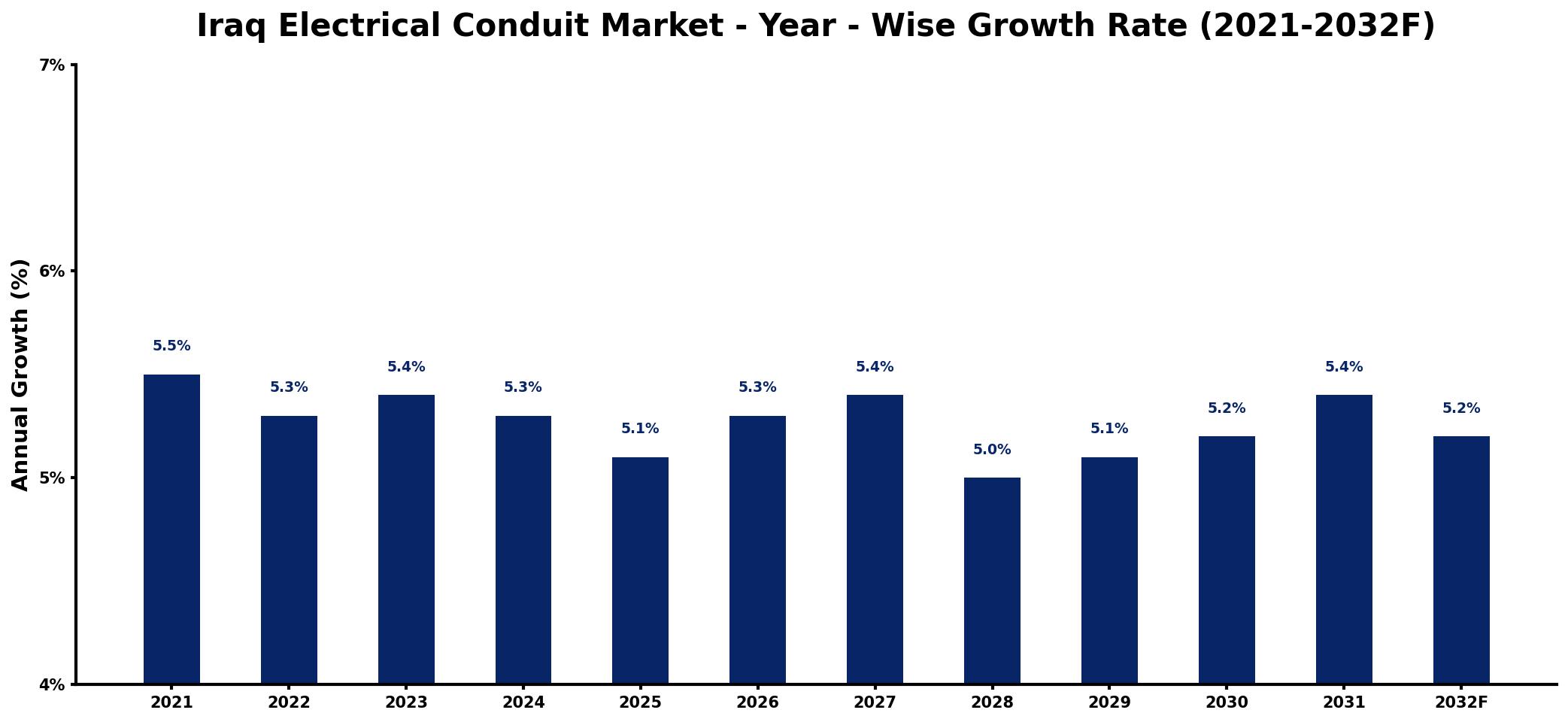
The table below presents the year‑wise growth rates along with the key drivers influencing the market
| Year | Growth Rate | Major Drivers |
| 2021 | 5.5% | Rising construction sector investments |
| 2022 | 5.3% | Infrastructure development projects increase |
| 2023 | 5.4% | Growing demand for housing units |
| 2024 | 5.3% | Urbanization trends drive demand |
| 2025 | 5.1% | Renewable energy initiatives expand |
| 2026 | 5.3% | Telecommunication upgrades spur growth |
| 2027 | 5.4% | Government funding for infrastructure |
| 2028 | 5.0% | Increased industrial manufacturing activities |
| 2029 | 5.1% | Technological advancements in construction |
| 2030 | 5.2% | Sustainability initiatives gain traction |
| 2031 | 5.4% | Rising population drives housing needs |
| 2032 | 5.2% | Economic stability encourages investments |
Note: Market size estimations and growth projections presented in this report are based on 6Wresearch's proprietary forecasting methodology, utilizing the latest available industry data, government publications, and primary research inputs.
Iraq Electrical Conduit Market Synopsis
Recently, the Iraq Electrical Conduit Market has experienced notable momentum, driven largely by investments in infrastructure and a burgeoning construction industry. However, this growth phase is juxtaposed with challenges such as political instability, which casts uncertainty on future developments.
Looking ahead, the market is expected to navigate these obstacles while tapping into emerging trends such as sustainability and smart technology integration. The shift towards more efficient electrical conduit solutions is likely to redefine industry standards and attract further investments.
Iraq Electrical Conduit Market Key Takeaways
- The market is witnessing a transition toward sustainable materials, such as PVC and steel, driven by energy efficiency requirements.
- Political instability poses risks, affecting long-term strategic planning for businesses in the sector.
- The demand for smart conduits equipped with remote monitoring capabilities is on the rise.
- Opportunities exist for local manufacturers to thrive amid government policies favoring domestic production.
- The growth of the construction sector presents a robust demand for reliable electrical conduit solutions.
Evaluation of Restraints in Iraq Electrical Conduit Market
The Iraq Electrical Conduit Market faces several constraints, primarily stemming from the region's ongoing political turmoil and security concerns. Such instability creates a challenging environment for businesses aiming to operate effectively. Additionally, inadequate infrastructure in parts of the country complicates logistics, making it difficult to establish reliable supply chains for electrical conduits. These factors contribute to uncertainty in project timelines and overall market growth, necessitating a strategic focus for stakeholders aiming to penetrate this market.
Iraq Electrical Conduit Market Trends
Current trends in the Iraq Electrical Conduit Market include a growing preference for innovative and sustainable conduit solutions. The increasing focus on energy efficiency has led to heightened interest in PVC and lightweight aluminum conduits that promise easier installation and maintenance. Moreover, advancements in technology are paving the way for smart conduit systems that offer enhanced monitoring and control features, making them more appealing to modern construction projects. This shift not only aims to improve safety standards but also aligns with global sustainability initiatives.
Iraq Electrical Conduit Market Opportunities
Investment opportunities in the Iraq Electrical Conduit Market are extensive, particularly as the government prioritizes infrastructure development and the enhancement of electricity distribution systems. Manufacturers of electrical conduits stand to gain significantly, especially those who can offer innovative products tailored to local construction demands. Additionally, supply chain companies that facilitate the distribution of conduits across varied regions will find lucrative prospects as projects continue to multiply. The focus on improving the country's electricity infrastructure underscores the potential for sustained demand in this sector.
Government Initiatives in the Iraq Electrical Conduit Market
The Iraqi government is actively promoting local production within the electrical conduit sector to reduce import dependency. Initiatives include providing tax incentives and subsidies for domestic manufacturers, enhancing their competitiveness against imported products. Furthermore, the government has set regulations aimed at ensuring product quality and safety standards, fostering an environment conducive to local innovation. This policy framework not only supports the existing market but also aims to stimulate new investments that align with the national goal of rebuilding the countrys infrastructure.
Future Insights of the Iraq Electrical Conduit Market
The future outlook for the Iraq Electrical Conduit Market remains optimistic as urbanization and electricity demand continue to rise. The ongoing reconstruction efforts across various sectors will necessitate robust electrical infrastructure, including the widespread installation of conduits in commercial, residential, and industrial buildings. Moreover, the emphasis on sustainable energy sources and smart city initiatives is set to drive demand further. While challenges such as political instability could temper growth rates, the overall market is positioned for expansion and innovation through 2032.
Iraq Electrical Conduit Market Latest Developments (2025 - 2026)
Recent developments within the Iraq Electrical Conduit Market suggest a growing interest in integrating advanced technologies into traditional conduit systems. Increased collaboration between local manufacturers and international firms is observed, leading to a wave of product innovations tailored to Iraqi conditions. There is also a visible shift towards prioritizing sustainable materials in manufacturing processes. As reconstruction efforts progress, these trends are likely to continue influencing the market landscape significantly.
Iraq Electrical Conduit Market - Key Attractiveness of the Report
- 10 Years of Market Numbers
- Historical Data Starting from 2022 to 2025
- Base Year: 2025
- Forecast Data until 2032
- Key Performance Indicators Impacting the Market
- Major Upcoming Developments and Projects
Key Highlights of the Report:
- Iraq Electrical Conduit Market Outlook
- Market Size of Iraq Electrical Conduit Market, 2025
- Forecast of Iraq Electrical Conduit Market, 2032
- Historical Data and Forecast of Iraq Electrical Conduit Revenues & Volume for the Period 2022-2032F
- Iraq Electrical Conduit Market Trend Evolution
- Iraq Electrical Conduit Market Drivers and Challenges
- Iraq Electrical Conduit Price Trends
- Iraq Electrical Conduit Porter's Five Forces
- Iraq Electrical Conduit Industry Life Cycle
- Historical Data and Forecast of Iraq Electrical Conduit Market Revenues & Volume By Type for the Period 2022-2032F
- Historical Data and Forecast of Iraq Electrical Conduit Market Revenues & Volume By Rigid for the Period 2022-2032F
- Historical Data and Forecast of Iraq Electrical Conduit Market Revenues & Volume By Flexible for the Period 2022-2032F
- Historical Data and Forecast of Iraq Electrical Conduit Market Revenues & Volume By Material for the Period 2022-2032F
- Historical Data and Forecast of Iraq Electrical Conduit Market Revenues & Volume By Metallic for the Period 2022-2032F
- Historical Data and Forecast of Iraq Electrical Conduit Market Revenues & Volume By Non-metallic for the Period 2022-2032F
- Historical Data and Forecast of Iraq Electrical Conduit Market Revenues & Volume By End-Use Industry for the Period 2022-2032F
- Historical Data and Forecast of Iraq Electrical Conduit Market Revenues & Volume By Building & Construction for the Period 2022-2032F
- Historical Data and Forecast of Iraq Electrical Conduit Market Revenues & Volume By Industrial Manufacturing for the Period 2022-2032F
- Historical Data and Forecast of Iraq Electrical Conduit Market Revenues & Volume By IT & Telecommunication for the Period 2022-2032F
- Historical Data and Forecast of Iraq Electrical Conduit Market Revenues & Volume By Oil & Gas for the Period 2022-2032F
- Historical Data and Forecast of Iraq Electrical Conduit Market Revenues & Volume By Energy & Utility for the Period 2022-2032F
- Historical Data and Forecast of Iraq Electrical Conduit Market Revenues & Volume By Others for the Period 2022-2032F
- Iraq Electrical Conduit Import Export Trade Statistics
- Market Opportunity Assessment By Type
- Market Opportunity Assessment By Material
- Market Opportunity Assessment By End-Use Industry
- Iraq Electrical Conduit Top Companies Market Share
- Iraq Electrical Conduit Competitive Benchmarking By Technical and Operational Parameters
- Iraq Electrical Conduit Company Profiles
- Iraq Electrical Conduit Key Strategic Recommendations






































