Iraq Fish Market Size, Share & Growth Rate
The Iraq Fish Market was estimated at USD 285 Million in 2025 and is projected to reach USD 381 Million by 2032, growing at a CAGR of 4.2% from 2026 to 2032. This growth trajectory is largely driven by an increasing demand for seafood as consumers become more health-conscious and aware of the nutritional benefits fish offers. Additionally, the ongoing urbanization and rising disposable incomes are contributing to a shift in dietary preferences towards fish, enhancing market dynamics.
Iraq Fish Market Year-wise Growth Rate and Key Drivers
This graph highlights how the Iraq Fish Market has steadily grown over the years, supported by major growth factors.
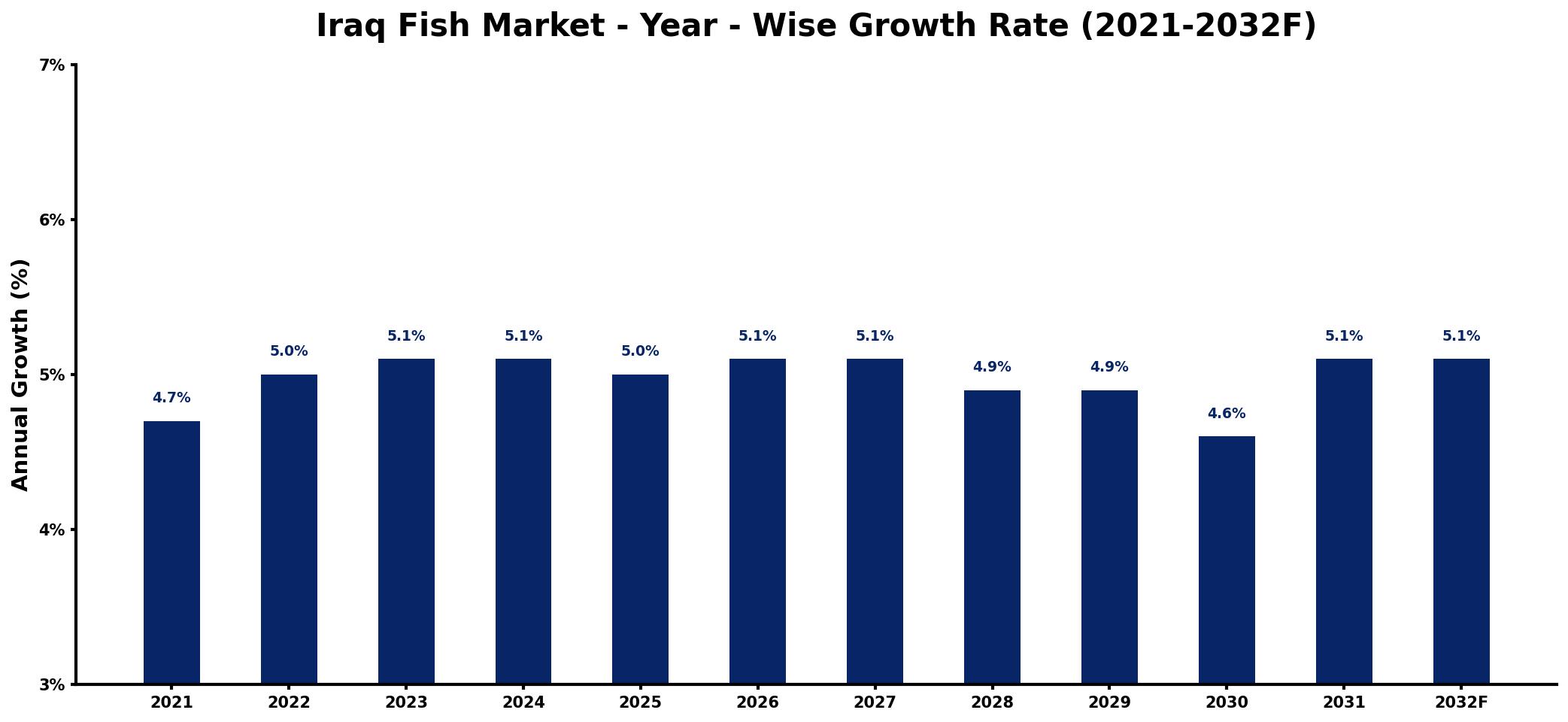
The table below presents the year‑wise growth rates along with the key drivers influencing the market
| Year | Growth Rate | Major Drivers |
| 2021 | 4.7% | Rising consumer health consciousness |
| 2022 | 5.0% | growing commercial sector adoption |
| 2023 | 5.1% | Growing food service sector |
| 2024 | 5.1% | Expansion of distribution networks |
| 2025 | 5.0% | Enhanced local sourcing initiatives |
| 2026 | 5.1% | Emergence of online marketplaces |
| 2027 | 5.1% | Government support for sustainability |
| 2028 | 4.9% | Increased exports to neighboring regions |
| 2029 | 4.9% | Growth in culinary tourism demand |
| 2030 | 4.6% | Diversification of product offerings |
| 2031 | 5.1% | Development of processing facilities |
| 2032 | 5.1% | Strengthening regional trade agreements |
Note: Market size estimations and growth projections presented in this report are based on 6Wresearch's proprietary forecasting methodology, utilizing the latest available industry data, government publications, and primary research inputs.
Iraq Fish Market Synopsis
The strongest force shaping the Iraq Fish Market right now is the rising consumer preference for fresh and locally sourced fish. As awareness regarding health and sustainability grows, more Iraqi households are seeking out high-quality seafood options, sparking a transformative shift in consumer behavior.
In addition to fresh fish, the market is witnessing a demand surge for value-added products such as smoked and marinated fish. This shift indicates a move towards convenience-oriented options that cater to the fast-paced lifestyle of modern consumers, further diversifying the market's offerings.
Iraq Fish Market Key Takeaways
- The Iraq Fish Market is projected to grow significantly, with an expected value of USD 381 Million by 2032.
- There is a notable shift toward the consumption of locally sourced and fresh fish, reflecting changing dietary preferences.
- Value-added seafood products are gaining popularity, indicating a demand for convenience and ready-to-eat options.
- Online sales of fish are increasing, driven by consumer preferences for safety and convenience amid health concerns.
- Government initiatives are focused on promoting sustainable fishing practices, enhancing food safety, and supporting local fishers.
Evaluation of Restraints in Iraq Fish Market
Despite the positive outlook, the Iraq Fish Market faces significant constraints that hinder its full potential. Limited access to fresh fish due to geographical challenges is a primary issue, compounded by the depletion of local fish stocks. Furthermore, the lack of modern infrastructure impacts the distribution and preservation of seafood, resulting in higher prices and quality deterioration. Regulatory inconsistencies and inadequate food safety measures further complicate operations for vendors, necessitating urgent investments and reform for sustained market growth.
Iraq Fish Market Trends
Several trends are currently shaping the Iraq Fish Market. The growing demand for a diverse range of fish species is on the rise, as consumers look beyond traditional options. There is also a notable interest in online purchasing, reflecting a shift toward e-commerce as consumers seek convenience and safety. Sustainable fishing practices are increasingly being prioritized, aligning with global environmental trends and consumer expectations for responsibly sourced products.
Iraq Fish Market Opportunities
The Iraq Fish Market presents numerous investment opportunities driven by a growing population and rising incomes. Fish farming has the potential to become a crucial growth area, alongside the establishment of processing facilities to cater to evolving consumer demands. Cold storage infrastructure and improved distribution networks could also enhance market efficiency and product quality. Investments focused on sustainable fishing practices and technologies will not only meet the increasing demand but also ensure long-term ecological viability.
Government Initiatives in the Iraq Fish Market
Government policies surrounding the Iraq Fish Market are centered on ensuring high food safety standards and promoting sustainable practices. Various ministries, including Agriculture and Health, oversee regulations concerning fish handling, storage, and transportation, emphasizing consumer safety. Initiatives are also in place to support local fishers with training and resources aimed at fostering sustainable fishing methods and safeguarding marine ecosystems. These policies play a crucial role in maintaining market integrity and supporting the livelihoods of fishing communities.
Future Insights of the Iraq Fish Market
Looking ahead, the Iraq Fish Market is set for notable expansion from 2026 to 2032. Rising disposable incomes and shifts in dietary preferences will likely fuel increased seafood consumption. Enhancements in infrastructure, coupled with technological advancements in fishing and processing, will further propel market growth. With abundant marine resources along Iraq's coastline, the potential for increased fish production is significant, positioning the market for robust development in the coming years.
Iraq Fish Market Latest Developments (2025 - 2026)
Recent developments in the Iraq Fish Market have underscored a commitment to modernization and sustainability. There is a growing emphasis on leveraging technology to improve supply chain efficiencies and enhance product quality. Initiatives aimed at increasing the capacity of local fish farms are also emerging, indicating a positive trend towards self-sufficiency in fish production. Additionally, various stakeholders are exploring partnerships to promote best practices in fish handling and processing, which could significantly benefit market participants.
Iraq Fish Market - Key Attractiveness of the Report
- 10 Years of Market Numbers
- Historical Data Starting from 2022 to 2025
- Base Year: 2025
- Forecast Data until 2032
- Key Performance Indicators Impacting the Market
- Major Upcoming Developments and Projects
Key Highlights of the Report:
- Iraq Fish Market Outlook
- Market Size of Iraq Fish Market, 2025
- Forecast of Iraq Fish Market, 2032
- Historical Data and Forecast of Iraq Fish Revenues & Volume for the Period 2022-2032F
- Iraq Fish Market Trend Evolution
- Iraq Fish Market Drivers and Challenges
- Iraq Fish Price Trends
- Iraq Fish Porter's Five Forces
- Iraq Fish Industry Life Cycle
- Historical Data and Forecast of Iraq Fish Market Revenues & Volume By Fish Type for the Period 2022-2032F
- Historical Data and Forecast of Iraq Fish Market Revenues & Volume By Inland Fishes for the Period 2022-2032F
- Historical Data and Forecast of Iraq Fish Market Revenues & Volume By Marine Fishes for the Period 2022-2032F
- Historical Data and Forecast of Iraq Fish Market Revenues & Volume By Shrimps for the Period 2022-2032F
- Historical Data and Forecast of Iraq Fish Market Revenues & Volume By Scampi for the Period 2022-2032F
- Historical Data and Forecast of Iraq Fish Market Revenues & Volume By Product Type for the Period 2022-2032F
- Historical Data and Forecast of Iraq Fish Market Revenues & Volume By Fresh for the Period 2022-2032F
- Historical Data and Forecast of Iraq Fish Market Revenues & Volume By Frozen for the Period 2022-2032F
- Historical Data and Forecast of Iraq Fish Market Revenues & Volume By Canned for the Period 2022-2032F
- Historical Data and Forecast of Iraq Fish Market Revenues & Volume By Others for the Period 2022-2032F
- Historical Data and Forecast of Iraq Fish Market Revenues & Volume By Distribution Channel for the Period 2022-2032F
- Historical Data and Forecast of Iraq Fish Market Revenues & Volume By Retail for the Period 2022-2032F
- Historical Data and Forecast of Iraq Fish Market Revenues & Volume By Institutional for the Period 2022-2032F
- Historical Data and Forecast of Iraq Fish Market Revenues & Volume By Sector for the Period 2022-2032F
- Historical Data and Forecast of Iraq Fish Market Revenues & Volume By Organised for the Period 2022-2032F
- Historical Data and Forecast of Iraq Fish Market Revenues & Volume By Unorganised for the Period 2022-2032F
- Iraq Fish Import Export Trade Statistics
- Market Opportunity Assessment By Fish Type
- Market Opportunity Assessment By Product Type
- Market Opportunity Assessment By Distribution Channel
- Market Opportunity Assessment By Sector
- Iraq Fish Top Companies Market Share
- Iraq Fish Competitive Benchmarking By Technical and Operational Parameters
- Iraq Fish Company Profiles
- Iraq Fish Key Strategic Recommendations






































