Iraq Food Enzymes Market Size, Share & Growth Rate
The Iraq Food Enzymes Market was estimated at USD 1276 Million in 2025 and is projected to reach USD 1832 Million by 2032, growing at a CAGR of 5.3% from 2026 to 2032. This growth trajectory is primarily fueled by a rising demand for processed and convenience foods, which is reshaping consumer preferences in the region. Additionally, increasing awareness about the nutritional benefits of food enzymes and a pivot towards natural ingredients are compelling manufacturers to innovate and adapt their formulations, further stimulating market expansion.
Iraq Food Enzymes Market Year-wise Growth Rate and Key Drivers
This graph highlights how the Iraq Food Enzymes Market has steadily grown over the years, supported by major growth factors.
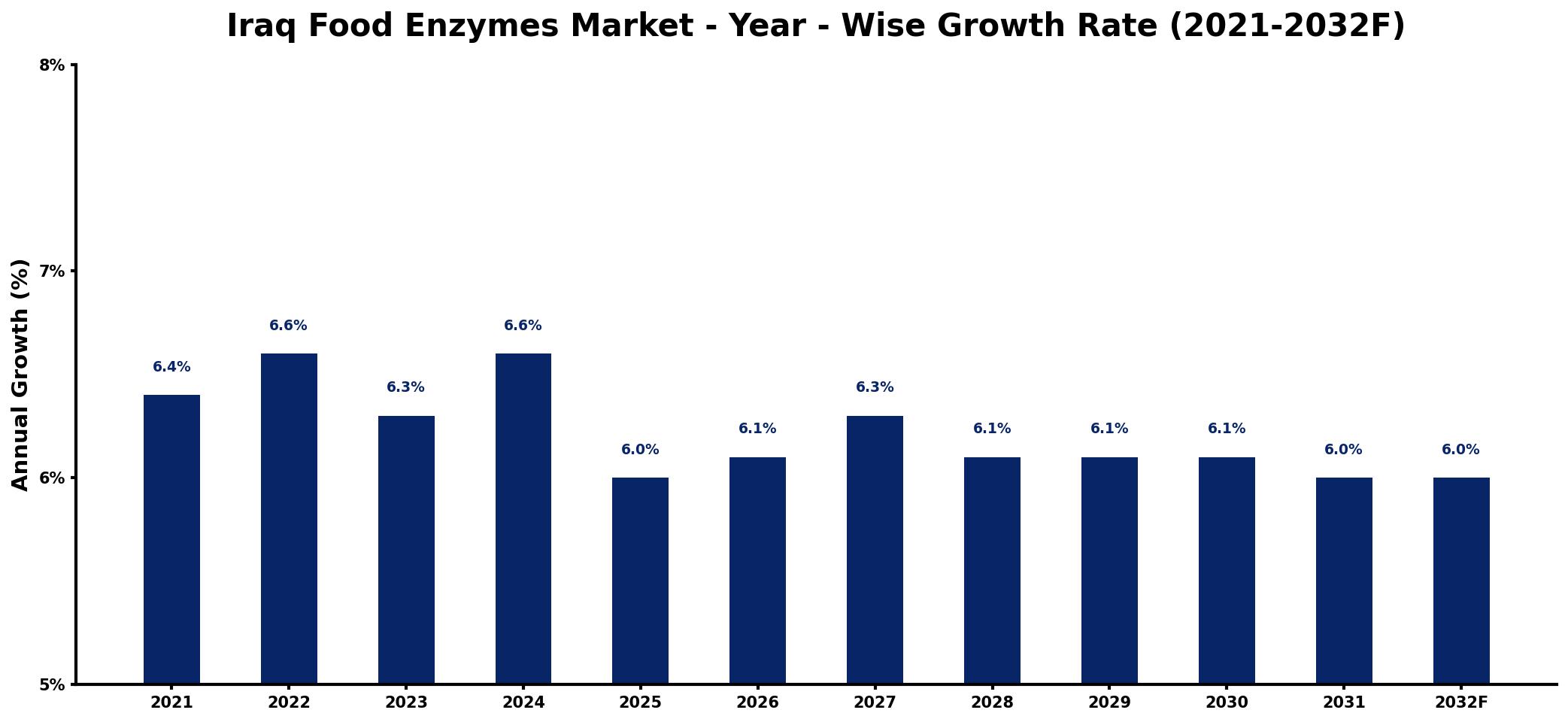
The table below presents the year‑wise growth rates along with the key drivers influencing the market
| Year | Growth Rate | Major Drivers |
| 2021 | 6.4% | Rising consumer health consciousness |
| 2022 | 6.6% | Increased investment in production |
| 2023 | 6.3% | Growing demand for natural solutions |
| 2024 | 6.6% | rising infrastructure development spending |
| 2025 | 6.0% | Higher adoption of sustainable practices |
| 2026 | 6.1% | Emergence of innovative applications |
| 2027 | 6.3% | Strengthened supply chain networks |
| 2028 | 6.1% | Enhanced research and development efforts |
| 2029 | 6.1% | Growing popularity of functional products |
| 2030 | 6.1% | Increased focus on product quality |
| 2031 | 6.0% | Expansion of export opportunities |
| 2032 | 6.0% | improved processing technologies adoption |
Note: Market size estimations and growth projections presented in this report are based on 6Wresearch's proprietary forecasting methodology, utilizing the latest available industry data, government publications, and primary research inputs.
Iraq Food Enzymes Market Synopsis
The strongest force shaping the Iraq Food Enzymes Market right now is the growing demand for processed food items that offer enhanced quality and extended shelf life. As consumers increasingly seek out convenient meal options, food manufacturers are turning to enzymes to improve product texture, flavor, and overall quality.
In addition, there is a notable shift towards clean label ingredients, prompting an upsurge in the adoption of natural enzymes sourced from reliable suppliers. This trend is directly addressing consumer preferences for healthier, more transparent food options, thereby driving the market further.
Iraq Food Enzymes Market Key Takeaways
- The market is witnessing a paradigm shift towards natural and clean label food additives.
- Increasing consumer awareness about the benefits of enzyme usage is propelling demand.
- Key areas of focus include the baking, dairy, and beverage sectors, enhancing product quality.
- Investment in research and development is critical for innovation in enzyme solutions.
- Regulatory frameworks are evolving to support the safe use of food enzymes in production.
Evaluation of Restraints in Iraq Food Enzymes Market
While the Iraq Food Enzymes Market is on an upward trajectory, several restraints are hindering its full potential. Political and economic instability can disrupt supply chains and create pricing volatility. Furthermore, a lack of consumer awareness about the advantages of food enzymes remains a barrier to widespread acceptance. Infrastructure deficiencies in storage and transportation also pose challenges for distribution, while stringent regulatory environments can complicate market entry for new products, inhibiting innovation and growth.
Iraq Food Enzymes Market Trends
Current trends indicate a marked increase in the incorporation of enzymes within food processing applications across various sectors. Enzymes are gaining traction for their roles in improving nutritional content and product consistency. Additionally, as health consciousness rises, there is an amplified focus on gluten-free, vegan, and clean label products. These consumer preferences are driving manufacturers to invest in innovative enzyme solutions derived from natural sources, aligning with the broader global trend towards sustainability in food production.
Iraq Food Enzymes Market Opportunities
The Iraq Food Enzymes Market is ripe with investment opportunities, particularly as the demand for processed and convenient foods escalates. Companies specializing in enzyme production or providing tailored enzyme solutions stand to benefit significantly. Moreover, as the food industry undergoes modernization, there is substantial potential for growth in segments prioritizing healthier and more sustainable options. Investors can leverage this market's evolution by supporting innovations that cater to changing consumer tastes.
Government Initiatives in the Iraq Food Enzymes Market
The Iraqi government is actively promoting policies aimed at enhancing food safety and quality standards within the food processing sector. Regulations have been established to oversee the use of food enzymes, focusing on ensuring consumer safety and transparent labeling. Public initiatives are fostering technological advancements while encouraging research and development efforts that enhance the utilization of enzymes. These governmental actions create a conducive environment for industry growth, ensuring that the market can evolve in alignment with consumer needs.
Future Insights of the Iraq Food Enzymes Market
Looking ahead to the period from 2026 to 2032, the Iraq Food Enzymes Market is expected to flourish, driven by sustained demand for processed foods and enhanced consumer awareness regarding the benefits of enzymes in food production. As the population grows and dietary preferences shift towards healthier options, manufacturers are poised to introduce innovative enzyme solutions tailored to meet these evolving needs. Advancements in enzyme technology will further catalyze market growth, supporting the development of high-quality, safe, and nutritious food products.
Iraq Food Enzymes Market Latest Developments (2025 - 2026)
Recent developments within the Iraq Food Enzymes Market indicate a surge in interest among manufacturers to innovate enzyme applications. Efforts are underway to enhance production capabilities, with a focus on improving supply chain efficiencies. Industry collaborations are becoming more common as companies seek to pool resources for research and development initiatives. Additionally, there is a noticeable uptick in consumer engagement, prompting brands to educate the market on the benefits of enzyme-enhanced products.
Iraq Food Enzymes Market - Key Attractiveness of the Report
- 10 Years of Market Numbers
- Historical Data Starting from 2022 to 2025
- Base Year: 2025
- Forecast Data until 2032
- Key Performance Indicators Impacting the Market
- Major Upcoming Developments and Projects
Key Highlights of the Report:
- Iraq Food Enzymes Market Outlook
- Market Size of Iraq Food Enzymes Market, 2025
- Forecast of Iraq Food Enzymes Market, 2032
- Historical Data and Forecast of Iraq Food Enzymes Revenues & Volume for the Period 2022-2032F
- Iraq Food Enzymes Market Trend Evolution
- Iraq Food Enzymes Market Drivers and Challenges
- Iraq Food Enzymes Price Trends
- Iraq Food Enzymes Porter's Five Forces
- Iraq Food Enzymes Industry Life Cycle
- Historical Data and Forecast of Iraq Food Enzymes Market Revenues & Volume By Source for the Period 2022-2032F
- Historical Data and Forecast of Iraq Food Enzymes Market Revenues & Volume By Microorganisms for the Period 2022-2032F
- Historical Data and Forecast of Iraq Food Enzymes Market Revenues & Volume By Animal for the Period 2022-2032F
- Historical Data and Forecast of Iraq Food Enzymes Market Revenues & Volume By Plant for the Period 2022-2032F
- Historical Data and Forecast of Iraq Food Enzymes Market Revenues & Volume By Type for the Period 2022-2032F
- Historical Data and Forecast of Iraq Food Enzymes Market Revenues & Volume By Carbohydarse for the Period 2022-2032F
- Historical Data and Forecast of Iraq Food Enzymes Market Revenues & Volume By Protease for the Period 2022-2032F
- Historical Data and Forecast of Iraq Food Enzymes Market Revenues & Volume By Lipase for the Period 2022-2032F
- Historical Data and Forecast of Iraq Food Enzymes Market Revenues & Volume By Others for the Period 2022-2032F
- Historical Data and Forecast of Iraq Food Enzymes Market Revenues & Volume By Form for the Period 2022-2032F
- Historical Data and Forecast of Iraq Food Enzymes Market Revenues & Volume By Liquid for the Period 2022-2032F
- Historical Data and Forecast of Iraq Food Enzymes Market Revenues & Volume By Solid for the Period 2022-2032F
- Historical Data and Forecast of Iraq Food Enzymes Market Revenues & Volume By Application for the Period 2022-2032F
- Historical Data and Forecast of Iraq Food Enzymes Market Revenues & Volume By Bakery for the Period 2022-2032F
- Historical Data and Forecast of Iraq Food Enzymes Market Revenues & Volume By Dairy for the Period 2022-2032F
- Historical Data and Forecast of Iraq Food Enzymes Market Revenues & Volume By Beverage for the Period 2022-2032F
- Historical Data and Forecast of Iraq Food Enzymes Market Revenues & Volume By Meat, Fish, and Egg Processing for the Period 2022-2032F
- Historical Data and Forecast of Iraq Food Enzymes Market Revenues & Volume By Grain and Oilseed Processing for the Period 2022-2032F
- Historical Data and Forecast of Iraq Food Enzymes Market Revenues & Volume By Others for the Period 2022-2032F
- Iraq Food Enzymes Import Export Trade Statistics
- Market Opportunity Assessment By Source
- Market Opportunity Assessment By Type
- Market Opportunity Assessment By Form
- Market Opportunity Assessment By Application
- Iraq Food Enzymes Top Companies Market Share
- Iraq Food Enzymes Competitive Benchmarking By Technical and Operational Parameters
- Iraq Food Enzymes Company Profiles
- Iraq Food Enzymes Key Strategic Recommendations






































