Iraq Frozen Fish Market Size, Share & Growth Rate
The Iraq Frozen Fish Market was estimated at USD 235 Million in 2025 and is projected to reach USD 311 Million by 2032, growing at a CAGR of 4.1% from 2026 to 2032. This growth trajectory is primarily driven by urbanization, where the shift toward city living enhances demand for convenient food options. Additionally, increasing health awareness among consumers has prompted a shift towards seafood as a preferred protein source, further boosting market dynamics.
Iraq Frozen Fish Market Year-wise Growth Rate and Key Drivers
This graph highlights how the Iraq Frozen Fish Market has steadily grown over the years, supported by major growth factors.
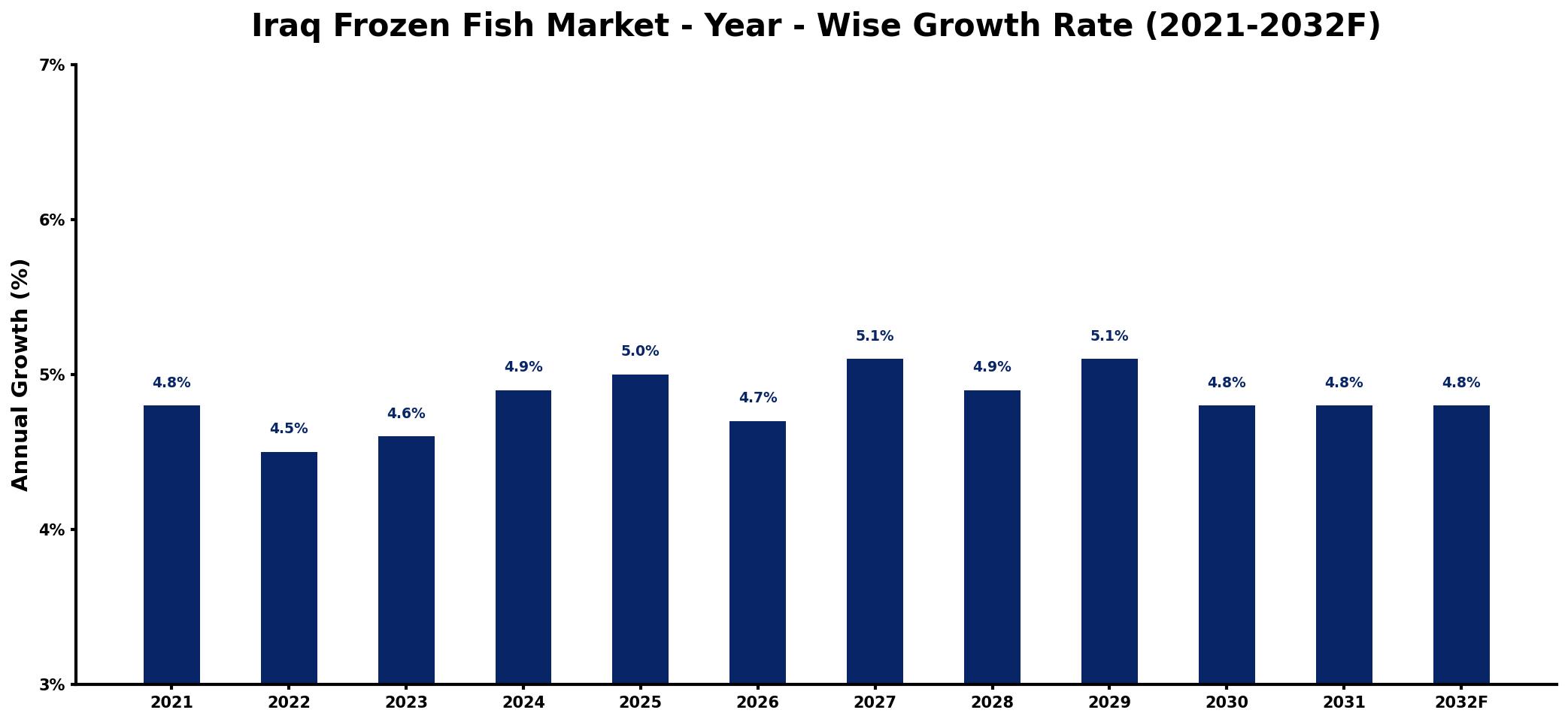
The table below presents the year‑wise growth rates along with the key drivers influencing the market
| Year | Growth Rate | Major Drivers |
| 2021 | 4.8% | Increased demand for seafood alternatives |
| 2022 | 4.5% | Expansion of cold chain logistics |
| 2023 | 4.6% | Growth in retail distribution networks |
| 2024 | 4.9% | enhanced product quality standards |
| 2025 | 5.0% | Investment in aquaculture technologies |
| 2026 | 4.7% | Enhanced supply chain efficiencies |
| 2027 | 5.1% | Broadening consumer preferences for protein |
| 2028 | 4.9% | Increase in export opportunities |
| 2029 | 5.1% | Development of new processing facilities |
| 2030 | 4.8% | growing commercial sector adoption |
| 2031 | 4.8% | Diversification of product offerings |
| 2032 | 4.8% | Growing popularity of meal kits |
Note: Market size estimations and growth projections presented in this report are based on 6Wresearch's proprietary forecasting methodology, utilizing the latest available industry data, government publications, and primary research inputs.
Iraq Frozen Fish Market Synopsis
The Iraq Frozen Fish Market is characterized by a diverse array of fish species, including popular options like tilapia and shrimp, which cater to evolving consumer tastes. Moreover, a notable trend is the growing consumer preference for high-quality imported frozen fish, highlighting the changing dynamics of food choices in Iraq.
This market is experiencing a notable increase in availability thanks to the rise of supermarkets and online grocery platforms, making frozen fish products more accessible than ever. As a result, consumers are increasingly prioritizing convenience and quality, positioning the frozen fish segment favorably within the broader food industry.
Iraq Frozen Fish Market Key Takeaways
- Significant growth potential driven by urbanization and changing dietary preferences.
- Consumer shift towards frozen fish products for convenience and longer shelf life.
- Import preferences are rising, particularly for seafood from quality-exporting nations.
- Supermarkets and online platforms are improving accessibility to frozen fish products.
- Health-conscious trends are enhancing the appeal of frozen fish as a protein source.
Evaluation of Restraints in Iraq Frozen Fish Market
Despite the promising growth outlook, the Iraq Frozen Fish Market is not without its challenges. A significant hurdle remains the country's infrastructure limitations, particularly in transportation and storage. Poor logistical networks can result in quality degradation and affect the freshness of products upon reaching consumers. Additionally, fluctuating consumer demand and regulatory hurdles complicate market operations, posing risks to consistent growth.
Furthermore, there is an ongoing challenge of consumer awareness regarding the benefits of frozen fish compared to fresh alternatives. Competing protein sources, along with the presence of counterfeit products, could also undermine the market's development, necessitating concerted efforts to address these barriers.
Iraq Frozen Fish Market Trends
The market is undergoing a transformation, with a notable trend toward premiumization of frozen fish products as consumers increasingly seek quality over price. Health trends are also driving a demand for seafood perceived as sustainable and nutritious. Moreover, advancements in cold chain technology are enabling better preservation of frozen fish, ensuring that products maintain their quality from processing to retail.
Iraq Frozen Fish Market Opportunities
Investment opportunities abound in the Iraq Frozen Fish Market, particularly in cold storage facilities and distribution networks. Establishing partnerships with local suppliers can enhance product sourcing and minimize logistical challenges. Moreover, technological investments in processing and packaging will elevate product quality and align with consumer expectations for freshness and safety.
Government Initiatives in the Iraq Frozen Fish Market
The Iraqi government has implemented various policies to enhance the frozen fish market. These include strict regulations to ensure that imported frozen fish meets safety and hygiene standards, protecting consumers. Additionally, there are initiatives promoting local fish production while simultaneously encouraging sustainable fishing practices to preserve marine resources. These policies aim to foster a safer, more competitive market environment.
Future Insights of the Iraq Frozen Fish Market
Looking ahead to 2026-2032, the Iraq Frozen Fish Market is expected to experience sustained growth driven by urbanization and an increasingly health-conscious population. Enhancements in cold chain logistics and distribution networks will make frozen fish more accessible, further entrenching its position in consumer diets. However, economic fluctuations and competition from fresh fish may pose ongoing challenges. Overall, with strategic planning and investment, the market is set for a promising future.
Iraq Frozen Fish Market Latest Developments (2025 - 2026)
Recently, the Iraq Frozen Fish Market has seen a surge in the entry of both local and international seafood suppliers, enhancing the variety available to consumers. Initiatives aimed at improving cold chain logistics are underway, which are expected to address some of the current infrastructure challenges. Additionally, consumer education campaigns highlighting the nutritional benefits of frozen fish are beginning to take shape, aiming to build awareness and drive market penetration.
Iraq Frozen Fish Market - Key Attractiveness of the Report
- 10 Years of Market Numbers
- Historical Data Starting from 2022 to 2025
- Base Year: 2025
- Forecast Data until 2032
- Key Performance Indicators Impacting the Market
- Major Upcoming Developments and Projects
Key Highlights of the Report:
- Iraq Frozen Fish Market Outlook
- Market Size of Iraq Frozen Fish Market, 2025
- Forecast of Iraq Frozen Fish Market, 2032
- Historical Data and Forecast of Iraq Frozen Fish Revenues & Volume for the Period 2022-2032F
- Iraq Frozen Fish Market Trend Evolution
- Iraq Frozen Fish Market Drivers and Challenges
- Iraq Frozen Fish Price Trends
- Iraq Frozen Fish Porter's Five Forces
- Iraq Frozen Fish Industry Life Cycle
- Historical Data and Forecast of Iraq Frozen Fish Market Revenues & Volume By Type for the Period 2022-2032F
- Historical Data and Forecast of Iraq Frozen Fish Market Revenues & Volume By Fish Fingers for the Period 2022-2032F
- Historical Data and Forecast of Iraq Frozen Fish Market Revenues & Volume By Fish Cakes for the Period 2022-2032F
- Historical Data and Forecast of Iraq Frozen Fish Market Revenues & Volume By Breaded/Battered Fish for the Period 2022-2032F
- Historical Data and Forecast of Iraq Frozen Fish Market Revenues & Volume By Whole Fish & Drawn Fish for the Period 2022-2032F
- Historical Data and Forecast of Iraq Frozen Fish Market Revenues & Volume By Single Fillet & Butterfly Fillet for the Period 2022-2032F
- Historical Data and Forecast of Iraq Frozen Fish Market Revenues & Volume By Dressed Fish for the Period 2022-2032F
- Historical Data and Forecast of Iraq Frozen Fish Market Revenues & Volume By Steaks Fish for the Period 2022-2032F
- Historical Data and Forecast of Iraq Fish Fingers Frozen Fish Market Revenues & Volume By Others for the Period 2022-2032F
- Historical Data and Forecast of Iraq Frozen Fish Market Revenues & Volume By Application for the Period 2022-2032F
- Historical Data and Forecast of Iraq Frozen Fish Market Revenues & Volume By Direct Consumption for the Period 2022-2032F
- Historical Data and Forecast of Iraq Frozen Fish Market Revenues & Volume By Restaurants for the Period 2022-2032F
- Historical Data and Forecast of Iraq Frozen Fish Market Revenues & Volume By Food Processing Factories for the Period 2022-2032F
- Historical Data and Forecast of Iraq Frozen Fish Market Revenues & Volume By Others for the Period 2022-2032F
- Historical Data and Forecast of Iraq Frozen Fish Market Revenues & Volume By Distribution Channel for the Period 2022-2032F
- Historical Data and Forecast of Iraq Frozen Fish Market Revenues & Volume By Supermarkets & Hypermarkets for the Period 2022-2032F
- Historical Data and Forecast of Iraq Frozen Fish Market Revenues & Volume By Convenience Stores for the Period 2022-2032F
- Historical Data and Forecast of Iraq Frozen Fish Market Revenues & Volume By Speciality Retailers for the Period 2022-2032F
- Historical Data and Forecast of Iraq Frozen Fish Market Revenues & Volume By Online for the Period 2022-2032F
- Historical Data and Forecast of Iraq Frozen Fish Market Revenues & Volume By Others for the Period 2022-2032F
- Iraq Frozen Fish Import Export Trade Statistics
- Market Opportunity Assessment By Type
- Market Opportunity Assessment By Application
- Market Opportunity Assessment By Distribution Channel
- Iraq Frozen Fish Top Companies Market Share
- Iraq Frozen Fish Competitive Benchmarking By Technical and Operational Parameters
- Iraq Frozen Fish Company Profiles
- Iraq Frozen Fish Key Strategic Recommendations






































