Iraq Glass Tiles Market Size, Share & Growth Rate
The Iraq Glass Tiles Market was estimated at USD 381 Million in 2025 and is projected to reach USD 531 Million by 2032, growing at a CAGR of 4.9% from 2026 to 2032. This growth trajectory is primarily driven by the booming construction sector, which increasingly adopts glass tiles for both aesthetic and functional purposes. The demand for decorative materials that enhance the visual appeal of residential and commercial spaces continues to rise, reflecting a trend toward modernization and urban beautification.
Iraq Glass Tiles Market Year-wise Growth Rate and Key Drivers
This graph highlights how the Iraq Glass Tiles Market has steadily grown over the years, supported by major growth factors.
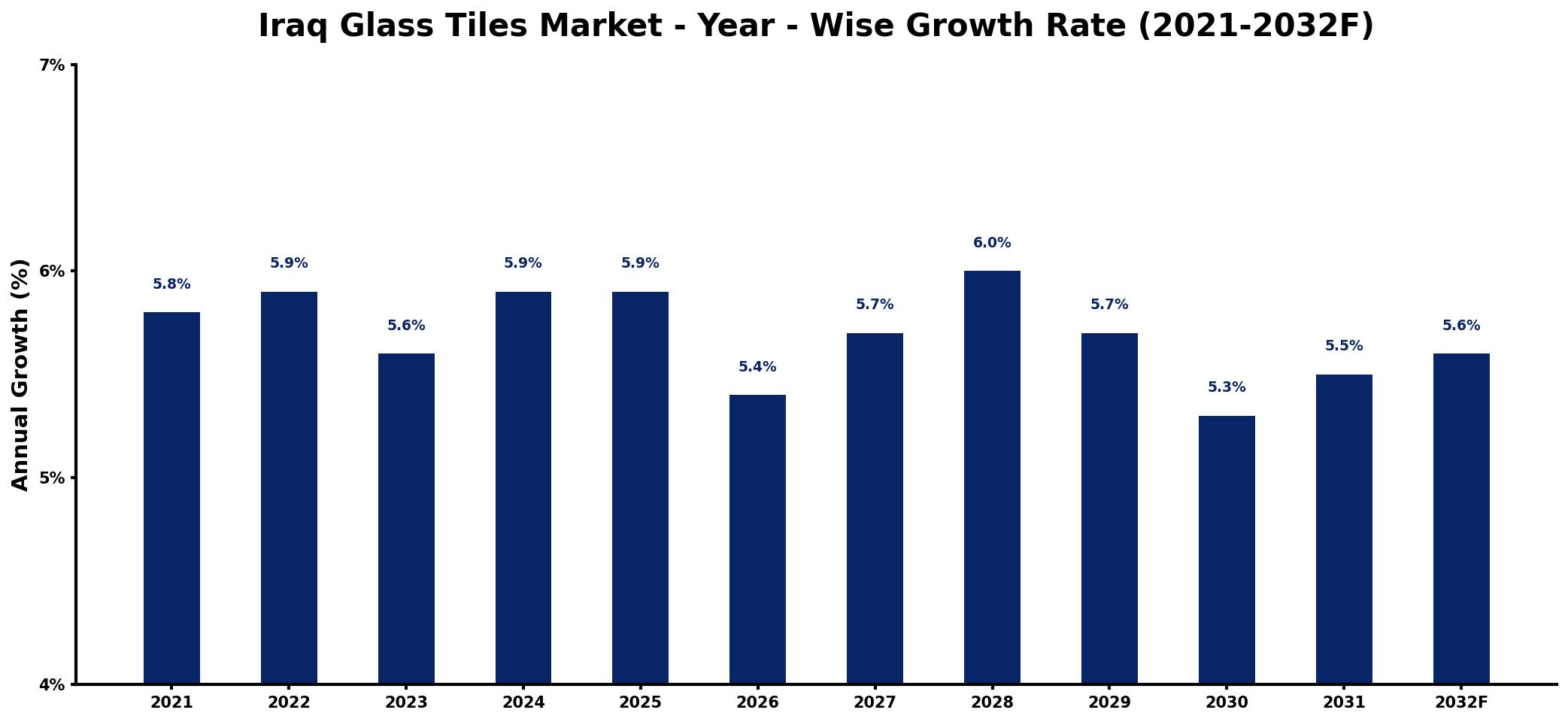
The table below presents the year‑wise growth rates along with the key drivers influencing the market
| Year | Growth Rate | Major Drivers |
| 2021 | 5.8% | Rising construction sector investments |
| 2022 | 5.9% | Increased urbanization and development |
| 2023 | 5.6% | Growing demand for aesthetic designs |
| 2024 | 5.9% | Expansion of luxury housing projects |
| 2025 | 5.9% | Surge in home renovation activities |
| 2026 | 5.4% | Strengthening tourism and hospitality industry |
| 2027 | 5.7% | Boost in infrastructure development projects |
| 2028 | 6.0% | Growing awareness of sustainable materials |
| 2029 | 5.7% | Increase in residential property sales |
| 2030 | 5.3% | growing downstream application demand |
| 2031 | 5.5% | Rising disposable income levels |
| 2032 | 5.6% | Growth in eco-friendly construction practices |
Note: Market size estimations and growth projections presented in this report are based on 6Wresearch's proprietary forecasting methodology, utilizing the latest available industry data, government publications, and primary research inputs.
Iraq Glass Tiles Market Synopsis
The versatility of glass tiles in Iraq is a significant factor behind their rising popularity, particularly in interior design applications. Their ability to reflect light and create a sense of spaciousness makes them an attractive choice for contemporary architecture, from luxurious villas to commercial complexes.
Furthermore, the ongoing government initiatives aimed at enhancing local manufacturing capabilities present a promising landscape for the glass tiles market. This development not only supports job creation but also aligns with the growing demand for customized and sustainable tiling solutions, meeting the specific needs of Iraqi consumers.
Iraq Glass Tiles Market Key Takeaways
- The market is on an upward trajectory, indicating strong growth potential through 2032.
- Government policies are supportive of local production and innovation in glass tile manufacturing.
- Increased focus on design flexibility and aesthetic appeal is shaping consumer preferences.
- There is a rising demand for glass tiles in both residential and commercial projects.
- Quality control and customization are becoming focal points for industry stakeholders.
Evaluation of Restraints in Iraq Glass Tiles Market
Despite the growth potential, several constraints impact the Iraq Glass Tiles Market. One major challenge lies in ensuring the durability and proper installation of glass tiles to meet architectural standards. Additionally, as competition in the sector intensifies, companies must prioritize quality control while addressing the diverse customization needs of clients. The balance between aesthetics and practicality often complicates procurement processes for developers and designers alike, creating an environment that requires careful management and strategic marketing.
Iraq Glass Tiles Market Trends
Current trends indicate a significant shift toward eco-friendly and sustainable practices in the glass tiles sector. Consumers are increasingly prioritizing environmentally responsible products, leading manufacturers to innovate with recycled materials and energy-efficient production methods. Furthermore, the rise of smart technology integration in homes is influencing the design of glass tiles, with an emphasis on features such as anti-bacterial surfaces and easy maintenance.
Iraq Glass Tiles Market Opportunities
The Iraq Glass Tiles Market holds promising growth opportunities, particularly in the realm of customization. As consumers seek unique designs to reflect their personal tastes, manufacturers who can offer bespoke solutions stand to gain a competitive edge. Additionally, the expansion of urban infrastructure and residential projects creates a fertile ground for investment in innovative glass tile applications. Public-private partnerships aiming at urban beautification initiatives further enhance the market's attractiveness for stakeholders looking to capitalize on these trends.
Government Initiatives in the Iraq Glass Tiles Market
The Iraqi government is actively promoting the growth of the glass tiles market through various initiatives aimed at bolstering local manufacturing capabilities. Policies are in place to encourage investment in advanced glass production technologies and to expand tile production capacities. Regulatory standards are also being established to ensure quality control and enhance the overall integrity of glass tile installations, which supports the broader objectives of sustainable development and urban revitalization in Iraq.
Future Insights of the Iraq Glass Tiles Market
Looking ahead to the period from 2026 to 2032, the Iraq Glass Tiles Market is poised for substantial evolution, driven by a mix of increasing construction activities and changing consumer preferences. The integration of technology in manufacturing processes is expected to enable greater customization and design innovation. As the construction industry continues to adopt modern materials, glass tiles will likely play a critical role in redefining architectural aesthetics across Iraq.
Iraq Glass Tiles Market Latest Developments (2025 - 2026)
Recently, the market has seen a notable push towards improving the quality of glass tiles through enhanced manufacturing processes. There are emerging partnerships between local manufacturers and international experts focusing on innovation in design and durability. Additionally, new marketing strategies aimed at educating consumers about the benefits of glass tiles have been implemented, helping to build awareness and drive demand in both residential and commercial sectors.
Iraq Glass Tiles Market - Key Attractiveness of the Report
- 10 Years of Market Numbers
- Historical Data Starting from 2022 to 2025
- Base Year: 2025
- Forecast Data until 2032
- Key Performance Indicators Impacting the Market
- Major Upcoming Developments and Projects
Key Highlights of the Report:
- Iraq Glass Tiles Market Outlook
- Market Size of Iraq Glass Tiles Market, 2025
- Forecast of Iraq Glass Tiles Market, 2032
- Historical Data and Forecast of Iraq Glass Tiles Revenues & Volume for the Period 2022-2032F
- Iraq Glass Tiles Market Trend Evolution
- Iraq Glass Tiles Market Drivers and Challenges
- Iraq Glass Tiles Price Trends
- Iraq Glass Tiles Porter's Five Forces
- Iraq Glass Tiles Industry Life Cycle
- Historical Data and Forecast of Iraq Glass Tiles Market Revenues & Volume By Manufacturing Process for the Period 2022-2032F
- Historical Data and Forecast of Iraq Glass Tiles Market Revenues & Volume By Smalti Tiles for the Period 2022-2032F
- Historical Data and Forecast of Iraq Glass Tiles Market Revenues & Volume By Fused Tiles for the Period 2022-2032F
- Historical Data and Forecast of Iraq Glass Tiles Market Revenues & Volume By Sintered Tiles for the Period 2022-2032F
- Historical Data and Forecast of Iraq Glass Tiles Market Revenues & Volume By Cast Tiles for the Period 2022-2032F
- Historical Data and Forecast of Iraq Glass Tiles Market Revenues & Volume By Other for the Period 2022-2032F
- Historical Data and Forecast of Iraq Glass Tiles Market Revenues & Volume By Product Type for the Period 2022-2032F
- Historical Data and Forecast of Iraq Glass Tiles Market Revenues & Volume By Matte-finished Glass Tile for the Period 2022-2032F
- Historical Data and Forecast of Iraq Glass Tiles Market Revenues & Volume By Smooth Glass Tile for the Period 2022-2032F
- Historical Data and Forecast of Iraq Glass Tiles Market Revenues & Volume By End-User Industry for the Period 2022-2032F
- Historical Data and Forecast of Iraq Glass Tiles Market Revenues & Volume By Residential for the Period 2022-2032F
- Historical Data and Forecast of Iraq Glass Tiles Market Revenues & Volume By Commercial for the Period 2022-2032F
- Historical Data and Forecast of Iraq Glass Tiles Market Revenues & Volume By Infrastructure for the Period 2022-2032F
- Iraq Glass Tiles Import Export Trade Statistics
- Market Opportunity Assessment By Manufacturing Process
- Market Opportunity Assessment By Product Type
- Market Opportunity Assessment By End-User Industry
- Iraq Glass Tiles Top Companies Market Share
- Iraq Glass Tiles Competitive Benchmarking By Technical and Operational Parameters
- Iraq Glass Tiles Company Profiles
- Iraq Glass Tiles Key Strategic Recommendations






































