Iraq Glycerol Market Size, Share & Growth Rate
The Iraq Glycerol Market was estimated at USD 405 Million in 2025 and is projected to reach USD 535 Million by 2032, growing at a CAGR of 4.1% from 2026 to 2032. This growth trajectory is primarily driven by the increasing adoption of glycerol in various sectors, including pharmaceuticals, cosmetics, and food production, where its natural properties serve multiple functions such as emulsifying and moisturizing. Moreover, as Iraq leverages its biodiesel production capabilities, the availability of glycerol as a renewable feedstock presents significant opportunities for industrial innovation and sustainable development.
Iraq Glycerol Market Year-wise Growth Rate and Key Drivers
This graph highlights how the Iraq Glycerol Market has steadily grown over the years, supported by major growth factors.
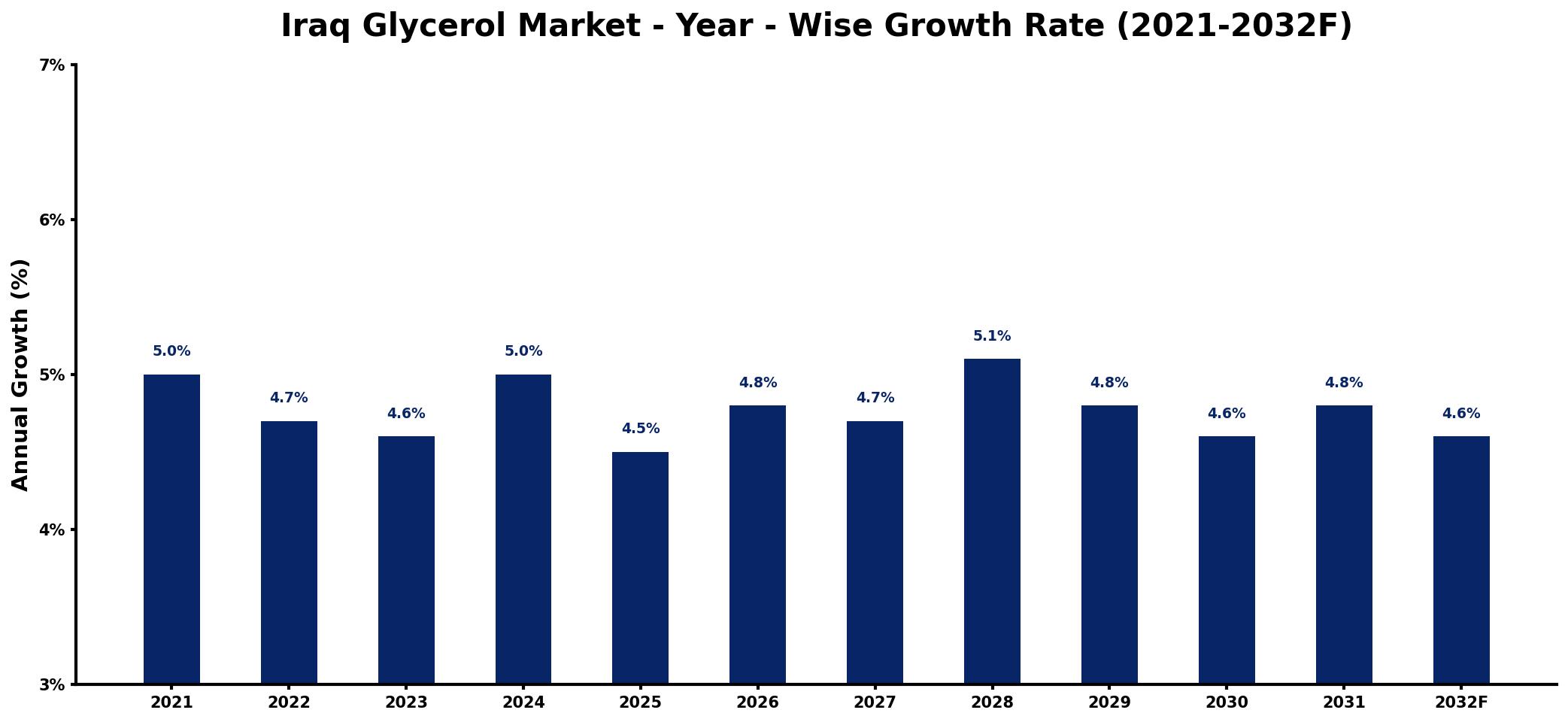
The table below presents the year‑wise growth rates along with the key drivers influencing the market
| Year | Growth Rate | Major Drivers |
| 2021 | 5.0% | Rising demand in pharmaceutical sector |
| 2022 | 4.7% | Increased investments in biofuels |
| 2023 | 4.6% | Expansion of food processing industry |
| 2024 | 5.0% | Growing popularity of personal care |
| 2025 | 4.5% | Surge in chemical manufacturing needs |
| 2026 | 4.8% | Boost in agricultural applications usage |
| 2027 | 4.7% | Higher consumption in cosmetic products |
| 2028 | 5.1% | Increased production of industrial solvents |
| 2029 | 4.8% | Growth in renewable energy initiatives |
| 2030 | 4.6% | Expansion in specialty chemical markets |
| 2031 | 4.8% | Rising application in food additives |
| 2032 | 4.6% | Increased utilization in cleaning products |
Note: Market size estimations and growth projections presented in this report are based on 6Wresearch's proprietary forecasting methodology, utilizing the latest available industry data, government publications, and primary research inputs.
Iraq Glycerol Market Synopsis
The glycerol market in Iraq is witnessing robust growth, fueled by the country's expanding biodiesel industry, which generates glycerol as a byproduct. This natural compound is increasingly recognized for its versatility in various applications, including personal care products and pharmaceuticals, where its unique properties enhance product quality and consumer appeal.
In addition to its traditional uses, the glycerol market is benefiting from advancements in biorefinery technologies. These innovations are not only improving production efficiency but also facilitating the conversion of glycerol into higher-value products, thereby driving market dynamics and investment interest in the sector.
Iraq Glycerol Market Key Takeaways
- The market is expected to grow significantly due to the rising demand for glycerol in pharmaceuticals and personal care.
- Technological advancements in biodiesel production are enhancing glycerol recovery and purification processes.
- The government is supporting glycerol market expansion through favorable policies and investment incentives.
- Challenges related to production efficiency and regulatory compliance continue to impact market dynamics.
- Market opportunities exist for innovation in glycerol-based applications, particularly in sustainable manufacturing.
Evaluation of Restraints in Iraq Glycerol Market
Despite its promising outlook, the Iraq glycerol market faces significant restraints that can hinder its growth. Key challenges include the optimization of production efficiency and the selection of appropriate feedstock. Additionally, the industry must navigate fluctuations in market demand and pricing volatility. Regulatory compliance remains an ongoing concern, necessitating stringent quality controls to meet purity standards. These factors collectively complicate the market landscape and require strategic management by stakeholders.
Iraq Glycerol Market Trends
Current trends indicate a shift towards sustainable and eco-friendly production methods in the glycerol market. Manufacturers are increasingly focusing on using glycerol derived from renewable sources, such as biodiesel production, to meet growing consumer demand for natural ingredients. Moreover, the integration of biorefinery technologies is streamlining glycerol production processes, enhancing cost-efficiency while minimizing waste. The growing emphasis on sustainability is also prompting industries to explore innovative glycerol applications, ranging from food additives to bioplastics.
Iraq Glycerol Market Opportunities
The glycerol market in Iraq presents numerous growth opportunities, particularly in the areas of product innovation and application diversification. The increasing interest in bioproducts and green chemistry opens avenues for developing new glycerol-based solutions tailored to meet specific industry needs. Additionally, as companies seek to reduce their carbon footprint, glycerol's role as a renewable feedstock for chemicals and fuels can further enhance its market appeal. Organizations that strategically invest in research and development will likely capitalize on these emerging trends.
Government Initiatives in the Iraq Glycerol Market
The Iraqi government has implemented several initiatives aimed at bolstering the glycerol market, focusing on the value-added utilization of biodiesel byproducts. Policies encouraging investment in biodiesel production technology and glycerol refining processes are at the forefront. Additionally, the government is promoting regulatory standards for glycerol purity to ensure its compatibility in various industrial applications. Capacity-building programs are also being established to enhance the skills of biodiesel producers and chemical manufacturers, fostering a more competitive and sustainable glycerol market.
Future Insights of the Iraq Glycerol Market
Looking ahead to 2026-2032, the Iraq glycerol market is poised for substantial growth, driven by a combination of favorable government policies and increasing industrial demand. As technological advancements continue to enhance glycerol production efficiency, the market is expected to attract further investments, paving the way for innovative applications. The drive for sustainability will likely remain a cornerstone of market expansion, with industries increasingly recognizing the value of glycerol as a renewable resource. Overall, a proactive approach toward overcoming existing challenges will be essential for stakeholders aiming to thrive in this evolving landscape.
Iraq Glycerol Market Latest Developments (2025 - 2026)
Recent developments in the Iraq glycerol market indicate a growing interest in biorefinery technologies that enhance glycerol recovery from biodiesel production. Industry players are beginning to collaborate on initiatives aimed at establishing more efficient glycerol purification techniques. Additionally, there is a noticeable increase in training programs for producers, focusing on best practices in glycerol utilization. As the market continues to evolve, these developments are expected to create a more sustainable and competitive environment.
Iraq Glycerol Market - Key Attractiveness of the Report
- 10 Years of Market Numbers
- Historical Data Starting from 2022 to 2025
- Base Year: 2025
- Forecast Data until 2032
- Key Performance Indicators Impacting the Market
- Major Upcoming Developments and Projects
Key Highlights of the Report:
- Iraq Glycerol Market Outlook
- Market Size of Iraq Glycerol Market, 2025
- Forecast of Iraq Glycerol Market, 2032
- Historical Data and Forecast of Iraq Glycerol Revenues & Volume for the Period 2022-2032F
- Iraq Glycerol Market Trend Evolution
- Iraq Glycerol Market Drivers and Challenges
- Iraq Glycerol Price Trends
- Iraq Glycerol Porter's Five Forces
- Iraq Glycerol Industry Life Cycle
- Historical Data and Forecast of Iraq Glycerol Market Revenues & Volume By Source for the Period 2022-2032F
- Historical Data and Forecast of Iraq Glycerol Market Revenues & Volume By Biodiesel for the Period 2022-2032F
- Historical Data and Forecast of Iraq Glycerol Market Revenues & Volume By Fatty Alcohols for the Period 2022-2032F
- Historical Data and Forecast of Iraq Glycerol Market Revenues & Volume By Fatty Acids for the Period 2022-2032F
- Historical Data and Forecast of Iraq Glycerol Market Revenues & Volume By Soap for the Period 2022-2032F
- Historical Data and Forecast of Iraq Glycerol Market Revenues & Volume By Type for the Period 2022-2032F
- Historical Data and Forecast of Iraq Glycerol Market Revenues & Volume By Crude for the Period 2022-2032F
- Historical Data and Forecast of Iraq Glycerol Market Revenues & Volume By Refined for the Period 2022-2032F
- Historical Data and Forecast of Iraq Glycerol Market Revenues & Volume By End-use for the Period 2022-2032F
- Historical Data and Forecast of Iraq Glycerol Market Revenues & Volume By Food & Beverage for the Period 2022-2032F
- Historical Data and Forecast of Iraq Glycerol Market Revenues & Volume By Pharmaceutical for the Period 2022-2032F
- Historical Data and Forecast of Iraq Glycerol Market Revenues & Volume By Nutraceutical for the Period 2022-2032F
- Historical Data and Forecast of Iraq Glycerol Market Revenues & Volume By Personal Care & Cosmetics for the Period 2022-2032F
- Historical Data and Forecast of Iraq Glycerol Market Revenues & Volume By Industrial for the Period 2022-2032F
- Historical Data and Forecast of Iraq Glycerol Market Revenues & Volume By Others for the Period 2022-2032F
- Iraq Glycerol Import Export Trade Statistics
- Market Opportunity Assessment By Source
- Market Opportunity Assessment By Type
- Market Opportunity Assessment By End-use
- Iraq Glycerol Top Companies Market Share
- Iraq Glycerol Competitive Benchmarking By Technical and Operational Parameters
- Iraq Glycerol Company Profiles
- Iraq Glycerol Key Strategic Recommendations






































