Iraq Holster Market Size, Share & Growth Rate
The Iraq Holster Market was estimated at USD 1084 Million in 2025 and is projected to reach USD 1563 Million by 2032, growing at a CAGR of 5.4% from 2026 to 2032. This growth trajectory is primarily driven by the rising demand for personal safety products as citizens increasingly focus on self-defense amid ongoing security concerns. Additionally, the burgeoning interest in outdoor activities such as hunting and shooting sports is further fueling market expansion, creating a diverse consumer base eager for various holster options.
Iraq Holster Market Year-wise Growth Rate and Key Drivers
This graph highlights how the Iraq Holster Market has steadily grown over the years, supported by major growth factors.
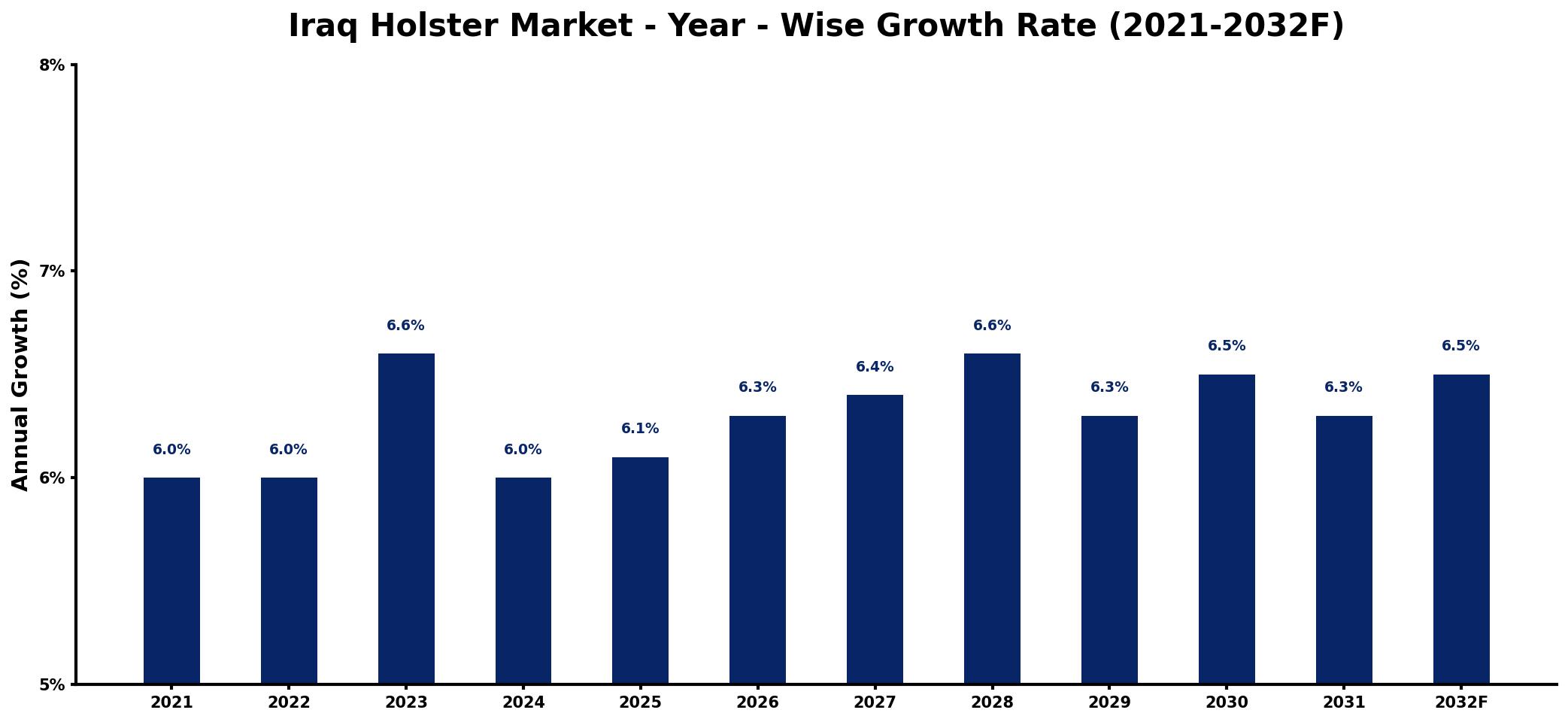
The table below presents the year‑wise growth rates along with the key drivers influencing the market
| Year | Growth Rate | Major Drivers |
| 2021 | 6.0% | Increased security personnel hiring |
| 2022 | 6.0% | strengthening underlying market demand |
| 2023 | 6.6% | Growing interest in tactical gear |
| 2024 | 6.0% | Expansion of law enforcement agencies |
| 2025 | 6.1% | Boost in outdoor recreational activities |
| 2026 | 6.3% | Surge in military training programs |
| 2027 | 6.4% | Increase in private security firms |
| 2028 | 6.6% | Heightened demand for personal safety |
| 2029 | 6.3% | Investment in emergency response systems |
| 2030 | 6.5% | Growth in sporting events participation |
| 2031 | 6.3% | improved raw material availability |
| 2032 | 6.5% | stronger distribution network expansion |
Note: Market size estimations and growth projections presented in this report are based on 6Wresearch's proprietary forecasting methodology, utilizing the latest available industry data, government publications, and primary research inputs.
Iraq Holster Market Synopsis
The Iraq Holster Market is currently witnessing a robust demand for a variety of holster materials, including leather, nylon, and Kydex. This array of choices reflects the evolving preferences of consumers who seek not just functionality but also style in their holster designs.
With personal safety increasingly at the forefront of public consciousness, both civilians and law enforcement agencies are leaning towards innovative holster solutions. The market is adapting to these needs, offering products that emphasize comfort, quick access, and secure firearm retention, all while accommodating diverse user requirements.
Iraq Holster Market Key Takeaways
- The market is responding to heightened security concerns and an increase in civilian firearm ownership.
- Innovative materials are making holsters lighter and more versatile for daily use.
- Customization options are becoming a key trend, catering to individual consumer preferences.
- Government regulations are aimed at enhancing public safety and ensuring compliance among manufacturers.
- Investment opportunities exist in high-quality, durable holster production and design innovation.
Evaluation of Restraints in Iraq Holster Market
Despite promising growth, the Iraq Holster Market faces significant constraints that impede its potential. A notable challenge is the lack of standardized regulations and quality control measures, which leads to a concerning prevalence of counterfeit products in the market. These inferior options not only compromise safety but also create distrust among consumers towards legitimate manufacturers. Furthermore, informal markets and unregistered vendors complicate the landscape, making it hard for established businesses to maintain a competitive edge. Political instability and ongoing security issues also contribute to market fluctuations, impacting both demand and supply chains.
Iraq Holster Market Trends
The market is evolving with a significant shift towards lightweight, versatile holster designs, particularly tailored for concealed carry options. Manufacturers are increasingly using advanced materials like Kydex and nylon to ensure comfort and functionality without sacrificing durability. Additionally, the emergence of modular holster systems is gaining traction, allowing users to modify their setups based on personal requirements. This trend reflects a broader consumer shift toward self-defense, with a growing demand for products that combine secure retention with rapid accessibility to firearms.
Iraq Holster Market Opportunities
The Iraq Holster Market is ripe with investment opportunities, particularly in sectors that prioritize personal security. As the interest in firearms ownership expands, so too does the demand for holsters that accommodate various personal defense needs. Companies that focus on high-quality production, innovative designs, and customizable options are likely to thrive. Moreover, tapping into the growing consumer desire for personalization could yield significant dividends, positioning investors favorably within this dynamic market.
Government Initiatives in the Iraq Holster Market
The Iraqi government has enacted several policies aimed at regulating the holster market to enhance public safety. Strict licensing requirements for manufacturers and sellers serve to enforce compliance with safety standards. Additionally, there are regulations concerning the materials and designs permissible for holsters, ensuring that products meet certain quality benchmarks. Restrictions on sales to unlicensed individuals further aim to curb the misuse of firearms. Such government initiatives are crucial for promoting responsible ownership and fostering a safer environment regarding firearm usage.
Future Insights of the Iraq Holster Market
Looking ahead to 2026-2032, the Iraq Holster Market is poised for continued growth, propelled by rising safety concerns and an expanding law enforcement and military presence. The civilian gun ownership trend is expected to remain strong, further driving demand for high-quality holster options. Technological advancements in materials and designs will also play a critical role in shaping market dynamics. However, challenges such as political instability and regulatory complexities will require careful navigation to maximize potential growth opportunities.
Iraq Holster Market Latest Developments (2025 - 2026)
In the latest developments within the Iraq Holster Market, there has been a noticeable emphasis on enhancing product safety and compliance among manufacturers. Industry players are increasingly adopting innovative production techniques and exploring partnerships to improve their market positions. The demand for eco-friendly materials is also gaining momentum, reflecting a shift in consumer preferences towards sustainable products. As competition intensifies, manufacturers are seeking to differentiate their offerings through customization and tailored solutions for various user needs.
Iraq Holster Market - Key Attractiveness of the Report
- 10 Years of Market Numbers
- Historical Data Starting from 2022 to 2025
- Base Year: 2025
- Forecast Data until 2032
- Key Performance Indicators Impacting the Market
- Major Upcoming Developments and Projects
Key Highlights of the Report:
- Iraq Holster Market Outlook
- Market Size of Iraq Holster Market, 2025
- Forecast of Iraq Holster Market, 2032
- Historical Data and Forecast of Iraq Holster Revenues & Volume for the Period 2022-2032F
- Iraq Holster Market Trend Evolution
- Iraq Holster Market Drivers and Challenges
- Iraq Holster Price Trends
- Iraq Holster Porter's Five Forces
- Iraq Holster Industry Life Cycle
- Historical Data and Forecast of Iraq Holster Market Revenues & Volume By Type for the Period 2022-2032F
- Historical Data and Forecast of Iraq Holster Market Revenues & Volume By Leather for the Period 2022-2032F
- Historical Data and Forecast of Iraq Holster Market Revenues & Volume By Nylon for the Period 2022-2032F
- Historical Data and Forecast of Iraq Holster Market Revenues & Volume By Plastic for the Period 2022-2032F
- Historical Data and Forecast of Iraq Holster Market Revenues & Volume By Other for the Period 2022-2032F
- Historical Data and Forecast of Iraq Holster Market Revenues & Volume By Application for the Period 2022-2032F
- Historical Data and Forecast of Iraq Holster Market Revenues & Volume By Civil for the Period 2022-2032F
- Historical Data and Forecast of Iraq Holster Market Revenues & Volume By Armed Forces for the Period 2022-2032F
- Historical Data and Forecast of Iraq Holster Market Revenues & Volume By others for the Period 2022-2032F
- Iraq Holster Import Export Trade Statistics
- Market Opportunity Assessment By Type
- Market Opportunity Assessment By Application
- Iraq Holster Top Companies Market Share
- Iraq Holster Competitive Benchmarking By Technical and Operational Parameters
- Iraq Holster Company Profiles
- Iraq Holster Key Strategic Recommendations






































