Iraq Household Cleaning Products Market Size, Share & Growth Rate
The Iraq Household Cleaning Products Market was estimated at USD 149 Million in 2025 and is projected to reach USD 162 Million by 2032, growing at a CAGR of 1.2% from 2026 to 2032. This growth trajectory is driven by a notable rise in hygiene consciousness among Iraqi consumers, particularly in urban areas, where the increasing standards of living correlate with the demand for effective cleaning solutions. As lifestyles evolve, households are prioritizing cleanliness, leading to heightened investments in products such as detergents, disinfectants, and surface cleaners.
Iraq Household Cleaning Products Market Year-wise Growth Rate and Key Drivers
This graph highlights how the Iraq Household Cleaning Products Market has steadily grown over the years, supported by major growth factors.
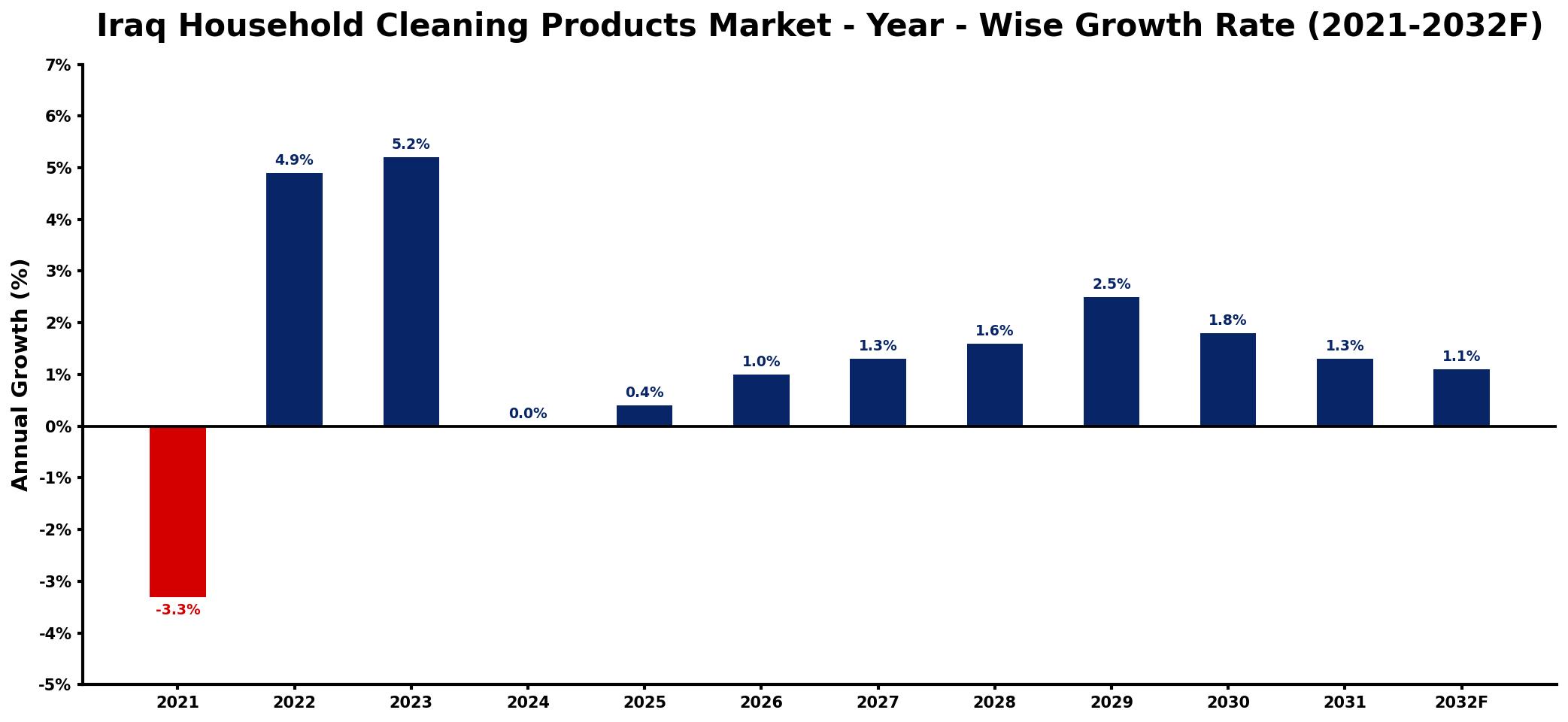
The table below presents the year‑wise growth rates along with the key drivers influencing the market
| Year | Growth Rate | Major Drivers |
| 2021 | -3.3% | decreased consumer spending patterns |
| 2022 | 4.9% | increased urban population density |
| 2023 | 5.2% | growing awareness of hygiene |
| 2024 | 0.0% | rising disposable income levels |
| 2025 | 0.4% | expansion of retail distribution channels |
| 2026 | 1.0% | increased investment in marketing |
| 2027 | 1.3% | growing demand for sustainability |
| 2028 | 1.6% | emergence of new brands |
| 2029 | 2.5% | increased focus on quality standards |
| 2030 | 1.8% | growing popularity of e-commerce |
| 2031 | 1.3% | increased availability of alternatives |
| 2032 | 1.1% | enhanced consumer education initiatives |
Note: Market size estimations and growth projections presented in this report are based on 6Wresearch's proprietary forecasting methodology, utilizing the latest available industry data, government publications, and primary research inputs.
Iraq Household Cleaning Products Market Synopsis
In recent years, the household cleaning products market in Iraq has witnessed substantial growth, fueled by a significant rise in consumer awareness regarding hygiene and sanitation. With urbanization on the rise, more households are seeking out convenient and effective cleaning solutions to maintain their living spaces. This shift in consumer behavior is indicative of changing lifestyles and an increasing focus on health and wellness.
Additionally, the ongoing economic recovery post-conflict has led to enhanced purchasing power among consumers. While the market faces challenges such as affordability and distribution inefficiencies, the overall sentiment leans towards greater investments in household cleanliness. This context creates an encouraging landscape for manufacturers to innovate and introduce products that cater to the evolving needs of the Iraqi consumer.
Iraq Household Cleaning Products Market Key Takeaways
- The market is projected to grow steadily, reflecting a broader trend towards hygiene awareness.
- Urbanization continues to drive demand, as consumers seek efficient cleaning solutions.
- Government initiatives aim to regulate the quality and safety of household cleaning products.
- Logistical challenges present ongoing hurdles but also highlight areas for improvement in supply chains.
- Emerging consumer preferences are pushing for eco-friendly and sustainable cleaning options.
Evaluation of Restraints in Iraq Household Cleaning Products Market
The household cleaning products market in Iraq grapples with several restraints that can stymie growth. Economic instability remains a significant factor, as fluctuations in purchasing power directly influence consumer spending on cleaning products. Additionally, the market faces distribution challenges, particularly in remote areas where access to effective supply chains is limited. These logistical hurdles can lead to stock shortages and limited product availability, ultimately deterring consumer trust and affecting brand loyalty.
Iraq Household Cleaning Products Market Trends
Current trends indicate a shift towards sustainable and eco-friendly cleaning products, as consumers become increasingly concerned about the environmental impact of their purchases. This trend is prompting manufacturers to explore innovative formulas that combine effectiveness with safety for both users and the planet. Furthermore, the rise of e-commerce is transforming the retail landscape, enabling consumers to access a wider range of products online, often at competitive prices.
Iraq Household Cleaning Products Market Opportunities
The household cleaning products sector in Iraq presents numerous growth opportunities for investors and manufacturers alike. With an expanding urban population and evolving consumer behaviors, there is a burgeoning demand for specialized cleaning products tailored to local needs. Additionally, local manufacturing initiatives, encouraged by government policies, can stimulate economic growth and position brands favorably in the market. The exploration of multi-functional products that serve both cleaning and disinfection purposes represents another key area for potential innovation.
Government Initiatives in the Iraq Household Cleaning Products Market
The Iraqi government has recognized the importance of maintaining hygiene and cleanliness for public health and well-being. To support the household cleaning products market, policies have been implemented that ensure the availability of safe, effective products. These regulations emphasize strict quality control and safety standards, promoting consumer trust. Moreover, awareness campaigns are being launched to educate citizens on the significance of proper cleaning practices, further enhancing the market's overall landscape.
Future Insights of the Iraq Household Cleaning Products Market
Looking ahead to 2026-2032, the Iraq Household Cleaning Products Market is poised for steady growth as consumer demands continue to evolve. The anticipated increase in urbanization will likely accelerate the need for innovative cleaning solutions that not only address basic hygiene but also incorporate eco-friendly attributes. As the market matures, opportunities for differentiation through product innovation and improved distribution networks will become increasingly critical for sustained success.
Iraq Household Cleaning Products Market Latest Developments (2025 - 2026)
Recent developments in the Iraq household cleaning products market include a noticeable uptick in the launch of eco-friendly product lines, reflecting growing consumer demand for sustainability. Additionally, advancements in distribution strategies are being explored, including partnerships with local retailers and increased online presence to enhance product accessibility. These trends point towards a dynamic shift within the industry, driven by consumer preferences and technological advancements.
Iraq Household Cleaning Products Market - Key Attractiveness of the Report
- 10 Years of Market Numbers
- Historical Data Starting from 2022 to 2025
- Base Year: 2025
- Forecast Data until 2032
- Key Performance Indicators Impacting the Market
- Major Upcoming Developments and Projects
Key Highlights of the Report:
- Iraq Household Cleaning Products Market Outlook
- Market Size of Iraq Household Cleaning Products Market, 2025
- Forecast of Iraq Household Cleaning Products Market, 2032
- Historical Data and Forecast of Iraq Household Cleaning Products Revenues & Volume for the Period 2022-2032F
- Iraq Household Cleaning Products Market Trend Evolution
- Iraq Household Cleaning Products Market Drivers and Challenges
- Iraq Household Cleaning Products Price Trends
- Iraq Household Cleaning Products Porter's Five Forces
- Iraq Household Cleaning Products Industry Life Cycle
- Historical Data and Forecast of Iraq Household Cleaning Products Market Revenues & Volume By Product Type for the Period 2022-2032F
- Historical Data and Forecast of Iraq Household Cleaning Products Market Revenues & Volume By Laundry Detergents for the Period 2022-2032F
- Historical Data and Forecast of Iraq Household Cleaning Products Market Revenues & Volume By Surface Cleaners for the Period 2022-2032F
- Historical Data and Forecast of Iraq Household Cleaning Products Market Revenues & Volume By Dishwashing Products for the Period 2022-2032F
- Historical Data and Forecast of Iraq Household Cleaning Products Market Revenues & Volume By Toilet Cleaners for the Period 2022-2032F
- Historical Data and Forecast of Iraq Household Cleaning Products Market Revenues & Volume By Others for the Period 2022-2032F
- Iraq Household Cleaning Products Import Export Trade Statistics
- Market Opportunity Assessment By Product Type
- Iraq Household Cleaning Products Top Companies Market Share
- Iraq Household Cleaning Products Competitive Benchmarking By Technical and Operational Parameters
- Iraq Household Cleaning Products Company Profiles
- Iraq Household Cleaning Products Key Strategic Recommendations






































