Iraq Industrial Equipment Market Size, Share & Growth Rate
The Iraq Industrial Equipment Market was estimated at USD 201 Million in 2025 and is projected to reach USD 219 Million by 2032, growing at a CAGR of 1.2% from 2026 to 2032. This growth trajectory is primarily driven by increasing infrastructure projects, particularly within the oil and gas sector, and the countrys broader efforts to modernize its industrial framework. Additionally, heightened investments in agricultural and construction machinery further emphasize the growing demand for advanced industrial equipment.
Iraq Industrial Equipment Market Year-wise Growth Rate and Key Drivers
This graph highlights how the Iraq Industrial Equipment Market has steadily grown over the years, supported by major growth factors.
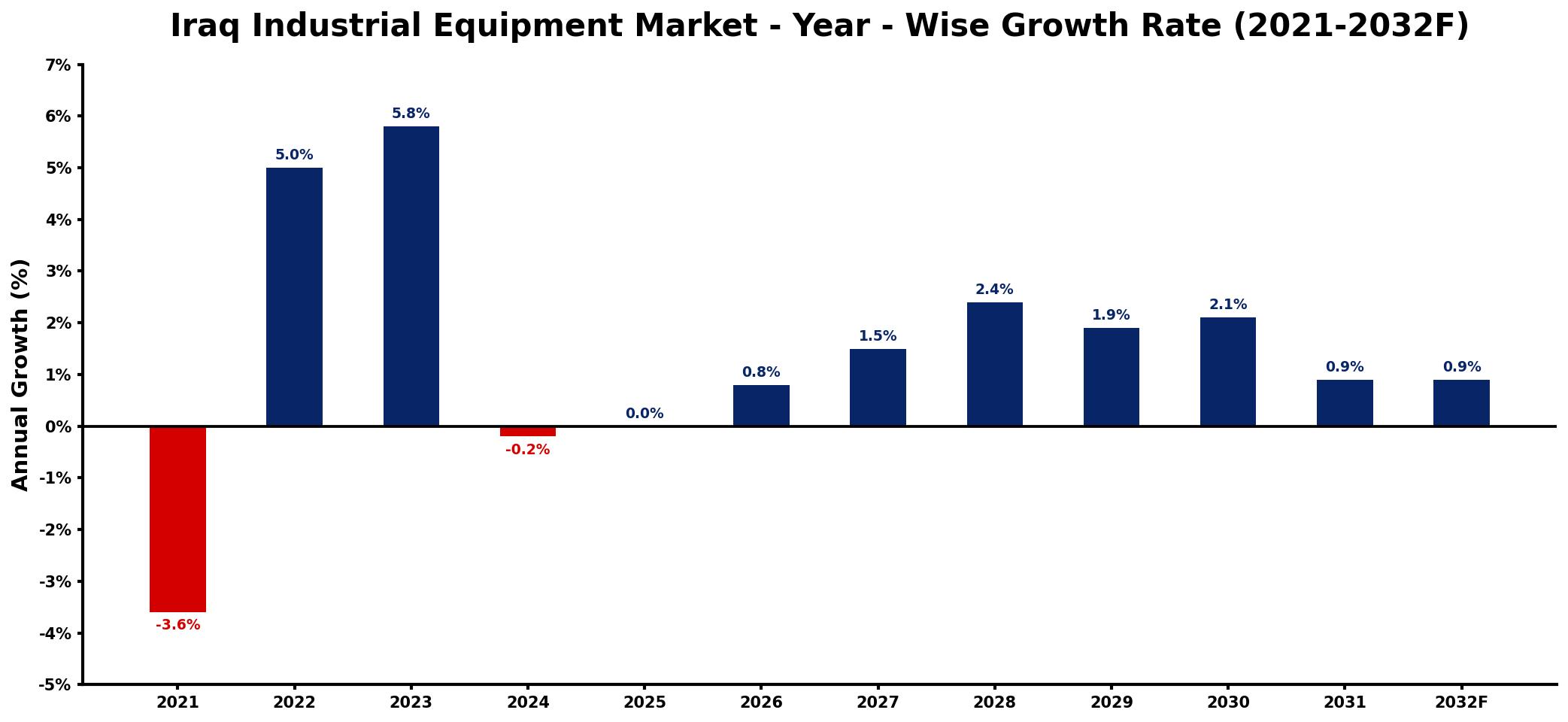
The table below presents the year‑wise growth rates along with the key drivers influencing the market
| Year | Growth Rate | Major Drivers |
| 2021 | -3.6% | decreased construction activity levels |
| 2022 | 5.0% | increased manufacturing sector investments |
| 2023 | 5.8% | growing infrastructure development projects |
| 2024 | -0.2% | lower foreign direct investments |
| 2025 | 0.0% | rising demand for automation solutions |
| 2026 | 0.8% | expansion in renewable energy projects |
| 2027 | 1.5% | increased focus on sustainability initiatives |
| 2028 | 2.4% | growing logistics and transportation needs |
| 2029 | 1.9% | enhanced technological adoption rates |
| 2030 | 2.1% | rising urbanization and population growth |
| 2031 | 0.9% | increased public sector spending |
| 2032 | 0.9% | growing emphasis on modernization efforts |
Note: Market size estimations and growth projections presented in this report are based on 6Wresearch's proprietary forecasting methodology, utilizing the latest available industry data, government publications, and primary research inputs.
Iraq Industrial Equipment Market Synopsis
A surge in infrastructure development is rapidly boosting the demand for industrial equipment in Iraq. The ongoing initiatives to rehabilitate and expand critical facilities create substantial opportunities for manufacturers of machinery, construction tools, and automation systems. Furthermore, the shift towards embracing technology and sustainability is compelling the market towards more sophisticated and eco-friendly equipment solutions.
Despite the challenges posed by political uncertainty, the Iraqi market remains resilient, indicating a steady demand for heavy machinery and automation tools. The increasing emphasis on local production and government incentives for domestic manufacturing further highlight the market's potential for growth and diversification across multiple industrial sectors.
Iraq Industrial Equipment Market Key Takeaways
- The market is driven by key sectors including oil & gas, construction, and agriculture.
- Technological advancements such as automation and IoT are reshaping operational efficiency.
- Government initiatives are focused on fostering local manufacturing capabilities.
- Political stability remains a critical factor impacting market dynamics.
- Investment opportunities are expanding with the modernization of Iraq's infrastructure.
Evaluation of Restraints in Iraq Industrial Equipment Market
The Iraq Industrial Equipment Market faces several constraints that hinder its potential for rapid growth. Political instability remains a paramount concern, influencing both local and foreign investments. Furthermore, the existing infrastructure is often outdated, complicating logistics and distribution processes. Additionally, the scarcity of skilled labor limits the effective implementation and maintenance of new technologies. These factors require careful strategic planning from companies looking to enter or expand in this market.
Iraq Industrial Equipment Market Trends
A significant trend within the Iraq Industrial Equipment Market is the escalating integration of automation and AI into traditional manufacturing and operational processes. This shift is aimed at enhancing productivity and ensuring competitiveness. Moreover, sustainability is becoming a cornerstone of market dynamics, with stakeholders increasingly prioritizing eco-friendly equipment and practices. Data-driven decision-making facilitated by smart industrial equipment is also gaining momentum, fostering a more connected industrial ecosystem.
Iraq Industrial Equipment Market Opportunities
The market presents numerous growth and investment opportunities, particularly as Iraq continues to rebuild and modernize its infrastructure. Investors may find fertile ground in supplying heavy machinery tailored for reconstruction projects, advanced manufacturing technology, and maintenance services. Additionally, as the government aims to diversify its economy beyond oil, sectors such as agriculture and renewable energy are increasingly demanding specific types of industrial equipment, further opening avenues for strategic investments.
Government Initiatives in the Iraq Industrial Equipment Market
The Iraqi government is actively promoting local manufacturing initiatives aimed at reducing dependence on imports. This includes incentives for domestic producers and preferential procurement for locally manufactured industrial equipment. Regulations have also been introduced to enforce safety and quality standards, ensuring that the local industry meets international benchmarks. Such initiatives are crucial for strengthening the industrial equipment market and encouraging sustainable growth.
Future Insights of the Iraq Industrial Equipment Market
Looking ahead to 2026-2032, the Iraq Industrial Equipment Market is poised for promising developments, fueled by the nation's ongoing reconstruction efforts and investments in diverse industrial sectors. Continued foreign investment and collaborative ventures are expected to bolster market stability and growth. However, for businesses to thrive, they must navigate the landscape carefully, focusing on innovative solutions and maintaining agility in adapting to the evolving regulatory and economic environment.
Iraq Industrial Equipment Market Latest Developments (2025 - 2026)
Recent developments in the Iraq Industrial Equipment Market indicate a strong push towards modernization and efficiency. Companies are increasingly exploring partnerships with local firms to enhance operational capabilities. Additionally, there is a noticeable trend towards integrating smart technologies and IoT solutions within existing infrastructure, aimed at improving productivity and reducing operational costs. This evolving landscape reflects a growing commitment to sustainable practices and technology adoption across various sectors.
Iraq Industrial Equipment Market - Key Attractiveness of the Report
- 10 Years of Market Numbers
- Historical Data Starting from 2022 to 2025
- Base Year: 2025
- Forecast Data until 2032
- Key Performance Indicators Impacting the Market
- Major Upcoming Developments and Projects
Key Highlights of the Report:
- Iraq Industrial Equipment Market Outlook
- Market Size of Iraq Industrial Equipment Market, 2025
- Forecast of Iraq Industrial Equipment Market, 2032
- Historical Data and Forecast of Iraq Industrial Equipment Revenues & Volume for the Period 2022-2032F
- Iraq Industrial Equipment Market Trend Evolution
- Iraq Industrial Equipment Market Drivers and Challenges
- Iraq Industrial Equipment Price Trends
- Iraq Industrial Equipment Porter's Five Forces
- Iraq Industrial Equipment Industry Life Cycle
- Historical Data and Forecast of Iraq Industrial Equipment Market Revenues & Volume By Type for the Period 2022-2032F
- Historical Data and Forecast of Iraq Industrial Equipment Market Revenues & Volume By Woodworking and Paper Machinery for the Period 2022-2032F
- Historical Data and Forecast of Iraq Industrial Equipment Market Revenues & Volume By Printing Machinery and Equipment for the Period 2022-2032F
- Historical Data and Forecast of Iraq Industrial Equipment Market Revenues & Volume By Semiconductor Machinery for the Period 2022-2032F
- Historical Data and Forecast of Iraq Industrial Equipment Market Revenues & Volume By Food Product Machinery for the Period 2022-2032F
- Historical Data and Forecast of Iraq Industrial Equipment Market Revenues & Volume By Others for the Period 2022-2032F
- Historical Data and Forecast of Iraq Industrial Equipment Market Revenues & Volume By Operation for the Period 2022-2032F
- Historical Data and Forecast of Iraq Industrial Equipment Market Revenues & Volume By Autonomous for the Period 2022-2032F
- Historical Data and Forecast of Iraq Industrial Equipment Market Revenues & Volume By Semi-Autonomous for the Period 2022-2032F
- Historical Data and Forecast of Iraq Industrial Equipment Market Revenues & Volume By Manual for the Period 2022-2032F
- Historical Data and Forecast of Iraq Industrial Equipment Market Revenues & Volume By Capacity for the Period 2022-2032F
- Historical Data and Forecast of Iraq Industrial Equipment Market Revenues & Volume By Small for the Period 2022-2032F
- Historical Data and Forecast of Iraq Industrial Equipment Market Revenues & Volume By Medium for the Period 2022-2032F
- Historical Data and Forecast of Iraq Industrial Equipment Market Revenues & Volume By Large for the Period 2022-2032F
- Iraq Industrial Equipment Import Export Trade Statistics
- Market Opportunity Assessment By Type
- Market Opportunity Assessment By Operation
- Market Opportunity Assessment By Capacity
- Iraq Industrial Equipment Top Companies Market Share
- Iraq Industrial Equipment Competitive Benchmarking By Technical and Operational Parameters
- Iraq Industrial Equipment Company Profiles
- Iraq Industrial Equipment Key Strategic Recommendations






































