Iraq Musical Instruments Market Summary
The iraq musical instruments market was estimated at USD 156 Million in 2025 and is projected to reach USD 170 Million by 2032, growing at a CAGR of 1.2% from 2026 to 2032.
Iraq Musical Instruments Market Year-wise Growth Rate and Key Drivers
This graph highlights how the Iraq Musical Instruments Market has steadily grown over the past five years, supported by major growth factors.
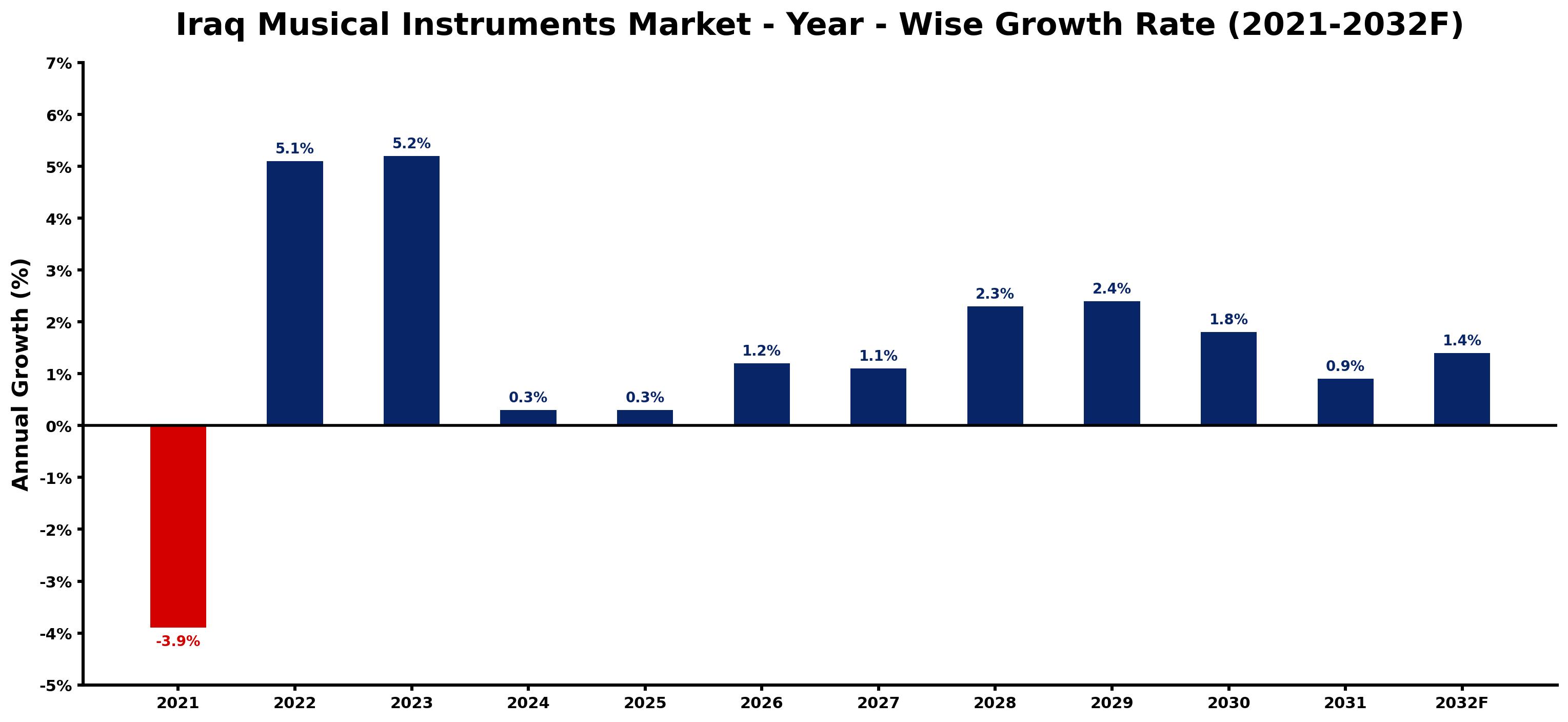
The table below presents the year wise growth rates along with the key drivers influencing the market
| Year | Growth Rate | Major Drivers |
| 2021 | -3.9% | Ongoing instability and security concerns in the region significantly hampered retail activity and consumer purchases. |
| 2022 | 5.1% | Local artisans focus on craftsmanship, attracting a niche market for handmade instruments. |
| 2023 | 5.2% | An upsurge in music festivals highlights the importance of cultural expression in Iraq. |
| 2024 | 0.3% | Online sales platforms emerge, expanding access to international musical brands. |
| 2025 | 0.3% | Music education initiatives establish institutional demand for diverse musical instruments. |
| 2026 | 1.2% | Collaboration between local musicians and international artists enhances market visibility. |
| 2027 | 1.1% | Increased tourism promotes local music scenes, leading to higher instrument purchases. |
| 2028 | 2.3% | Investment in cultural heritage preservation drives demand for traditional musical instruments. |
| 2029 | 2.4% | Emerging electronic music trends create new markets for innovative and portable instruments. |
| 2030 | 1.8% | Youth-oriented marketing campaigns resonate, bolstering sales of beginner and professional instruments. |
| 2031 | 0.9% | Local music labels gain traction, supporting local artists and diversifying instrument needs. |
| 2032 | 1.4% | Sustainability trends influence production, promoting eco-friendly materials for instrument manufacturing. |
Note - Market size estimations and growth projections presented in this report are based on 6Wresearch's advanced forecasting approach, validated with industry datasets as of June 2026.
Iraq Musical Instruments Market Synopsis
The Iraq Musical Instruments Market is projected to reach 1.2% and witness significant growth during the forecast period (2026-2032). This growth is attributed to the country's rich musical heritage and the increasing interest in both traditional and modern musical forms. Diverse instruments such as the oud, darbuka, guitar, and keyboard are popular among various demographics, contributing to a dynamic market environment.
Iraq Musical Instruments Market Growth Drivers
Several factors are propelling the Iraq Musical Instruments Market forward. Chief among these is the rise in disposable income among consumers, which has led to increased spending on leisure activities, including music. Urbanization is also playing a significant role, as more people migrate to urban areas, creating a burgeoning demand for musical instruments. Additionally, a cultural shift towards appreciating both traditional and contemporary music influences purchasing behavior.
- Improved economic conditions are enabling consumers to allocate more resources towards hobbies and interests, including music.
- The growth in urban areas is fostering a music scene that promotes learning and performing, thus increasing instrument sales.
- Technological advancements in online retail platforms allow greater accessibility to musical instruments, enhancing market reach.
- Social media and digital content are driving trends in music, allowing emerging artists to showcase their skills, thus stimulating instrument demand.
- Collaborations between traditional music institutes and modern educational setups are enhancing music appreciation among younger generations.
Iraq Musical Instruments Market Challenges and Restraints
While the Iraq Musical Instruments Market is on a growth trajectory, it faces several challenges. Traditional instruments often dominate consumer preferences, limiting the market potential for modern musical equipment. Accessibility issues, including affordability and inefficient distribution channels, hinder international brands from penetrating the market effectively. Moreover, cultural perceptions of music as a form of expression rather than a commercial product impact purchasing decisions.
- The prevalence of traditional music styles can overshadow the appeal of modern instruments, reducing overall market growth.
- Cost barriers and limited availability of diverse instruments may deter potential buyers, especially in rural areas.
- Consumers' perceived need to preserve cultural heritage can restrict openness to foreign musical influences.
- Distribution networks are often underdeveloped, making it difficult for consumers to access certain instruments.
- Competition from informal markets, where traditional instruments are sold at lower prices, presents challenges for formal retailers.
Iraq Musical Instruments Market Government Investment and Initiatives
The Iraqi government has recognized the importance of the musical instruments market as a key component of cultural and economic growth. Initiatives have been put in place to nurture the market, including policies aimed at supporting music education and appreciation among the youth. Investment in local production of musical instruments is encouraged, aiming to boost domestic craftsmanship and reduce reliance on imports. Furthermore, the government supports programs that aim to preserve traditional music forms while encouraging modern innovation in musical instrument design. Collaboration with global music organizations is also being explored to not only enhance competitiveness but to promote Iraqi musical heritage internationally.
Iraq Musical Instruments Market Latest Developments (May 2025 - June 2026)
During the period from May 2025 to June 2026, the Iraq Musical Instruments Market has witnessed notable developments. There has been an increase in community-driven music festivals and events aimed at celebrating both traditional and contemporary music, thereby raising awareness and interest in various instruments. Furthermore, local artisans have begun revitalizing traditional craftsmanship techniques, aligning them with modern designs to attract younger audiences. Online sales platforms have experienced a rise in user engagement, indicating a shift in consumer purchasing patterns towards digital channels. Initiatives aimed at integrating music education into school curriculums have gained traction, paving the way for a new generation of musicians.
Iraq Musical Instruments Market - Key Attractiveness of the Report
- 10 Years of Market Numbers
- Historical Data Starting from 2022 to 2025
- Base Year: 2025
- Forecast Data until 2032
- Key Performance Indicators Impacting the Market
- Major Upcoming Developments and Projects
Key Highlights of the Report:
- Iraq Musical Instruments Market Outlook
- Market Size of Iraq Musical Instruments Market, 2025
- Forecast of Iraq Musical Instruments Market, 2032
- Historical Data and Forecast of Iraq Musical Instruments Revenues & Volume for the Period 2022-2032F
- Iraq Musical Instruments Market Trend Evolution
- Iraq Musical Instruments Market Drivers and Challenges
- Iraq Musical Instruments Price Trends
- Iraq Musical Instruments Porter's Five Forces
- Iraq Musical Instruments Industry Life Cycle
- Historical Data and Forecast of Iraq Musical Instruments Market Revenues & Volume By Type for the Period 2022-2032F
- Historical Data and Forecast of Iraq Musical Instruments Market Revenues & Volume By Percussion Instruments for the Period 2022-2032F
- Historical Data and Forecast of Iraq Musical Instruments Market Revenues & Volume By String Instruments for the Period 2022-2032F
- Historical Data and Forecast of Iraq Musical Instruments Market Revenues & Volume By Piano & Key Instruments for the Period 2022-2032F
- Historical Data and Forecast of Iraq Musical Instruments Market Revenues & Volume By Organs & Air Blown Instruments for the Period 2022-2032F
- Historical Data and Forecast of Iraq Musical Instruments Market Revenues & Volume By Others for the Period 2022-2032F
- Historical Data and Forecast of Iraq Musical Instruments Market Revenues & Volume By End-users for the Period 2022-2032F
- Historical Data and Forecast of Iraq Musical Instruments Market Revenues & Volume By Commercial Events for the Period 2022-2032F
- Historical Data and Forecast of Iraq Musical Instruments Market Revenues & Volume By Personal Use for the Period 2022-2032F
- Historical Data and Forecast of Iraq Musical Instruments Market Revenues & Volume By Music Production/ Direction for the Period 2022-2032F
- Historical Data and Forecast of Iraq Musical Instruments Market Revenues & Volume By Others for the Period 2022-2032F
- Iraq Musical Instruments Import Export Trade Statistics
- Market Opportunity Assessment By Type
- Market Opportunity Assessment By End-users
- Iraq Musical Instruments Top Companies Market Share
- Iraq Musical Instruments Competitive Benchmarking By Technical and Operational Parameters
- Iraq Musical Instruments Company Profiles
- Iraq Musical Instruments Key Strategic Recommendations






































