Iraq Organic Fruits And Vegetables Market Size, Share & Growth Rate
The Iraq Organic Fruits And Vegetables Market was estimated at USD 495 Million in 2025 and is projected to reach USD 715 Million by 2032, growing at a CAGR of 5.4% from 2026 to 2032. This upward trajectory is largely driven by increasing consumer awareness surrounding health benefits associated with organic produce, coupled with a growing emphasis on sustainability. As the middle class expands and disposable incomes rise, consumers are increasingly leaning towards chemical-free options that promise both health and environmental benefits.
Iraq Organic Fruits And Vegetables Market Year-wise Growth Rate and Key Drivers
This graph highlights how the Iraq Organic Fruits And Vegetables Market has steadily grown over the years, supported by major growth factors.
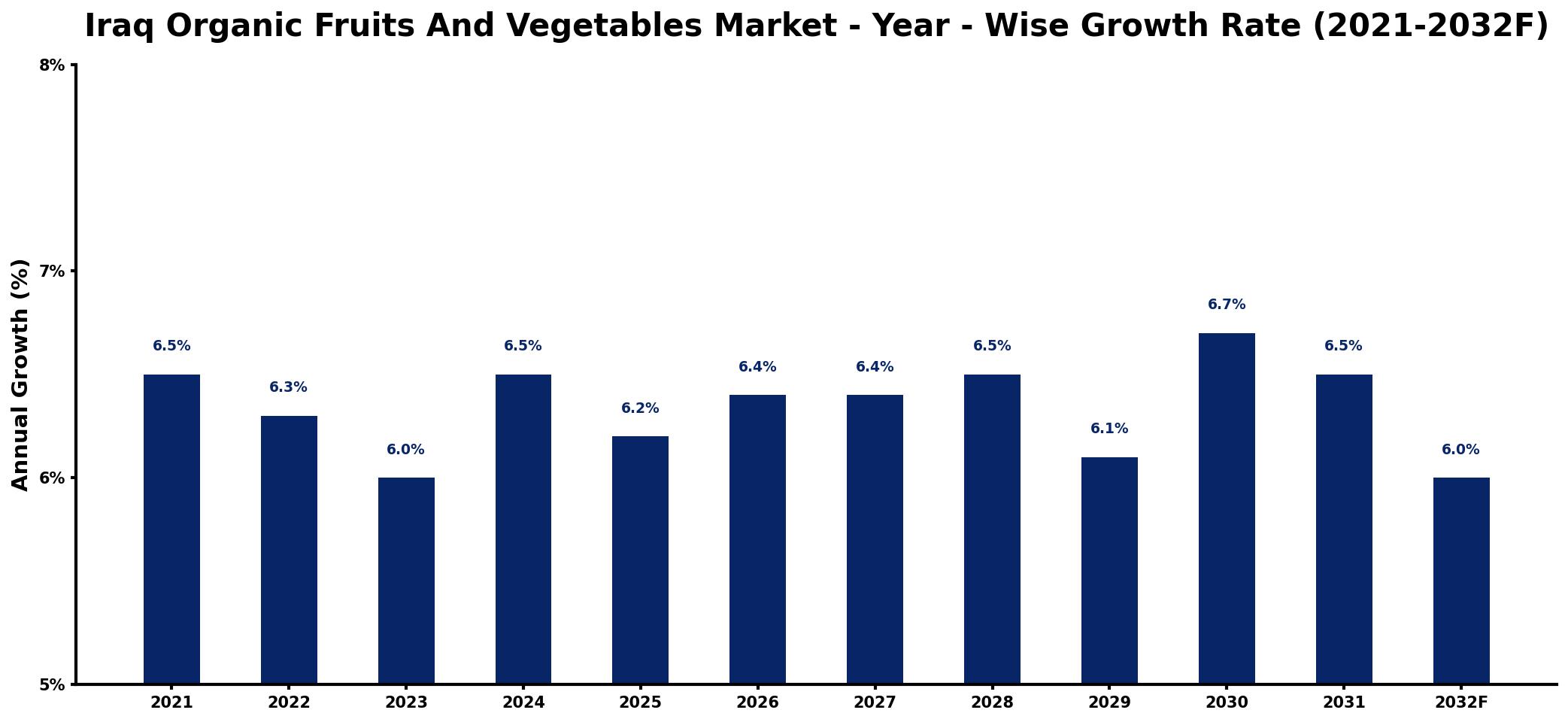
The table below presents the year‑wise growth rates along with the key drivers influencing the market
| Year | Growth Rate | Major Drivers |
| 2021 | 6.5% | Increased health awareness initiatives |
| 2022 | 6.3% | Rising consumer preference shift |
| 2023 | 6.0% | Growing local production capabilities |
| 2024 | 6.5% | Expansion of retail distribution networks |
| 2025 | 6.2% | Increased investment in agritech |
| 2026 | 6.4% | Higher export market opportunities |
| 2027 | 6.4% | Strengthened supply chain efficiencies |
| 2028 | 6.5% | Enhanced agricultural sustainability practices |
| 2029 | 6.1% | Growing online shopping platforms |
| 2030 | 6.7% | Rising urban population demand |
| 2031 | 6.5% | Increased government support programs |
| 2032 | 6.0% | Strengthened regional trade agreements |
Note: Market size estimations and growth projections presented in this report are based on 6Wresearch's proprietary forecasting methodology, utilizing the latest available industry data, government publications, and primary research inputs.
Iraq Organic Fruits And Vegetables Market Synopsis
The Iraq organic fruits and vegetables market has gained momentum recently, characterized by a rise in consumer awareness regarding the health advantages of organic foods. As a result, local farmers and international suppliers are adapting their practices to meet this burgeoning demand. Looking ahead, the market is on a path of transformation that promises greater accessibility to organic produce, enhancing consumer options across various segments.
Despite this positive trend, challenges remain that could impede growth. Issues such as insufficient infrastructure, limited organic certification access, and elevated production costs need to be addressed. However, the broader focus on health and sustainability continues to create a fertile environment for innovation and investment in the Iraqi organic fruits and vegetables market.
Iraq Organic Fruits And Vegetables Market Key Takeaways
- The market is driven by rising consumer awareness regarding the health benefits of organic produce.
- Investment opportunities are expanding due to increasing middle-class purchasing power.
- Challenges in infrastructure and certification standards pose significant barriers to growth.
- Government initiatives are promoting organic farming practices and supporting local farmers.
- Innovative technologies in organic farming can enhance competitive advantages in the market.
Evaluation of Restraints in Iraq Organic Fruits And Vegetables Market
The growth of the Iraq organic fruits and vegetables market faces several real limitations. A significant barrier is the limited awareness among both producers and consumers regarding organic practices. Many local farmers continue to rely on traditional methods, which restrict the adoption of more sustainable agricultural techniques. The absence of proper certification and regulatory frameworks further complicates the landscape, leading to inconsistencies in product quality and consumer trust. Moreover, ongoing political and economic instability in the region adds an element of uncertainty, making it challenging for stakeholders to invest in the long-term development of organic agriculture.
Iraq Organic Fruits And Vegetables Market Trends
In the evolving landscape of the Iraq organic fruits and vegetables market, several trends are emerging. Firstly, the surge in health-conscious consumer behavior is driving a significant shift towards organic products. Additionally, there is a heightened interest in locally sourced foods, which align with sustainability values. The market is also witnessing a transition towards modern organic farming techniques and certifications as stakeholders recognize the importance of ethical practices. Enhanced distribution channels are being developed to better connect farmers with consumers, improving overall accessibility to organic produce.
Iraq Organic Fruits And Vegetables Market Opportunities
Opportunities abound in the Iraq organic fruits and vegetables market, especially for investors keen on establishing organic farming operations or enhancing existing supply chains. The growing demand for organic produce presents potential for innovative storage and packaging solutions, essential for maintaining product quality. Collaborating with local farmers to promote organic practices can foster community-based agricultural development. Furthermore, introducing advanced agricultural technologies and certifying organic products can significantly elevate market competitiveness, meeting both local and international demand for organic fruits and vegetables.
Government Initiatives in the Iraq Organic Fruits And Vegetables Market
The Iraqi government is actively working to bolster the organic fruits and vegetables market through various supportive policies. These initiatives include financial incentives for farmers who transition to organic farming and comprehensive training programs to enhance their skills. Additionally, the establishment of certification standards aims to ensure the authenticity and quality of organic products. Efforts to develop necessary infrastructure and distribution channels further illustrate the government's commitment to promoting organic agriculture, thereby enhancing food security and sustainability.
Future Insights of the Iraq Organic Fruits And Vegetables Market
The outlook for the Iraq organic fruits and vegetables market between 2026 and 2032 is highly promising. As consumers continue to prioritize health and sustainability, the demand for organic produce is set to rise significantly. Government initiatives aimed at supporting organic farming and enhancing local agricultural practices will likely further propel market growth. As Iraq navigates its recovery from past conflicts and works towards stabilizing its economy, the conditions are ripe for increased investment in organic farming, paving the way for a robust future in this sector.
Iraq Organic Fruits And Vegetables Market Latest Developments (2025 - 2026)
Recent developments in the Iraq organic fruits and vegetables market have seen a marked increase in community-driven agricultural programs, aimed at educating both farmers and consumers about the benefits of organic produce. Additionally, initiatives to improve supply chain logistics are being introduced, which will enhance the freshness and quality of organic products available to consumers. The market is also witnessing growing participation from various stakeholders committed to advancing organic practices within the region.
Iraq Organic Fruits And Vegetables Market - Key Attractiveness of the Report
- 10 Years of Market Numbers
- Historical Data Starting from 2022 to 2025
- Base Year: 2025
- Forecast Data until 2032
- Key Performance Indicators Impacting the Market
- Major Upcoming Developments and Projects
Key Highlights of the Report:
- Iraq Organic Fruits And Vegetables Market Outlook
- Market Size of Iraq Organic Fruits And Vegetables Market, 2025
- Forecast of Iraq Organic Fruits And Vegetables Market, 2032
- Historical Data and Forecast of Iraq Organic Fruits And Vegetables Revenues & Volume for the Period 2022-2032F
- Iraq Organic Fruits And Vegetables Market Trend Evolution
- Iraq Organic Fruits And Vegetables Market Drivers and Challenges
- Iraq Organic Fruits And Vegetables Price Trends
- Iraq Organic Fruits And Vegetables Porter's Five Forces
- Iraq Organic Fruits And Vegetables Industry Life Cycle
- Historical Data and Forecast of Iraq Organic Fruits And Vegetables Market Revenues & Volume By Product Type for the Period 2022-2032F
- Historical Data and Forecast of Iraq Organic Fruits And Vegetables Market Revenues & Volume By Organic Fruits for the Period 2022-2032F
- Historical Data and Forecast of Iraq Organic Fruits And Vegetables Market Revenues & Volume By Organic Vegetables for the Period 2022-2032F
- Historical Data and Forecast of Iraq Organic Fruits And Vegetables Market Revenues & Volume By Form for the Period 2022-2032F
- Historical Data and Forecast of Iraq Organic Fruits And Vegetables Market Revenues & Volume By Fresh for the Period 2022-2032F
- Historical Data and Forecast of Iraq Organic Fruits And Vegetables Market Revenues & Volume By Frozen for the Period 2022-2032F
- Historical Data and Forecast of Iraq Organic Fruits And Vegetables Market Revenues & Volume By End User for the Period 2022-2032F
- Historical Data and Forecast of Iraq Organic Fruits And Vegetables Market Revenues & Volume By Residential for the Period 2022-2032F
- Historical Data and Forecast of Iraq Organic Fruits And Vegetables Market Revenues & Volume By Commercial for the Period 2022-2032F
- Historical Data and Forecast of Iraq Organic Fruits And Vegetables Market Revenues & Volume By Distribution Channel for the Period 2022-2032F
- Historical Data and Forecast of Iraq Organic Fruits And Vegetables Market Revenues & Volume By Supermarket for the Period 2022-2032F
- Historical Data and Forecast of Iraq Organic Fruits And Vegetables Market Revenues & Volume By Hypermarket for the Period 2022-2032F
- Historical Data and Forecast of Iraq Organic Fruits And Vegetables Market Revenues & Volume By Convenience Store for the Period 2022-2032F
- Historical Data and Forecast of Iraq Organic Fruits And Vegetables Market Revenues & Volume By Online Sale Channel for the Period 2022-2032F
- Historical Data and Forecast of Iraq Organic Fruits And Vegetables Market Revenues & Volume By Others for the Period 2022-2032F
- Iraq Organic Fruits And Vegetables Import Export Trade Statistics
- Market Opportunity Assessment By Product Type
- Market Opportunity Assessment By Form
- Market Opportunity Assessment By End User
- Market Opportunity Assessment By Distribution Channel
- Iraq Organic Fruits And Vegetables Top Companies Market Share
- Iraq Organic Fruits And Vegetables Competitive Benchmarking By Technical and Operational Parameters
- Iraq Organic Fruits And Vegetables Company Profiles
- Iraq Organic Fruits And Vegetables Key Strategic Recommendations






































