Iraq Pharmaceutical Packaging Market Summary
The iraq pharmaceutical packaging market was estimated at USD 1065 Million in 2025 and is projected to reach USD 1554 Million by 2032, growing at a CAGR of 6.6% from 2026 to 2032.
Iraq Pharmaceutical Packaging Market Year-wise Growth Rate and Key Drivers
This graph highlights how the Iraq Pharmaceutical Packaging Market has steadily grown over the past five years, supported by major growth factors.
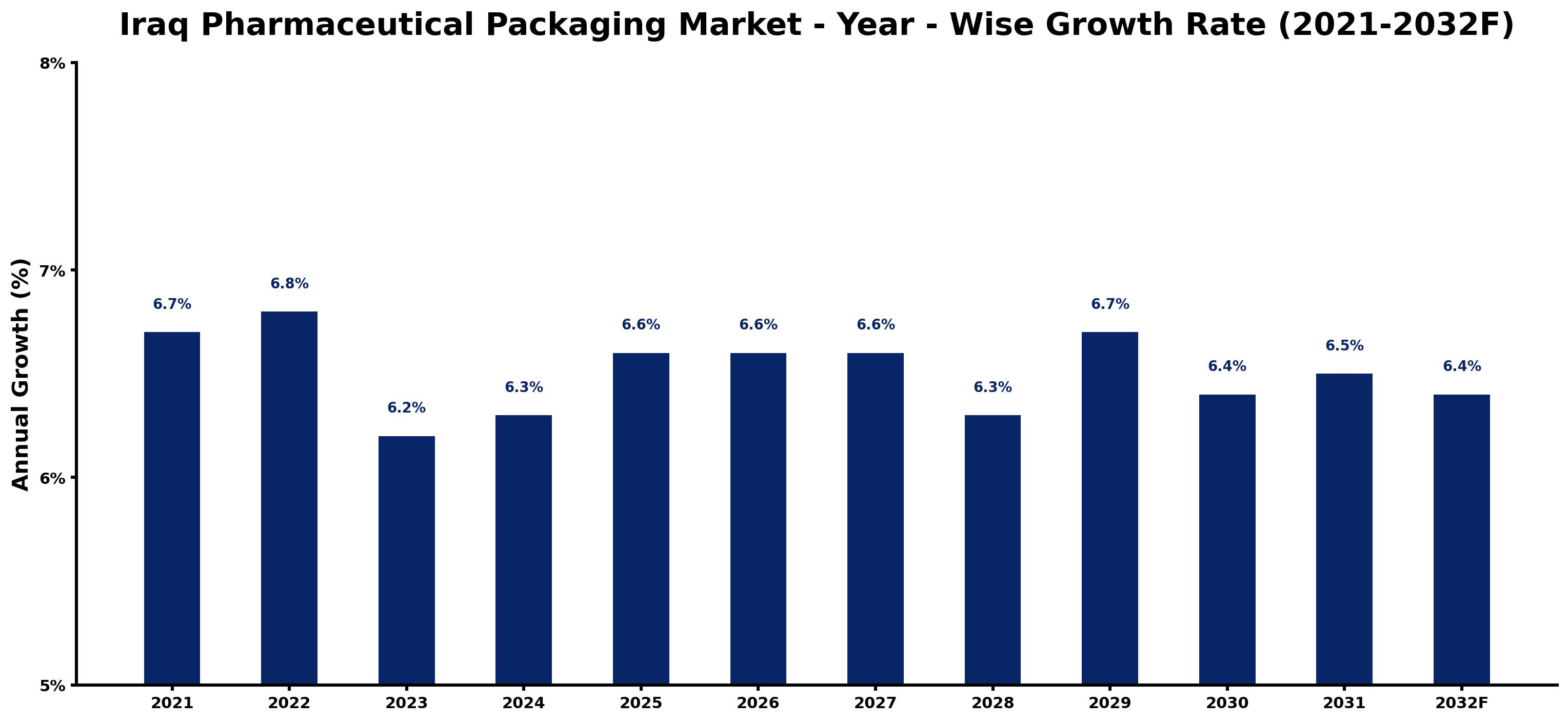
The table below presents the year wise growth rates along with the key drivers influencing the market
| Year | Growth Rate | Major Drivers |
| 2021 | 6.7% | Increasing healthcare investments are fostering pharmaceutical innovation across Iraq's market. |
| 2022 | 6.8% | Local manufacturers are adjusting to international standards in packaging processes. |
| 2023 | 6.2% | E-commerce platforms are enhancing the distribution reach of packaged pharmaceuticals. |
| 2024 | 6.3% | Collaboration between local firms and global companies strengthens packaging technology adoption. |
| 2025 | 6.6% | Emerging consumer preferences drive the demand for sustainable packaging solutions. |
| 2026 | 6.6% | Rising health awareness is leading to a broader range of pharmaceutical products. |
| 2027 | 6.6% | Logistical improvements are facilitating quicker delivery of pharmaceuticals to remote areas. |
| 2028 | 6.3% | Technological advancements in packaging materials are enhancing product safety and shelf-life. |
| 2029 | 6.7% | Pharmaceutical exports are increasing, necessitating compliance with international packaging regulations. |
| 2030 | 6.4% | Investment in research and development is yielding innovative packaging materials and designs. |
| 2031 | 6.5% | Growing urbanization is influencing packaging requirements for pharmaceutical distribution networks. |
| 2032 | 6.4% | Focus on patient-centric solutions is redefining packaging standards in the healthcare sector. |
Note - Market size estimations and growth projections presented in this report are based on 6Wresearch's advanced forecasting approach, validated with industry datasets as of June 2026.
Iraq Pharmaceutical Packaging Market Synopsis
The Iraq Pharmaceutical Packaging Market is projected to reach 6.6% and witness significant growth during the forecast period (2026-2032). This growth trajectory is primarily driven by several factors, including the increasing demand for healthcare services and medical products, heightened focus on sustainable packaging solutions, and a surge in investment towards research and development initiatives. Additionally, advancements in technology aimed at enhancing patient safety have further propelled the innovation of packaging solutions in the pharmaceutical sector. The Iraq pharmaceutical packaging market is also influenced by regulatory developments that are compelling manufacturers to integrate advanced techniques such as visual inspection systems to ensure quality and safety. However, the ongoing economic challenges, particularly as a legacy of the COVID-19 pandemic, have resulted in reduced funding for the health sector, potentially constraining market expansion.
Iraq Pharmaceutical Packaging Market Growth Drivers
Several key factors are propelling the growth of the Iraq Pharmaceutical Packaging Market. Firstly, the increasing demand for healthcare services is driving the need for efficient packaging solutions that ensure drug integrity and safety. Furthermore, the rising awareness among consumers about sustainable packaging alternatives has motivated manufacturers to adopt eco-friendly materials, which is becoming an industry standard. The growing preference for advanced packaging technologies, such as tamper-evident and child-resistant packaging, reflects an enhanced focus on patient safety. Moreover, substantial investments in research and development are catalyzing innovations that cater specifically to the unique needs of the Iraqi market. Lastly, evolving regulatory frameworks are creating a conducive environment for the adoption of state-of-the-art packaging technologies, thereby enhancing overall market growth.
Iraq Pharmaceutical Packaging Market Trends and Opportunities
The Iraq Pharmaceutical Packaging Market is witnessing several noteworthy trends that present both challenges and opportunities for stakeholders. One prominent trend is the increasing integration of smart packaging solutions that utilize technologies like QR codes and NFC tags, allowing consumers and healthcare providers to access crucial product information. This is especially relevant in combating counterfeit medicines, an issue that has historically impacted the market. Additionally, there is a significant shift towards the adoption of biodegradable and recyclable materials, aligning with global sustainability goals. Another key trend is the rise of customization in packaging designs to enhance brand differentiation and consumer appeal. Furthermore, as the healthcare landscape evolves, there is an opportunity for manufacturers to focus on developing packaging that caters to emerging pharmaceuticals, including biologics and biosimilars. Collectively, these trends are shaping the future of pharmaceutical packaging in Iraq.
Iraq Pharmaceutical Packaging Market Challenges and Restraints
While the Iraq Pharmaceutical Packaging Market is poised for growth, several challenges pose risks to its expansion. Economic instability significantly hampers investment in the health sector, leading to constraints on funding for packaging innovations. Additionally, there exists a considerable lack of awareness regarding the importance of drug security and counterfeiting among the population, which can undermine the perceived value of advanced packaging solutions. Compliance with evolving regulations can also be challenging for manufacturers, particularly smaller companies that may lack the resources to adapt swiftly. Moreover, the ongoing ramifications of the COVID-19 pandemic have disrupted supply chains, affecting the availability of materials required for pharmaceutical packaging. Lastly, fluctuating raw material prices add an additional layer of complexity to the operating environment, influencing overall market dynamics.
Iraq Pharmaceutical Packaging Market Government Investment and Initiatives
The Iraqi government has recognized the necessity of advancing its healthcare infrastructure, which directly influences the pharmaceutical packaging market. Initiatives aimed at improving healthcare delivery often encompass policies that encourage investment in medical equipment and related sectors, including packaging. Public spending has been directed towards health sector improvements, with an emphasis on sustainable practices and the integration of advanced technologies. Government strategies also focus on bolstering local production capacities, reducing dependency on imports, and promoting research and development to stimulate innovation. Incentives for businesses that invest in environmentally friendly packaging solutions are gaining traction, reflecting the broader goal of aligning with international sustainability standards. Such government initiatives are essential in creating a favorable environment for the growth of the Iraq Pharmaceutical Packaging Market.
Iraq Pharmaceutical Packaging Market Latest Developments (May 2025 - June 2026)
Recent developments in the Iraq Pharmaceutical Packaging Market between May 2025 and June 2026 indicate a notable shift toward adopting advanced technologies and sustainable practices. Several innovations have been introduced to enhance the security and efficacy of pharmaceutical products. The industry has seen increasing collaboration among stakeholders, aiming to address the growing concerns surrounding counterfeiting and ensure compliance with international standards. Moreover, regulatory bodies have ramped up efforts to enforce stricter guidelines on packaging, which has led to an overall enhancement in product safety and transparency. With the economic landscape beginning to stabilize post-pandemic, there is renewed optimism regarding investments in infrastructure and technology that could positively impact the pharmaceutical packaging sector. Companies are increasingly focusing on marketing strategies that highlight the benefits of innovative packaging solutions, catering to an informed consumer base.
Iraq Pharmaceutical Packaging Market - Key Attractiveness of the Report
- 10 Years of Market Numbers
- Historical Data Starting from 2022 to 2025
- Base Year: 2025
- Forecast Data until 2032
- Key Performance Indicators Impacting the Market
- Major Upcoming Developments and Projects
Key Highlights of the Report:
- Iraq Pharmaceutical Packaging Market Outlook
- Market Size of Iraq Pharmaceutical Packaging Market, 2025
- Forecast of Iraq Pharmaceutical Packaging Market, 2032F
- Historical Data and Forecast of Iraq Pharmaceutical Packaging Revenues & Volume for the Period 2022-2032F
- Iraq Pharmaceutical Packaging Market Trend Evolution
- Iraq Pharmaceutical Packaging Market Drivers and Challenges
- Iraq Pharmaceutical Packaging Price Trends
- Iraq Pharmaceutical Packaging Porter's Five Forces
- Iraq Pharmaceutical Packaging Industry Life Cycle
- Historical Data and Forecast of Iraq Pharmaceutical Packaging Market Revenues & Volume By Material Types for the Period 2022-2032F
- Historical Data and Forecast of Iraq Pharmaceutical Packaging Market Revenues & Volume By Plastics & Polymers for the Period 2022-2032F
- Historical Data and Forecast of Iraq Pharmaceutical Packaging Market Revenues & Volume By Paper & Paperboard for the Period 2022-2032F
- Historical Data and Forecast of Iraq Pharmaceutical Packaging Market Revenues & Volume By Glass for the Period 2022-2032F
- Historical Data and Forecast of Iraq Pharmaceutical Packaging Market Revenues & Volume By Aluminum Foil for the Period 2022-2032F
- Historical Data and Forecast of Iraq Pharmaceutical Packaging Market Revenues & Volume By Others for the Period 2022-2032F
- Historical Data and Forecast of Iraq Pharmaceutical Packaging Market Revenues & Volume By Product Types for the Period 2022-2032F
- Historical Data and Forecast of Iraq Pharmaceutical Packaging Market Revenues & Volume By Primary Pharmaceutical Packaging for the Period 2022-2032F
- Historical Data and Forecast of Iraq Pharmaceutical Packaging Market Revenues & Volume By Secondary Pharmaceutical Packaging for the Period 2022-2032F
- Historical Data and Forecast of Iraq Pharmaceutical Packaging Market Revenues & Volume By Tertiary Pharmaceutical Packaging for the Period 2022-2032F
- Historical Data and Forecast of Iraq Pharmaceutical Packaging Market Revenues & Volume By End-users for the Period 2022-2032F
- Historical Data and Forecast of Iraq Pharmaceutical Packaging Market Revenues & Volume By Pharmaceutical Manufacturing for the Period 2022-2032F
- Historical Data and Forecast of Iraq Pharmaceutical Packaging Market Revenues & Volume By Retail Pharmacy for the Period 2022-2032F
- Historical Data and Forecast of Iraq Pharmaceutical Packaging Market Revenues & Volume By Contract Packaging for the Period 2022-2032F
- Historical Data and Forecast of Iraq Pharmaceutical Packaging Market Revenues & Volume By Institutional Pharmacy for the Period 2022-2032F
- Historical Data and Forecast of Iraq Pharmaceutical Packaging Market Revenues & Volume By Others for the Period 2022-2032F
- Iraq Pharmaceutical Packaging Import Export Trade Statistics
- Market Opportunity Assessment By Material Types
- Market Opportunity Assessment By Product Types
- Market Opportunity Assessment By End-users
- Iraq Pharmaceutical Packaging Top Companies Market Share
- Iraq Pharmaceutical Packaging Competitive Benchmarking By Technical and Operational Parameters
- Iraq Pharmaceutical Packaging Company Profiles
- Iraq Pharmaceutical Packaging Key Strategic Recommendations






































