Iraq Power Transformer Market Size, Share & Growth Rate
The Iraq Power Transformer Market was estimated at USD 351 Million in 2025 and is projected to reach USD 464 Million by 2032, growing at a CAGR of 4.1% from 2026 to 2032. This growth trajectory is primarily fueled by substantial investments in power infrastructure development, critical for meeting the burgeoning electricity demand driven by population growth, urbanization, and industrial expansion. Moreover, the integration of renewable energy sources into the grid is shaping a new landscape for transformer solutions, demanding enhanced performance and reliability.
Iraq Power Transformer Market Year-wise Growth Rate and Key Drivers
This graph highlights how the Iraq Power Transformer Market has steadily grown over the years, supported by major growth factors.
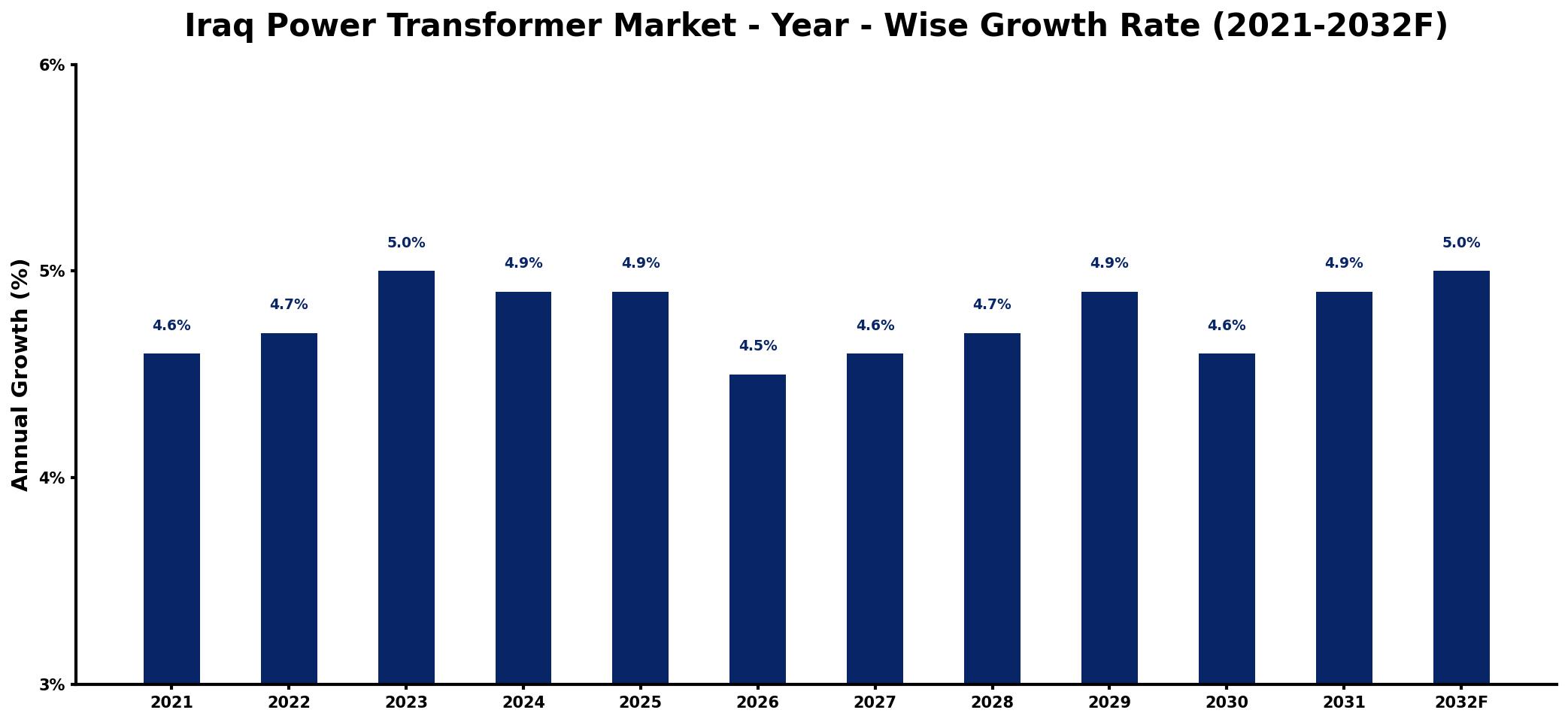
The table below presents the year‑wise growth rates along with the key drivers influencing the market
| Year | Growth Rate | Major Drivers |
| 2021 | 4.6% | Rising energy infrastructure investments |
| 2022 | 4.7% | Growing industrial electricity demand |
| 2023 | 5.0% | Expansion of renewable energy projects |
| 2024 | 4.9% | Increased urbanization and development |
| 2025 | 4.9% | Government incentives for energy efficiency |
| 2026 | 4.5% | Technological advancements in distribution |
| 2027 | 4.6% | Strengthened regional energy cooperation |
| 2028 | 4.7% | Growing demand for reliable supply |
| 2029 | 4.9% | expanding healthcare application demand |
| 2030 | 4.6% | Increased focus on sustainability initiatives |
| 2031 | 4.9% | Rising population driving consumption |
| 2032 | 5.0% | Investments in smart grid technologies |
Note: Market size estimations and growth projections presented in this report are based on 6Wresearch's proprietary forecasting methodology, utilizing the latest available industry data, government publications, and primary research inputs.
Iraq Power Transformer Market Synopsis
The most significant force currently shaping the Iraq Power Transformer Market is the urgent need for infrastructure upgrades. As Iraq strives to enhance its power grids reliability and efficiency, the demand for advanced transformer technologies has surged. These modern transformers not only accommodate higher load fluctuations but also optimize energy management in an increasingly complex grid environment.
In addition to infrastructure improvements, the electrification of transportation is presenting unique challenges and opportunities within the power transformer sector. This evolution necessitates transformers that can effectively handle dynamic load requirements, particularly as electric vehicle adoption accelerates. The markets evolution is, therefore, closely tied to broader national initiatives promoting sustainability and modernization.
Iraq Power Transformer Market Key Takeaways
- The Iraq Power Transformer Market is experiencing significant growth due to increasing demand for reliable electricity supply.
- Investments in modernizing grid infrastructure are critical to overcoming existing challenges and enhancing efficiency.
- The integration of renewable energy sources is driving the need for advanced transformer technologies capable of managing diverse load profiles.
- Government policies are fostering innovation and technology adoption in the transformer sector.
- Logistical challenges continue to pose barriers to the timely deployment of new transformers across the region.
Evaluation of Restraints in Iraq Power Transformer Market
Despite the promising growth prospects for the Iraq Power Transformer Market, several factors restrain its potential. Chief among these is the aging transformer infrastructure, which requires significant investment to modernize and align with current demand. Delays in procurement processes, often due to regulatory challenges, hinder timely upgrades, leaving the grid vulnerable to inefficiencies and failures. Furthermore, logistical difficulties in transporting heavy transformer units to remote or conflict-affected regions complicate the overall supply chain, necessitating a strategic focus on overcoming these barriers to enhance market viability.
Iraq Power Transformer Market Trends
The landscape of the Iraq Power Transformer Market is evolving, with several trends indicating a shift towards smarter and more efficient transformer solutions. One notable trend is the increasing adoption of smart grid technologies that enhance real-time monitoring and management capabilities. Additionally, there is a growing emphasis on environmentally-friendly transformer designs, which reflect a commitment to sustainability while meeting regulatory requirements. The demand for modular transformer solutions that allow for scalable deployment and easier maintenance is also rising, supporting the overall modernization of the power sector.
Iraq Power Transformer Market Opportunities
As the Iraq Power Transformer Market matures, several growth opportunities are emerging. The governments commitment to infrastructure investments presents potential avenues for private sector partnerships aimed at transformer upgrades. Furthermore, the shift towards renewable energy sources, such as solar and wind, opens new markets for transformers designed for variable loads. There is also a significant opportunity for companies to develop digital solutions that enhance asset management and operational efficiency, aligning with global industry trends.
Government Initiatives in the Iraq Power Transformer Market
The Iraqi government has recognized the critical importance of transforming the power sector to ensure reliable electricity supply. Initiatives focused on modernizing the power transformer market include policies that incentivize high-efficiency transformers and promote smart technology adoption. Regulatory frameworks are being strengthened to guarantee quality and safety in transformer manufacturing, along with the establishment of energy efficiency standards. These measures not only aim to facilitate a smoother procurement process but also to enhance overall grid performance.
Future Insights of the Iraq Power Transformer Market
Looking ahead to the period from 2026 to 2032, the Iraq Power Transformer Market is expected to witness transformative changes driven by technological advancements and policy enhancements. Continued investments in renewable energy will necessitate transformers that can adapt to diverse operational demands. Moreover, as urbanization accelerates, the need for a more resilient power infrastructure will propel demand for state-of-the-art transformers. It is anticipated that ongoing government initiatives will play a pivotal role in shaping the market landscape, fostering an environment ripe for innovation and growth.
Iraq Power Transformer Market Latest Developments (2025 - 2026)
In recent months, the Iraq Power Transformer Market has seen heightened activity aimed at enhancing grid reliability and capacity. Efforts are being made to streamline the procurement processes for high-efficiency transformers, and initiatives encouraging the adoption of smart technologies are gaining momentum. Stakeholders are increasingly focused on establishing partnerships that leverage digital solutions for transformer management, positioning the market for substantial advancements in efficiency and performance.
Iraq Power Transformer Market - Key Attractiveness of the Report
- 10 Years of Market Numbers
- Historical Data Starting from 2022 to 2025
- Base Year: 2025
- Forecast Data until 2032
- Key Performance Indicators Impacting the Market
- Major Upcoming Developments and Projects
Key Highlights of the Report:
- Iraq Power Transformer Market Outlook
- Market Size of Iraq Power Transformer Market, 2025
- Forecast of Iraq Power Transformer Market, 2032
- Historical Data and Forecast of Iraq Power Transformer Revenues & Volume for the Period 2022-2032F
- Iraq Power Transformer Market Trend Evolution
- Iraq Power Transformer Market Drivers and Challenges
- Iraq Power Transformer Price Trends
- Iraq Power Transformer Porter's Five Forces
- Iraq Power Transformer Industry Life Cycle
- Historical Data and Forecast of Iraq Power Transformer Market Revenues & Volume By Rating for the Period 2022-2032F
- Historical Data and Forecast of Iraq Power Transformer Market Revenues & Volume By Low (5 MVA to 100 MVA) for the Period 2022-2032F
- Historical Data and Forecast of Iraq Power Transformer Market Revenues & Volume By Medium (100 MVA to 500 MVA) for the Period 2022-2032F
- Historical Data and Forecast of Iraq Power Transformer Market Revenues & Volume By High (above 500 MVA) for the Period 2022-2032F
- Iraq Power Transformer Import Export Trade Statistics
- Market Opportunity Assessment By Rating
- Iraq Power Transformer Top Companies Market Share
- Iraq Power Transformer Competitive Benchmarking By Technical and Operational Parameters
- Iraq Power Transformer Company Profiles
- Iraq Power Transformer Key Strategic Recommendations






































