Iraq Public Cloud Market Size & Growth Rate (2026-2032)
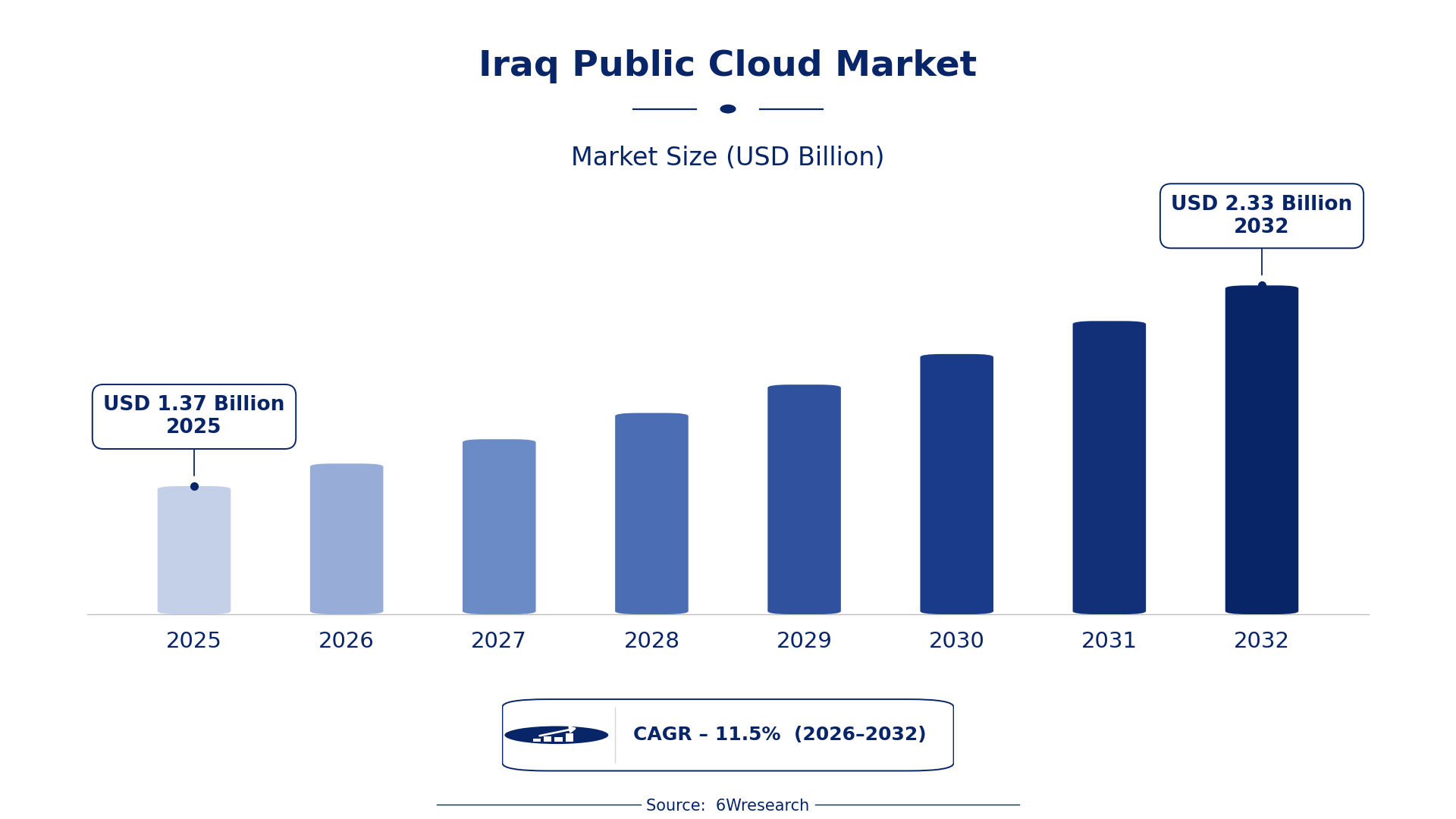
The Iraq Public Cloud Market was estimated at USD 1366 Million in 2025 and is projected to reach USD 2329 Million by 2032, growing at a CAGR of 11.5% from 2026 to 2032.
Iraq Public Cloud Market Synopsis
The Iraq Public Cloud Market is on an upward trajectory, with businesses increasingly recognizing the value of cloud solutions in enhancing their operations. This shift is spurred by a growing demand for cost-effective IT services, improved internet connectivity, and a push for digital transformation across various sectors.
Global players like Microsoft Azure, AWS, and Google Cloud are establishing a foothold, while local providers are emerging to meet specific regional needs. Key industries such as banking, healthcare, and education are driving this momentum, seeking to leverage cloud technology for better efficiency and innovation.
Iraq Public Cloud Market Year-wise Growth Rate and Key Drivers
This graph illustrates the annual growth rates of the Iraq Public Cloud Market from 2021 to 2032, highlighting a steady upward trajectory and projected expansion over the forecast period.
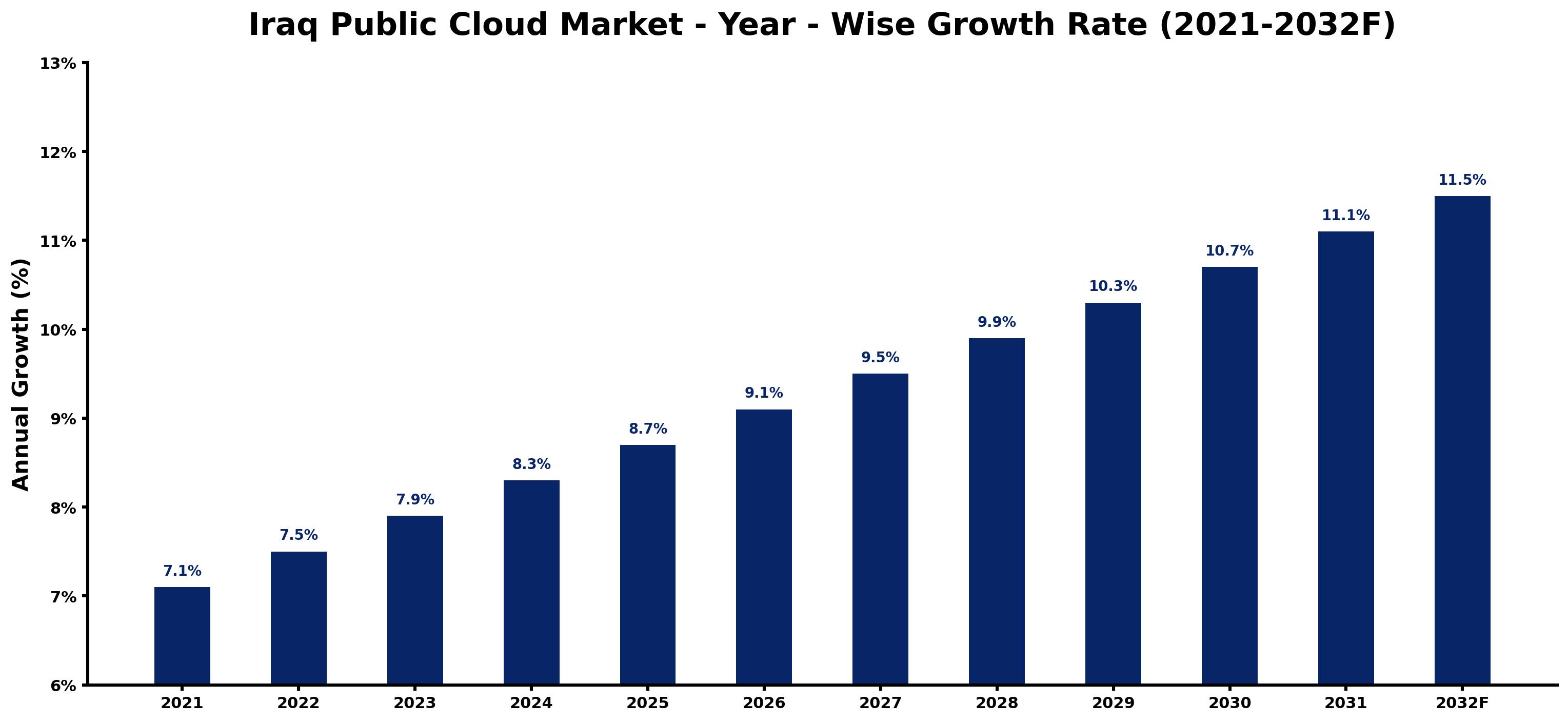
The table below presents the year‑wise growth rates along with the key drivers influencing the market
| Year | Growth Rate | Major Drivers |
| 2021 | 7.1% | Government's initiative for e-Government services implementation |
| 2022 | 7.5% | Increase in local startups leveraging cloud solutions |
| 2023 | 7.9% | Boost in internet penetration rates among urban populations |
| 2024 | 8.3% | Adoption of cloud for disaster recovery solutions |
| 2025 | 8.7% | Local universities enhancing IT curricula with cloud training |
| 2026 | 9.1% | Partnerships with global cloud providers for local services |
| 2027 | 9.5% | Significant rise in mobile device usage among consumers |
| 2028 | 9.9% | Increased private sector investment in digital infrastructure |
| 2029 | 10.3% | Regulatory support for data privacy and cloud compliance |
| 2030 | 10.7% | Emergence of fintech startups utilizing cloud technologies |
| 2031 | 11.1% | Government tax incentives for tech investments in cloud |
| 2032 | 11.5% | Rise in demand for educational platforms using cloud resources |
Note: Market size estimations and growth projections presented in this report are based on 6Wresearch's proprietary forecasting methodology, utilizing the latest available industry data, government publications, and primary research inputs.
Iraq Public Cloud Market Key Takeaways
Below are some of the specific key takeaways from the market, including:
- The increasing adoption of hybrid cloud solutions among businesses to mitigate data security concerns.
- Rising demand for specialized cloud services tailored to Iraq's unique business environment.
- Government initiatives aimed at enhancing digital infrastructure and cybersecurity measures.
- Emergence of edge computing as a solution to support IoT devices in various sectors.
- Continued investment in improving internet connectivity across the country.
Evaluation of Restraints in Iraq Public Cloud Market
While the Iraq Public Cloud Market exhibits promising growth potential, several restraints hinder its progress. Limited internet infrastructure remains a pressing challenge, particularly in rural areas where connectivity is inconsistent. Data security and privacy concerns are prevalent, making businesses cautious about adopting cloud solutions.
Additionally, regulatory restrictions and a lack of clear guidelines complicate the operational landscape for cloud service providers. Many businesses also grapple with a limited understanding of cloud technology, which further stalls the transition from traditional IT systems to more modern cloud-based solutions.
Iraq Public Cloud Market Trends
The market is currently witnessing a shift towards hybrid cloud architectures, which offer a blend of flexibility and security. As businesses strive to safeguard sensitive data while enjoying the benefits of cloud computing, the demand for hybrid solutions continues to grow.
on top of that, the increasing popularity of cloud-based software applications is evident, particularly in sectors like finance and education. Edge computing is gaining traction as organizations seek to harness the power of IoT devices, enabling faster data processing and real-time analytics.
Iraq Public Cloud Market Opportunities
There are numerous opportunities for growth within the Iraq Public Cloud Market, particularly for service providers offering tailored solutions. Businesses are in need of enhanced data protection measures and localized support to address their unique challenges. As the country continues to modernize its digital infrastructure, cloud service providers can forge strategic partnerships with local enterprises eager to embrace cloud technology.
on top of that, with increasing government support for digital initiatives, providers can capitalize on opportunities to deliver specialized services that cater to the evolving demands of Iraqi businesses.
Government Initiatives in the Iraq Public Cloud Market
The Iraqi government is gradually implementing initiatives to foster the growth of the public cloud market, focusing on enhancing digital infrastructure and promoting cybersecurity. Recognizing the importance of digital transformation, policymakers are taking steps to create a favorable environment for cloud services.
- A national digital infrastructure upgrade programme currently underway aims to improve internet connectivity across the country.
- Recent legislation introduced to enhance cybersecurity measures is designed to instill confidence in cloud adoption among businesses.
- A planned public-private partnership is expected to facilitate the expansion of cloud services, focusing on data protection and regulatory compliance.
- Ongoing workshops and training sessions to raise awareness about cloud technology among businesses are being organized by government agencies.
Future Insights of the Iraq Public Cloud Market
The outlook for the Iraq Public Cloud Market from 2026 to 2032 is promising, with strong growth anticipated as digital transformation initiatives gain momentum. Businesses will increasingly seek cost-effective solutions, driving demand for public cloud services.
As internet penetration continues to improve and digital infrastructure modernizes, the market is expected to witness substantial expansion. The focus on remote work and the need for agility will further encourage organizations to embrace cloud technologies, solidifying their role in Iraq's economic development.
Iraq Public Cloud Market Latest Developments
In the last year, the Iraq Public Cloud Market has seen increased activity as both local and international players strive to enhance their offerings. The focus on improving digital services has led to a series of initiatives aimed at expanding cloud capabilities across various sectors.
- A major technology vendor launched a new cloud service aimed at the healthcare sector in early 2025, enhancing data management and patient care.
- An initiative that began in mid-2025 is currently underway to upgrade the national broadband infrastructure, aimed at supporting cloud services expansion.
- A partnership between two local firms is expected to roll out cloud-based solutions for small and medium enterprises by late 2026.
- A new training program focused on cloud technologies was recently completed, aimed at equipping local IT professionals with necessary skills.
Iraq Public Cloud Market - Key Attractiveness of the Report
- 10 Years of Market Numbers
- Historical Data Starting from 2022 to 2025
- Base Year: 2025
- Forecast Data until 2032
- Key Performance Indicators Impacting the Market
- Major Upcoming Developments and Projects
Key Highlights of the Report:
- Iraq Public Cloud Market Outlook
- Market Size of Iraq Public Cloud Market, 2025
- Forecast of Iraq Public Cloud Market, 2032
- Historical Data and Forecast of Iraq Public Cloud Revenues & Volume for the Period 2022-2032F
- Iraq Public Cloud Market Trend Evolution
- Iraq Public Cloud Market Drivers and Challenges
- Iraq Public Cloud Price Trends
- Iraq Public Cloud Porter's Five Forces
- Iraq Public Cloud Industry Life Cycle
- Historical Data and Forecast of Iraq Public Cloud Market Revenues & Volume By Service Model for the Period 2022-2032F
- Historical Data and Forecast of Iraq Public Cloud Market Revenues & Volume By Infrastructure as a Service for the Period 2022-2032F
- Historical Data and Forecast of Iraq Public Cloud Market Revenues & Volume By Platform as a Service for the Period 2022-2032F
- Historical Data and Forecast of Iraq Public Cloud Market Revenues & Volume By Software as a Service for the Period 2022-2032F
- Historical Data and Forecast of Iraq Public Cloud Market Revenues & Volume By Organization Size Large enterprises for the Period 2022-2032F
- Historical Data and Forecast of Iraq Public Cloud Market Revenues & Volume By Small for the Period 2022-2032F
- Historical Data and Forecast of Iraq Public Cloud Market Revenues & Volume By Medium Enterprises SMEs for the Period 2022-2032F
- Historical Data and Forecast of Iraq Public Cloud Market Revenues & Volume By Verticals for the Period 2022-2032F
- Historical Data and Forecast of Iraq Public Cloud Market Revenues & Volume By BFSI for the Period 2022-2032F
- Historical Data and Forecast of Iraq Public Cloud Market Revenues & Volume By Telecommunication for the Period 2022-2032F
- Historical Data and Forecast of Iraq Public Cloud Market Revenues & Volume By IT & ITeS for the Period 2022-2032F
- Historical Data and Forecast of Iraq Public Cloud Market Revenues & Volume By Government & Public Sector for the Period 2022-2032F
- Historical Data and Forecast of Iraq Public Cloud Market Revenues & Volume By Retail & Consumer Goods for the Period 2022-2032F
- Historical Data and Forecast of Iraq Public Cloud Market Revenues & Volume By Manufacturing for the Period 2022-2032F
- Historical Data and Forecast of Iraq Public Cloud Market Revenues & Volume By Energy & Utility for the Period 2022-2032F
- Historical Data and Forecast of Iraq Public Cloud Market Revenues & Volume By Media & Entertainment for the Period 2022-2032F
- Iraq Public Cloud Import Export Trade Statistics
- Market Opportunity Assessment By Service Model
- Market Opportunity Assessment By Organization Size Large enterprises
- Market Opportunity Assessment By Verticals
- Iraq Public Cloud Top Companies Market Share
- Iraq Public Cloud Competitive Benchmarking By Technical and Operational Parameters
- Iraq Public Cloud Company Profiles
- Iraq Public Cloud Key Strategic Recommendations






































