Iraq Stainless Steel Market Size, Share & Growth Rate
The Iraq Stainless Steel Market was estimated at USD 1399 Million in 2025 and is projected to reach USD 2491 Million by 2032, growing at a CAGR of 8.6% from 2026 to 2032. This growth is fueled primarily by increased investments in infrastructure and a burgeoning automotive sector. The demand for durable and corrosion-resistant materials like stainless steel is anticipated to rise as the country undertakes significant reconstruction efforts and diversifies its economy away from oil dependency.
Iraq Stainless Steel Market Year-wise Growth Rate and Key Drivers
This graph highlights how the Iraq Stainless Steel Market has steadily grown over the years, supported by major growth factors.
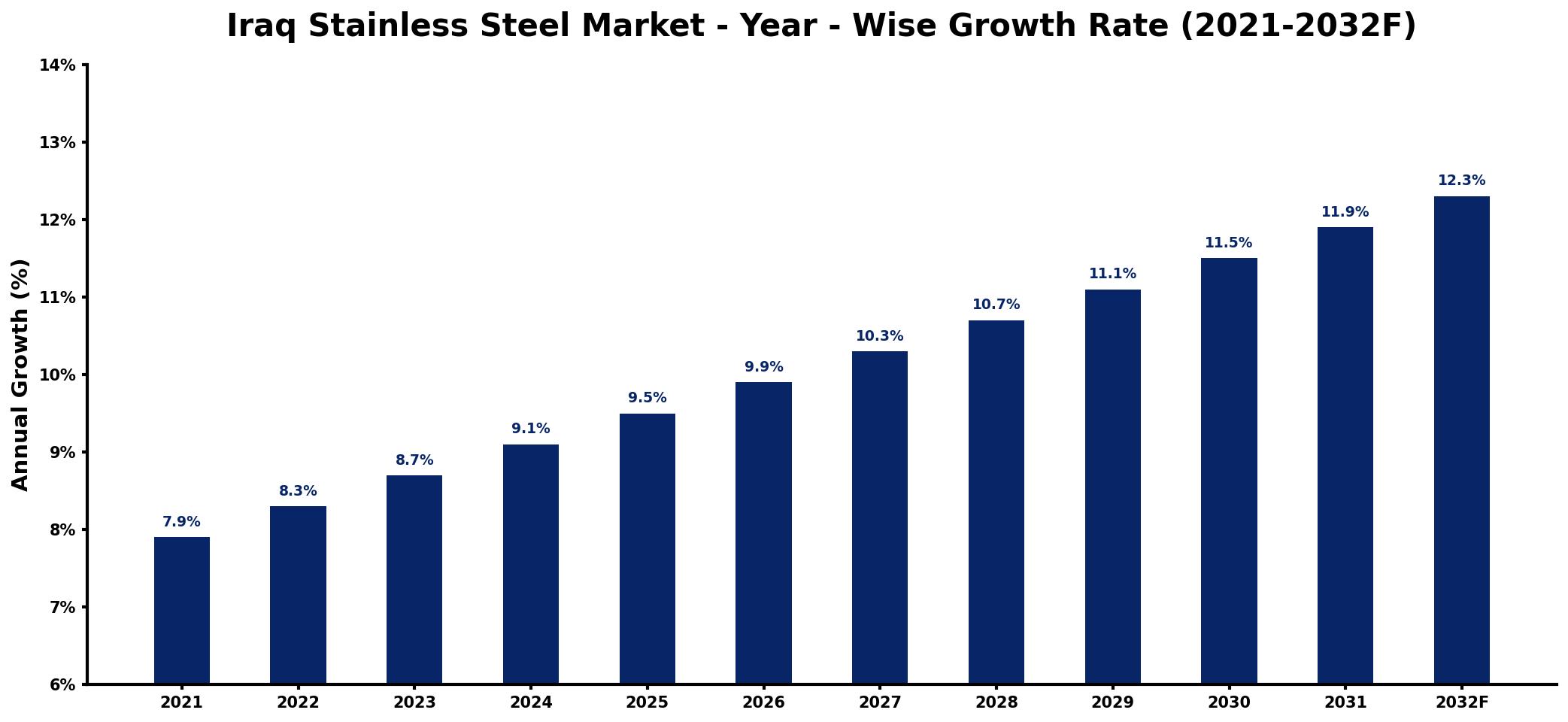
The table below presents the year‑wise growth rates along with the key drivers influencing the market
| Year | Growth Rate | Major Drivers |
| 2021 | 7.9% | Rising construction sector investments |
| 2022 | 8.3% | Increased demand from automotive industry |
| 2023 | 8.7% | Growing infrastructure development projects |
| 2024 | 9.1% | Expansion of manufacturing capabilities |
| 2025 | 9.5% | Surge in energy sector projects |
| 2026 | 9.9% | Boost in residential housing market |
| 2027 | 10.3% | Growing export opportunities emerging |
| 2028 | 10.7% | Technological advancements in production |
| 2029 | 11.1% | Increased foreign direct investments |
| 2030 | 11.5% | Demand from renewable energy initiatives |
| 2031 | 11.9% | improved processing technologies adoption |
| 2032 | 12.3% | Rising consumer goods production |
Note: Market size estimations and growth projections presented in this report are based on 6Wresearch's proprietary forecasting methodology, utilizing the latest available industry data, government publications, and primary research inputs.
Iraq Stainless Steel Market Synopsis
Currently, the Iraq stainless steel market is in a phase of gradual expansion, driven by burgeoning construction and industrial activities. Infrastructure projects are pivotal, with a notable increase in government spending aimed at modernizing the nation's facilities and services.
In addition, the oil and gas industry continues to spur demand for high-quality stainless steel products, which are essential in developing pipelines and storage solutions. The governments commitment to fostering local production adds a competitive edge to the market, positioning Iraq as an emerging hub for stainless steel manufacturing.
Iraq Stainless Steel Market Key Takeaways
- Strong growth forecast driven by increased construction and industrial demand.
- Rising investments in oil & gas and automotive sectors are key market drivers.
- Government initiatives are promoting local manufacturing and reducing import reliance.
- Local manufacturers are enhancing quality standards and product offerings.
- Challenges remain due to geopolitical stability and raw material cost fluctuations.
Evaluation of Restraints in Iraq Stainless Steel Market
The Iraq stainless steel market encounters significant restraints that impede its growth trajectory. Political instability remains a primary concern, as security issues can disrupt supply chains and deter foreign investment. Furthermore, economic fluctuations driven by oil revenue dependencies create an unpredictable market environment. Such instability can adversely affect consumer purchasing power and project financing, complicating long-term planning for businesses within the sector. Additionally, reliance on imported raw materials leads to vulnerabilities in pricing and supply continuity, challenging local manufacturers.
Iraq Stainless Steel Market Trends
Several trends are shaping the Iraq stainless steel market. Notably, the shift towards sustainable construction practices is influencing the demand for stainless steel due to its recyclability and durability. Manufacturers are also investing in advanced technologies to enhance production efficiency and meet evolving quality standards. The automotive sector is witnessing an uptick in the use of stainless steel for components, driven by the need for lightweight and high-strength materials. Lastly, local firms are becoming more competitive by focusing on customized solutions tailored to specific industry needs.
Iraq Stainless Steel Market Opportunities
The Iraq stainless steel market offers substantial investment opportunities across several sectors. As the country embarks on extensive reconstruction and infrastructure development projects, there is a rising need for stainless steel in construction and engineering applications. The automotive industry's growth also creates demand for stainless steel components. Furthermore, the oil & gas sector's continual expansion presents a robust market for stainless steel pipelines, fittings, and storage tanks. Investors can leverage these emerging opportunities to capitalize on the ongoing industrialization and modernization of Iraq's economy.
Government Initiatives in the Iraq Stainless Steel Market
The Iraqi government is actively implementing policies to boost domestic production of stainless steel and lessen dependence on imports. Trade barriers and tariffs on imported products aim to protect local manufacturers while fostering a competitive market. Additionally, the government is focused on ensuring quality standards and promoting sustainable practices within the industry. Incentives such as subsidies and tax breaks for local production contribute to a more favorable investment climate and encourage foreign capital inflow into the sector.
Future Insights of the Iraq Stainless Steel Market
Looking ahead to 2026-2032, the Iraq stainless steel market is set for a promising future. Continued infrastructure development coupled with economic diversification efforts will sustain the demand for stainless steel across key sectors. While challenges remain, such as geopolitical uncertainties and market volatility, the governments initiatives to stabilize the business environment will bolster growth. As the economy modernizes, the market is likely to benefit from increased innovation and efficiency, positioning it as a vital segment within the broader industrial landscape.
Iraq Stainless Steel Market Latest Developments (2025 - 2026)
Recent developments in the Iraq stainless steel market reflect a growing alignment with international standards. Local manufacturers are engaging in partnerships to enhance their capabilities, fostering innovation and quality improvements. Additionally, increased trade activities have been observed, as domestic firms seek to expand their reach and competitiveness amidst a challenging economic backdrop. Infrastructure projects funded by government initiatives continue to gain momentum, further stimulating demand for stainless steel products.
Iraq Stainless Steel Market - Key Attractiveness of the Report
- 10 Years of Market Numbers
- Historical Data Starting from 2022 to 2025
- Base Year: 2025
- Forecast Data until 2032
- Key Performance Indicators Impacting the Market
- Major Upcoming Developments and Projects
Key Highlights of the Report:
- Iraq Stainless Steel Market Outlook
- Market Size of Iraq Stainless Steel Market, 2025
- Forecast of Iraq Stainless Steel Market, 2032
- Historical Data and Forecast of Iraq Stainless Steel Revenues & Volume for the Period 2022-2032F
- Iraq Stainless Steel Market Trend Evolution
- Iraq Stainless Steel Market Drivers and Challenges
- Iraq Stainless Steel Price Trends
- Iraq Stainless Steel Porter's Five Forces
- Iraq Stainless Steel Industry Life Cycle
- Historical Data and Forecast of Iraq Stainless Steel Market Revenues & Volume By Product for the Period 2022-2032F
- Historical Data and Forecast of Iraq Stainless Steel Market Revenues & Volume By Long for the Period 2022-2032F
- Historical Data and Forecast of Iraq Stainless Steel Market Revenues & Volume By Flat for the Period 2022-2032F
- Historical Data and Forecast of Iraq Stainless Steel Market Revenues & Volume By Application for the Period 2022-2032F
- Historical Data and Forecast of Iraq Stainless Steel Market Revenues & Volume By Polish finishing for the Period 2022-2032F
- Historical Data and Forecast of Iraq Stainless Steel Market Revenues & Volume By Exhaust system for the Period 2022-2032F
- Historical Data and Forecast of Iraq Stainless Steel Market Revenues & Volume By Surgical instrument for the Period 2022-2032F
- Historical Data and Forecast of Iraq Stainless Steel Market Revenues & Volume By Others for the Period 2022-2032F
- Historical Data and Forecast of Iraq Stainless Steel Market Revenues & Volume By End User for the Period 2022-2032F
- Historical Data and Forecast of Iraq Stainless Steel Market Revenues & Volume By Consumer goods for the Period 2022-2032F
- Historical Data and Forecast of Iraq Stainless Steel Market Revenues & Volume By Automotive for the Period 2022-2032F
- Historical Data and Forecast of Iraq Stainless Steel Market Revenues & Volume By Food & beverage for the Period 2022-2032F
- Historical Data and Forecast of Iraq Stainless Steel Market Revenues & Volume By Oil & gas for the Period 2022-2032F
- Historical Data and Forecast of Iraq Stainless Steel Market Revenues & Volume By Others for the Period 2022-2032F
- Iraq Stainless Steel Import Export Trade Statistics
- Market Opportunity Assessment By Product
- Market Opportunity Assessment By Application
- Market Opportunity Assessment By End User
- Iraq Stainless Steel Top Companies Market Share
- Iraq Stainless Steel Competitive Benchmarking By Technical and Operational Parameters
- Iraq Stainless Steel Company Profiles
- Iraq Stainless Steel Key Strategic Recommendations






































