Iraq Synthetic Fiber Market Size, Share & Growth Rate
The Iraq Synthetic Fiber Market was estimated at USD 178 Million in 2025 and is projected to reach USD 233 Million by 2032, growing at a CAGR of 3.9% from 2026 to 2032. This growth trajectory is primarily driven by increasing demand across key sectors, particularly textiles, automotive, and construction. As industries evolve and domestic production capabilities expand, the market is set to capitalize on rising disposable incomes and a growing preference for high-quality synthetic fibers.
Iraq Synthetic Fiber Market Year-wise Growth Rate and Key Drivers
This graph highlights how the Iraq Synthetic Fiber Market has steadily grown over the years, supported by major growth factors.
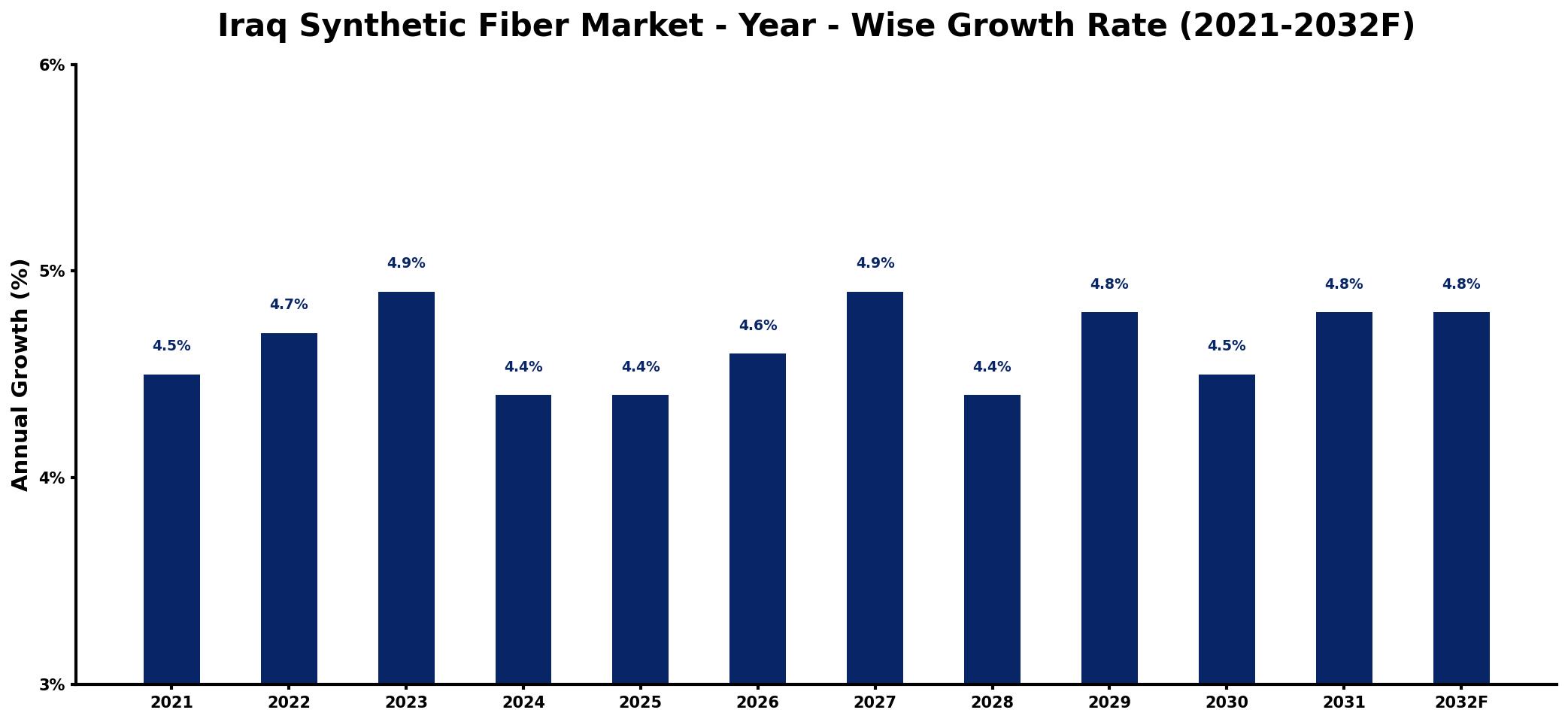
The table below presents the year‑wise growth rates along with the key drivers influencing the market
| Year | Growth Rate | Major Drivers |
| 2021 | 4.5% | Rising demand in apparel industry |
| 2022 | 4.7% | Increased investment in manufacturing |
| 2023 | 4.9% | Growing popularity of eco-friendly materials |
| 2024 | 4.4% | Expansion of textile production facilities |
| 2025 | 4.4% | Surge in construction sector projects |
| 2026 | 4.6% | Adoption of advanced production technologies |
| 2027 | 4.9% | Increased exports to regional markets |
| 2028 | 4.4% | Growth in automotive interior applications |
| 2029 | 4.8% | Rising need for durable materials |
| 2030 | 4.5% | Boost in local retail markets |
| 2031 | 4.8% | Growing interest in sustainable practices |
| 2032 | 4.8% | expanding healthcare application demand |
Note: Market size estimations and growth projections presented in this report are based on 6Wresearch's proprietary forecasting methodology, utilizing the latest available industry data, government publications, and primary research inputs.
Iraq Synthetic Fiber Market Synopsis
The Iraq Synthetic Fiber Market has recently gained momentum, spurred by an uptick in industrial activity and consumer demand. However, as the market moves forward, it faces both opportunities and challenges that will shape its future.
The increasing shift towards durable and low-maintenance synthetic fibers over traditional natural fibers indicates a promising trend. Additionally, the construction industry's embrace of synthetic fibers for reinforcement and insulation applications reflects a significant growth potential in the near future.
Iraq Synthetic Fiber Market Key Takeaways
- The market is bolstered by a robust demand from textiles, automotive, and construction sectors.
- Polyester and nylon remain the dominant synthetic fibers due to their versatility and affordability.
- Environmental concerns are driving interest in eco-friendly synthetic fiber innovations.
- Political stability and infrastructure development are critical for future market expansion.
- Government policies are fostering a favorable environment for domestic production and investment.
Evaluation of Restraints in Iraq Synthetic Fiber Market
Despite its promising outlook, the Iraq Synthetic Fiber Market grapples with significant restraints that hinder its growth potential. Fluctuating raw material prices pose a consistent challenge, impacting profit margins for manufacturers. Additionally, the market suffers from limited access to international markets, often due to political instability, which stymies export potential. Inadequate infrastructure, particularly in transportation and energy supply, further complicates operations and increases costs. Lastly, a lack of skilled labor and investment in research and development has stunted technological advancements necessary for enhancing production efficiency and competitiveness.
Iraq Synthetic Fiber Market Trends
Emerging trends in the Iraq Synthetic Fiber Market point towards a growing preference for sustainable production practices and innovative materials. As environmental concerns become more prominent among consumers and manufacturers, there is a marked shift towards developing eco-friendly synthetic fibers. This is not only in response to regulatory pressures but also a reflection of changing consumer preferences. Moreover, advancements in manufacturing technologies are enhancing the performance characteristics of synthetic fibers, allowing them to meet the evolving needs of various industries.
Iraq Synthetic Fiber Market Opportunities
Investment opportunities in the Iraq Synthetic Fiber Market are vast, driven by a burgeoning demand across several sectors. With a population that continues to grow and a rising middle class, there is an increasing appetite for high-quality textile products and industrial materials. The government's focus on infrastructure projects further augments this demand. As more companies look to establish or expand operations within Iraq, the potential for returns on investment in synthetic fiber production could be substantial, particularly if investors align their strategies with market trends and consumer preferences.
Government Initiatives in the Iraq Synthetic Fiber Market
The Iraqi government has implemented several initiatives aimed at fostering the growth of the synthetic fiber industry. These include import tariffs designed to reduce dependency on foreign materials while providing subsidies to domestic manufacturers to encourage local production. Investment incentives are also in place to attract both local and foreign investments, alongside regulations that uphold quality standards and promote environmental sustainability. These policies are strategically positioned to stimulate the sector, create jobs, and improve overall competitiveness in the market.
Future Insights of the Iraq Synthetic Fiber Market
Looking ahead to the period from 2026 to 2032, the Iraq Synthetic Fiber Market appears poised for steady growth. Continued demand from the textiles, automotive, and construction industries will be the primary driver. With rising disposable incomes and an evolving consumer landscape, the market is likely to see increased adoption of synthetic fibers across various applications. Technological innovations aimed at sustainability will also contribute positively to the sector's expansion, despite existing challenges related to infrastructure and political stability that could temper growth rates.
Iraq Synthetic Fiber Market Latest Developments (2025 - 2026)
Recent developments in the Iraq Synthetic Fiber Market have centered around initiatives to modernize production facilities and enhance capacity. Companies are increasingly prioritizing sustainable practices and technologies to align with global trends. Collaborative efforts between the government and private sectors aim to improve the infrastructure needed to support manufacturing and distribution. Furthermore, increased investments in R&D are emerging, focusing on the development of advanced synthetic materials to meet industry demands.
Iraq Synthetic Fiber Market - Key Attractiveness of the Report
- 10 Years of Market Numbers
- Historical Data Starting from 2022 to 2025
- Base Year: 2025
- Forecast Data until 2032
- Key Performance Indicators Impacting the Market
- Major Upcoming Developments and Projects
Key Highlights of the Report:
- Iraq Synthetic Fiber Market Outlook
- Market Size of Iraq Synthetic Fiber Market, 2025
- Forecast of Iraq Synthetic Fiber Market, 2032
- Historical Data and Forecast of Iraq Synthetic Fiber Revenues & Volume for the Period 2022-2032F
- Iraq Synthetic Fiber Market Trend Evolution
- Iraq Synthetic Fiber Market Drivers and Challenges
- Iraq Synthetic Fiber Price Trends
- Iraq Synthetic Fiber Porter's Five Forces
- Iraq Synthetic Fiber Industry Life Cycle
- Historical Data and Forecast of Iraq Synthetic Fiber Market Revenues & Volume By Type for the Period 2022-2032F
- Historical Data and Forecast of Iraq Synthetic Fiber Market Revenues & Volume By Polyester for the Period 2022-2032F
- Historical Data and Forecast of Iraq Synthetic Fiber Market Revenues & Volume By Nylon for the Period 2022-2032F
- Historical Data and Forecast of Iraq Synthetic Fiber Market Revenues & Volume By Acrylics for the Period 2022-2032F
- Historical Data and Forecast of Iraq Synthetic Fiber Market Revenues & Volume By Polyolefin for the Period 2022-2032F
- Historical Data and Forecast of Iraq Synthetic Fiber Market Revenues & Volume By Others for the Period 2022-2032F
- Historical Data and Forecast of Iraq Synthetic Fiber Market Revenues & Volume By Application for the Period 2022-2032F
- Historical Data and Forecast of Iraq Synthetic Fiber Market Revenues & Volume By Clothing for the Period 2022-2032F
- Historical Data and Forecast of Iraq Synthetic Fiber Market Revenues & Volume By Home Furnishing for the Period 2022-2032F
- Historical Data and Forecast of Iraq Synthetic Fiber Market Revenues & Volume By Automotive for the Period 2022-2032F
- Historical Data and Forecast of Iraq Synthetic Fiber Market Revenues & Volume By Filtration for the Period 2022-2032F
- Historical Data and Forecast of Iraq Synthetic Fiber Market Revenues & Volume By Others for the Period 2022-2032F
- Iraq Synthetic Fiber Import Export Trade Statistics
- Market Opportunity Assessment By Type
- Market Opportunity Assessment By Application
- Iraq Synthetic Fiber Top Companies Market Share
- Iraq Synthetic Fiber Competitive Benchmarking By Technical and Operational Parameters
- Iraq Synthetic Fiber Company Profiles
- Iraq Synthetic Fiber Key Strategic Recommendations






































