Iraq Two Wheeler Market Summary
The iraq two wheeler market was estimated at USD 329 Million in 2025 and is projected to reach USD 441 Million by 2032, growing at a CAGR of 5.2% from 2026 to 2032.
Iraq Two Wheeler Market Year-wise Growth Rate and Key Drivers
This graph highlights how the Iraq Two Wheeler Market has steadily grown over the past five years, supported by major growth factors.
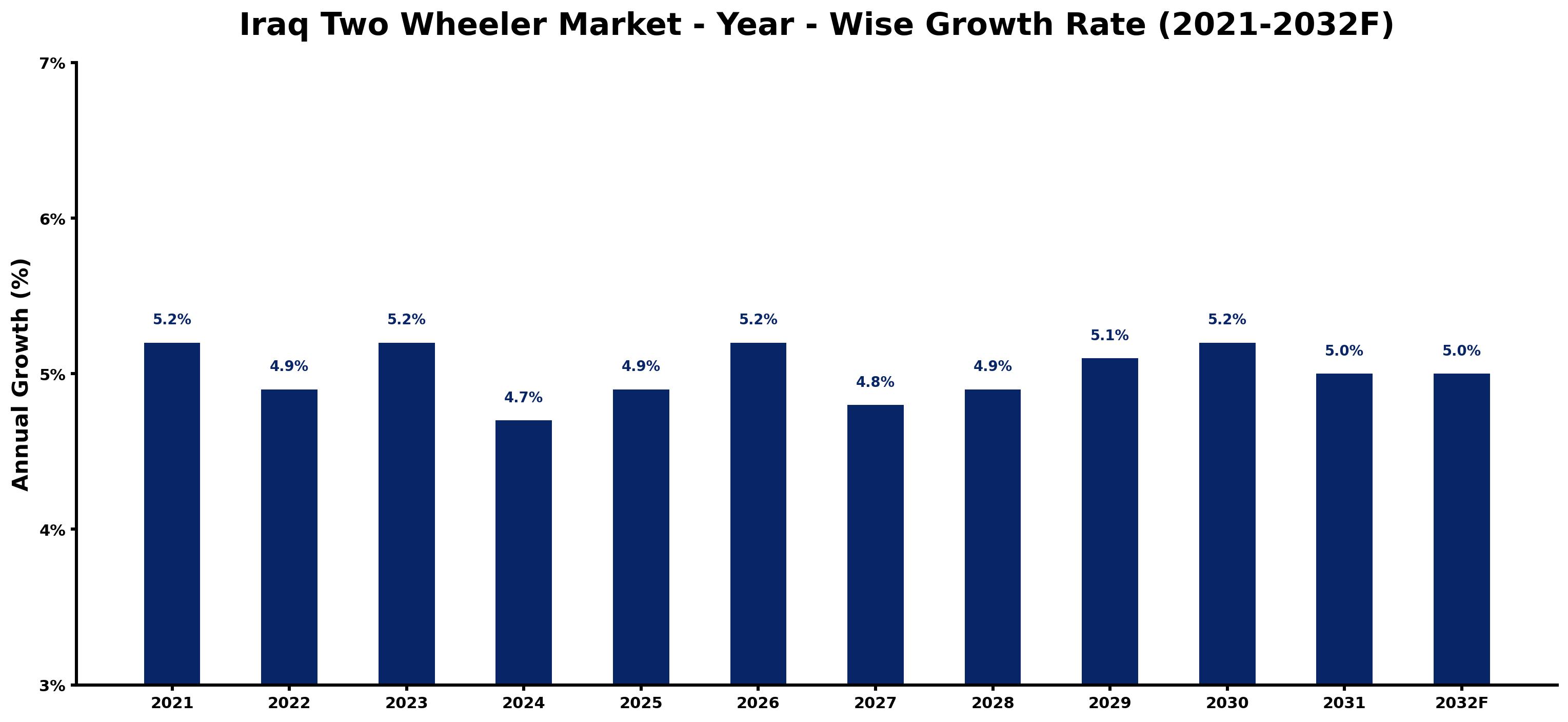
The table below presents the year wise growth rates along with the key drivers influencing the market
| Year | Growth Rate | Major Drivers |
| 2021 | 5.2% | Iraq's urbanization patterns highlight rising commuter preferences for affordable transportation solutions. |
| 2022 | 4.9% | Climate conditions create increasing demand for two-wheelers over traditional vehicles. |
| 2023 | 5.2% | Improved fuel economy of two-wheelers appeals to cost-conscious consumers in Iraq. |
| 2024 | 4.7% | Local manufacturers aim to enhance production capabilities and reduce import reliance. |
| 2025 | 4.9% | Emerging financing options empower young Iraqis to purchase two-wheelers more readily. |
| 2026 | 5.2% | Infrastructural investments in roads enhance the viability and safety of two-wheelers. |
| 2027 | 4.8% | Cultural shifts towards personal mobility promote two-wheeler adoption among families. |
| 2028 | 4.9% | Availability of e-commerce platforms accelerates two-wheeler sales across urban areas. |
| 2029 | 5.1% | Environmental concerns spur interest in electric two-wheelers as viable alternatives. |
| 2030 | 5.2% | Youth engagement in two-wheeler sports encourages a vibrant, enthusiastic market. |
| 2031 | 5.0% | Partnerships between local dealers and global brands expand customer outreach effectively. |
| 2032 | 5.0% | Technological innovations in safety features increase consumer confidence in two-wheelers. |
Note - Market size estimations and growth projections presented in this report are based on 6Wresearch's advanced forecasting approach, validated with industry datasets as of June 2026.
Iraq Two Wheeler Market Synopsis
The Iraq Two Wheeler Market is projected to reach 5.2% and witness significant growth during the forecast period (2026-2032). This anticipated growth is driven by various factors, including increasing demand for personal mobility, improvements in disposable income, and developing road infrastructure within the country. As urbanization rates rise, the practicality of two-wheelers as an affordable transportation solution becomes evident, fostering a substantial surge in their adoption.
Iraq Two Wheeler Market Growth Drivers
Several factors are propelling the growth of the Iraq Two Wheeler Market. Firstly, the rising disposable income among consumers enables a broader section of the population to afford two-wheelers, which are favored for their cost-effectiveness. Secondly, with traffic congestions becoming more commonplace in urban areas, the maneuverability of two-wheelers offers a viable alternative for daily commutes.
- Increased awareness of environmental issues has led to a growing interest in electric scooters, which are increasingly seen as a sustainable mode of transport.
- Government initiatives encouraging the adoption of eco-friendly vehicles, particularly those powered by alternative energy sources, play a critical role in market expansion.
- Urbanization in cities across Iraq is resulting in higher population densities, further incentivizing the use of two-wheelers.
- The continuous introduction of innovative products at competitive prices enhances consumer appeal and stimulates sales.
- Advancements in road infrastructure contribute to the viability and safety of using two-wheelers for daily transportation.
Iraq Two Wheeler Market Trends and Opportunities
As the Iraq Two Wheeler Market evolves, several trends are emerging that could create new opportunities for growth. The increasing focus on sustainability and clean energy is likely to drive innovation towards electric two-wheelers, supported by consumer preference for environmentally friendly options.
- Smart features in two-wheelers, such as connectivity and advanced safety systems, are becoming increasingly popular, attracting tech-savvy consumers.
- Rural areas are witnessing a gradual increase in two-wheeler adoption, as improved road conditions and economic development promote individual mobility.
- Rental and sharing models are gaining traction, particularly among younger demographics looking for convenient and affordable transportation solutions.
- Collaborations and partnerships with technology firms may pave the way for enhanced product offerings, merging mobility with digital solutions.
- Growing consumer interest in customized two-wheelers presents opportunities for companies to cater to specific design and functional preferences.
Iraq Two Wheeler Market Challenges and Restraints
Despite its growth potential, the Iraq Two Wheeler Market faces certain challenges that may hinder its progress. One of the primary concerns is regulatory compliance, as fluctuating policies regarding vehicle emissions and safety can create uncertainty for manufacturers.
- Infrastructure challenges, particularly in rural regions, may limit the reach of two-wheelers, affecting market penetration.
- Consumer preferences can shift based on economic conditions, leading to fluctuations in two-wheeler sales.
- Competition from other modes of transport, like buses and taxis, may limit market share for two-wheelers.
- A lack of awareness regarding the benefits of electric two-wheelers may slow down their adoption among consumers.
- The high initial cost of advanced electric two-wheelers can be a barrier for cost-conscious consumers.
Iraq Two Wheeler Market Government Investment and Initiatives
The government of Iraq has initiated several policies aimed at fostering the growth of the two wheeler market, particularly with incentives for eco-friendly vehicles. By investing in road infrastructure improvements and promoting public awareness campaigns focused on sustainable transportation, the government is actively seeking to facilitate the transition towards more environmentally friendly commuting options.
- Incentives for electric two-wheelers, including potential subsidies, aim to lower the entry cost for consumers and encourage adoption.
- Public investments in expanding road networks are designed to accommodate the increasing number of two-wheelers, enhancing safety and accessibility.
- Regulatory frameworks are being developed to streamline vehicle registration processes, making it easier for consumers to purchase two-wheelers.
- Educational programs focus on the benefits of two-wheelers, particularly electric models, in reducing traffic congestion and lowering emissions.
- Partnerships with manufacturers to promote local assembly of two-wheelers aim to stimulate the domestic economy while providing consumers with more affordable options.
Iraq Two Wheeler Market Latest Developments (May 2025 - June 2026)
The Iraq Two Wheeler Market has witnessed a number of significant developments between May 2025 and June 2026. The focus has increasingly shifted toward promoting electric mobility solutions, with new models being introduced that cater to environmentally conscious consumers. Additionally, government-backed initiatives have aimed to bolster electric two-wheeler sales through various incentives and public awareness campaigns.
- Market players have begun to emphasize the integration of smart technologies into two-wheelers, offering enhanced safety and efficiency features.
- New electric scooter models have entered the market, demonstrating advancements in battery technology and performance.
- Cooperative agreements between private sectors and government entities have streamlined the regulatory processes surrounding two-wheeler registrations.
- The rise of mobility-as-a-service (MaaS) platforms has increased interest in rental models, contributing to higher two-wheeler usage rates.
- Consumer preferences have shown a marked shift towards electric models, spurred by rising fuel costs and environmental concerns.
Iraq Two Wheeler Market - Key Attractiveness of the Report
- 10 Years of Market Numbers
- Historical Data Starting from 2022 to 2025
- Base Year: 2025
- Forecast Data until 2032
- Key Performance Indicators Impacting the Market
- Major Upcoming Developments and Projects
Key Highlights of the Report:
- Iraq Two Wheeler Market Outlook
- Market Size of Iraq Two Wheeler Market, 2025
- Forecast of Iraq Two Wheeler Market, 2032F
- Historical Data and Forecast of Iraq Two Wheeler Revenues & Volume for the Period 2022-2032F
- Iraq Two Wheeler Market Trend Evolution
- Iraq Two Wheeler Market Drivers and Challenges
- Iraq Two Wheeler Price Trends
- Iraq Two Wheeler Porter's Five Forces
- Iraq Two Wheeler Industry Life Cycle
- Historical Data and Forecast of Iraq Two Wheeler Market Revenues & Volume By Vehicle Type for the Period 2022-2032F
- Historical Data and Forecast of Iraq Two Wheeler Market Revenues & Volume By Motorcycle for the Period 2022-2032F
- Historical Data and Forecast of Iraq Two Wheeler Market Revenues & Volume By Scooter/Moped for the Period 2022-2032F
- Historical Data and Forecast of Iraq Two Wheeler Market Revenues & Volume By Engine Capacity for the Period 2022-2032F
- Historical Data and Forecast of Iraq Two Wheeler Market Revenues & Volume By Up to 125cc for the Period 2022-2032F
- Historical Data and Forecast of Iraq Two Wheeler Market Revenues & Volume By 126-250cc for the Period 2022-2032F
- Historical Data and Forecast of Iraq Two Wheeler Market Revenues & Volume By 251-500cc for the Period 2022-2032F
- Historical Data and Forecast of Iraq Two Wheeler Market Revenues & Volume By Above 500cc for the Period 2022-2032F
- Iraq Two Wheeler Import Export Trade Statistics
- Market Opportunity Assessment By Vehicle Type
- Market Opportunity Assessment By Engine Capacity
- Iraq Two Wheeler Top Companies Market Share
- Iraq Two Wheeler Competitive Benchmarking By Technical and Operational Parameters
- Iraq Two Wheeler Company Profiles
- Iraq Two Wheeler Key Strategic Recommendations






































