Iraq Wheat Starch Market Size, Share & Growth Rate
The Iraq Wheat Starch Market was estimated at USD 1244 Million in 2025 and is projected to reach USD 1799 Million by 2032, growing at a CAGR of 5.4% from 2026 to 2032. This growth trajectory is largely driven by the escalating demand for wheat starch across the food and beverage sector, coupled with the increasing use of wheat starch as a functional ingredient in pharmaceuticals and other industries. The burgeoning food processing industry, along with consumer trends favoring convenience and healthier options, are further propelling market expansion.
Iraq Wheat Starch Market Year-wise Growth Rate and Key Drivers
This graph highlights how the Iraq Wheat Starch Market has steadily grown over the years, supported by major growth factors.
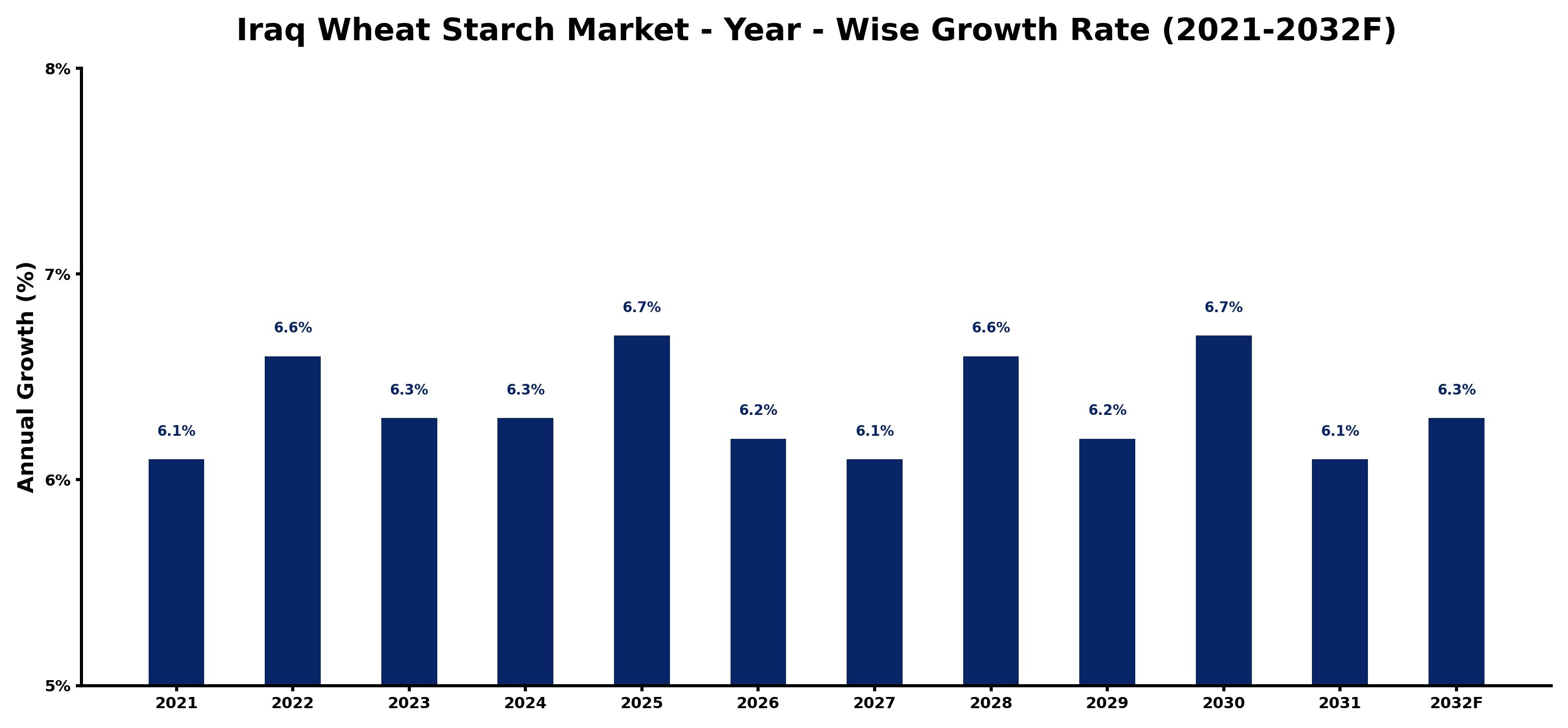
The table below presents the year‑wise growth rates along with the key drivers influencing the market
| Year | Growth Rate | Major Drivers |
| 2021 | 6.1% | Increased demand for gluten-free products |
| 2022 | 6.6% | Rising health consciousness among consumers |
| 2023 | 6.3% | Food processing sector expansion accelerated |
| 2024 | 6.3% | Growth in convenience food market |
| 2025 | 6.7% | Emerging food trends influenced purchases |
| 2026 | 6.2% | Investment in food technology advancements |
| 2027 | 6.1% | Higher disposable income among consumers |
| 2028 | 6.6% | Increased exports to neighboring countries |
| 2029 | 6.2% | Growing popularity of organic products |
| 2030 | 6.7% | Rising demand for specialty starches |
| 2031 | 6.1% | Enhanced distribution networks improved access |
| 2032 | 6.3% | Consumer preference for local sourcing |
Note - Market size estimations and growth projections presented in this report are based on 6Wresearch’s advanced forecasting approach, validated with industry datasets as of June 2026.
Iraq Wheat Starch Market Synopsis
The Iraq wheat starch market has witnessed robust momentum, thanks to a surge in processed food consumption and the rising need for gluten-free alternatives. As consumer awareness of health benefits increases, the outlook for wheat starch continues to evolve positively.
Looking forward, the market is set to capitalize on the growing trend of convenience foods and innovative product applications. The interplay between local production efforts and increasing import dependence creates a dynamic landscape that industry players must navigate carefully.
Iraq Wheat Starch Market Key Takeaways
- Increasing demand for wheat starch as a binding and thickening agent in various food applications.
- Heightened consumer interest in gluten-free products bolstering market growth.
- Government initiatives focused on supporting domestic production enhance industry stability.
- Fluctuations in global wheat prices present ongoing challenges for manufacturers.
- Emerging investment opportunities in processing facilities and distribution networks.
Evaluation of Restraints in Iraq Wheat Starch Market
Despite its promising outlook, the Iraq wheat starch market faces several restraints that could impede growth. The volatility of global wheat prices often complicates production costs, affecting pricing strategies for local manufacturers. Additionally, the political landscape in Iraq presents challenges related to infrastructure and supply chain disruptions. Quality control remains critical, as compliance with food safety regulations is paramount for maintaining consumer trust and ensuring product integrity. The competition posed by imported starch and alternative sources adds another layer of complexity for domestic producers striving to maintain market share.
Iraq Wheat Starch Market Trends
The demand for wheat starch in Iraq is increasingly driven by its versatile applications across the food industry, particularly as a thickening, gelling, and stabilizing agent. The trend towards health-conscious eating is making wheat starch a sought-after ingredient due to its low fat content and nutritional advantages. Additionally, the market is observing a shift towards adopting innovative formulations that incorporate wheat starch to cater to diverse consumer preferences.
Iraq Wheat Starch Market Opportunities
Investment opportunities within the Iraq wheat starch market are abundant, particularly in light of the expanding food processing industry. Establishing new processing facilities and forming partnerships with local wheat farmers could ensure a steady supply chain. Furthermore, there is potential for exporting wheat starch to neighboring regions, which could enhance profitability for investors willing to navigate the local market landscape. Research and development initiatives focused on product enhancement and efficiency are also likely to yield significant returns.
Government Initiatives in the Iraq Wheat Starch Market
The government of Iraq is committed to boosting self-sufficiency in wheat production and reducing import dependency. To support this initiative, policies are being implemented to enhance domestic production capabilities, such as providing subsidies to farmers and regulating import prices. In addition, the government is focusing on modernizing agricultural practices through the adoption of technology and improving infrastructure. These initiatives are geared towards bolstering the wheat starch industry while ensuring food security and economic stability.
Future Insights of the Iraq Wheat Starch Market
The future of the Iraq wheat starch market looks increasingly optimistic, bolstered by heightened health awareness and growing demand in the food and beverage sector. With the expected rise in the prevalence of gluten-free products and convenience food consumption, the market will likely see substantial growth in the coming years. Government initiatives aimed at enhancing local production capabilities and addressing supply chain challenges are anticipated to further solidify this upward trajectory, paving the way for sustainable development in the sector.
Iraq Wheat Starch Market Latest Developments (May 2025 - June 2026)
Recent developments in the Iraq wheat starch market indicate a proactive approach to addressing both production and distribution challenges. Industry stakeholders are prioritizing innovation in product formulations and exploring technological advancements to enhance processing efficiency. Furthermore, collaborative efforts between local farmers and processing companies are being fostered to create a more resilient supply chain. Overall, the market is evolving rapidly in response to both domestic needs and external pressures, positioning itself for future growth.
Iraq Wheat Starch Market - Key Attractiveness of the Report
- 10 Years of Market Numbers
- Historical Data Starting from 2022 to 2025
- Base Year: 2025
- Forecast Data until 2032
- Key Performance Indicators Impacting the Market
- Major Upcoming Developments and Projects
Key Highlights of the Report:
- Iraq Wheat Starch Market Outlook
- Market Size of Iraq Wheat Starch Market, 2025
- Forecast of Iraq Wheat Starch Market, 2032
- Historical Data and Forecast of Iraq Wheat Starch Revenues & Volume for the Period 2022-2032F
- Iraq Wheat Starch Market Trend Evolution
- Iraq Wheat Starch Market Drivers and Challenges
- Iraq Wheat Starch Price Trends
- Iraq Wheat Starch Porter's Five Forces
- Iraq Wheat Starch Industry Life Cycle
- Historical Data and Forecast of Iraq Wheat Starch Market Revenues & Volume By Type for the Period 2022-2032F
- Historical Data and Forecast of Iraq Wheat Starch Market Revenues & Volume By Native Wheat Starch for the Period 2022-2032F
- Historical Data and Forecast of Iraq Wheat Starch Market Revenues & Volume By Modified Wheat Starch for the Period 2022-2032F
- Historical Data and Forecast of Iraq Wheat Starch Market Revenues & Volume By Grade for the Period 2022-2032F
- Historical Data and Forecast of Iraq Wheat Starch Market Revenues & Volume By Food Grade for the Period 2022-2032F
- Historical Data and Forecast of Iraq Wheat Starch Market Revenues & Volume By Industrial Grade for the Period 2022-2032F
- Historical Data and Forecast of Iraq Wheat Starch Market Revenues & Volume By End-Users Industry for the Period 2022-2032F
- Historical Data and Forecast of Iraq Wheat Starch Market Revenues & Volume By Food and Beverages for the Period 2022-2032F
- Historical Data and Forecast of Iraq Wheat Starch Market Revenues & Volume By Cosmetics for the Period 2022-2032F
- Historical Data and Forecast of Iraq Wheat Starch Market Revenues & Volume By Others for the Period 2022-2032F
- Iraq Wheat Starch Import Export Trade Statistics
- Market Opportunity Assessment By Type
- Market Opportunity Assessment By Grade
- Market Opportunity Assessment By End-Users Industry
- Iraq Wheat Starch Top Companies Market Share
- Iraq Wheat Starch Competitive Benchmarking By Technical and Operational Parameters
- Iraq Wheat Starch Company Profiles
- Iraq Wheat Starch Key Strategic Recommendations






































