Italy Connector Market: Import Trend Analysis
In 2024, Italy connector Market: Import Trend Analysis saw a significant increase in imports. The trend reflected a growing demand for foreign connector products, likely driven by factors such as technological advancements and expanding industrial sectors.
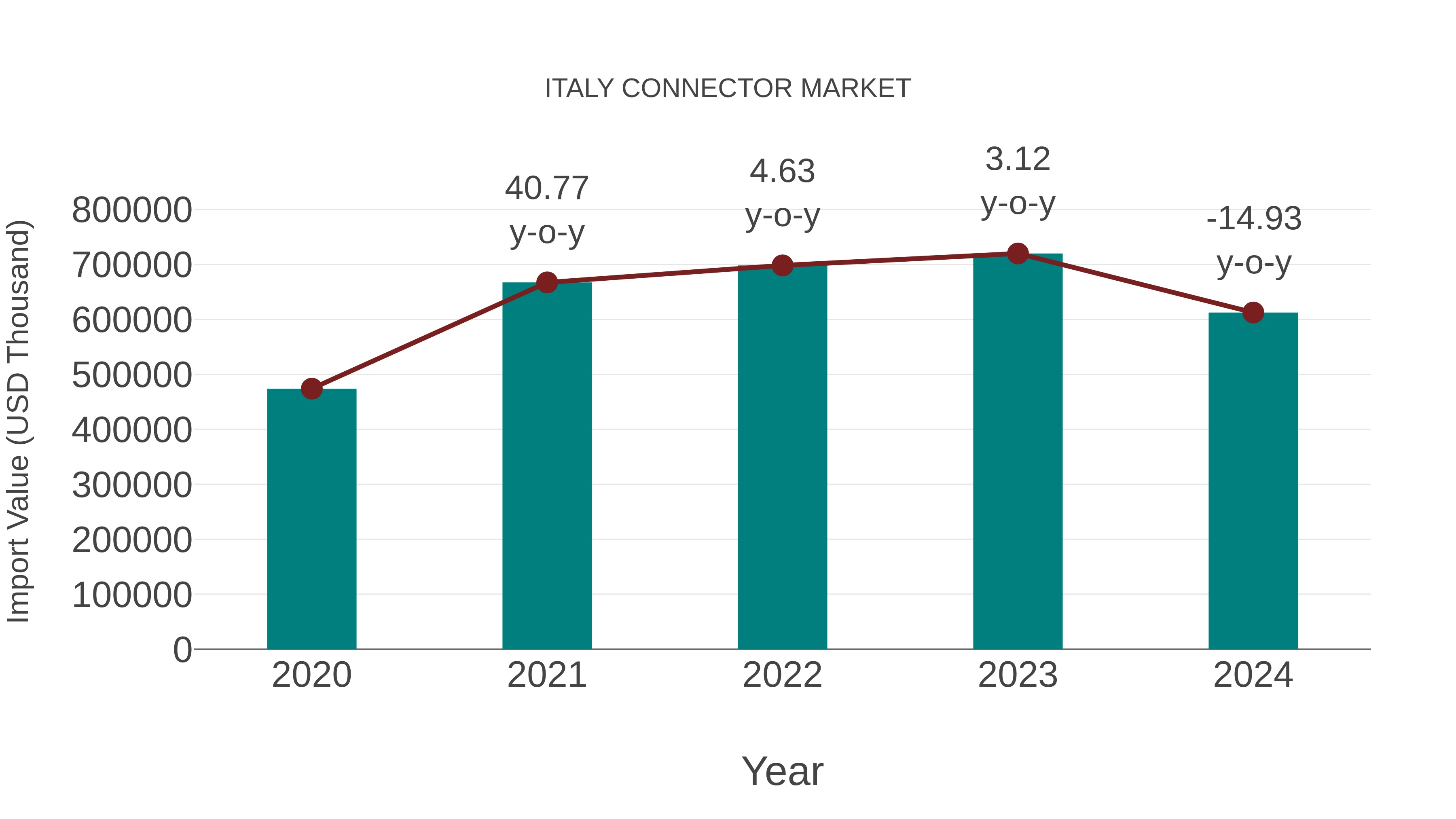
Italy Connector Market Synopsis
The connector market in Italy supplies a wide range of electrical, electronic, and fiber optic connectors used in various industries such as automotive, telecommunications, aerospace, and healthcare. Connectors play a critical role in facilitating signal transmission, power distribution, and data connectivity in complex systems and devices. Italy connector manufacturers emphasize product reliability, durability, and customization to meet the demanding requirements of different applications and market segments.
Drivers of the market
Growth in this market is fueled by factors such as the expanding automotive and electronics industries, increasing demand for high-speed data transmission, advancements in connector design and materials, and the rising adoption of connectors in various end-use applications such as telecommunications, aerospace, and healthcare.
Challenges of the market
Italy connector market encounters challenges associated with technological advancements and miniaturization. As electronic devices become smaller and more complex, connectors must meet increasingly stringent performance requirements while maintaining reliability. Additionally, ensuring compatibility across different device models and standards poses a challenge for connector manufacturers.
Government Policy of the market
In the connector market, Italy has implemented policies to support the development and standardization of connectivity solutions across industries. Government initiatives aimed at fostering innovation and competitiveness in the electronics sector have encouraged investment in research and development of advanced connector technologies. Furthermore, regulations governing product certification and compliance have ensured reliability and interoperability of connectors used in critical applications such as telecommunications, automotive, and aerospace, driving market growth while upholding quality standards and consumer trust.
Key Highlights of the Report:
- Italy Connector Market Outlook
- Market Size of Italy Connector Market, 2024
- Forecast of Italy Connector Market, 2031
- Historical Data and Forecast of Italy Connector Revenues & Volume for the Period 2018 - 2031
- Italy Connector Market Trend Evolution
- Italy Connector Market Drivers and Challenges
- Italy Connector Price Trends
- Italy Connector Porter's Five Forces
- Italy Connector Industry Life Cycle
- Historical Data and Forecast of Italy Connector Market Revenues & Volume By Product for the Period 2018 - 2031
- Historical Data and Forecast of Italy Connector Market Revenues & Volume By PCB Connectors for the Period 2018 - 2031
- Historical Data and Forecast of Italy Connector Market Revenues & Volume By IO Connectors for the Period 2018 - 2031
- Historical Data and Forecast of Italy Connector Market Revenues & Volume By Circular Connectors for the Period 2018 - 2031
- Historical Data and Forecast of Italy Connector Market Revenues & Volume By Fiber Optic Connectors for the Period 2018 - 2031
- Historical Data and Forecast of Italy Connector Market Revenues & Volume By RF Coaxial Connectors for the Period 2018 - 2031
- Historical Data and Forecast of Italy Connector Market Revenues & Volume By Others for the Period 2018 - 2031
- Historical Data and Forecast of Italy Connector Market Revenues & Volume By End Use for the Period 2018 - 2031
- Historical Data and Forecast of Italy Connector Market Revenues & Volume By Telecom for the Period 2018 - 2031
- Historical Data and Forecast of Italy Connector Market Revenues & Volume By Transportation for the Period 2018 - 2031
- Historical Data and Forecast of Italy Connector Market Revenues & Volume By Automotive for the Period 2018 - 2031
- Historical Data and Forecast of Italy Connector Market Revenues & Volume By Industrial for the Period 2018 - 2031
- Historical Data and Forecast of Italy Connector Market Revenues & Volume By Computer & Peripherals for the Period 2018 - 2031
- Historical Data and Forecast of Italy Connector Market Revenues & Volume By Others for the Period 2018 - 2031
- Italy Connector Import Export Trade Statistics
- Market Opportunity Assessment By Product
- Market Opportunity Assessment By End Use
- Italy Connector Top Companies Market Share
- Italy Connector Competitive Benchmarking By Technical and Operational Parameters
- Italy Connector Company Profiles
- Italy Connector Key Strategic Recommendations






































