Italy Data Center Market Size & Growth Rate (2026-2032)
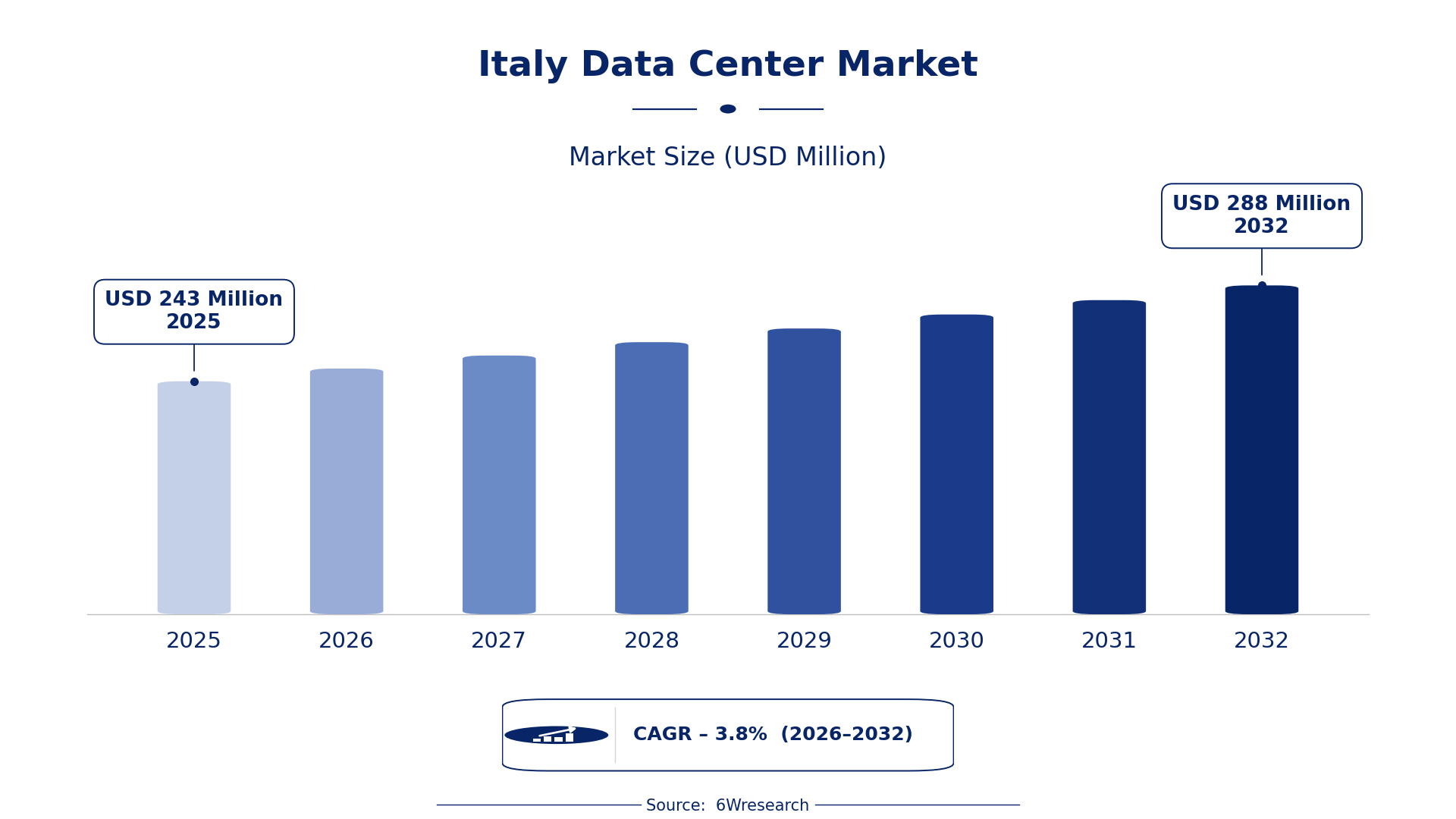
The Italy Data Center Market was estimated at USD 243 Million in 2025 and is projected to reach USD 288 Million by 2032, growing at a CAGR of 3.8% from 2026 to 2032.
Italy Data Center Market Synopsis
The increasing demand for colocation services in Italy is reshaping the data center landscape, with businesses seeking flexible and cost-effective IT infrastructure solutions. Major cities like Milan and Rome are emerging as prime locations for data center establishments, thanks to their advanced connectivity and proximity to key European markets.
The growth trajectory of the Italy Data Center Market is fueled by a surge in cloud computing adoption and digital transformation initiatives across industries. As organizations ramp up their data storage capabilities, the focus on energy efficiency and sustainability is becoming paramount, driving investments in innovative technologies.
Italy Data Center Market Year-wise Growth Rate and Key Drivers
This graph illustrates the annual growth rates of the Italy Data Center Market from 2021 to 2032, highlighting a steady upward trajectory and projected expansion over the forecast period.
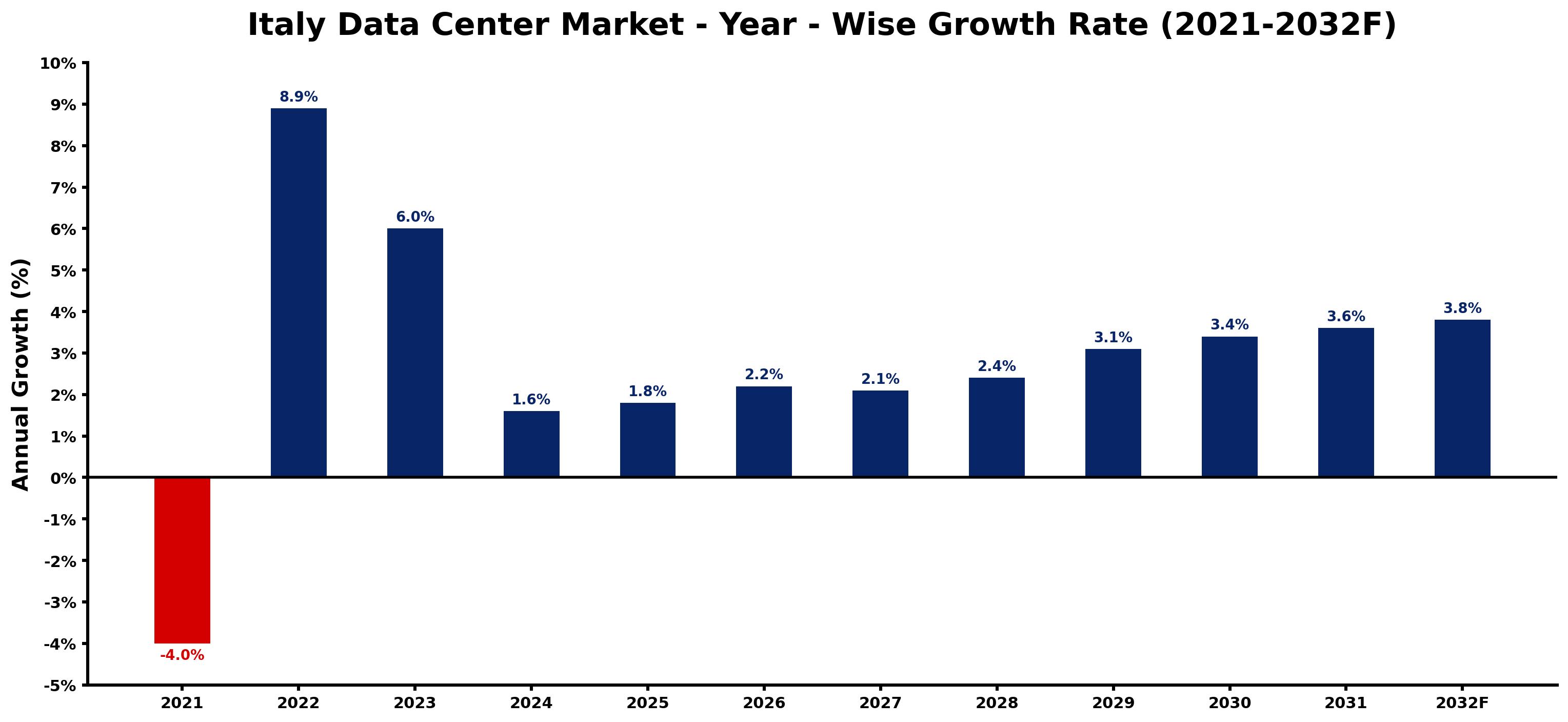
The table below presents the year‑wise growth rates along with the key drivers influencing the market
| Year | Growth Rate | Major Drivers |
| 2021 | -4.0% | Data center energy efficiency regulations hindered expansion plans. |
| 2022 | 8.9% | Italian Digital Transition Plan prioritizing data infrastructure development |
| 2023 | 6.0% | Increased demand for cloud services from SMEs in Italy |
| 2024 | 1.6% | New regulations supporting energy-efficient data center operations |
| 2025 | 1.8% | Government incentives for sustainable technology investments |
| 2026 | 2.2% | Rise in remote work boosting data center utilization |
| 2027 | 2.1% | Growth of fintech firms driving increased data storage needs |
| 2028 | 2.4% | Expanding e-commerce sector requiring robust data management systems |
| 2029 | 3.1% | Adoption of edge computing for local data processing |
| 2030 | 3.4% | Italy's focus on cybersecurity mandates enhancing data protection |
| 2031 | 3.6% | Collaboration with local universities fostering innovation in data services |
| 2032 | 3.8% | Increased investment from European funds for digital infrastructure |
Note: Market size estimations and growth projections presented in this report are based on 6Wresearch's proprietary forecasting methodology, utilizing the latest available industry data, government publications, and primary research inputs.
Italy Data Center Market Key Takeaways
Below are some of the specific key takeaways from the market, including:
- Colocation services are in high demand as businesses prioritize outsourcing their IT infrastructure.
- Energy efficiency and sustainability initiatives are gaining momentum among data center operators.
- Key cities like Milan and Rome are becoming major data center hubs, enhancing regional connectivity.
- The Italian government's focus on data privacy regulations is shaping market growth strategies.
- Emerging technologies like IoT and AI are driving innovation within the data center space.
Evaluation of Restraints in Italy Data Center Market
Despite its growth potential, the Italy Data Center Market faces several constraints. The escalating demand for data storage is putting pressure on existing facilities, while the limited availability of suitable land for new developments presents significant challenges. Additionally, high energy costs and stringent regulations surrounding data privacy necessitate careful planning and compliance, which can deter new entrants. The competitive nature of the market, dominated by a few major players, further complicates the landscape, making it difficult for smaller providers to gain traction.
Italy Data Center Market Trends
A clear trend is emerging as organizations increasingly turn to edge computing solutions. This shift allows for improved latency and enhanced data processing capabilities closer to end-users. Concurrently, the emphasis on renewable energy sources in data centers is intensifying, reflecting a broader commitment to sustainability.
on top of that, businesses are recognizing the importance of cybersecurity, prompting data center operators to enhance their security protocols. As digitalization accelerates, a greater focus on compliance with data protection regulations is also evident, prompting providers to invest in secure and compliant hosting solutions.
Italy Data Center Market Opportunities
With the ongoing digital transformation across various sectors, there are ample opportunities for data center providers to expand their services. The rise in remote work is boosting demand for cloud-based solutions, creating a need for enhanced data storage facilities. Additionally, the government's commitment to promoting digital infrastructure presents a favorable environment for investment in new data center projects.
The increasing focus on energy-efficient technologies and sustainable practices offers further avenues for growth, allowing providers to differentiate themselves in a competitive market. These opportunities highlight the necessity for strategic investments and innovative approaches to meet evolving customer needs.
Government Initiatives in the Italy Data Center Market
Government policy plays a crucial role in shaping the Italy Data Center Market. With a focus on enhancing digital infrastructure and ensuring data protection compliance, the Italian government is implementing initiatives that foster market growth while addressing sustainability concerns. These efforts are particularly relevant as businesses seek reliable and compliant data storage solutions.
- A national digital infrastructure upgrade programme launched in early 2025 is enhancing connectivity across major cities.
- Current efforts are underway to promote energy efficiency in data centers, encouraging operators to adopt green technologies.
- A regulatory framework established in 2025 mandates transparency in billing practices for data center services.
- Upcoming plans for a public-private partnership initiative aim to increase access to data center services by 2028.
- Tax incentives for data center investments have been recently introduced to attract foreign investment into the sector.
Future Insights of the Italy Data Center Market
The future of the Italy Data Center Market appears bright, with a projected uptick in demand for cloud services and digital solutions. As more businesses transition to digital operations, the need for secure and efficient data storage will only grow. The ongoing push for sustainability will likely shape investment strategies, leading to a significant shift towards greener data center practices.
on top of that, as regulatory frameworks evolve, providers will need to remain agile, ensuring compliance while leveraging new technologies. The combination of these factors suggests that the market will continue to expand, driven by innovation and a commitment to meeting the changing demands of customers.
Italy Data Center Market Latest Developments
In the past year, the Italy Data Center Market has seen considerable activity, reflecting a strong commitment to innovation and sustainability. As operators invest in new technologies and expand their facilities, the competitive landscape is shifting. Major advancements in energy efficiency and data security are becoming focal points for industry players.
- A leading regional operator completed the expansion of its Milan facility in Q2 2025, increasing capacity to meet rising demand.
- In early 2025, a major technology vendor launched a new energy-efficient cooling system, designed specifically for data centers.
- A partnership between local governments and private firms is currently underway, aimed at enhancing cybersecurity measures across the sector.
- By late 2026, a new data center is expected to open in Turin, focusing on providing colocation services for SMEs.
- Recent updates to data privacy regulations are prompting operators to upgrade their compliance protocols, an initiative that is ongoing.
Italy Data Center Market - Key Attractiveness of the Report
- 10 Years of Market Numbers
- Historical Data Starting from 2022 to 2025
- Base Year: 2025
- Forecast Data until 2032
- Key Performance Indicators Impacting the Market
- Major Upcoming Developments and Projects
Key Highlights of the Report:
- Italy Data Center Market Outlook
- Market Size of Italy Data Center Market, 2025
- Forecast of Italy Data Center Market, 2032
- Historical Data and Forecast of Italy Data Center Revenues & Volume for the Period 2022-2032F
- Italy Data Center Market Trend Evolution
- Italy Data Center Market Drivers and Challenges
- Italy Data Center Price Trends
- Italy Data Center Porter's Five Forces
- Italy Data Center Industry Life Cycle
- Historical Data and Forecast of Italy Data Center Market Revenues & Volume By Component for the Period 2022-2032F
- Historical Data and Forecast of Italy Data Center Market Revenues & Volume By Electrical for the Period 2022-2032F
- Historical Data and Forecast of Italy Data Center Market Revenues & Volume By Mechanical for the Period 2022-2032F
- Historical Data and Forecast of Italy Data Center Market Revenues & Volume By Networking for the Period 2022-2032F
- Historical Data and Forecast of Italy Data Center Market Revenues & Volume By Racks for the Period 2022-2032F
- Historical Data and Forecast of Italy Data Center Market Revenues & Volume By Security Systems for the Period 2022-2032F
- Historical Data and Forecast of Italy Data Center Market Revenues & Volume By Fire Systems for the Period 2022-2032F
- Historical Data and Forecast of Italy Data Center Market Revenues & Volume By Vertical for the Period 2022-2032F
- Historical Data and Forecast of Italy Data Center Market Revenues & Volume By Banking Financial Services & Insurance (BFSI) for the Period 2022-2032F
- Historical Data and Forecast of Italy Data Center Market Revenues & Volume By Government for the Period 2022-2032F
- Historical Data and Forecast of Italy Data Center Market Revenues & Volume By IT & Telecom for the Period 2022-2032F
- Historical Data and Forecast of Italy Data Center Market Revenues & Volume By Media for the Period 2022-2032F
- Historical Data and Forecast of Italy Data Center Market Revenues & Volume By Retail for the Period 2022-2032F
- Historical Data and Forecast of Italy Data Center Market Revenues & Volume By Manufacturing for the Period 2022-2032F
- Historical Data and Forecast of Italy Data Center Market Revenues & Volume By Others for the Period 2022-2032F
- Italy Data Center Import Export Trade Statistics
- Market Opportunity Assessment By Component
- Market Opportunity Assessment By Vertical
- Italy Data Center Top Companies Market Share
- Italy Data Center Competitive Benchmarking By Technical and Operational Parameters
- Italy Data Center Company Profiles
- Italy Data Center Key Strategic Recommendations






































