Italy Decorative tile Market Summary
The italy decorative tile market was estimated at USD 147 Million in 2025 and is projected to reach USD 161 Million by 2032, growing at a CAGR of 0.7% from 2026 to 2032.
Italy Decorative tile Market Year-wise Growth Rate and Key Drivers
This graph highlights how the Italy Decorative tile Market has steadily grown over the past five years, supported by major growth factors.
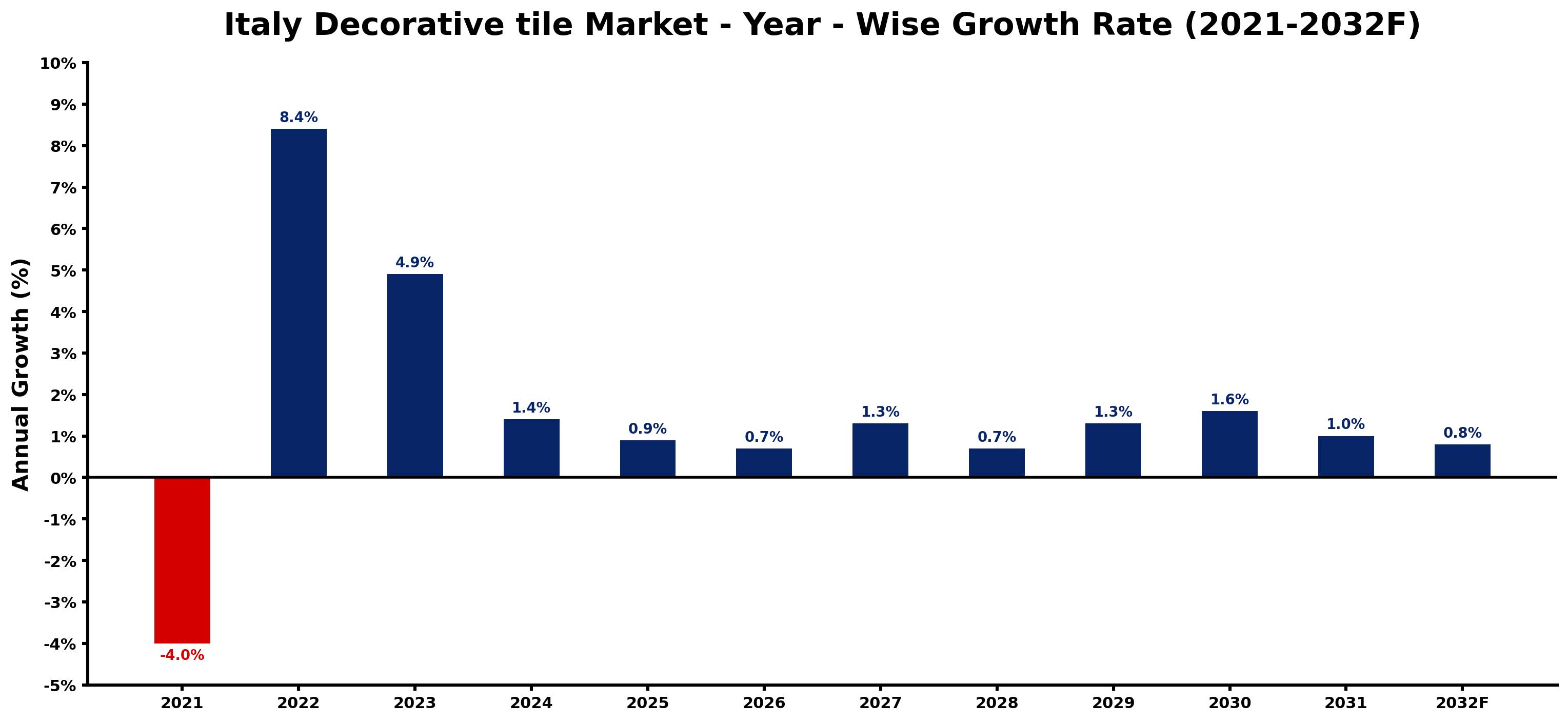
The table below presents the year wise growth rates along with the key drivers influencing the market
| Year | Growth Rate | Major Drivers |
| 2021 | -4.0% | A significant downturn in tourism led to decreased investments in renovation projects, affecting decorative tile sales. |
| 2022 | 8.4% | Local craftsmanship gained traction, enhancing the appeal of handcrafted decorative tiles. |
| 2023 | 4.9% | An influx of eco-friendly materials attracted environmentally conscious consumers to the market. |
| 2024 | 1.4% | Architectural trends shifted towards personalized designs, highlighting unique tile patterns and finishes. |
| 2025 | 0.9% | Increased tourism led to heightened demand for aesthetically pleasing commercial spaces. |
| 2026 | 0.7% | Digital platforms facilitated direct-to-consumer sales, broadening market access for artisans. |
| 2027 | 1.3% | Sustainability certifications became crucial, influencing purchasing decisions among discerning buyers. |
| 2028 | 0.7% | Renovation projects surged as homeowners sought to enhance property value and appeal. |
| 2029 | 1.3% | Collaborations between designers and manufacturers introduced innovative tile collections to the market. |
| 2030 | 1.6% | The revival of historical craftsmanship techniques sparked consumer interest in traditional designs. |
| 2031 | 1.0% | Emerging technologies enabled more intricate tile designs, appealing to modern architectural styles. |
| 2032 | 0.8% | Urbanization trends increased demand for decorative tiles in upscale residential developments. |
Note - Market size estimations and growth projections presented in this report are based on 6Wresearch's advanced forecasting approach, validated with industry datasets as of June 2026.
Italy Decorative tile Market Synopsis
The Italy Decorative tile Market is projected to reach 0.7% and witness significant growth during the forecast period (2026-2032). This dynamic market is characterized by an array of decorative tiles that cater to diverse aesthetic preferences and contemporary design trends. Known for their exquisite craftsmanship and quality, Italian decorative tiles are commonly made from durable materials such as porcelain, ceramic, and glass. The increasing demand for premium and custom-designed tiles is a primary driver, particularly for residential and commercial applications in spaces like kitchens, bathrooms, and outdoor areas.
Italy Decorative tile Market Trends
The Italy decorative tile market is evolving with notable trends that reflect changing consumer preferences and technological advancements. A significant trend is the growing interest in eco-friendly and sustainable materials. Many consumers now prefer tiles crafted from recycled materials or natural stone alternatives, aligning their purchases with environmental responsibility. Another emerging trend is the demand for unique and customizable designs, with consumers showing a preference for artisanal craftsmanship and intricate patterns. Digital printing technology is increasingly enabling manufacturers to produce highly detailed and bespoke tile options. Furthermore, there is a notable shift towards larger format tiles, alongside a revival of traditional motifs that celebrate Italy's rich cultural heritage.
Italy Decorative tile Market Challenges and Restraints
The Italy decorative tile market faces several challenges that impact its overall growth. Intense competition from both domestic and international manufacturers creates significant pricing pressures, pushing companies to innovate and differentiate their products. Additionally, fluctuations in raw material costs, especially for ceramic and porcelain, can disrupt profit margins. Economic uncertainties and evolving regulations further complicate the landscape for businesses operating in this market, compelling them to continually adapt their strategies to meet changing market dynamics. As such, companies must remain innovative to sustain competitiveness and drive growth.
Italy Decorative tile Market Investment Opportunities
Investors looking at the Italy decorative tile market will find several promising opportunities due to the nation's esteemed history of artistic craftsmanship and design excellence. With high demand for luxury home decor, Italian decorative tiles are increasingly sought after for their refined aesthetic and quality. Key investment areas include manufacturing, distribution, and retail, where businesses can capitalize on the growing domestic and international demand. The rise of digital printing technology allows for a broader range of customization options, appealing to consumers seeking distinctive products. Collaborating with local artisans can enhance product offerings, attracting discerning customers who appreciate exclusivity and premium craftsmanship.
Italy Decorative tile Market Government Investment and Initiatives
Government policies in Italy significantly influence the decorative tile market, driving initiatives that promote sustainable development and innovation within the construction sector. Various regulations have been established to encourage companies to use eco-friendly materials and implement energy-efficient production processes. Furthermore, the government offers incentives and subsidies for businesses investing in research and development for new tile designs and technologies. Strict adherence to quality standards and certification processes ensures the integrity of products and consumer safety. The government also actively supports initiatives that promote Italian craftsmanship, preserving traditional tile-making techniques while enhancing the competitiveness of domestically produced tiles on the global stage.
Italy Decorative tile Market Latest Developments (May 2025 - June 2026)
Recent developments in the Italy decorative tile market reflect a strong push towards innovation and sustainability. Companies have increasingly adopted advanced digital technologies to enhance production capabilities and design personalization. There has been a marked focus on eco-friendly practices, with several manufacturers pivoting towards sustainable sourcing and production methods. The interest in unique, customized tiles has intensified, prompting many producers to explore collaborations with local artists to create distinct offerings. Overall, the market is adapting to meet consumer expectations for quality, sustainability, and artistic design as it evolves continuously.
Italy Decorative tile Market - Key Attractiveness of the Report
- 10 Years of Market Numbers
- Historical Data Starting from 2022 to 2025
- Base Year: 2025
- Forecast Data until 2032
- Key Performance Indicators Impacting the Market
- Major Upcoming Developments and Projects
Key Highlights of the Report:
- Italy Decorative tile Market Outlook
- Market Size of Italy Decorative tile Market, 2025
- Forecast of Italy Decorative tile Market, 2032F
- Historical Data and Forecast of Italy Decorative tile Revenues & Volume for the Period 2022-2032F
- Italy Decorative tile Market Trend Evolution
- Italy Decorative tile Market Drivers and Challenges
- Italy Decorative tile Price Trends
- Italy Decorative tile Porter's Five Forces
- Italy Decorative tile Industry Life Cycle
- Historical Data and Forecast of Italy Decorative tile Market Revenues & Volume By Type for the Period 2022-2032F
- Historical Data and Forecast of Italy Decorative tile Market Revenues & Volume By Ceramic Wall Tiles for the Period 2022-2032F
- Historical Data and Forecast of Italy Decorative tile Market Revenues & Volume By Vinyl Wall Tiles for the Period 2022-2032F
- Historical Data and Forecast of Italy Decorative tile Market Revenues & Volume By Stone Wall Tiles for the Period 2022-2032F
- Historical Data and Forecast of Italy Decorative tile Market Revenues & Volume By Other Types for the Period 2022-2032F
- Historical Data and Forecast of Italy Decorative tile Market Revenues & Volume By End-users for the Period 2022-2032F
- Historical Data and Forecast of Italy Decorative tile Market Revenues & Volume By Residential for the Period 2022-2032F
- Historical Data and Forecast of Italy Decorative tile Market Revenues & Volume By Commercial for the Period 2022-2032F
- Historical Data and Forecast of Italy Decorative tile Market Revenues & Volume By Application for the Period 2022-2032F
- Historical Data and Forecast of Italy Decorative tile Market Revenues & Volume By Flooring for the Period 2022-2032F
- Historical Data and Forecast of Italy Decorative tile Market Revenues & Volume By Wall Coverings for the Period 2022-2032F
- Historical Data and Forecast of Italy Decorative tile Market Revenues & Volume By Other Applications for the Period 2022-2032F
- Italy Decorative tile Import Export Trade Statistics
- Market Opportunity Assessment By Type
- Market Opportunity Assessment By End-users
- Market Opportunity Assessment By Application
- Italy Decorative tile Top Companies Market Share
- Italy Decorative tile Competitive Benchmarking By Technical and Operational Parameters
- Italy Decorative tile Company Profiles
- Italy Decorative tile Key Strategic Recommendations






































