Italy Edge Computing Market Size & Growth Rate (2026-2032)
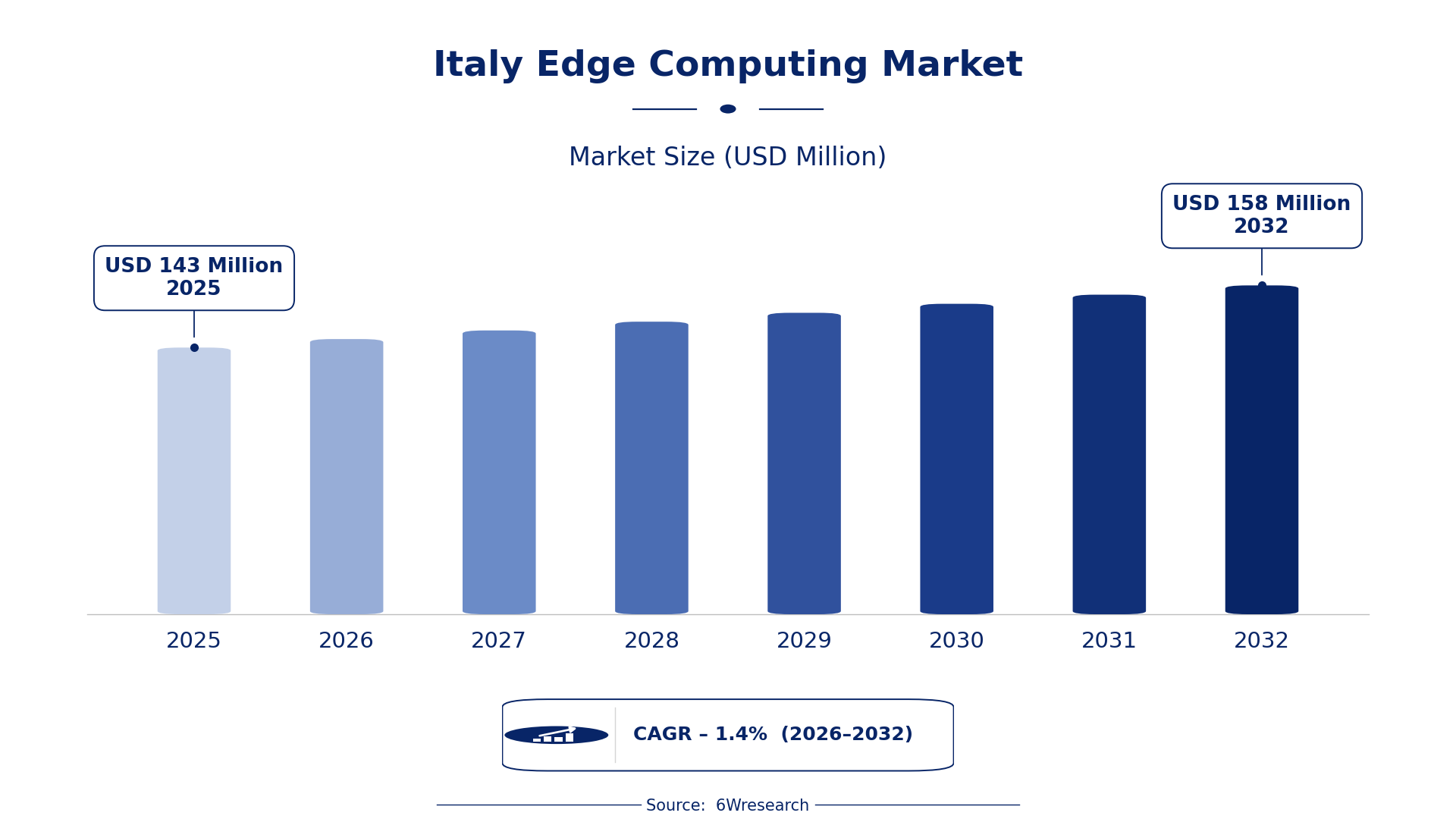
The Italy Edge Computing Market was estimated at USD 143 Million in 2025 and is projected to reach USD 158 Million by 2032, growing at a CAGR of 1.4% from 2026 to 2032.
Italy Edge Computing Market Synopsis
The most influential factor currently shaping the Italy Edge Computing Market is the rapid adoption of IoT devices across various sectors. This trend is creating a heightened demand for solutions that can process data in real-time and reduce latency, making edge computing an essential component of modern infrastructure.
In tandem with this growth, organizations are increasingly undertaking digital transformation initiatives. The need for efficient data processing capabilities is becoming more pronounced, particularly in industries like manufacturing and healthcare, where timely decision-making can significantly impact operational outcomes.
Italy Edge Computing Market Year-wise Growth Rate and Key Drivers
This graph illustrates the annual growth rates of the Italy Edge Computing Market from 2021 to 2032, highlighting a steady upward trajectory and projected expansion over the forecast period.
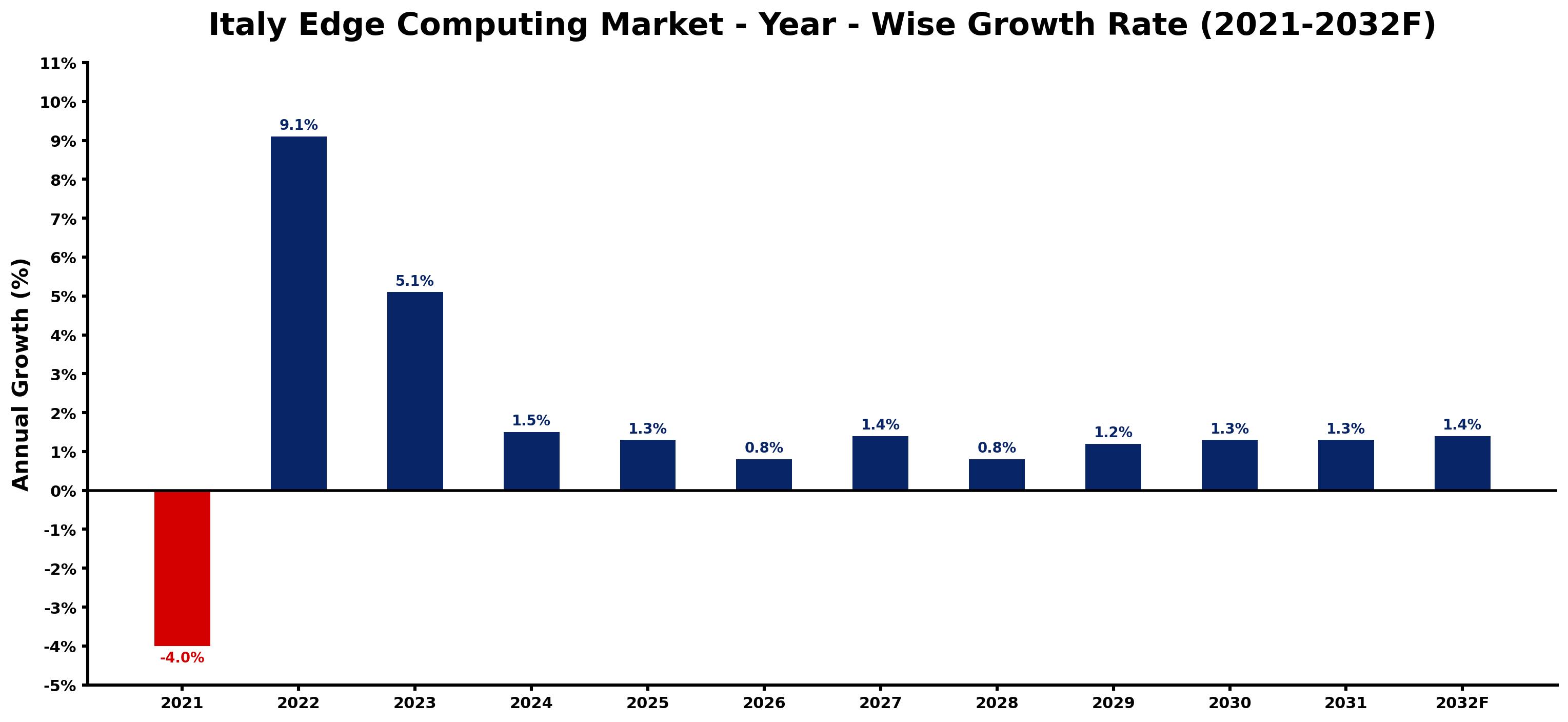
The table below presents the year‑wise growth rates along with the key drivers influencing the market
| Year | Growth Rate | Major Drivers |
| 2021 | -4.0% | Lack of 5G infrastructure rollout across Italy |
| 2022 | 9.1% | European Digital Strategy enhancing cloud and edge services |
| 2023 | 5.1% | Increased demand for IoT applications in smart cities |
| 2024 | 1.5% | Government initiatives promoting 5G connectivity expansion |
| 2025 | 1.3% | Growth of remote working leading to distributed computing |
| 2026 | 0.8% | Adoption of AI technologies driving local data processing |
| 2027 | 1.4% | Rising interest in real-time data analytics across sectors |
| 2028 | 0.8% | Local enterprises prioritizing data sovereignty and compliance |
| 2029 | 1.2% | Emergence of edge AI solutions in tech startups |
| 2030 | 1.3% | Focus on reducing latency in urban digital solutions |
| 2031 | 1.3% | Investment in healthcare tech fostering edge infrastructure |
| 2032 | 1.4% | Smart manufacturing trends pushing for local data centers |
Note: Market size estimations and growth projections presented in this report are based on 6Wresearch's proprietary forecasting methodology, utilizing the latest available industry data, government publications, and primary research inputs.
Italy Edge Computing Market Key Takeaways
Below are some of the specific key takeaways from the market, including:
- The rise in IoT device adoption is a primary driver of edge computing solutions.
- Healthcare and manufacturing sectors are leading the demand for edge technologies.
- Real-time data processing capabilities are critical for enhancing operational efficiency.
- Data security and regulatory compliance remain significant challenges for market players.
- Investment opportunities are emerging in data center and telecommunications infrastructure.
Evaluation of Restraints in Italy Edge Computing Market
The Italy Edge Computing Market faces several barriers that could impede its growth trajectory. Chief among these are data security concerns, as processing occurs closer to data sources, increasing vulnerability to breaches. Compliance with stringent regulations, particularly those set forth by the GDPR, adds another layer of complexity. Additionally, a shortage of skilled professionals in edge computing technologies complicates implementation and management for organizations, restricting the market's potential.
Italy Edge Computing Market Trends
A noticeable trend is the increasing integration of edge computing with 5G technology, which facilitates faster data transmission and enhances the capabilities of edge solutions. Organizations are also prioritizing energy efficiency and scalability in their edge computing investments. As the volume of data generated by connected devices continues to grow, businesses are increasingly looking to edge computing to process this data effectively, thus driving further demand.
Italy Edge Computing Market Opportunities
Investment opportunities abound in the Italy Edge Computing Market, particularly in sectors embracing smart infrastructure. The burgeoning demand for autonomous vehicles and smart city projects presents avenues for growth. Companies focusing on developing edge computing hardware and software, as well as those enhancing data center capabilities, stand to benefit significantly. Collaboration with local startups specializing in edge innovations could yield unique investment prospects.
Government Initiatives in the Italy Edge Computing Market
The Italian government is actively promoting digital innovation to enhance the Edge Computing Market. With a strong focus on data security and privacy, recent policies aim to ensure compliance with regulations like the GDPR. Investments in digital infrastructure and support for research and development initiatives are also part of the strategy to foster innovation and competitiveness.
- A national digital infrastructure upgrade programme launched in early 2025 aims to enhance connectivity for edge computing solutions.
- Current efforts include a regulatory framework ensuring data protection compliance that is underway.
- A planned public-private initiative expected to expand telecommunications infrastructure access by 2028 is set to support edge computing growth.
- Recently completed initiatives include funding for R&D projects focused on edge technology advancements.
Future Insights of the Italy Edge Computing Market
Looking ahead to 2026-2032, the Italy Edge Computing Market is likely to experience substantial growth. The convergence of IoT, cloud computing, and data analytics will drive demand for edge computing solutions. As organizations seek to optimize their operations and improve decision-making processes, the market will expand, creating opportunities for both established players and new entrants. Innovations in technology will continue to shape the market's trajectory, making it an exciting space to watch.
Italy Edge Computing Market Latest Developments
In the last year, the Italy Edge Computing Market has seen a flurry of activity, reflecting a growing commitment to enhance technological capabilities. Organizations are increasingly investing in edge solutions to meet the demands of data-intensive applications. The push towards digital transformation has spurred collaborations and technological advancements.
- A major technology vendor announced an ongoing initiative in mid-2025 to integrate edge computing capabilities into existing cloud platforms.
- In early 2025, a leading regional operator completed a rollout of edge computing infrastructure to support smart city projects.
- Currently, a partnership between local universities and tech firms is underway to drive innovation in edge computing applications.
- A rollout expected to begin in the second half of 2026 will focus on enhancing data processing capabilities for autonomous vehicles.
Italy Edge Computing Market - Key Attractiveness of the Report
- 10 Years of Market Numbers
- Historical Data Starting from 2022 to 2025
- Base Year: 2025
- Forecast Data until 2032
- Key Performance Indicators Impacting the Market
- Major Upcoming Developments and Projects
Key Highlights of the Report:
- Italy Edge Computing Market Outlook
- Market Size of Italy Edge Computing Market, 2025
- Forecast of Italy Edge Computing Market, 2032
- Historical Data and Forecast of Italy Edge Computing Revenues & Volume for the Period 2022-2032F
- Italy Edge Computing Market Trend Evolution
- Italy Edge Computing Market Drivers and Challenges
- Italy Edge Computing Price Trends
- Italy Edge Computing Porter's Five Forces
- Italy Edge Computing Industry Life Cycle
- Historical Data and Forecast of Italy Edge Computing Market Revenues & Volume By Component for the Period 2022-2032F
- Historical Data and Forecast of Italy Edge Computing Market Revenues & Volume By Hardware for the Period 2022-2032F
- Historical Data and Forecast of Italy Edge Computing Market Revenues & Volume By Software for the Period 2022-2032F
- Historical Data and Forecast of Italy Edge Computing Market Revenues & Volume By Services for the Period 2022-2032F
- Historical Data and Forecast of Italy Edge Computing Market Revenues & Volume By Organization Size for the Period 2022-2032F
- Historical Data and Forecast of Italy Edge Computing Market Revenues & Volume By Large Enterprises for the Period 2022-2032F
- Historical Data and Forecast of Italy Edge Computing Market Revenues & Volume By SMEs for the Period 2022-2032F
- Historical Data and Forecast of Italy Edge Computing Market Revenues & Volume By Application for the Period 2022-2032F
- Historical Data and Forecast of Italy Edge Computing Market Revenues & Volume By Smart Cities for the Period 2022-2032F
- Historical Data and Forecast of Italy Edge Computing Market Revenues & Volume By Industrial Internet of Things (IIoT) for the Period 2022-2032F
- Historical Data and Forecast of Italy Edge Computing Market Revenues & Volume By Remote Monitoring for the Period 2022-2032F
- Historical Data and Forecast of Italy Edge Computing Market Revenues & Volume By Content Delivery for the Period 2022-2032F
- Historical Data and Forecast of Italy Edge Computing Market Revenues & Volume By Augmented Reality (AR) and Virtual Reality (VR) for the Period 2022-2032F
- Historical Data and Forecast of Italy Edge Computing Market Revenues & Volume By Others (Autonomous Vehicles, Drones, And Gaming) for the Period 2022-2032F
- Historical Data and Forecast of Italy Edge Computing Market Revenues & Volume By Vertical for the Period 2022-2032F
- Historical Data and Forecast of Italy Edge Computing Market Revenues & Volume By Manufacturing for the Period 2022-2032F
- Historical Data and Forecast of Italy Edge Computing Market Revenues & Volume By Energy and Utilities for the Period 2022-2032F
- Historical Data and Forecast of Italy Edge Computing Market Revenues & Volume By Government and Defense for the Period 2022-2032F
- Historical Data and Forecast of Italy Edge Computing Market Revenues & Volume By Telecommunications for the Period 2022-2032F
- Historical Data and Forecast of Italy Edge Computing Market Revenues & Volume By Media and Entertainment for the Period 2022-2032F
- Historical Data and Forecast of Italy Edge Computing Market Revenues & Volume By Retail and Consumer Goods for the Period 2022-2032F
- Historical Data and Forecast of Italy Edge Computing Market Revenues & Volume By Transportation and Logistics for the Period 2022-2032F
- Historical Data and Forecast of Italy Edge Computing Market Revenues & Volume By Healthcare and Life Sciences for the Period 2022-2032F
- Italy Edge Computing Import Export Trade Statistics
- Market Opportunity Assessment By Component
- Market Opportunity Assessment By Organization Size
- Market Opportunity Assessment By Application
- Market Opportunity Assessment By Vertical
- Italy Edge Computing Top Companies Market Share
- Italy Edge Computing Competitive Benchmarking By Technical and Operational Parameters
- Italy Edge Computing Company Profiles
- Italy Edge Computing Key Strategic Recommendations






































