Italy Edible Oil Market Size (2020-2030)
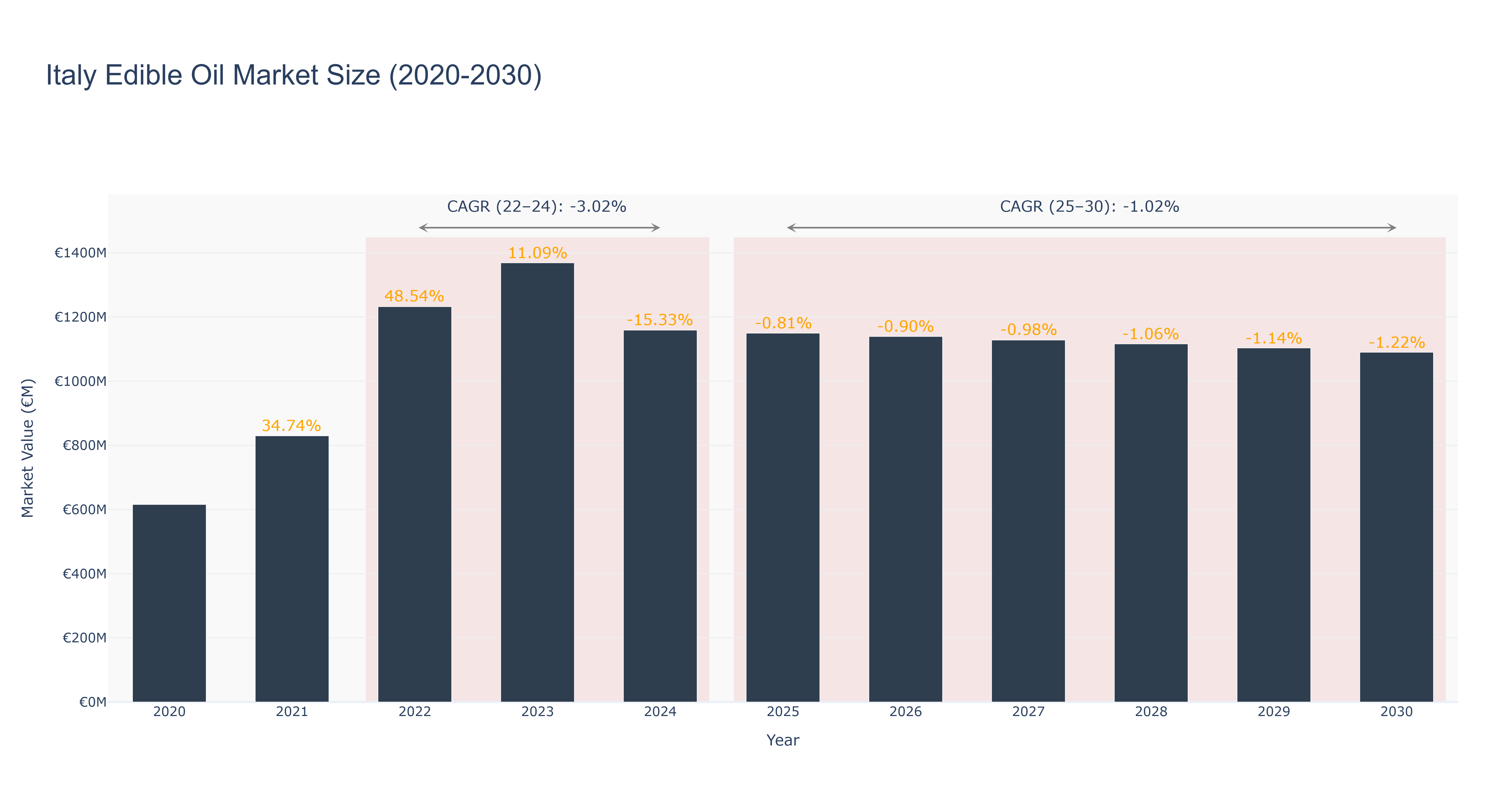
Italy Edible Oil Market has shown a fluctuating trend in recent years. The peak market size was recorded in 2023 at €1368.86 million. Actual market sizes from 2020 to 2024 were €615.69 million, €829.55 million, €1232.26 million, €1368.86 million, and €1159.01 million, respectively. The forecasted market sizes from 2025 to 2030 are expected to be €1149.57 million, €1139.27 million, €1128.13 million, €1116.20 million, €1103.48 million, and €1090.02 million. The CAGR for 2022-24 is -3.02%, while for 2025-30, it is -1.02%. The market experienced a significant growth rate between 2020 and 2023, driven by increased consumer demand for healthier food options. However, the downward trend post-2023 can be attributed to market saturation and increased competition. In the near future, Italy's Edible Oil Market is set to witness advancements in sustainable production practices to meet evolving consumer preferences.
Italy Edible Oil Market: Production & Trade Performance (2019-2025)
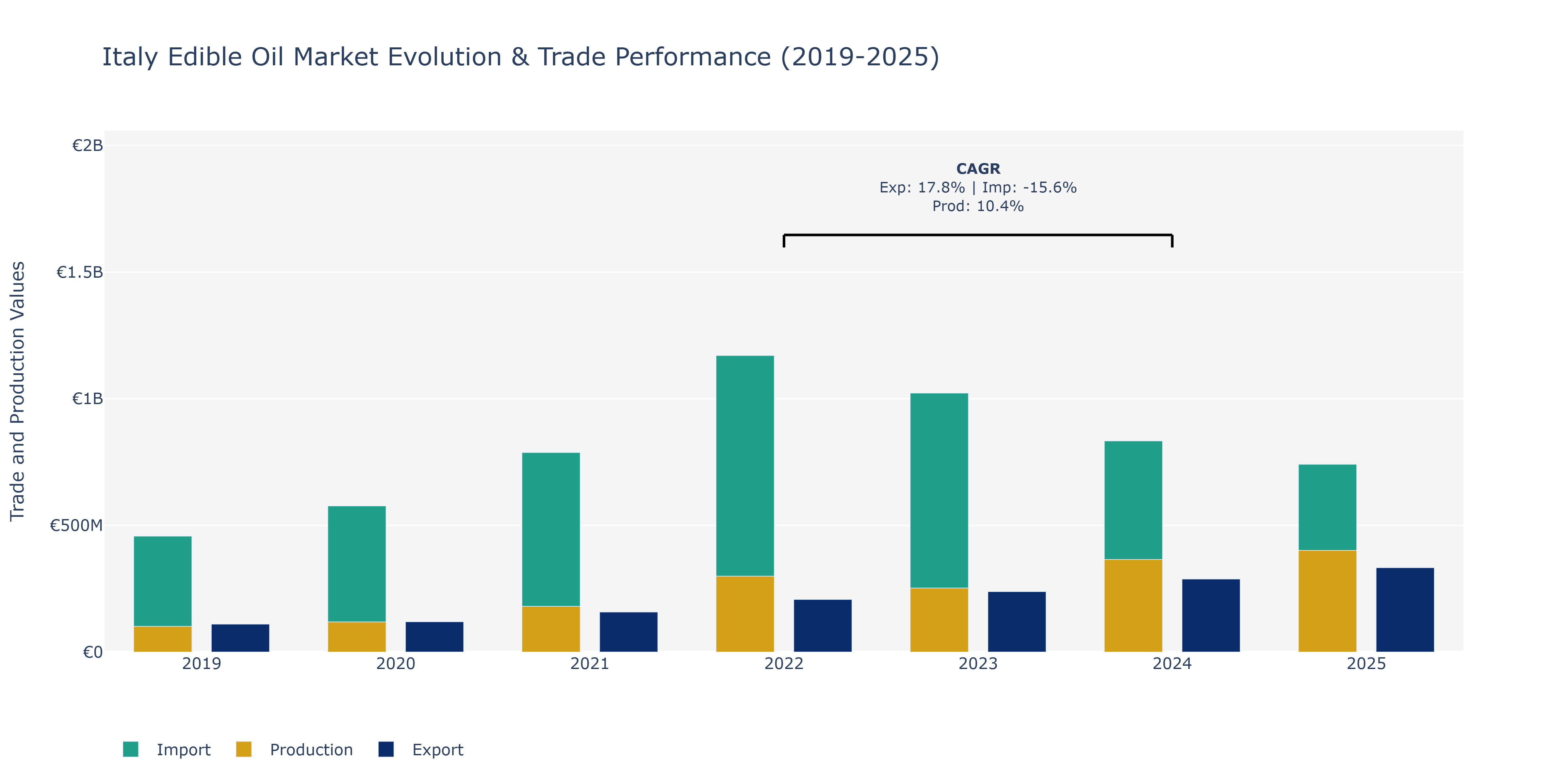
Between 2019 and 2025, the Italy Edible Oil Market experienced notable shifts in Exports, Imports, and Production. Exports grew steadily from €110.21 million in 2019 to €333.07 million in 2025, indicating increased international demand for Italian edible oils, possibly due to a reputation for quality and taste. In contrast, Imports fluctuated, peaking at €1.17 billion in 2022 before declining to €741.14 million in 2025, suggesting a shift towards greater self-sufficiency or changes in domestic consumption patterns. Production showed a consistent upward trend, reaching €401.2 million in 2025, reflecting investments in manufacturing capacity and technology to meet both domestic and export demands. These dynamics align with global trends emphasizing health-conscious consumption and sustainable sourcing, encouraging market players to adapt production processes and offerings to meet evolving consumer preferences.
Italy Edible Oil Market Overview
The Italy Edible Oil Market is characterized by a diverse range of products including olive oil, sunflower oil, and seed oils. Olive oil holds a significant market share due to Italy`s strong tradition of olive cultivation and consumption. The market is also influenced by growing health consciousness among consumers, leading to a preference for healthier cooking oils. The presence of renowned olive oil brands and a focus on quality and authenticity further drive market growth. Sunflower oil and seed oils are also popular choices, catering to different consumer preferences and cooking needs. The market is competitive, with players focusing on product innovation, sustainability, and marketing strategies to maintain or improve their market positions. Overall, the Italy Edible Oil Market is dynamic, reflecting evolving consumer preferences and industry trends.
Italy Edible Oil Market Trends
The Italy Edible Oil Market is currently experiencing a shift towards healthier and more sustainable options, with increasing consumer demand for oils such as olive oil, avocado oil, and coconut oil. Consumers are becoming more health-conscious and are opting for oils that are perceived to have health benefits and are produced using environmentally friendly practices. There is also a growing interest in organic and premium quality edible oils in Italy, driven by concerns for food safety and quality. Additionally, the market is seeing a rise in the popularity of specialty oils like truffle-infused oil and flavored oils, catering to the evolving tastes and preferences of consumers. Overall, the Italy Edible Oil Market is witnessing a trend towards premium, healthy, and sustainable options.
Italy Edible Oil Market Challenges
The Italy Edible Oil Market faces several challenges, including fluctuating raw material prices, increasing competition from imported oils, and changing consumer preferences towards healthier and more sustainable options. The market is also impacted by regulatory requirements, such as labeling regulations and quality standards, which can add complexity and cost to the production and distribution processes. Additionally, the economic instability in the region and the impact of global events, such as trade disputes and geopolitical tensions, can affect the market dynamics and create uncertainties for both producers and consumers. Adapting to these challenges requires companies in the Italy Edible Oil Market to innovate, diversify their product offerings, and focus on efficient supply chain management to remain competitive in a rapidly evolving landscape.
Italy Edible Oil Market Investment Opportunities
The Italy Edible Oil Market presents promising investment opportunities due to factors such as increasing consumer awareness of health benefits, rising demand for high-quality cooking oils, and a growing trend towards healthier eating habits. Investors can consider opportunities in premium and organic edible oils, as well as innovative products like infused oils or specialty oils. Additionally, the market offers potential for expansion in the olive oil sector, leveraging Italy`s reputation as a leading producer of high-quality olive oil. Investing in sustainable practices and production methods can also be a strategic move to align with the increasing consumer preference for environmentally friendly products. Overall, the Italy Edible Oil Market offers diverse investment prospects driven by evolving consumer preferences and market trends.
Italy Edible Oil Market Government Policy
Government policies related to the Italy Edible Oil Market primarily focus on promoting domestic production, ensuring food safety standards, and regulating imports. Italy has implemented measures to support local farmers and encourage the production of high-quality edible oils such as olive oil. The government also enforces strict regulations to maintain the quality and safety of edible oils consumed in the country, including labeling requirements and monitoring of production processes. Import regulations are in place to control the influx of foreign edible oils and protect domestic producers. Additionally, there are initiatives to promote sustainable practices in the edible oil industry, aligning with broader environmental and health goals set by the government. Overall, government policies in Italy aim to safeguard consumer health, support local producers, and uphold industry standards in the edible oil market.
Italy Edible Oil Market Future Outlook
The future outlook for the Italy Edible Oil Market looks positive with a steady growth trajectory projected over the next few years. Factors such as increasing health consciousness among consumers, growing demand for healthier cooking oils like olive oil, and the rise in culinary tourism promoting the use of specialty oils are expected to drive market growth. Additionally, innovations in packaging, product diversification, and the emphasis on sustainability in production methods are likely to further boost the market. With a focus on quality, authenticity, and traceability becoming more important to consumers, Italian edible oil producers are well-positioned to capitalize on these trends and maintain a competitive edge in the market.
Key Highlights of the Report:
- Italy Edible Oil Market Outlook
- Market Size of Italy Edible Oil Market, 2021
- Forecast of Italy Edible Oil Market, 2031
- Historical Data and Forecast of Italy Edible Oil Revenues & Volume for the Period 2018 - 2031
- Italy Edible Oil Market Trend Evolution
- Italy Edible Oil Market Drivers and Challenges
- Italy Edible Oil Price Trends
- Italy Edible Oil Porter's Five Forces
- Italy Edible Oil Industry Life Cycle
- Historical Data and Forecast of Italy Edible Oil Market Revenues & Volume By Type for the Period 2018 - 2031
- Historical Data and Forecast of Italy Edible Oil Market Revenues & Volume By Palm Oil for the Period 2018 - 2031
- Historical Data and Forecast of Italy Edible Oil Market Revenues & Volume By Soybean Oil for the Period 2018 - 2031
- Historical Data and Forecast of Italy Edible Oil Market Revenues & Volume By Mustard Oil for the Period 2018 - 2031
- Historical Data and Forecast of Italy Edible Oil Market Revenues & Volume By Sunflower Oil for the Period 2018 - 2031
- Historical Data and Forecast of Italy Edible Oil Market Revenues & Volume By Others for the Period 2018 - 2031
- Historical Data and Forecast of Italy Edible Oil Market Revenues & Volume By for the Period 2018 - 2031
- Historical Data and Forecast of Italy Edible Oil Market Revenues & Volume By Packaging Type for the Period 2018 - 2031
- Historical Data and Forecast of Italy Edible Oil Market Revenues & Volume By Pouches for the Period 2018 - 2031
- Historical Data and Forecast of Italy Edible Oil Market Revenues & Volume By Jars for the Period 2018 - 2031
- Historical Data and Forecast of Italy Edible Oil Market Revenues & Volume By Cans for the Period 2018 - 2031
- Historical Data and Forecast of Italy Edible Oil Market Revenues & Volume By Bottles for the Period 2018 - 2031
- Historical Data and Forecast of Italy Edible Oil Market Revenues & Volume By for the Period 2018 - 2031
- Historical Data and Forecast of Italy Edible Oil Market Revenues & Volume By Pack Size for the Period 2018 - 2031
- Historical Data and Forecast of Italy Edible Oil Market Revenues & Volume By Less than 1 Litres for the Period 2018 - 2031
- Historical Data and Forecast of Italy Edible Oil Market Revenues & Volume By 1 Litres for the Period 2018 - 2031
- Historical Data and Forecast of Italy Edible Oil Market Revenues & Volume By 1 Litres - 5 litres for the Period 2018 - 2031
- Historical Data and Forecast of Italy Edible Oil Market Revenues & Volume By 5 Litres - 10 Litres for the Period 2018 - 2031
- Historical Data and Forecast of Italy Edible Oil Market Revenues & Volume By 10 Litres and Above for the Period 2018 - 2031
- Historical Data and Forecast of Italy Edible Oil Market Revenues & Volume By for the Period 2018 - 2031
- Historical Data and Forecast of Italy Edible Oil Market Revenues & Volume By Packaging Material for the Period 2018 - 2031
- Historical Data and Forecast of Italy Edible Oil Market Revenues & Volume By Metal for the Period 2018 - 2031
- Historical Data and Forecast of Italy Edible Oil Market Revenues & Volume By Plastic for the Period 2018 - 2031
- Historical Data and Forecast of Italy Edible Oil Market Revenues & Volume By Paper for the Period 2018 - 2031
- Historical Data and Forecast of Italy Edible Oil Market Revenues & Volume By Others for the Period 2018 - 2031
- Historical Data and Forecast of Italy Edible Oil Market Revenues & Volume By Application for the Period 2018 - 2031
- Historical Data and Forecast of Italy Edible Oil Market Revenues & Volume By HoReCa for the Period 2018 - 2031
- Historical Data and Forecast of Italy Edible Oil Market Revenues & Volume By Home Users for the Period 2018 - 2031
- Historical Data and Forecast of Italy Edible Oil Market Revenues & Volume By Food Processing Industry for the Period 2018 - 2031
- Historical Data and Forecast of Italy Edible Oil Market Revenues & Volume By for the Period 2018 - 2031
- Historical Data and Forecast of Italy Edible Oil Market Revenues & Volume By Distribution Channel for the Period 2018 - 2031
- Historical Data and Forecast of Italy Edible Oil Market Revenues & Volume By Direct/Institutional Sales for the Period 2018 - 2031
- Historical Data and Forecast of Italy Edible Oil Market Revenues & Volume By Supermarkets and Hypermarkets for the Period 2018 - 2031
- Historical Data and Forecast of Italy Edible Oil Market Revenues & Volume By Convenience Stores for the Period 2018 - 2031
- Historical Data and Forecast of Italy Edible Oil Market Revenues & Volume By Online for the Period 2018 - 2031
- Historical Data and Forecast of Italy Edible Oil Market Revenues & Volume By Others for the Period 2018 - 2031
- Italy Edible Oil Import Export Trade Statistics
- Market Opportunity Assessment By Type
- Market Opportunity Assessment By Packaging Type
- Market Opportunity Assessment By Pack Size
- Market Opportunity Assessment By Packaging Material
- Market Opportunity Assessment By Application
- Market Opportunity Assessment By Distribution Channel
- Italy Edible Oil Top Companies Market Share
- Italy Edible Oil Competitive Benchmarking By Technical and Operational Parameters
- Italy Edible Oil Company Profiles
- Italy Edible Oil Key Strategic Recommendations






































