Italy Filament Led Bulb Market Size, Share & Growth Rate
The Italy Filament Led Bulb Market was estimated at USD 243 Million in 2025 and is projected to reach USD 268 Million by 2032, growing at a CAGR of 1.4% from 2026 to 2032. This growth trajectory is primarily fueled by an increasing consumer inclination toward energy-efficient lighting and the continuing transition from traditional incandescent bulbs to more advanced LED technology. The unique combination of aesthetic appeal and energy savings offered by filament LED bulbs is significantly enhancing their adoption across various segments, particularly in residential and commercial settings.
Italy Filament Led Bulb Market Year-wise Growth Rate and Key Drivers
This graph highlights how the Italy Filament Led Bulb Market has steadily grown over the years, supported by major growth factors.
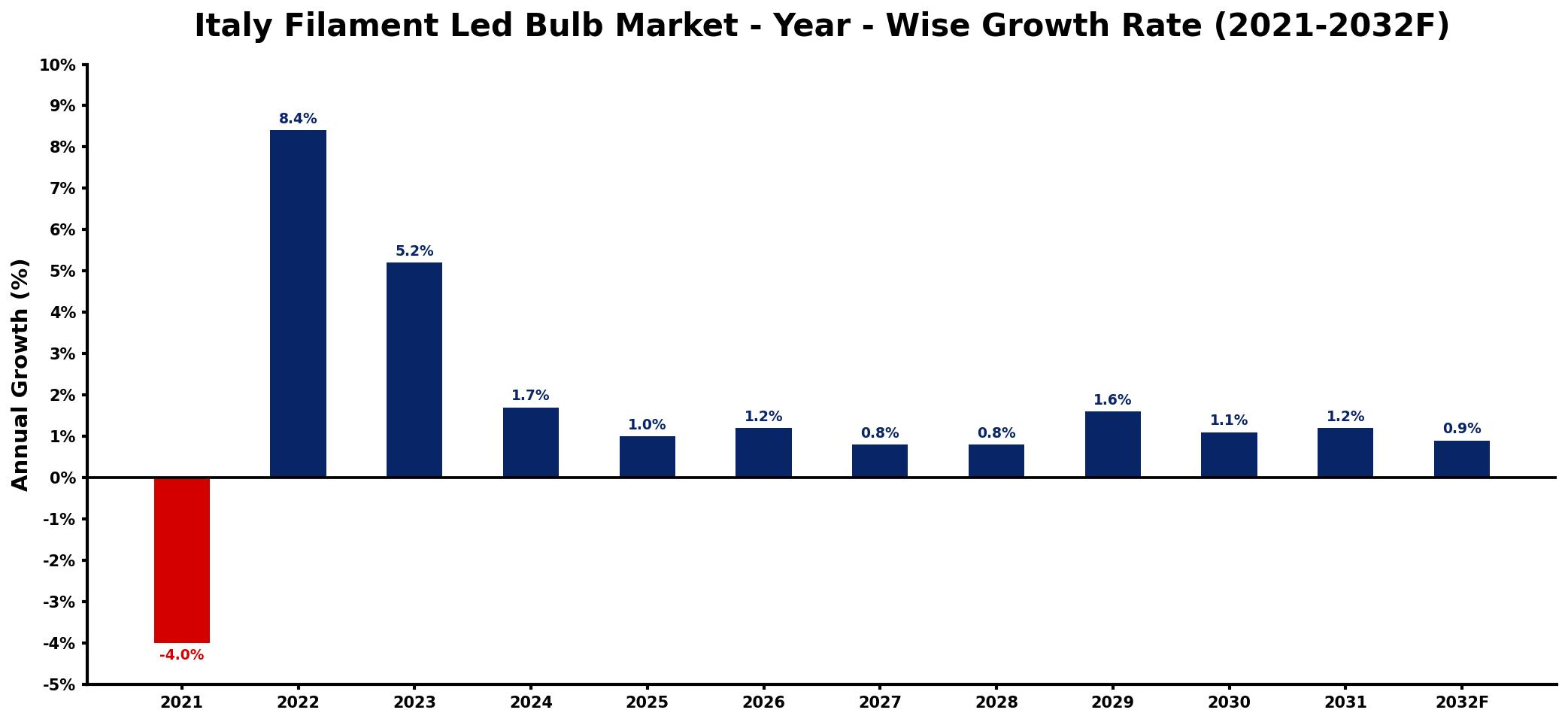
The table below presents the year‑wise growth rates along with the key drivers influencing the market
| Year | Growth Rate | Major Drivers |
| 2021 | -4.0% | reduced demand from construction sector |
| 2022 | 8.4% | expanding industrial usage applications |
| 2023 | 5.2% | increased investments in sustainable technologies |
| 2024 | 1.7% | expansion of smart home applications |
| 2025 | 1.0% | rising awareness of environmental benefits |
| 2026 | 1.2% | growth in retail distribution channels |
| 2027 | 0.8% | enhanced government incentives for sustainability |
| 2028 | 0.8% | emergence of innovative lighting solutions |
| 2029 | 1.6% | surge in residential renovation projects |
| 2030 | 1.1% | adoption of advanced energy regulations |
| 2031 | 1.2% | increased focus on design trends |
| 2032 | 0.9% | growing demand for customizable options |
Note: Market size estimations and growth projections presented in this report are based on 6Wresearch's proprietary forecasting methodology, utilizing the latest available industry data, government publications, and primary research inputs.
Italy Filament Led Bulb Market Synopsis
The burgeoning demand for energy-efficient lighting solutions in Italy is driving the filament LED bulb market forward. Consumers are increasingly drawn to these bulbs not only for their efficiency but also for their nostalgic design, which closely resembles traditional incandescent bulbs, making them ideal for decorative lighting.
In parallel, advancements in LED technology have played a pivotal role in enhancing the performance of filament bulbs. As energy costs rise, and awareness of sustainable practices increases, consumers are now more informed about the long-term savings associated with energy-efficient lighting, further bolstering market growth.
Italy Filament Led Bulb Market Key Takeaways
- Growing demand for energy-efficient and visually appealing lighting is shaping market dynamics.
- Consumer preference for retro design and modern technology combination is driving adoption.
- Ongoing advancements in LED technology are enhancing product performance and sustainability.
- Regulatory frameworks are supporting the transition to more energy-efficient lighting solutions.
- Increased public awareness campaigns are educating consumers about the benefits of filament LED bulbs.
Evaluation of Restraints in Italy Filament Led Bulb Market
Despite the promising growth in the Italy filament LED bulb market, several restraints pose challenges. One significant factor is the varying consumer expectations regarding color rendering and brightness levels, which can affect purchasing decisions. Additionally, some consumers may express concerns regarding compatibility with existing dimmer switches, which necessitates continuous product innovations and compliance with evolving energy efficiency standards. The market must address these issues to fully capitalize on the potential growth opportunities.
Italy Filament Led Bulb Market Trends
A notable trend shaping the Italy filament LED bulb market is the increasing preference for smart lighting solutions. Consumers are leaning toward bulbs that not only offer energy efficiency but can also integrate seamlessly with smart home systems. Additionally, there is a growing demand for customized lighting solutions, as consumers seek to create unique atmospheres in their spaces. These trends reflect a shift toward personalization in lighting, which filament LED bulbs can effectively fulfill.
Italy Filament Led Bulb Market Opportunities
As the market continues to evolve, significant growth and investment opportunities lie in expanding the range of filament LED bulb designs and functionalities. Innovations that improve compatibility with smart home technologies can attract tech-savvy consumers. Furthermore, capitalizing on the growing trend of sustainability by developing eco-friendly packaging and promoting the longevity of filament LED bulbs can enhance market appeal. Engaging in partnerships with interior designers and lighting retailers can also open new avenues for market expansion.
Government Initiatives in the Italy Filament Led Bulb Market
The Italian government is actively supporting the transition toward energy-efficient lighting solutions. Policies that promote the adoption of filament LED bulbs include stringent energy efficiency standards for lighting products and public awareness campaigns aimed at educating consumers about the benefits of energy-efficient lighting. Furthermore, incentives such as subsidies for LED lighting upgrades are designed to accelerate the market's growth and facilitate a broader acceptance of these innovative lighting solutions.
Future Insights of the Italy Filament Led Bulb Market
Looking ahead to the period between 2026 and 2032, the Italy filament LED bulb market is poised for steady growth. The ongoing shift towards sustainability, coupled with technological advancements in LED technology, will continue to enhance the market's attractiveness. As consumers become more environmentally conscious, the demand for energy-efficient products will likely rise. Additionally, increased collaborations with the design and hospitality sectors may further stimulate market growth, solidifying the filament LED bulb's position as a favored lighting choice.
Italy Filament Led Bulb Market Latest Developments (2025 - 2026)
Recent developments in the Italy filament LED bulb market indicate a growing emphasis on sustainable production practices. Manufacturers are increasingly adopting environmentally friendly processes and materials in their production lines. Additionally, there has been a noticeable surge in product offerings that incorporate smart technology, responding to consumer demand for integrated lighting solutions. These shifts reflect the industry's commitment to innovation and sustainability in the face of evolving consumer preferences.
Italy Filament Led Bulb Market - Key Attractiveness of the Report
- 10 Years of Market Numbers
- Historical Data Starting from 2022 to 2025
- Base Year: 2025
- Forecast Data until 2032
- Key Performance Indicators Impacting the Market
- Major Upcoming Developments and Projects
Key Highlights of the Report:
- Italy Filament Led Bulb Market Outlook
- Market Size of Italy Filament Led Bulb Market, 2025
- Forecast of Italy Filament Led Bulb Market, 2032
- Historical Data and Forecast of Italy Filament Led Bulb Revenues & Volume for the Period 2022-2032F
- Italy Filament Led Bulb Market Trend Evolution
- Italy Filament Led Bulb Market Drivers and Challenges
- Italy Filament Led Bulb Price Trends
- Italy Filament Led Bulb Porter's Five Forces
- Italy Filament Led Bulb Industry Life Cycle
- Historical Data and Forecast of Italy Filament Led Bulb Market Revenues & Volume By Product for the Period 2022-2032F
- Historical Data and Forecast of Italy Filament Led Bulb Market Revenues & Volume By 25-Watt Type for the Period 2022-2032F
- Historical Data and Forecast of Italy Filament Led Bulb Market Revenues & Volume By 40-Watt Type for the Period 2022-2032F
- Historical Data and Forecast of Italy Filament Led Bulb Market Revenues & Volume By 60-Watt Type for the Period 2022-2032F
- Historical Data and Forecast of Italy Filament Led Bulb Market Revenues & Volume By Others for the Period 2022-2032F
- Historical Data and Forecast of Italy Filament Led Bulb Market Revenues & Volume By Application for the Period 2022-2032F
- Historical Data and Forecast of Italy Filament Led Bulb Market Revenues & Volume By Restaurants for the Period 2022-2032F
- Historical Data and Forecast of Italy Filament Led Bulb Market Revenues & Volume By Bars for the Period 2022-2032F
- Historical Data and Forecast of Italy Filament Led Bulb Market Revenues & Volume By Hotels for the Period 2022-2032F
- Historical Data and Forecast of Italy Filament Led Bulb Market Revenues & Volume By Cafes & Homes for the Period 2022-2032F
- Historical Data and Forecast of Italy Filament Led Bulb Market Revenues & Volume By Others for the Period 2022-2032F
- Italy Filament Led Bulb Import Export Trade Statistics
- Market Opportunity Assessment By Product
- Market Opportunity Assessment By Application
- Italy Filament Led Bulb Top Companies Market Share
- Italy Filament Led Bulb Competitive Benchmarking By Technical and Operational Parameters
- Italy Filament Led Bulb Company Profiles
- Italy Filament Led Bulb Key Strategic Recommendations






































