Italy Food Retail Market Summary
The italy food retail market was estimated at USD 300 Million in 2025 and is projected to reach USD 381 Million by 2032, growing at a CAGR of 3.3% from 2026 to 2032.
Italy Food Retail Market Year-wise Growth Rate and Key Drivers
This graph highlights how the Italy Food Retail Market has steadily grown over the past five years, supported by major growth factors.
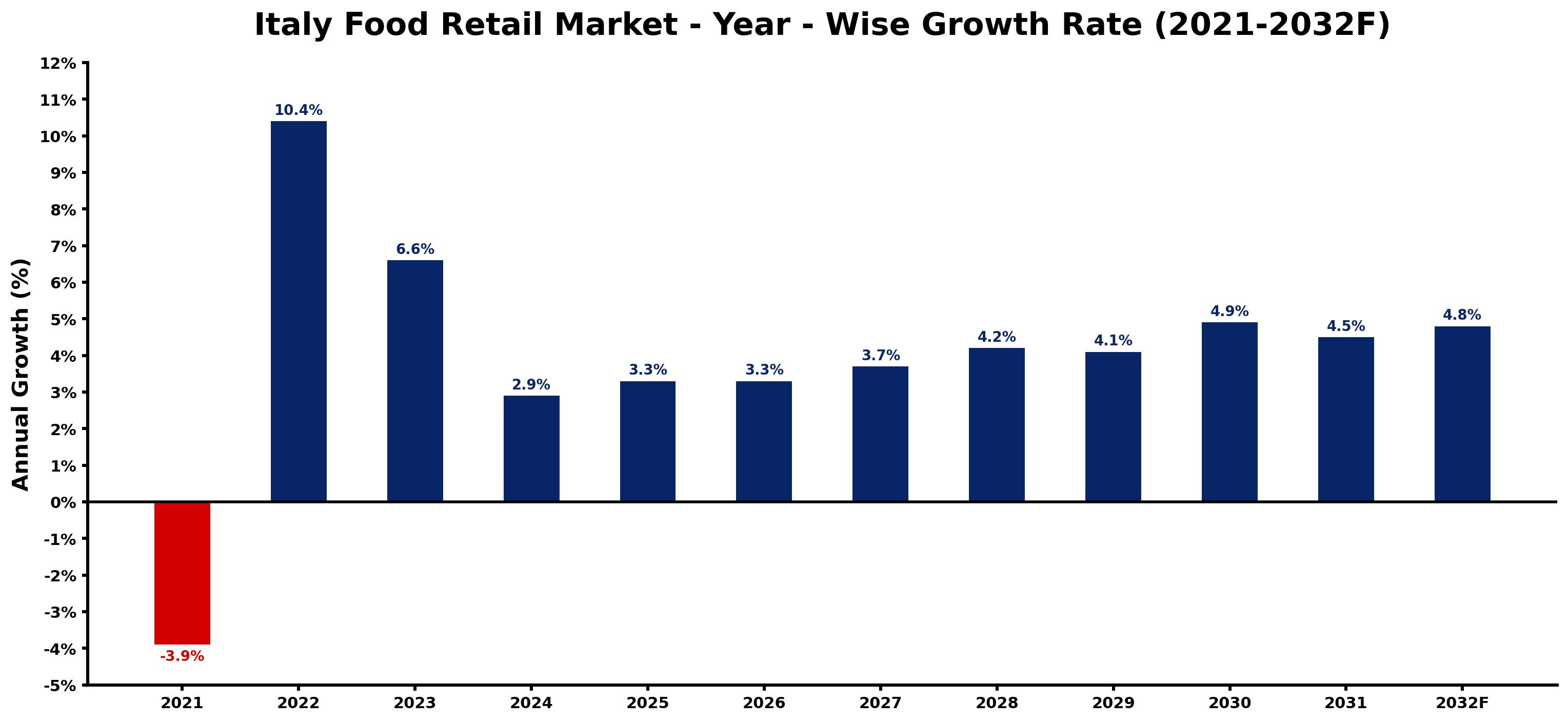
The table below presents the year wise growth rates along with the key drivers influencing the market
| Year | Growth Rate | Major Drivers |
| 2021 | -3.9% | Heightened restrictions on food service operations due to the pandemic stifled instore shopping and sales. |
| 2022 | 10.4% | E-commerce growth reshaped traditional shopping behaviors in urban and rural areas. |
| 2023 | 6.6% | Health-conscious consumer preferences drive demand for organic and premium food products. |
| 2024 | 2.9% | Sustainability trends influence packaging innovations across the food retail sector. |
| 2025 | 3.3% | Technological integration streamlines inventory management and enhances customer shopping experiences. |
| 2026 | 3.3% | Investment in local producers strengthens community ties and food freshness perceptions. |
| 2027 | 3.7% | Culinary tourism boosts demand for authentic regional products and unique food experiences. |
| 2028 | 4.2% | Grocery consolidation leads to fewer but larger retail players with expansive offerings. |
| 2029 | 4.1% | Increased mobility options foster food truck culture, diversifying urban food retail. |
| 2030 | 4.9% | Consumer education on nutrition shapes product selection and influences purchasing decisions. |
| 2031 | 4.5% | Digital marketing strategies evolve, engaging younger consumers through personalized campaigns. |
| 2032 | 4.8% | Emerging food technologies redefine product customization, appealing to niche market segments. |
Note - Market size estimations and growth projections presented in this report are based on 6Wresearch's advanced forecasting approach, validated with industry datasets as of June 2026.
Italy Food Retail Market Synopsis
The Italy Food Retail Market is projected to reach 3.3% and witness significant growth during the forecast period (2026-2032). This market is distinguished by its rich culinary heritage, where local producers and high-quality ingredients hold a central position in consumer preferences. Supermarkets and hypermarkets dominate the landscape, providing a comprehensive mix of both domestic and international offerings. Nevertheless, traditional food markets and specialty shops maintain a vital presence, especially in urban locales, where they cater to a clientele that values authenticity and uniqueness.
Italy Food Retail Market Trends and Opportunities
The prevailing trends within the Italy Food Retail Market are indicative of a dynamic shift towards health-conscious and environmentally sustainable choices. As Italian consumers increasingly prioritize well-being, there is a marked rise in the demand for organic and locally sourced foods. This trend has birthed an expansion of specialty stores and farmers' markets that focus on such offerings, catering directly to consumer preferences for quality and transparency in sourcing.
Additionally, the growth of e-commerce in food retailing has been substantial, driven by the demand for convenience and the changing shopping behaviors of consumers, particularly in urban settings. Retailers are innovating rapidly, exploring unique product offerings and enhancing customer experiences to differentiate themselves in an intensely competitive environment. The focus on convenience also aligns with a growing interest in ready-to-eat meals and meal kit delivery solutions, which are gaining traction among busy professionals and families.
Italy Food Retail Market Challenges and Restraints
Despite its growth potential, the Italy Food Retail Market faces a series of challenges that impact profitability and operational efficiency. Severe competition among retailers has led to price wars, creating downward pressure on profit margins. Retailers must continuously adapt to the evolving preferences of consumers, who increasingly favor healthier, organic, and sustainable products, which places additional strain on supply chain management and inventory strategies.
The coexistence of traditional markets and independent stores alongside larger supermarket chains introduces further complexity to the competitive landscape. Additionally, regulatory constraints related to food safety, labeling, and sustainability practices can pose hurdles for retailers seeking to expand or innovate their offerings. Economic fluctuations and changing consumer spending patterns also play a significant role in influencing the overall performance of food retailers in Italy, necessitating agility and strategic foresight.
Italy Food Retail Market Investment Opportunities
The Italy Food Retail Market presents numerous investment opportunities, particularly as consumer preferences shift towards quality and convenience. One of the most promising avenues lies within the online grocery segment. As a growing percentage of the population embraces e-commerce for their grocery needs, investing in digital platforms and logistics infrastructure can offer substantial returns as this trend continues to evolve.
Moreover, the organic and specialty food segment is experiencing significant growth, with consumers increasingly seeking healthier and unique product offerings. Opportunities in this segment may include investing in specialty food stores or establishing partnerships with local producers to offer exclusive products that cater to the evolving consumer palate. The ready-to-eat meal market is also ripe for investment, as busy lifestyles drive demand for convenient and quick meal solutions, offering avenues for meal kit services or grab-and-go options.
Italy Food Retail Market Government Investment and Initiatives
Government policies concerning the Italy Food Retail Market emphasize sustainability, the support of local producers, and the promotion of fair competition. Authorities have implemented various measures aimed at reducing food waste, encouraging the adoption of environmentally friendly packaging, and promoting organic farming practices. Regulatory frameworks are also in place to protect small and medium-sized food retailers from the competitive advantages of larger corporations.
Additionally, the government is actively involved in initiatives that strengthen the connection between consumers and local food producers, emphasizing the value of locally sourced products. Overall, these policies seek to foster a more sustainable and competitive food retail market in Italy while championing local businesses and advocating for healthier eating habits among consumers.
Italy Food Retail Market Latest Developments (May 2025 - June 2026)
Recent developments in the Italy Food Retail Market reflect a continued adaptation to consumer preferences and technological advancements. There has been an observable increase in the integration of e-commerce solutions, with many retailers enhancing their online platforms to meet growing demand. This shift is coinciding with a broader embrace of technology in logistics and inventory management, ensuring that retailers can respond swiftly to market changes.
Moreover, the focus on sustainability remains paramount, with retailers investing in environmentally friendly practices and product offerings. The growth of farmers' markets and specialty stores highlights a consumer shift towards local sourcing, which is further supported by government initiatives promoting local producers. The increasing popularity of meal kits and ready-to-eat meals indicates a shift in consumer lifestyles and preferences, enhancing the competitive landscape within the market.
Italy Food Retail Market - Key Attractiveness of the Report
- 10 Years of Market Numbers
- Historical Data Starting from 2022 to 2025
- Base Year: 2025
- Forecast Data until 2032
- Key Performance Indicators Impacting the Market
- Major Upcoming Developments and Projects
Key Highlights of the Report:
- Italy Food Retail Market Outlook
- Market Size of Italy Food Retail Market, 2025
- Forecast of Italy Food Retail Market, 2032F
- Historical Data and Forecast of Italy Food Retail Revenues & Volume for the Period 2022-2032F
- Italy Food Retail Market Trend Evolution
- Italy Food Retail Market Drivers and Challenges
- Italy Food Retail Price Trends
- Italy Food Retail Porter's Five Forces
- Italy Food Retail Industry Life Cycle
- Historical Data and Forecast of Italy Food Retail Market Revenues & Volume By Product Types for the Period 2022-2032F
- Historical Data and Forecast of Italy Food Retail Market Revenues & Volume By Unpackaged Food for the Period 2022-2032F
- Historical Data and Forecast of Italy Food Retail Market Revenues & Volume By Packaged Food for the Period 2022-2032F
- Historical Data and Forecast of Italy Food Retail Market Revenues & Volume By Drinks for the Period 2022-2032F
- Historical Data and Forecast of Italy Food Retail Market Revenues & Volume By Household Products for the Period 2022-2032F
- Historical Data and Forecast of Italy Food Retail Market Revenues & Volume By Packaging Types for the Period 2022-2032F
- Historical Data and Forecast of Italy Food Retail Market Revenues & Volume By Boxes for the Period 2022-2032F
- Historical Data and Forecast of Italy Food Retail Market Revenues & Volume By Cans for the Period 2022-2032F
- Historical Data and Forecast of Italy Food Retail Market Revenues & Volume By Cellophane Wrapping for the Period 2022-2032F
- Historical Data and Forecast of Italy Food Retail Market Revenues & Volume By Cylindrical Cardboard for the Period 2022-2032F
- Italy Food Retail Import Export Trade Statistics
- Market Opportunity Assessment By Product Types
- Market Opportunity Assessment By Packaging Types
- Italy Food Retail Top Companies Market Share
- Italy Food Retail Competitive Benchmarking By Technical and Operational Parameters
- Italy Food Retail Company Profiles
- Italy Food Retail Key Strategic Recommendations






































