Italy Mobile Security Market Size & Growth Rate (2026-2032)
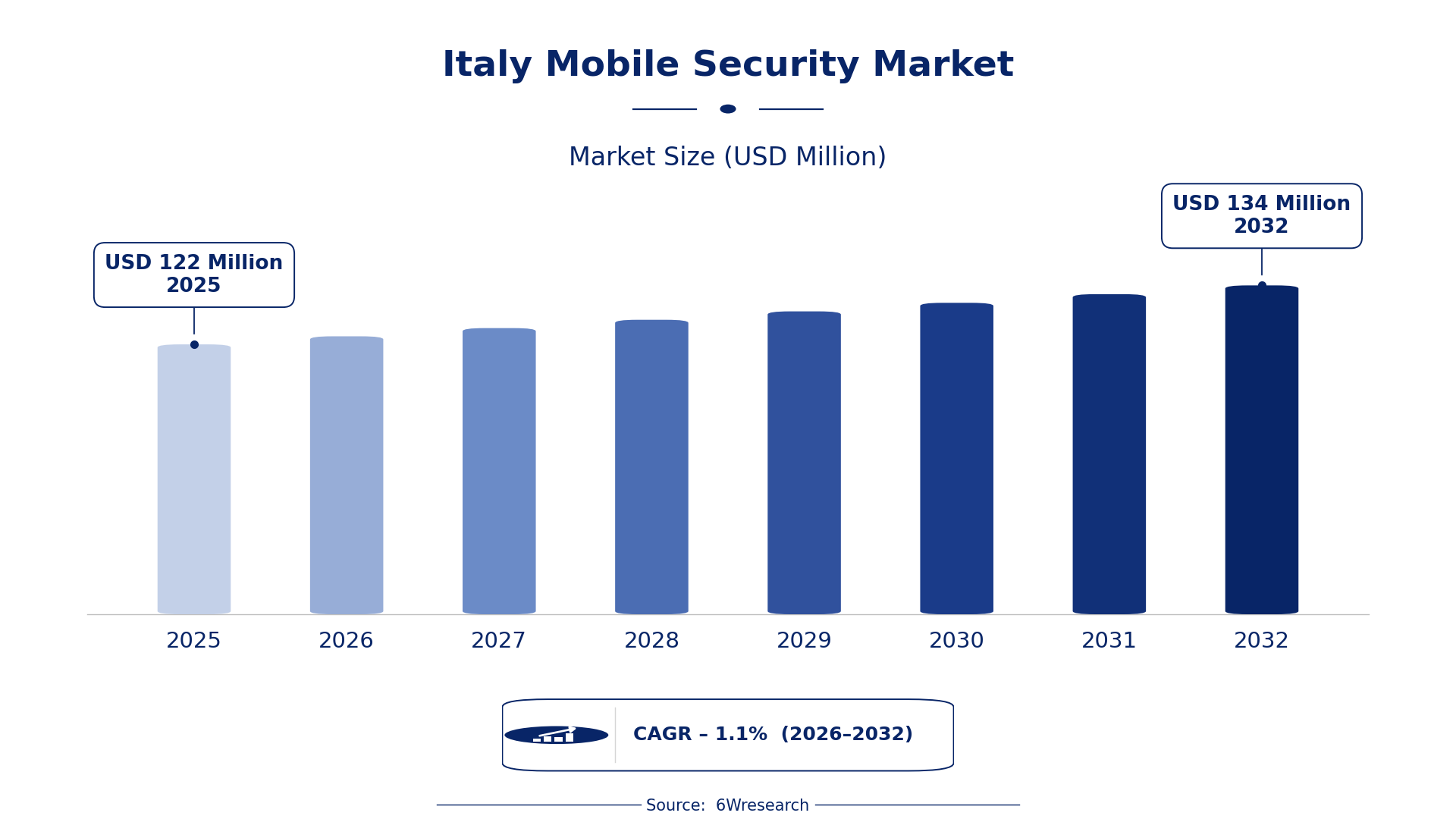
The Italy Mobile Security Market was estimated at USD 122 Million in 2025 and is projected to reach USD 134 Million by 2032, growing at a CAGR of 1.1% from 2026 to 2032.
Italy Mobile Security Market Synopsis
The Italy Mobile Security Market is currently experiencing a wave of growth, driven by a surge in mobile device usage and a parallel rise in cyber threats. Enterprises and individuals alike are becoming increasingly aware of the vulnerabilities that exist within mobile technology, resulting in a heightened demand for comprehensive security solutions tailored to address these risks.
Looking ahead, the market is set to evolve, influenced by technological advancements and regulatory changes. The growing acceptance of Bring Your Own Device (BYOD) policies is a double-edged sword, creating opportunities for innovative security solutions while simultaneously complicating the protective landscape.
Italy Mobile Security Market Year-wise Growth Rate and Key Drivers
This graph illustrates the annual growth rates of the Italy Mobile Security Market from 2021 to 2032, highlighting a steady upward trajectory and projected expansion over the forecast period.
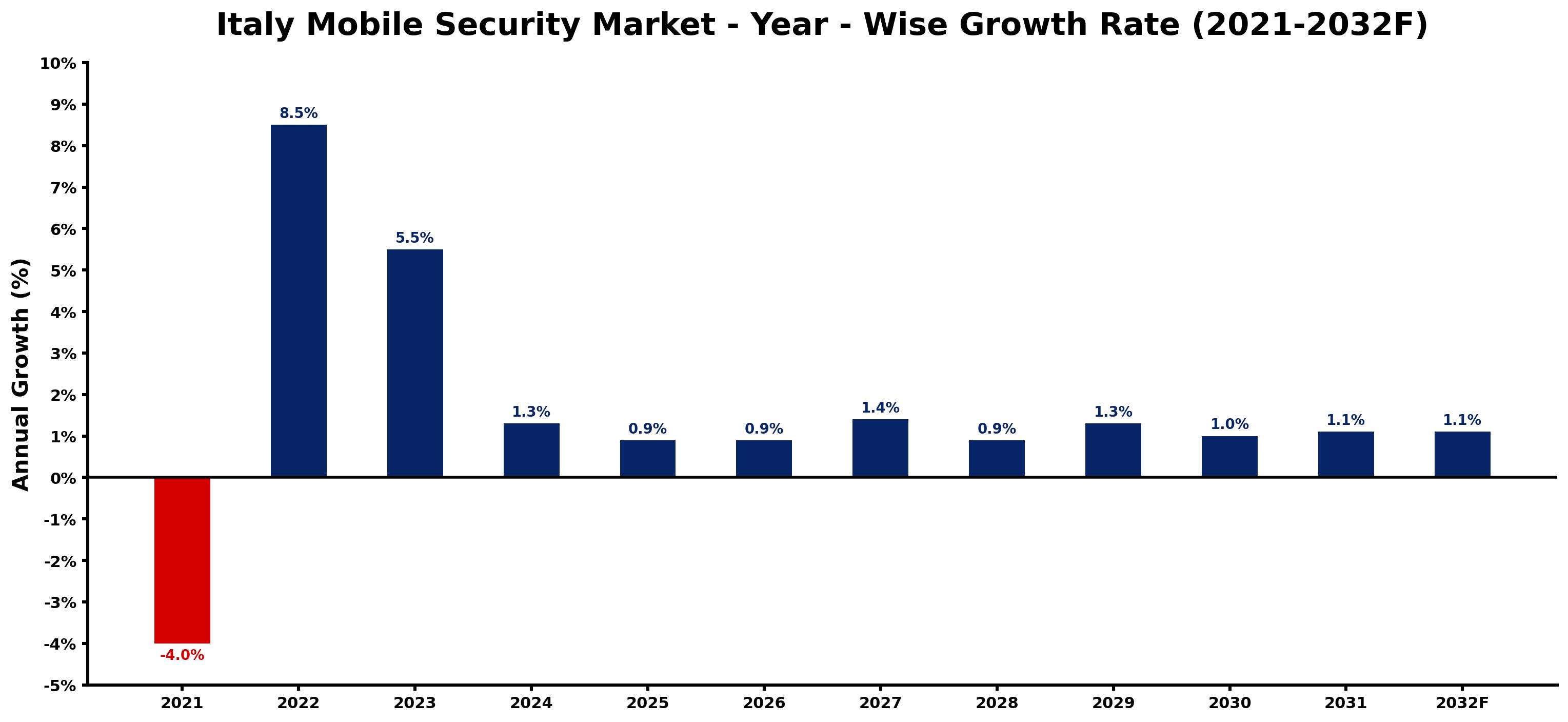
The table below presents the year‑wise growth rates along with the key drivers influencing the market
| Year | Growth Rate | Major Drivers |
| 2021 | -4.0% | Increased fraud led by Italian financial institutions vulnerabilities. |
| 2022 | 8.5% | EU Cybersecurity Act mandates stronger mobile security protocols. |
| 2023 | 5.5% | Increased mobile internet adoption among Italian seniors boosts demand. |
| 2024 | 1.3% | Rising smartphone penetration in Italian youth drives security needs. |
| 2025 | 0.9% | Government campaigns promote cybersecurity awareness in businesses. |
| 2026 | 0.9% | Healthcare sector digitization requires enhanced mobile security measures. |
| 2027 | 1.4% | Strict GDPR enforcement encourages better mobile data protection practices. |
| 2028 | 0.9% | Remote work culture increases mobile security requirements for firms. |
| 2029 | 1.3% | Local startups innovate mobile identity verification solutions. |
| 2030 | 1.0% | Mobile gaming boom necessitates robust protection against fraud. |
| 2031 | 1.1% | Italian e-commerce growth drives demand for secure transactions. |
| 2032 | 1.1% | Smartphone adoption rate remains high among Italian consumers. |
Note: Market size estimations and growth projections presented in this report are based on 6Wresearch's proprietary forecasting methodology, utilizing the latest available industry data, government publications, and primary research inputs.
Italy Mobile Security Market Key Takeaways
Below are some of the specific key takeaways from the market, including:
- Rising incidents of cyberattacks targeting mobile devices are fueling market growth.
- The increasing reliance on mobile devices for sensitive transactions is prompting enhanced security measures.
- BYOD policies in the workplace are driving demand for mobile security solutions, including Mobile Device Management (MDM).
- Advancements in security technologies are vital in keeping pace with evolving threats.
- Regulatory compliance is pushing organizations to adopt stringent mobile security frameworks.
Evaluation of Restraints in Italy Mobile Security Market
Despite the upward trajectory, the Italy Mobile Security Market faces notable restraints. Companies struggle with the rapid evolution of cyber threats, which often outpace existing security measures. Device vulnerabilities pose a constant challenge, particularly in the context of BYOD environments where personal and professional devices intermingle. Compliance with stringent data protection regulations adds another layer of complexity, as firms must balance security needs with user privacy and transparency requirements.
Italy Mobile Security Market Trends
The market is witnessing several key trends that are shaping demand for mobile security solutions. First, there’s a shift towards adopting Artificial Intelligence (AI) and machine learning technologies to enhance threat detection capabilities. Additionally, the trend toward zero-trust security models is gaining momentum, compelling organizations to rethink their security postures. Finally, an increasing emphasis on user education and awareness programs is emerging as a critical component in combating social engineering attacks that target mobile users.
Italy Mobile Security Market Opportunities
There are genuine growth prospects in the Italy Mobile Security Market, particularly in the sectors of healthcare, finance, and retail. As these industries increasingly embrace digital transformation, the demand for tailored security solutions will likely rise. on top of that, partnerships between technology vendors and telecom operators can create synergistic opportunities for enhancing mobile security services, especially in areas like secure app development and endpoint protection.
Government Initiatives in the Italy Mobile Security Market
Government policy plays a critical role in shaping the Italy Mobile Security Market. Authorities are prioritizing cybersecurity, with a focus on establishing regulatory frameworks that promote data protection and encourage technological innovation. These initiatives aim to create a safer digital environment for users and businesses alike, reflecting a commitment to securing Italy's digital economy.
- A national digital infrastructure upgrade programme initiated in early 2025 aims to enhance the security standards of mobile devices across public services.
- Currently ongoing is a regulatory initiative focused on developing mobile device security standards, expected to be finalized by mid-2026.
- A planned public-private partnership to bolster cybersecurity awareness among enterprises is set to roll out in late 2026.
- Recent efforts include a cybersecurity grant programme launched in 2024 that offers financial support for organizations investing in mobile security technologies.
- A framework introduced in 2025 mandates encryption requirements for sensitive mobile transactions, enhancing data security across sectors.
Future Insights of the Italy Mobile Security Market
Looking ahead to 2026-2032, the Italy Mobile Security Market is likely to see continued expansion fueled by technological advancements and increasing regulatory requirements. As the complexity of cyber threats escalates, organizations will have to adopt more sophisticated security protocols. This trend presents a clear opportunity for security solution providers to innovate and differentiate themselves, especially in sectors that handle sensitive personal and financial information. The interplay of regulatory pressure and technological innovation will be a defining factor in the market's evolution.
Italy Mobile Security Market Latest Developments
Recent months have seen significant activity in the Italy Mobile Security Market, reflecting a proactive approach by businesses and regulators to address rising threats. New technologies and solutions are being launched at a steady pace, aimed at improving the overall security posture of mobile devices and applications.
- A major technology vendor rolled out an upgraded mobile threat defense solution in Q2 2025, focusing on real-time threat detection and response capabilities.
- A leading regional operator is currently implementing a new endpoint protection platform, expected to enhance mobile device security for its customers by late 2025.
- Plans are in motion for a comprehensive security awareness training programme set to commence in early 2026, targeting employees in high-risk sectors.
- A collaborative research initiative began in late 2024, aimed at developing advanced encryption techniques for mobile communications.
- An initiative to integrate biometric security measures into mobile applications is currently ongoing, with rollout expected by mid-2026.
Italy Mobile Security Market - Key Attractiveness of the Report
- 10 Years of Market Numbers
- Historical Data Starting from 2022 to 2025
- Base Year: 2025
- Forecast Data until 2032
- Key Performance Indicators Impacting the Market
- Major Upcoming Developments and Projects
Key Highlights of the Report:
- Italy Mobile Security Market Outlook
- Market Size of Italy Mobile Security Market, 2025
- Forecast of Italy Mobile Security Market, 2032
- Historical Data and Forecast of Italy Mobile Security Revenues & Volume for the Period 2022-2032F
- Italy Mobile Security Market Trend Evolution
- Italy Mobile Security Market Drivers and Challenges
- Italy Mobile Security Price Trends
- Italy Mobile Security Porter's Five Forces
- Italy Mobile Security Industry Life Cycle
- Historical Data and Forecast of Italy Mobile Security Market Revenues & Volume By End User for the Period 2022-2032F
- Historical Data and Forecast of Italy Mobile Security Market Revenues & Volume By Individual for the Period 2022-2032F
- Historical Data and Forecast of Italy Mobile Security Market Revenues & Volume By Enterprise (Solution (Authentication, Application Security, & Device Security), Service) for the Period 2022-2032F
- Historical Data and Forecast of Italy Mobile Security Market Revenues & Volume By Deployment Mode for the Period 2022-2032F
- Historical Data and Forecast of Italy Mobile Security Market Revenues & Volume By On-premises for the Period 2022-2032F
- Historical Data and Forecast of Italy Mobile Security Market Revenues & Volume By Cloud for the Period 2022-2032F
- Historical Data and Forecast of Italy Mobile Security Market Revenues & Volume By Organization Size for the Period 2022-2032F
- Historical Data and Forecast of Italy Mobile Security Market Revenues & Volume By Small and Medium-Sized Enterprises (SMEs) for the Period 2022-2032F
- Historical Data and Forecast of Italy Mobile Security Market Revenues & Volume By Large Enterprises for the Period 2022-2032F
- Historical Data and Forecast of Italy Mobile Security Market Revenues & Volume By Vertical for the Period 2022-2032F
- Historical Data and Forecast of Italy Mobile Security Market Revenues & Volume By BFSI for the Period 2022-2032F
- Historical Data and Forecast of Italy Mobile Security Market Revenues & Volume By Telecom & IT for the Period 2022-2032F
- Historical Data and Forecast of Italy Mobile Security Market Revenues & Volume By Retail for the Period 2022-2032F
- Historical Data and Forecast of Italy Mobile Security Market Revenues & Volume By Healthcare for the Period 2022-2032F
- Historical Data and Forecast of Italy Mobile Security Market Revenues & Volume By Government & Defense for the Period 2022-2032F
- Historical Data and Forecast of Italy Mobile Security Market Revenues & Volume By Manufacturing for the Period 2022-2032F
- Historical Data and Forecast of Italy Mobile Security Market Revenues & Volume By Others for the Period 2022-2032F
- Historical Data and Forecast of Italy Mobile Security Market Revenues & Volume By Operating System for the Period 2022-2032F
- Historical Data and Forecast of Italy Mobile Security Market Revenues & Volume By iOS for the Period 2022-2032F
- Historical Data and Forecast of Italy Mobile Security Market Revenues & Volume By Android for the Period 2022-2032F
- Italy Mobile Security Import Export Trade Statistics
- Market Opportunity Assessment By End User
- Market Opportunity Assessment By Deployment Mode
- Market Opportunity Assessment By Organization Size
- Market Opportunity Assessment By Vertical
- Market Opportunity Assessment By Operating System
- Italy Mobile Security Top Companies Market Share
- Italy Mobile Security Competitive Benchmarking By Technical and Operational Parameters
- Italy Mobile Security Company Profiles
- Italy Mobile Security Key Strategic Recommendations






































