Italy Nuclear Power Plant and Equipment Market Size, Share & Growth Rate
The Italy Nuclear Power Plant and Equipment Market was estimated at USD 235 Million in 2025 and is projected to reach USD 259 Million by 2032, growing at a CAGR of 1.4% from 2026 to 2032. This modest growth trajectory is underpinned by an increasing interest in nuclear energy as a clean power source, alongside stringent carbon reduction commitments. Although public and regulatory challenges remain significant, discussions surrounding the possible reintroduction of nuclear energy are gaining momentum, which may shape future market dynamics.
Italy Nuclear Power Plant and Equipment Market Year-wise Growth Rate and Key Drivers
This graph highlights how the Italy Nuclear Power Plant and Equipment Market has steadily grown over the years, supported by major growth factors.
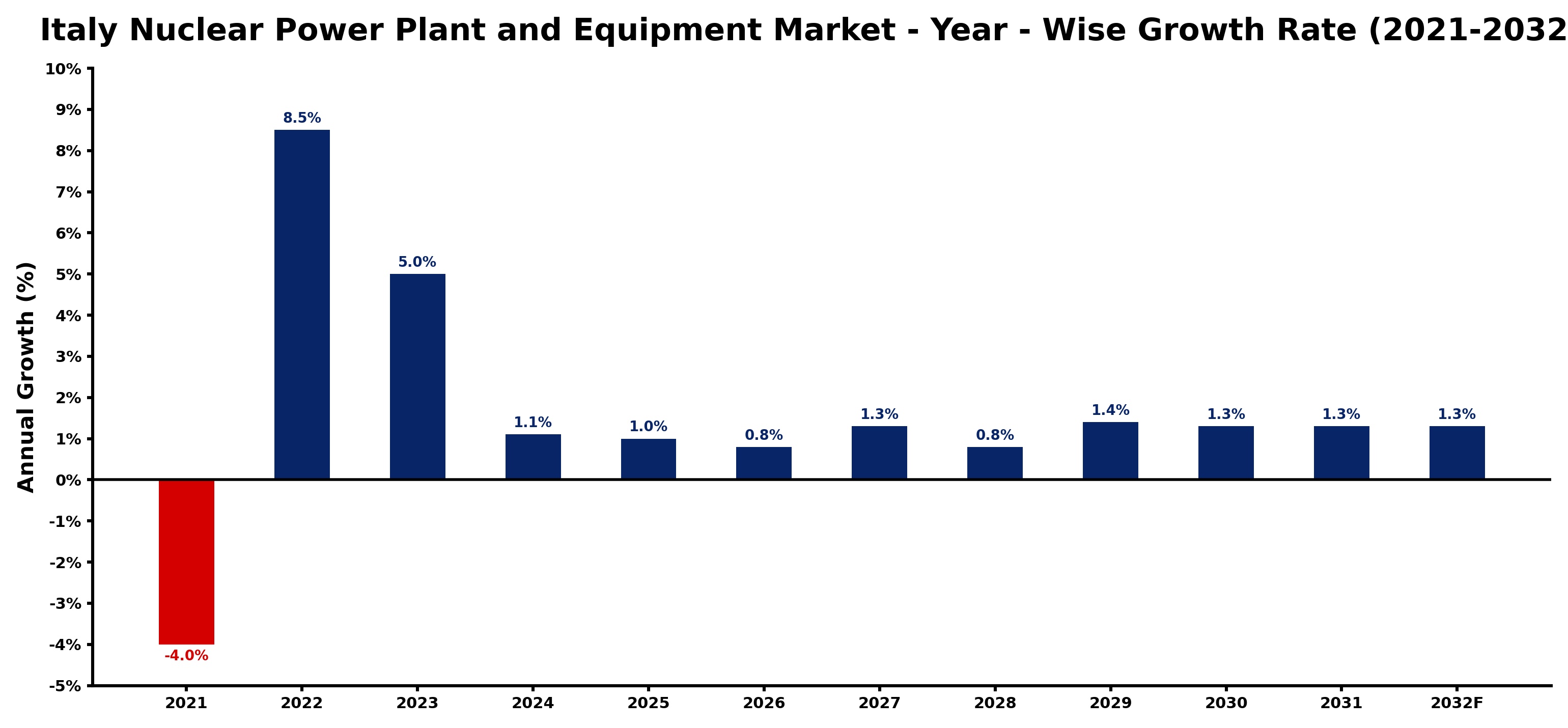
The table below presents the year‑wise growth rates along with the key drivers influencing the market
| Year | Growth Rate | Major Drivers |
| 2021 | -4.0% | Increasing smart city development projects |
| 2022 | 8.5% | Increasing smart city development projects |
| 2023 | 5.0% | Rapid growth in telecom and data center sectors |
| 2024 | 1.1% | Rising electricity demand across industries |
| 2025 | 1.0% | Rapid growth in telecom and data center sectors |
| 2026 | 0.8% | Growing renewable energy integration projects |
| 2027 | 1.3% | Increasing industrial infrastructure investments |
| 2028 | 0.8% | Increasing industrial infrastructure investments |
| 2029 | 1.4% | Government infrastructure modernization initiatives |
| 2030 | 1.3% | Rising electricity demand across industries |
| 2031 | 1.3% | Increasing industrial automation investments |
| 2032 | 1.3% | Rapid growth in telecom and data center sectors |
Note - Market size estimations and growth projections presented in this report are based on 6Wresearch’s advanced forecasting approach, validated with industry datasets as of June 2026.
Italy Nuclear Power Plant and Equipment Market Synopsis
Recent developments in Italy's energy landscape have showcased a strong commitment to phasing out traditional energy sources, notably coal. However, the shift away from nuclear energy, initiated after the Fukushima disaster in 2011, has left the market in a state of stagnation. The absence of operational nuclear plants since the late 1980s reflects a broader strategic pivot towards renewable energy.
As the country approaches its goal of carbon neutrality by 2050, there is an emerging dialogue about re-evaluating nuclear power's role in Italy's energy strategy. This transition not only presents challenges but also introduces potential opportunities for investment in decommissioning efforts and innovative technologies aimed at enhancing energy sustainability.
Italy Nuclear Power Plant and Equipment Market Key Takeaways
- The Italian government aims to completely phase out nuclear power by 2025, impacting the current market dynamics.
- There is an increasing demand for clean energy solutions as Italy targets carbon neutrality by 2050.
- Investment opportunities exist in decommissioning services and technologies to facilitate the energy transition.
- Public perception and regulatory barriers continue to challenge nuclear energy prospects in Italy.
- New collaborations with European Union energy research programs may influence future developments in the market.
Evaluation of Restraints in Italy Nuclear Power Plant and Equipment Market
The Italy Nuclear Power Plant and Equipment Market faces significant restraints stemming from historical public sentiment against nuclear power. Years of opposition, fueled by high-profile disasters, have cultivated a landscape where new nuclear ventures are met with skepticism and resistance. Additionally, Italy's intricate regulatory framework complicates the introduction of new technologies and facilities, placing further limits on market expansion. High initial investments required for any new projects also deter potential investors, especially in a climate increasingly focused on renewable energy alternatives.
Italy Nuclear Power Plant and Equipment Market Trends
The market is witnessing a pronounced trend towards decommissioning older nuclear facilities and investing in clean energy technologies. Companies are diversifying their portfolios to provide specialized services related to dismantling and waste management, reflecting the urgent need for sustainable energy solutions. Furthermore, advancements in radiation monitoring and renewable energy integration technologies are expected to drive demand as Italy navigates its energy transition.
Italy Nuclear Power Plant and Equipment Market Opportunities
Despite its complexities, the Italy Nuclear Power Plant and Equipment Market presents several investment opportunities. As the country commits to eliminating coal-fired power plants, there is renewed interest in nuclear energy as a low-carbon alternative. This necessitates investments not only in nuclear construction but also in enhancing existing technologies. Opportunities in the supply chain for nuclear fuel, waste management solutions, and safety systems are also ripe for exploration, particularly as Italy engages with EU energy research initiatives.
Government Initiatives in the Italy Nuclear Power Plant and Equipment Market
Government policy in Italy continues to play a pivotal role in shaping the nuclear landscape. The legislative framework remains focused on phasing out nuclear energy in favor of renewable sources. Current initiatives emphasize the growth of wind and solar energy and place significant funding towards research and development in clean technologies. Public spending is primarily directed towards ensuring a sustainable energy future, with regulations that complicate nuclear energy's potential resurgence.
Future Insights of the Italy Nuclear Power Plant and Equipment Market
Looking ahead to 2026-2032, the Italy Nuclear Power Plant and Equipment Market is poised for cautious evolution. As the focus on renewable energy intensifies, any potential growth in the nuclear sector will hinge on successfully addressing public concerns and regulatory hurdles. Continued dialogue regarding the reintroduction of nuclear power as a viable energy source could reshape market conditions, although significant investment and strategic collaboration will be crucial to navigate the evolving landscape.
Italy Nuclear Power Plant and Equipment Market Latest Developments (May 2025 - June 2026)
Recent developments indicate a tentative shift in public sentiment, with renewed discussions around the feasibility of nuclear energy in Italy's energy mix. Legislative measures are being reviewed to assess potential reforms in the regulatory framework, aimed at possibly enabling future nuclear projects. Additionally, increased collaboration with European energy initiatives signals a strategic approach to align with broader clean energy goals.
Italy Nuclear Power Plant and Equipment Market - Key Attractiveness of the Report
- 10 Years of Market Numbers
- Historical Data Starting from 2022 to 2025
- Base Year: 2025
- Forecast Data until 2032
- Key Performance Indicators Impacting the Market
- Major Upcoming Developments and Projects
Key Highlights of the Report:
- Italy Nuclear Power Plant and Equipment Market Outlook
- Market Size of Italy Nuclear Power Plant and Equipment Market, 2025
- Forecast of Italy Nuclear Power Plant and Equipment Market, 2032
- Historical Data and Forecast of Italy Nuclear Power Plant and Equipment Revenues & Volume for the Period 2022-2032F
- Italy Nuclear Power Plant and Equipment Market Trend Evolution
- Italy Nuclear Power Plant and Equipment Market Drivers and Challenges
- Italy Nuclear Power Plant and Equipment Price Trends
- Italy Nuclear Power Plant and Equipment Porter's Five Forces
- Italy Nuclear Power Plant and Equipment Industry Life Cycle
- Historical Data and Forecast of Italy Nuclear Power Plant and Equipment Market Revenues & Volume By Reactor Type for the Period 2022-2032F
- Historical Data and Forecast of Italy Nuclear Power Plant and Equipment Market Revenues & Volume By PWR for the Period 2022-2032F
- Historical Data and Forecast of Italy Nuclear Power Plant and Equipment Market Revenues & Volume By PHWR for the Period 2022-2032F
- Historical Data and Forecast of Italy Nuclear Power Plant and Equipment Market Revenues & Volume By Boiling water reactor for the Period 2022-2032F
- Historical Data and Forecast of Italy Nuclear Power Plant and Equipment Market Revenues & Volume By High temperature gas cooled reactor for the Period 2022-2032F
- Historical Data and Forecast of Italy Nuclear Power Plant and Equipment Market Revenues & Volume By Fast Breeder Reactor for the Period 2022-2032F
- Historical Data and Forecast of Italy Nuclear Power Plant and Equipment Market Revenues & Volume By Others for the Period 2022-2032F
- Historical Data and Forecast of Italy Nuclear Power Plant and Equipment Market Revenues & Volume By Equipment for the Period 2022-2032F
- Historical Data and Forecast of Italy Nuclear Power Plant and Equipment Market Revenues & Volume By Island Equipment for the Period 2022-2032F
- Historical Data and Forecast of Italy Nuclear Power Plant and Equipment Market Revenues & Volume By Auxiliary Equipment for the Period 2022-2032F
- Italy Nuclear Power Plant and Equipment Import Export Trade Statistics
- Market Opportunity Assessment By Reactor Type
- Market Opportunity Assessment By Equipment
- Italy Nuclear Power Plant and Equipment Top Companies Market Share
- Italy Nuclear Power Plant and Equipment Competitive Benchmarking By Technical and Operational Parameters
- Italy Nuclear Power Plant and Equipment Company Profiles
- Italy Nuclear Power Plant and Equipment Key Strategic Recommendations






































