Italy Planting Equipment Market Size, Share & Growth Rate
The Italy Planting Equipment Market was estimated at USD 95 Million in 2025 and is projected to reach USD 106 Million by 2032, growing at a CAGR of 1.6% from 2026 to 2032. This upward trajectory is fueled by the increasing adoption of technologically advanced agricultural machinery, as farmers seek to enhance their productivity and operational efficiency. Government initiatives aimed at modernizing agriculture, alongside a rising focus on sustainable practices, are key catalysts driving this growth.
Italy Planting Equipment Market Year-wise Growth Rate and Key Drivers
This graph highlights how the Italy Planting Equipment Market has steadily grown over the years, supported by major growth factors.
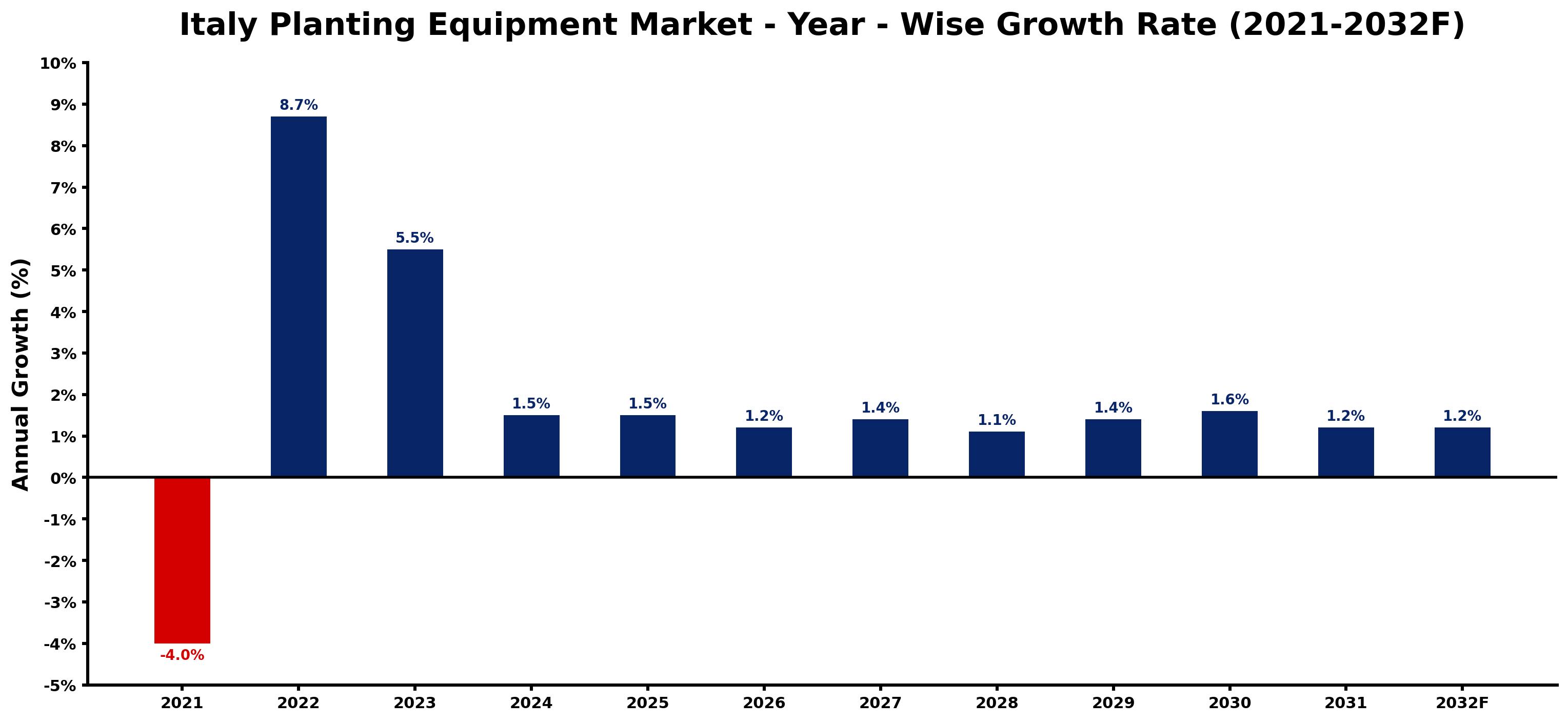
The table below presents the year‑wise growth rates along with the key drivers influencing the market
| Year | Growth Rate | Major Drivers |
| 2021 | -4.0% | Expansion of transportation and logistics networks |
| 2022 | 8.7% | Expansion of commercial construction activities |
| 2023 | 5.5% | Growing urbanization and commercial development |
| 2024 | 1.5% | Increasing industrial automation investments |
| 2025 | 1.5% | Government infrastructure modernization initiatives |
| 2026 | 1.2% | Expansion of commercial construction activities |
| 2027 | 1.4% | Growing renewable energy integration projects |
| 2028 | 1.1% | Rapid growth in telecom and data center sectors |
| 2029 | 1.4% | Expansion of transportation and logistics networks |
| 2030 | 1.6% | Rapid growth in telecom and data center sectors |
| 2031 | 1.2% | Expansion of manufacturing activities |
| 2032 | 1.2% | Expansion of commercial construction activities |
Note - Market size estimations and growth projections presented in this report are based on 6Wresearch’s advanced forecasting approach, validated with industry datasets as of June 2026.
Italy Planting Equipment Market Synopsis
While recent momentum in the Italy Planting Equipment Market reflects a strong interest in innovative agricultural solutions, future developments are expected to pivot towards more precision-focused methodologies. This evolution aims to equip farmers with tools that not only maximize crop yields but also adhere to environmental sustainability.
Looking ahead, the market is poised for significant advancements as precision agriculture technologies gain traction among Italian farmers. The synergy of automation, efficiency, and sustainability will shape the evolution of planting equipment, ensuring that the sector remains dynamic and responsive to the challenges of modern agriculture.
Italy Planting Equipment Market Key Takeaways
- The market is projected to grow steadily due to government support and technological advancements.
- Farmers are increasingly adopting precision agriculture tools to optimize planting efficiency.
- There is a strong trend towards eco-friendly planting equipment that minimizes environmental impact.
- Investment opportunities are rising as demand for innovative planting technologies grows.
- Government initiatives are pivotal in promoting sustainable practices and agricultural modernization.
Evaluation of Restraints in Italy Planting Equipment Market
Several factors are currently restraining growth in the Italy Planting Equipment Market. The initial investment costs associated with advanced precision agriculture technologies can be a significant barrier for smaller farmers. These technologies require specialized knowledge, which may not be readily available to all producers. Additionally, as the market shifts toward sustainable practices, traditional manufacturers face challenges in reengineering their product lines to meet new environmental standards. Economic fluctuations and commodity price instability also contribute to uncertainties, impacting farmers' purchasing decisions and delaying investments in modern planting solutions.
Italy Planting Equipment Market Trends
The Italy Planting Equipment Market is currently experiencing several pivotal trends. The rise of precision agriculture technologies, such as GPS-guided planting equipment and variable rate application methods, allows farmers to optimize seed placement and resource usage effectively. Automation features, including row shut-off systems and section control, are increasingly integrated into planting machinery to improve operational productivity. Moreover, there is a burgeoning demand for planting equipment that aligns with eco-friendly practices, ensuring minimal environmental impact while maximizing agricultural output.
Italy Planting Equipment Market Opportunities
Amidst the evolving landscape of the Italy Planting Equipment Market, significant investment opportunities abound. As farmers seek efficient solutions to enhance productivity and reduce labor costs, the demand for high-quality precision seeders, planters, and transplanters is rapidly increasing. Additionally, government initiatives promoting agricultural modernization pave the way for investments in innovative planting technologies. By exploring partnerships with local manufacturers and investing in distribution networks, stakeholders can capitalize on the growing need for technologically advanced planting equipment in the Italian agricultural sector.
Government Initiatives in the Italy Planting Equipment Market
The Italian government has rolled out several policies to promote sustainability and innovation within the planting equipment sector. These include incentives for the adoption of precision agriculture technologies aimed at enhancing planting efficiency while minimizing environmental impacts. Furthermore, support programs are available to encourage farmers to invest in modern, efficient planting equipment that adheres to stringent environmental and safety standards. Research and development initiatives are also being promoted to bolster innovation and competitiveness in the agricultural market.
Future Insights of the Italy Planting Equipment Market
Looking forward to the years 2026-2032, the Italy Planting Equipment Market is set to experience a robust growth trajectory. The ongoing emphasis on technological advancements and mechanization in agriculture will play a critical role in this evolution. Farmers are increasingly recognizing the value of modern planting equipment as a means to improve operational efficiency and enhance crop yields. Government backing for agricultural mechanization further supports this growth, creating a fertile environment for market players to invest in innovative, sustainable solutions that meet the demands of contemporary agriculture.
Italy Planting Equipment Market Latest Developments (May 2025 - June 2026)
Recent developments in the Italy Planting Equipment Market indicate a strong focus on integrating advanced technologies into farming practices. Efforts to enhance automation and precision have led to the introduction of new product lines designed to optimize planting operations. Additionally, there has been an increasing collaboration between manufacturers and research institutions aimed at driving innovation and improving the sustainability of planting equipment. This period also saw heightened participation in government-sponsored initiatives designed to modernize agricultural practices across the nation.
Italy Planting Equipment Market - Key Attractiveness of the Report
- 10 Years of Market Numbers
- Historical Data Starting from 2022 to 2025
- Base Year: 2025
- Forecast Data until 2032
- Key Performance Indicators Impacting the Market
- Major Upcoming Developments and Projects
Key Highlights of the Report:
- Italy Planting Equipment Market Outlook
- Market Size of Italy Planting Equipment Market, 2025
- Forecast of Italy Planting Equipment Market, 2032
- Historical Data and Forecast of Italy Planting Equipment Revenues & Volume for the Period 2022-2032F
- Italy Planting Equipment Market Trend Evolution
- Italy Planting Equipment Market Drivers and Challenges
- Italy Planting Equipment Price Trends
- Italy Planting Equipment Porter's Five Forces
- Italy Planting Equipment Industry Life Cycle
- Historical Data and Forecast of Italy Planting Equipment Market Revenues & Volume By Type for the Period 2022-2032F
- Historical Data and Forecast of Italy Planting Equipment Market Revenues & Volume By Air seeders for the Period 2022-2032F
- Historical Data and Forecast of Italy Planting Equipment Market Revenues & Volume By Seed drills for the Period 2022-2032F
- Historical Data and Forecast of Italy Planting Equipment Market Revenues & Volume By Planters for the Period 2022-2032F
- Historical Data and Forecast of Italy Planting Equipment Market Revenues & Volume By Others for the Period 2022-2032F
- Historical Data and Forecast of Italy Planting Equipment Market Revenues & Volume By Design for the Period 2022-2032F
- Historical Data and Forecast of Italy Planting Equipment Market Revenues & Volume By Mechanical for the Period 2022-2032F
- Historical Data and Forecast of Italy Planting Equipment Market Revenues & Volume By Automatic for the Period 2022-2032F
- Historical Data and Forecast of Italy Planting Equipment Market Revenues & Volume By Crop Type for the Period 2022-2032F
- Historical Data and Forecast of Italy Planting Equipment Market Revenues & Volume By Cereals & grains for the Period 2022-2032F
- Historical Data and Forecast of Italy Planting Equipment Market Revenues & Volume By Oilseeds & pulses for the Period 2022-2032F
- Historical Data and Forecast of Italy Planting Equipment Market Revenues & Volume By Fruits & vegetables for the Period 2022-2032F
- Historical Data and Forecast of Italy Planting Equipment Market Revenues & Volume By Others for the Period 2022-2032F
- Italy Planting Equipment Import Export Trade Statistics
- Market Opportunity Assessment By Type
- Market Opportunity Assessment By Design
- Market Opportunity Assessment By Crop Type
- Italy Planting Equipment Top Companies Market Share
- Italy Planting Equipment Competitive Benchmarking By Technical and Operational Parameters
- Italy Planting Equipment Company Profiles
- Italy Planting Equipment Key Strategic Recommendations






































