Japan 3D Laser Scanner Market Size & Growth Rate
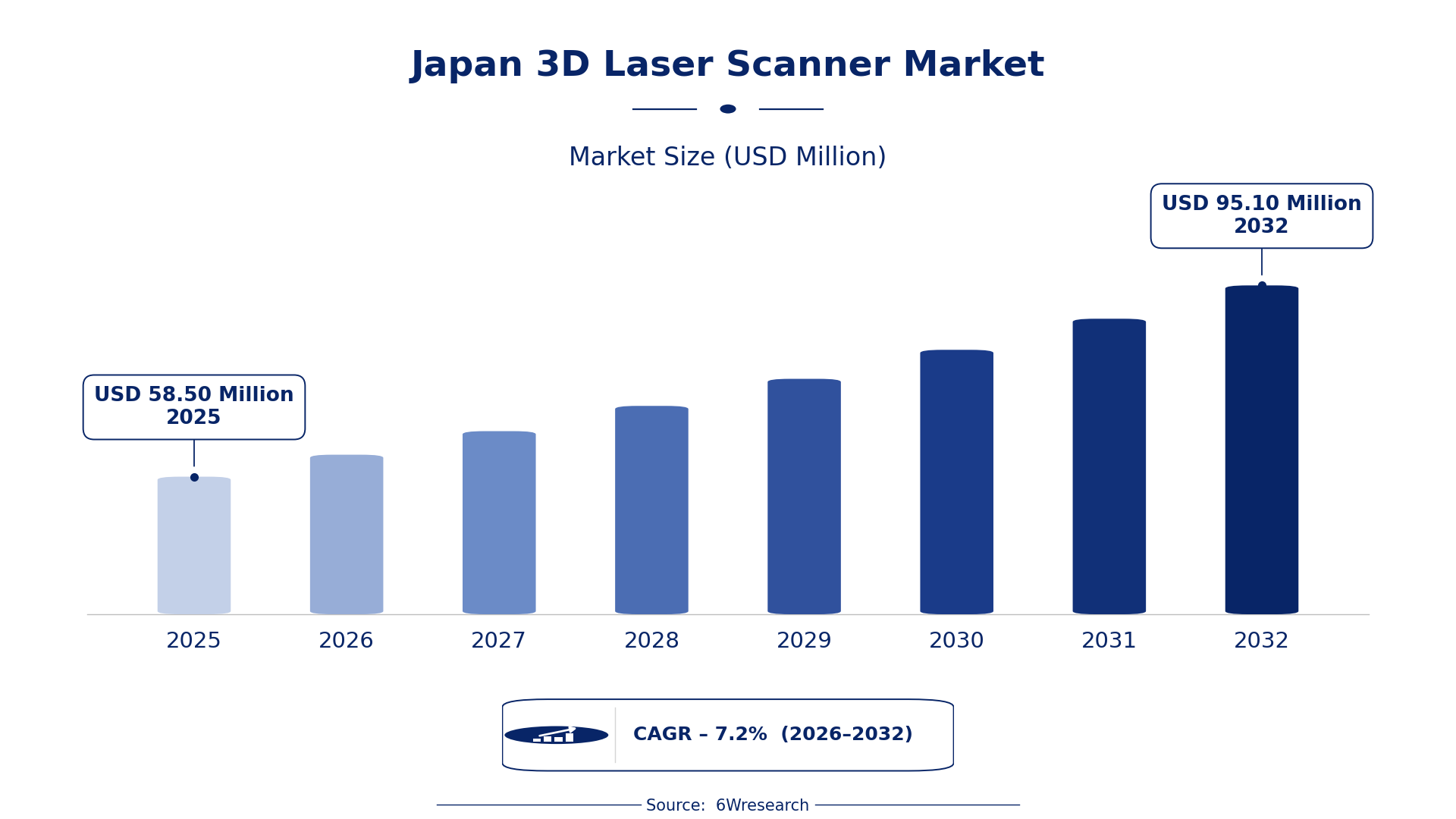
According to 6Wresearch internal database and industry insights, the Japan 3D Laser Scanner Market was valued at USD 58.50 Million in 2025 and is projected to reach USD 95.10 Million by 2032, growing at a CAGR of approximately 7.2% during 2026–2032.
Japan 3D Laser Scanner Market Highlights
| Report Metric | Details |
| Report Name | Japan 3D Laser Scanner Market (2026-2032) |
| Market Size 2025 | USD 58.50 Million |
| Market Size 2032 | USD 95.10 Million |
| Absolute Growth 2025–2032 | USD 36.60 Million |
| CAGR 2026–2032 | 7.2% |
| Peak Annual Growth | 8.6% in 2026 |
| Forecast Period | 2026–2032 |
| Historical Data | 2022–2025 |
| Base Year | 2025 |
| Leading Range, 2025 | Short (45% share) |
| Leading Product, 2025 | Tripod Mounted (43% share) |
| Leading Offering, 2025 | Hardware & Software (59% share) |
| Leading Application, 2025 | Quality Control & Inspection (35% share) |
| Leading End User, 2025 | Automotive (33% share) |
| Fastest-Growing Range | Medium (8.9% CAGR) |
| Fastest-Growing Product | Portable CMM Based (10.2% CAGR) |
| Fastest-Growing Offering | After-Sales Services (10.0% CAGR) |
| Fastest-Growing Application | Reverse Engineering (9.4% CAGR) |
| Fastest-Growing End User | Healthcare (9.5% CAGR) |
| Growing Sector | Construction and Healthcare |
| Key End Users | Automotive manufacturers, healthcare providers, construction firms, cultural heritage organizations |
Japan 3D Laser Scanner Market Year-wise Growth Rate and Key Drivers (2022–2032)
This graph illustrates the annual growth rates of the market from 2022 to 2032, highlighting a steady upward trajectory and projected market expansion over the forecast period.
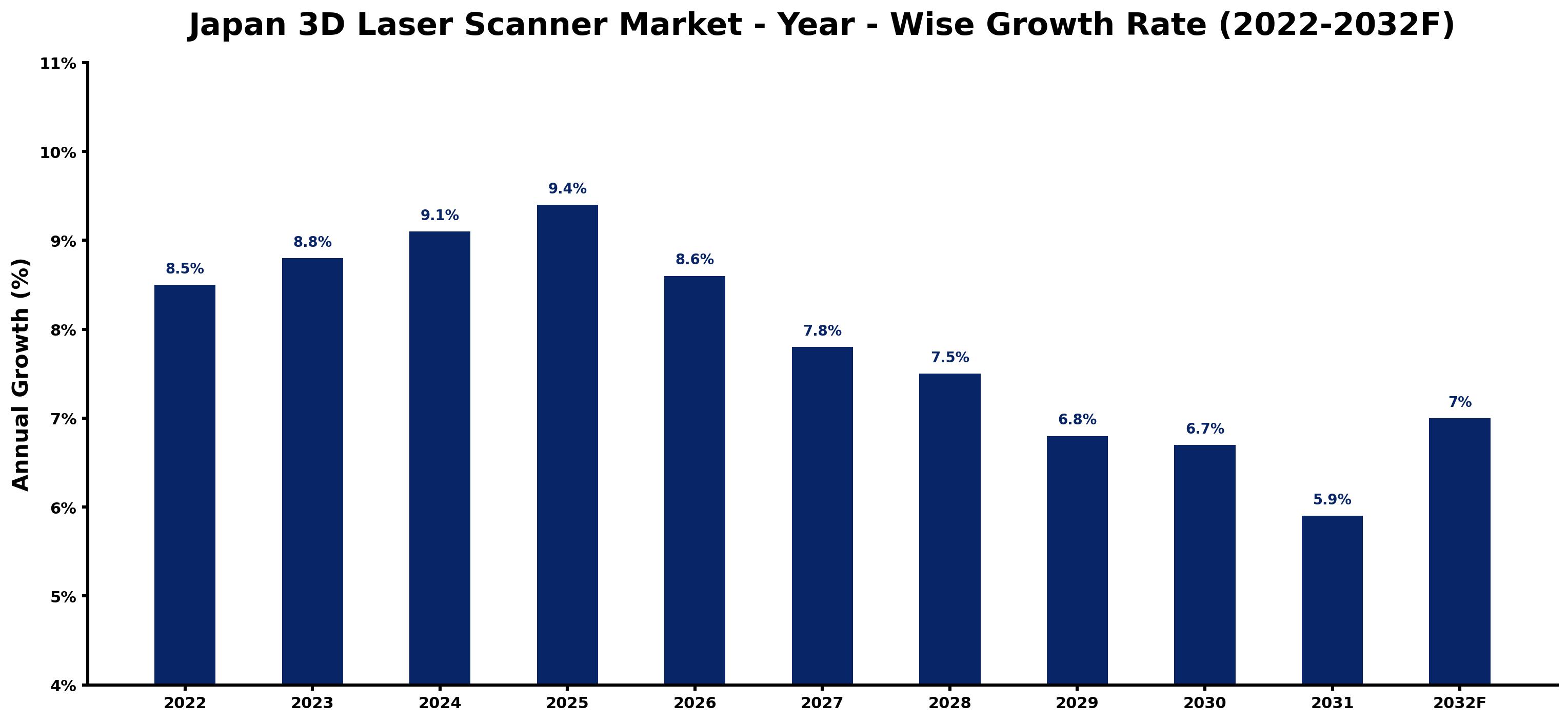
Year by year, the estimates below pair each growth rate with the development that shaped it.
| Year | Estimated Annual Growth (%) | Market Rationale |
| 2022 | 8.5 | The market experienced solid growth due to strong demand from the automotive sector. |
| 2023 | 8.8 | Increased adoption of 3D laser scanners in healthcare contributed to higher growth rates. |
| 2024 | 9.1 | The automotive industry's focus on quality control drove further demand for scanning technologies. |
| 2025 | 9.4 | The peak growth was supported by advancements in manufacturing technologies and standards. |
| 2026 | 8.6 | Growth is expected to slow as the market adjusts to the previous year's peak performance. |
| 2027 | 7.8 | A continued focus on quality assurance in manufacturing will maintain positive growth. |
| 2028 | 7.5 | Demand is expected to stabilise as the market matures and competition intensifies. |
| 2029 | 6.8 | Growth is projected to continue slowing as buyers become more selective in their investments. |
| 2030 | 6.7 | The market is expected to see a slight decrease in growth as saturation begins in key sectors. |
| 2031 | 5.9 | Demand will remain steady, but growth rates will reflect a more cautious investment climate. |
| 2032 | 7.0 | Growth is expected to pick up again as new applications emerge in healthcare and construction. |
Note: Market size estimations and growth projections presented in this report are based on 6Wresearch's proprietary forecasting methodology, utilizing the latest available industry data, government publications, and primary research inputs.
Japan 3D Laser Scanner Market Synopsis
3D laser scanners are advanced devices that capture precise three-dimensional data using laser technology. They are primarily used in quality control, reverse engineering, and virtual simulations, particularly in the automotive and healthcare sectors. The Japan 3D Laser Scanner Market is growing due to rising demand from automotive quality control, healthcare modelling, and urban development projects, driven by technological advancements and increased awareness of their benefits. In 2023, the Ministry of Economy, Trade and Industry launched a program to promote advanced manufacturing technologies, further stimulating market growth.
Market Dynamics Impact Analysis (2026–2032)
| Factor | Type | Impact | Primary Segment Affected |
| Rising demand for quality control in automotive manufacturing | Driver | High | Quality Control & Inspection |
| Increased adoption of 3D laser scanners in healthcare for patient-specific modelling | Driver | High | Healthcare |
| Growing urban development projects in Tokyo and Osaka | Opportunity | High | Short |
| Increased funding for heritage preservation projects using 3D scanning | Opportunity | Medium | Artifacts & Heritage Preservation Department |
| High initial investment costs for advanced scanning technology | Restraint | High | Portable CMM Based |
| Limited awareness of 3D scanning benefits in smaller industries | Restraint | Medium | Desktop |
| Competition from alternative measurement technologies | Challenge | High | Medium |
| Technological advancements requiring continuous investment | Challenge | Medium | Tripod Mounted |
Evaluation of Drivers in Japan 3D Laser Scanner Market (2026–2032)
The factors lifting demand, and the evidence behind each, are summarised below.
| Drivers | Primary Segment Affected | Why It Matters (Evidence) |
| Increased quality control measures in automotive manufacturing | Quality Control & Inspection | Quality control inspections account for 35% of 3D laser scanner usage in the automotive sector. |
| Healthcare industry's growing use of 3D laser scanners for patient modelling | Healthcare | Around 20% of hospitals in Japan utilize 3D laser scanners for patient-specific modelling. |
| Adoption of ISO 9001 standards in manufacturing | Quality Control & Inspection | ISO 9001 standards drive demand for precise measurement technologies in quality assurance. |
| Urban development initiatives in Tokyo and Osaka | Short | The demand for 3D laser scanners in construction is projected to rise due to urban development projects. |
| Increased funding for cultural heritage preservation | Artifacts & Heritage Preservation Department | The Artifacts Preservation Agency increased funding for 3D scanning projects by 15% in 2023. |
Much of the new demand traces back to the automotive sector's rigorous quality control measures, with 3D laser scanners used in 60% of design processes. The healthcare industry also contributes, as 20% of hospitals employ these scanners for patient modelling. Adherence to ISO 9001 standards in manufacturing drives the need for precise measurement tools. Urban development projects in regions like Tokyo are further boosting demand for scanning technologies. Increased funding for cultural heritage preservation has led to a rise in 3D scanning applications, supporting documentation efforts.
Evaluation of Restraints in Japan 3D Laser Scanner Market
The table below lists the restraints and the evidence behind each.
| Market Restraint | Primary Segment Affected | Why It Matters (Evidence) |
| High initial investment costs for advanced scanning technology | Portable CMM Based | The high costs deter smaller manufacturers from adopting advanced scanning solutions. |
| Limited awareness of 3D scanning benefits in smaller industries | Desktop | Many smaller industries are not fully aware of the advantages of 3D scanning technology. |
| Competition from alternative measurement technologies | Medium | Alternative technologies may offer lower-cost solutions, impacting scanner adoption rates. |
| Technological advancements requiring continuous investment | Tripod Mounted | Ongoing advancements necessitate frequent upgrades, which can strain budgets for some buyers. |
| Market saturation in key sectors leading to cautious investments | Quality Control & Inspection | As markets mature, buyers may hesitate to invest in new technologies. |
Japan 3D Laser Scanner Market Challenges
Producers encounter intense competition from both domestic and international manufacturers, which squeezes profit margins and forces pricing adjustments. Importers struggle with supply chain disruptions for specialized 3D laser scanners, resulting in lead times that can extend by 30%. Buyers face escalating raw material costs, which have surged by 25% over the past year, necessitating budget revisions. A shortage of skilled workers hampers the effective implementation of 3D laser scanning technologies, increasing training costs by 20% for firms aiming to upskill their workforce.
Trends in the Japan 3D Laser Scanner Market
The trends below show where the Japan 3D Laser Scanner Market is heading.
- Shift in Automotive Quality Control Practices: The automotive sector is increasingly adopting 3D laser scanning for quality control, with 60% of design processes utilising this technology. This shift began in 2022, reflecting a commitment to precision and efficiency.
- Growing Adoption of 3D Scanning in Healthcare: Since 2023, healthcare facilities have increasingly integrated 3D laser scanners for patient-specific modelling, with 20% of hospitals now using this technology. This trend improves treatment planning and patient outcomes.
- Increased Funding for Heritage Preservation Projects: The Artifacts Preservation Agency has boosted funding for 3D scanning projects by 15% in 2023, highlighting the importance of technology in documenting cultural heritage and historical artifacts.
- Expansion of Urban Development Initiatives: Urban development projects in Tokyo and Osaka are driving demand for 3D laser scanners, with significant investments projected through 2025. This trend supports enhanced construction and design accuracy.
Investment Opportunities in the Japan 3D Laser Scanner Market
Investors looking at the Japan 3D Laser Scanner Market should consider the following areas.
- Market Gap in Portable CMM Scanners: With a projected increase in demand, there is an opportunity for suppliers of portable CMM scanners. Partnering with construction firms in Tokyo can facilitate market entry.
- Investment in After-Sales Services: The growing need for after-sales services presents an opportunity for companies to invest in support offerings. Engaging with automotive manufacturers can improve service delivery and customer satisfaction.
- Healthcare Sector Expansion: The healthcare sector is expected to grow, with an increasing need for patient modelling technologies. Collaborating with hospitals can help suppliers meet this demand effectively.
- Urban Development Projects in Osaka: With urban development initiatives driving demand, suppliers can focus on construction applications. Establishing joint ventures with local construction firms can facilitate market penetration.
Government Initiatives in the Japan 3D Laser Scanner Market
The Clinical Trials Act, enacted in 2017 and enforced from 2018, sets forth rules for conducting and disclosing clinical research, impacting healthcare applications of 3D laser scanners. Additionally, the Battery Industry Strategy, introduced by METI in August 2022, aims to strengthen domestic manufacturing capabilities, indirectly supporting the technology sector.
In 2023, ¥2 billion was allocated for technology upgrades in the construction sector, administered by the Ministry of Economy, Trade and Industry. This funding supports advancements in 3D laser scanning technologies, promoting efficiency and innovation in construction practices.
Future Insight of the Japan 3D Laser Scanner Market
Investment in advanced manufacturing technologies will rise, driven by government initiatives that allocate funding for construction upgrades. This will create robust demand for 3D laser scanners in urban development projects. By 2032, the adoption of the JIS B 1501 standard will ensure uniformity in scanning applications across various industries. The healthcare sector's growing awareness of 3D scanning benefits will further stimulate market growth.
Market Segmentation Analysis
Japan 3D Laser Scanner Market report covers a detailed analysis of the following market segments:
By Range – Short Leads, Medium Expected to Grow Fastest
According to Dhaval Chaurasia, Assistant Manager at 6Wresearch, Short took 45% of range revenue in 2025, more than any other category. Short range scanners are preferred for their ability to conduct detailed scans in tight spaces, making them indispensable for intricate applications. Their extensive use in automotive design processes highlights their critical role in achieving precision. Medium is projected to grow fastest, at a CAGR of 8.9% during 2026–2032. Medium range scanners are rapidly gaining traction due to their versatility in handling medium-sized objects, which are increasingly needed in construction. The ongoing urban development projects are a key factor driving their adoption. Suppliers should focus on enhancing medium range scanner offerings to meet the growing market demand.
By Product – Tripod Mounted Leads, Portable CMM Based Expected to Grow Fastest
Tripod Mounted held 43% of the Japan 3D Laser Scanner Market by product in 2025. Tripod mounted scanners dominate the market due to their high accuracy and reliability in stationary measurements, which are essential for quality control in manufacturing. Their widespread use in the automotive sector for precise design processes underscores their importance. Over 2026–2032, Portable CMM Based is expected to post the fastest growth, at a CAGR of 10.2%. Portable CMM based scanners are experiencing notable growth as they provide flexibility for on-site measurements, catering to industries such as construction. Their mobility makes them attractive to users who require adaptable solutions. Buyers may achieve greater operational efficiency by investing in portable scanning solutions for field applications.
By Offering – Hardware & Software Leads, After-Sales Services Expected to Grow Fastest
Hardware & Software accounted for 59% of the market by offering in 2025. The hardware and software segment leads the market as they are fundamental for the operation and data analysis of 3D laser scanners, ensuring effective performance. This is particularly crucial in the automotive industry where high-quality data is essential for design accuracy. After-Sales Services are set to record the highest CAGR in this split, 10.0% over 2026–2032. After-sales services are becoming increasingly important as users seek ongoing support and maintenance for their scanning equipment. The complexity of modern technology requires reliable service partnerships to maintain optimal functionality. Suppliers should prioritise after-sales support to enhance customer satisfaction and retention.
By Application – Quality Control & Inspection Leads, Reverse Engineering Expected to Grow Fastest
In 2025, Quality Control & Inspection led the application split with a 35% share. Quality control and inspection applications hold the largest market share as they are vital for maintaining product standards across various industries. The automotive sector heavily relies on these processes to ensure compliance with stringent quality benchmarks. The quickest growth will come from Reverse Engineering, forecast to expand at a CAGR of 9.4% between 2026 and 2032. Reverse engineering is the fastest-growing application due to its essential role in recreating designs from existing objects, particularly in healthcare. The rising demand for patient-specific modelling is significantly driving this growth. Investing in reverse engineering capabilities could offer a competitive edge for suppliers.
By End User – Automotive Leads, Healthcare Expected to Grow Fastest
With 33% of end user revenue in 2025, Automotive was the largest category. The automotive sector leads in 3D laser scanner usage, primarily for design and manufacturing processes where precision is essential. This industry constitutes a substantial portion of the overall market share in Japan. Healthcare is projected to grow fastest, at a CAGR of 9.5% during 2026–2032. Healthcare is the fastest-growing end user as the demand for patient-specific modelling and planning rises, particularly in hospitals. The growing awareness of 3D scanning benefits in healthcare is driving this expansion. Suppliers should tailor their products to meet the specific requirements of the healthcare sector.
Key Attractiveness of the Report
- 10 Years of Market Numbers
- Historical Data Starting from 2022 to 2025
- Base Year 2025
- Forecast Data until 2032
- Key Performance Indicators Impacting the Market
- Major Upcoming Developments and Projects
Key Highlights of the Report:
- Japan 3D Laser Scanner Market Outlook
- Market Size of Japan 3D Laser Scanner Market, 2025
- Forecast of Japan 3D Laser Scanner Market, 2032
- Historical Data and Forecast of Japan 3D Laser Scanner Revenues & Volume for the Period 2022-2032
- Japan 3D Laser Scanner Market Trend Evolution
- Japan 3D Laser Scanner Market Drivers and Challenges
- Japan 3D Laser Scanner Price Trends
- Japan 3D Laser Scanner Porter's Five Forces
- Japan 3D Laser Scanner Industry Life Cycle
- Historical Data and Forecast of Japan 3D Laser Scanner Market Revenues & Volume By Range for the Period 2022-2032
- Historical Data and Forecast of Japan 3D Laser Scanner Market Revenues & Volume By Short for the Period 2022-2032
- Historical Data and Forecast of Japan 3D Laser Scanner Market Revenues & Volume By Medium for the Period 2022-2032
- Historical Data and Forecast of Japan 3D Laser Scanner Market Revenues & Volume By Long for the Period 2022-2032
- Historical Data and Forecast of Japan 3D Laser Scanner Market Revenues & Volume By Product for the Period 2022-2032
- Historical Data and Forecast of Japan 3D Laser Scanner Market Revenues & Volume By Tripod Mounted for the Period 2022-2032
- Historical Data and Forecast of Japan 3D Laser Scanner Market Revenues & Volume By Fixed CMM Based for the Period 2022-2032
- Historical Data and Forecast of Japan 3D Laser Scanner Market Revenues & Volume By Portable CMM Based for the Period 2022-2032
- Historical Data and Forecast of Japan 3D Laser Scanner Market Revenues & Volume By Desktop for the Period 2022-2032
- Historical Data and Forecast of Japan 3D Laser Scanner Market Revenues & Volume By Offering for the Period 2022-2032
- Historical Data and Forecast of Japan 3D Laser Scanner Market Revenues & Volume By Hardware & Software for the Period 2022-2032
- Historical Data and Forecast of Japan 3D Laser Scanner Market Revenues & Volume By After-Sales Services for the Period 2022-2032
- Historical Data and Forecast of Japan 3D Laser Scanner Market Revenues & Volume By Application for the Period 2022-2032
- Historical Data and Forecast of Japan 3D Laser Scanner Market Revenues & Volume By Quality Control & Inspection for the Period 2022-2032
- Historical Data and Forecast of Japan 3D Laser Scanner Market Revenues & Volume By Reverse Engineering for the Period 2022-2032
- Historical Data and Forecast of Japan 3D Laser Scanner Market Revenues & Volume By Virtual Simulation for the Period 2022-2032
- Historical Data and Forecast of Japan 3D Laser Scanner Market Revenues & Volume By Others for the Period 2022-2032
- Historical Data and Forecast of Japan 3D Laser Scanner Market Revenues & Volume By End User for the Period 2022-2032
- Historical Data and Forecast of Japan 3D Laser Scanner Market Revenues & Volume By Automotive for the Period 2022-2032
- Historical Data and Forecast of Japan 3D Laser Scanner Market Revenues & Volume By Healthcare for the Period 2022-2032
- Historical Data and Forecast of Japan 3D Laser Scanner Market Revenues & Volume By Aerospace & Defense for the Period 2022-2032
- Historical Data and Forecast of Japan 3D Laser Scanner Market Revenues & Volume By Architecture & Construction for the Period 2022-2032
- Historical Data and Forecast of Japan 3D Laser Scanner Market Revenues & Volume By Energy & Power for the Period 2022-2032
- Historical Data and Forecast of Japan 3D Laser Scanner Market Revenues & Volume By Tunnel & Mining for the Period 2022-2032
- Historical Data and Forecast of Japan 3D Laser Scanner Market Revenues & Volume By Artifacts & Heritage Preservation Department for the Period 2022-2032
- Historical Data and Forecast of Japan 3D Laser Scanner Market Revenues & Volume By Others for the Period 2022-2032
- Japan 3D Laser Scanner Import Export Trade Statistics
- Market Opportunity Assessment By Range
- Market Opportunity Assessment By Product
- Market Opportunity Assessment By Offering
- Market Opportunity Assessment By Application
- Market Opportunity Assessment By End User
- Japan 3D Laser Scanner Top Companies Market Share
- Japan 3D Laser Scanner Competitive Benchmarking By Technical and Operational Parameters
- Japan 3D Laser Scanner Company Profiles
- Japan 3D Laser Scanner Key Strategic Recommendations
Market Covered
Coverage by segment is as follows.
By Range
- Short
- Medium
- Long
By Product
- Tripod Mounted
- Fixed CMM Based
- Portable CMM Based
- Desktop
By Offering
- Hardware & Software
- After-Sales Services
By Application
- Quality Control & Inspection
- Reverse Engineering
- Virtual Simulation
- Others
By End User
- Automotive
- Healthcare
- Aerospace & Defense
- Architecture & Construction
- Energy & Power
- Tunnel & Mining
- Artifacts & Heritage Preservation Department
- Others






































