Japan 5G Satellite Communication Market Size & Growth Rate
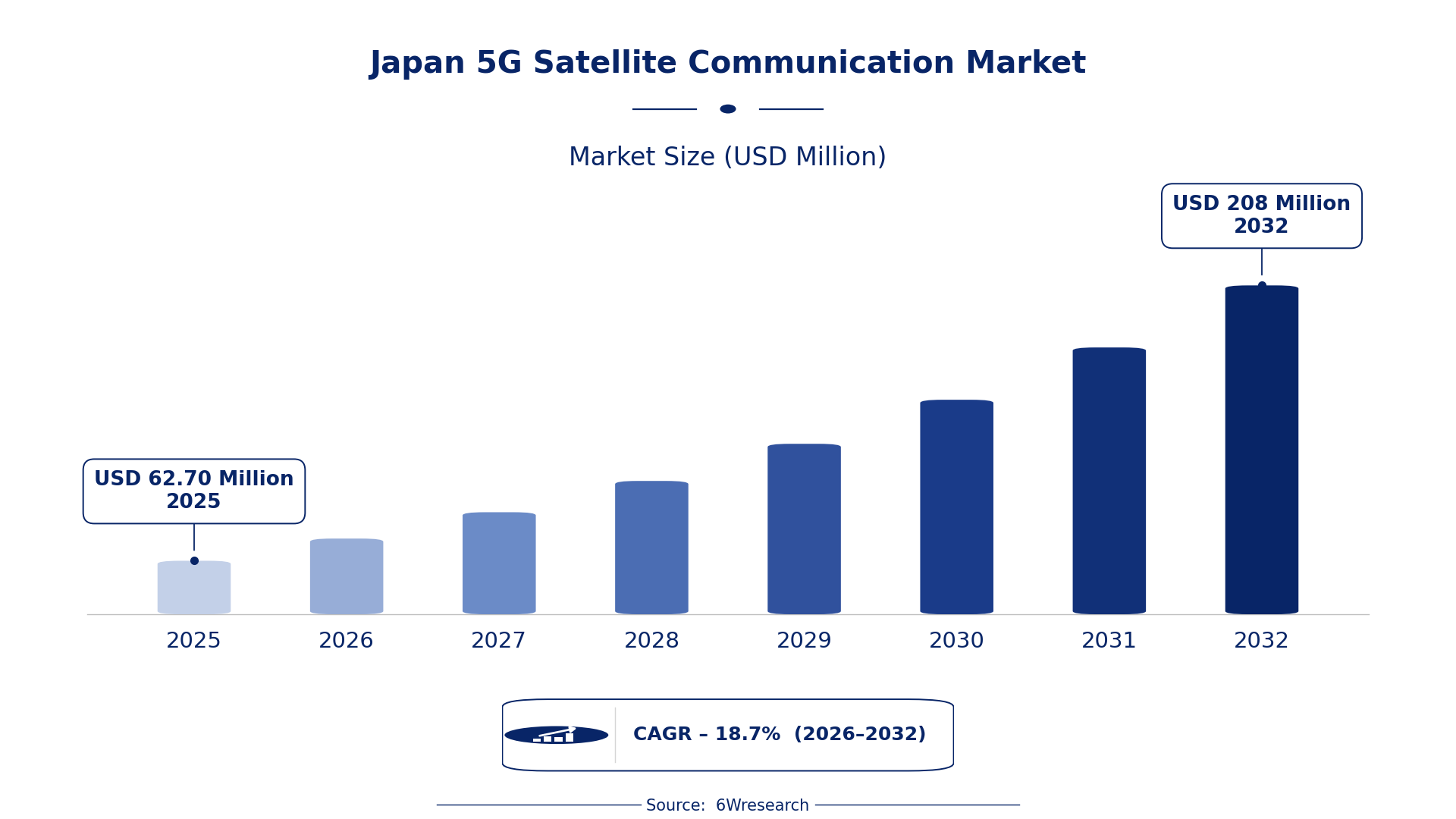
According to 6Wresearch internal database and industry insights, the Japan 5G Satellite Communication Market was valued at USD 62.70 Million in 2025 and is projected to reach USD 208 Million by 2032, growing at a CAGR of approximately 18.7% during 2026–2032.
Japan 5G Satellite Communication Market Highlights
| Report Metric | Details |
| Report Name | Japan 5G Satellite Communication Market (2026-2032) |
| Market Size 2025 | USD 62.70 Million |
| Market Size 2032 | USD 208 Million |
| Absolute Growth 2025–2032 | USD 145.30 Million |
| CAGR 2026–2032 | 18.7% |
| Peak Annual Growth | 22.0% in 2026 |
| Forecast Period | 2026–2032 |
| Historical Data | 2022–2025 |
| Base Year | 2025 |
| Leading Orbit, 2025 | Low Earth Orbit (LEO) (50% share) |
| Leading Satellite Solutions, 2025 | Backend and Tower Feed (52% share) |
| Leading Spectrum, 2025 | L and S band (1-4 GHZ) (47% share) |
| Leading End-users, 2025 | Defense and Government (33% share) |
| Fastest-Growing Orbit | Medium Earth Orbit (MEO) (22.9% CAGR) |
| Fastest-Growing Satellite Solutions | Trunking and Head-end Feed (25.4% CAGR) |
| Fastest-Growing Spectrum | C and X band (4-12 GHZ) (23.3% CAGR) |
| Fastest-Growing End-users | Consumer Electronics (24.5% CAGR) |
| Growing Sector | Defense and Government |
| Key End Users | Government agencies, Defense contractors, Telecommunications providers, IoT service providers |
Japan 5G Satellite Communication Market Year-wise Growth Rate and Key Drivers (2022–2032)
This graph illustrates the annual growth rates of the market from 2022 to 2032, highlighting a steady upward trajectory and projected market expansion over the forecast period.
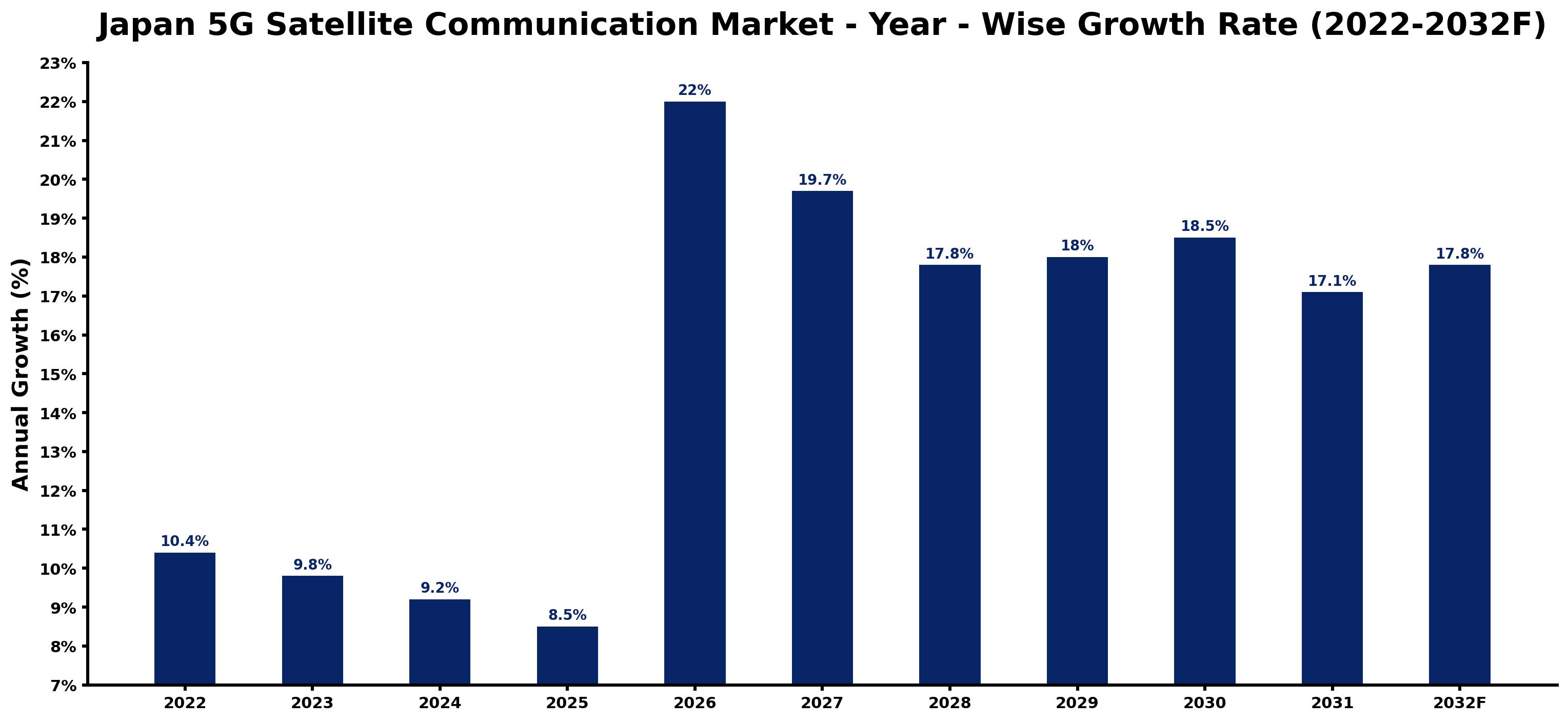
Annual growth estimates for each year appear below with the principal reason behind them, explaining the shifts that set the pace of the market.
| Year | Estimated Annual Growth (%) | Market Rationale |
| 2022 | 10.4 | The market experienced steady growth due to increased interest in satellite communication technologies. |
| 2023 | 9.8 | Growth slowed as investments in infrastructure faced delays, yet demand remained strong. |
| 2024 | 9.2 | Continued investments in satellite technology supported growth, though at a reduced pace. |
| 2025 | 8.5 | The market saw a further slowdown as projects faced regulatory hurdles and funding challenges. |
| 2026 | 22.0 | Demand surged as major government initiatives launched, driving investments in 5G satellite communication. |
| 2027 | 19.7 | Growth slowed slightly following the peak year, yet interest in satellite solutions persisted. |
| 2028 | 17.8 | The market maintained a healthy growth rate as new applications for satellite communication emerged. |
| 2029 | 18.0 | Demand accelerated again as advancements in technology attracted new buyers and applications. |
| 2030 | 18.5 | Continued growth was supported by expanding infrastructure and increasing government budgets for satellite projects. |
| 2031 | 17.1 | The market experienced a slowdown as competition intensified, yet demand remained strong. |
| 2032 | 17.8 | Growth picked up again as new projects and partnerships in satellite communication were established. |
Note: Market size estimations and growth projections presented in this report are based on 6Wresearch's proprietary forecasting methodology, utilizing the latest available industry data, government publications, and primary research inputs.
Japan 5G Satellite Communication Market Synopsis
5G satellite communication integrates satellite and terrestrial networks to provide high-speed internet connectivity. This technology supports reliable communication for defense and government operations, particularly in remote areas. The Japan 5G Satellite Communication Market is expanding due to significant investments in 5G infrastructure as part of the 'Society 5.0' initiative, aiming for 100% 5G coverage by 2025. The Tokyo metropolitan area serves as a major hub for technology development, with domestic users driving demand for dependable connectivity. The market is expected to grow as advancements in satellite technology enhance service offerings.
Market Dynamics Impact Analysis (2026–2032)
| Factor | Type | Impact | Primary Segment Affected |
| Increased government initiatives for satellite communication | Driver | High | Defense and Government |
| Growing demand for IoT applications in remote areas | Driver | High | Communication-on-the-move |
| Expansion of satellite communication capabilities in rural areas | Opportunity | High | Low Earth Orbit (LEO) |
| Rising investments in satellite technology development | Opportunity | High | Backend and Tower Feed |
| Regulatory hurdles affecting project timelines | Restraint | High | Medium Earth Orbit (MEO) |
| Limited consumer awareness of satellite communication benefits | Restraint | Medium | Consumer Electronics |
| High costs associated with satellite technology deployment | Challenge | High | Aviation |
| Capacity constraints in existing satellite infrastructure | Challenge | Medium | Energy and Utilities |
Evaluation of Drivers in Japan 5G Satellite Communication Market (2026–2032)
The table below links each growth driver to the segment it affects and the evidence for it.
| Drivers | Primary Segment Affected | Why It Matters (Evidence) |
| Government initiatives promoting satellite communication | Defense and Government | The Japanese defense budget includes allocations for satellite communication advancements, encouraging procurement and investment. |
| Demand for IoT applications in remote areas | Communication-on-the-move | Increased IoT adoption in rural Japan drives demand for reliable satellite connectivity solutions. |
| Investment in 5G infrastructure as part of 'Society 5.0' | Low Earth Orbit (LEO) | The initiative aims for 100% 5G coverage by 2025, enhancing satellite communication integration. |
| Technological advancements in satellite systems | Backend and Tower Feed | New satellite technologies improve data transmission capabilities, attracting more users and applications. |
| Growing urbanisation in metropolitan areas | Trunking and Head-end Feed | Urban areas like Tokyo see increased demand for high-capacity satellite communication solutions. |
Behind the steady rise in orders is a commitment to satellite communication capabilities. The defence budget allocates resources for advancements, with around 126 million people driving demand for reliable connectivity. Urbanisation in metropolitan areas heightens the need for high-capacity satellite solutions, while IoT applications in remote regions further stimulate demand. New satellite technologies are enhancing data transmission capabilities, attracting a variety of users and applications. The emphasis on improving communication in remote areas is likely to create new opportunities for suppliers.
Evaluation of Restraints in Japan 5G Satellite Communication Market
These are the pressures that could keep growth below its potential.
| Market Restraint | Primary Segment Affected | Why It Matters (Evidence) |
| Regulatory hurdles affecting project timelines | Medium Earth Orbit (MEO) | Delays in regulatory approvals can postpone satellite deployment, impacting service availability. |
| Limited consumer awareness of satellite communication benefits | Consumer Electronics | Many potential users remain unaware of the advantages of satellite technology, hindering market growth. |
| High costs associated with satellite technology deployment | Aviation | The investment required for satellite systems can deter smaller operators from entering the market. |
| Capacity constraints in existing satellite infrastructure | Energy and Utilities | Limited bandwidth and infrastructure can restrict service offerings, affecting user satisfaction. |
| Competition from terrestrial communication technologies | Transportation and Logistics | Alternative communication methods may limit the adoption of satellite solutions in certain sectors. |
Japan 5G Satellite Communication Market Challenges
In 2023, Japan's population of around 126 million generates a strong demand for 5G satellite communication, yet buyers encounter delays due to regulatory hurdles from the Ministry of Internal Affairs and Communications, which can prolong project timelines by up to six months. A shortage of skilled professionals in satellite technology development particularly hampers producers in the Tokyo metropolitan area, resulting in project delays that may exceed a year. Rising costs associated with advanced satellite technology development can increase expenses by 20% for suppliers, affecting their pricing strategies. Rapid technological advancements require ongoing investment, placing pressure on budgets for clinics and government operations that depend on up-to-date infrastructure.
Trends in the Japan 5G Satellite Communication Market
The following changes are redrawing the Japan 5G Satellite Communication Market.
- Shift to Low Earth Orbit Satellite Solutions: The Tokyo metropolitan area is increasingly adopting Low Earth Orbit (LEO) satellite solutions for communication. As of 2023, Japan has launched multiple LEO satellites, improving connectivity in remote regions.
- Rising Demand for IoT Applications: In 2023, approximately 126 million people in Japan are driving the demand for IoT applications supported by satellite communication. This trend will grow as more devices require reliable connectivity.
- Increased Investment in Satellite Technology: The Japanese government has committed funding to satellite technology development, with the defense budget allocating resources for advancements. This investment aims to strengthen national security and communication capabilities.
- Expansion of Satellite Communication in Rural Areas: The government aims to achieve 100% 5G coverage by 2025, enhancing satellite communication integration in rural areas. This initiative will bridge the digital divide in remote communities.
Investment Opportunities in the Japan 5G Satellite Communication Market
The opportunities below stand out in the Japan 5G Satellite Communication Market for new entrants and existing suppliers.
- Government Initiatives for Rural Connectivity: Defense and Government sectors are increasingly seeking satellite solutions to improve communication in rural areas. With a target of 100% 5G coverage by 2025, there is an opportunity for investment in satellite infrastructure.
- Growing Urbanisation in Tokyo: The Tokyo metropolitan area is experiencing a surge in demand for high-capacity satellite solutions. As urbanisation continues, investments in satellite technology are essential to meet growing communication needs.
- Investment in Satellite Communication for IoT: With a large population in Japan, there is a pressing need for IoT applications supported by satellite communication. Suppliers can enter this market by partnering with local government initiatives.
- Technological Advancements in Satellite Systems: The ongoing development of advanced satellite technologies presents an opportunity for suppliers to innovate. By collaborating with research institutions, companies can improve their offerings in the satellite communication market.
Government Initiatives in the Japan 5G Satellite Communication Market
The Hydrogen Society Promotion Act (2024) provides support for low-carbon hydrogen supply chains, encouraging investment in satellite technology that aligns with sustainable energy initiatives. This law complements Japan's long-term environmental goals and reinforces previous regulations on satellite communication.
In 2023, funding was allocated for multiple satellite projects overseen by the Japan Aerospace Exploration Agency (JAXA). This support aims to improve satellite communication capabilities, promoting progress in the sector.
Future Insight of the Japan 5G Satellite Communication Market
The launch of new satellite communication projects by 2032 will enhance connectivity across remote areas, driven by the 'Society 5.0' initiative. The integration of 5G infrastructure will support IoT applications, creating new opportunities for suppliers to innovate. By 2025, achieving 100% 5G coverage will facilitate communication for buyers, particularly in defence and government sectors. Japan's space industry is projected to grow significantly, with advancements in satellite technology likely leading to a 30% increase in operational efficiency for clinics and other users.
Market Segmentation Analysis
Japan 5G Satellite Communication Market report covers a detailed analysis of the following market segments:
By Orbit – Low Earth Orbit (LEO) Leads, Medium Earth Orbit (MEO) Expected to Grow Fastest
According to Ravi Bhandari, Research Head at 6Wresearch, with 50% of orbit revenue in 2025, Low Earth Orbit (LEO) was the largest category. Low Earth Orbit (LEO) holds the largest share due to its capability to provide low-latency communication, crucial for applications like IoT and remote connectivity. The multiple LEO satellites launched by Japan in 2023 illustrate the nation's commitment to enhancing this technology. Medium Earth Orbit (MEO) is set to record the highest CAGR in this split, 22.9% over 2026–2032. Medium Earth Orbit (MEO) is experiencing rapid growth as it supports specific applications such as navigation and timing, which are increasingly sought after. The integration of MEO with existing infrastructure is expected to further accelerate its adoption. Suppliers should focus on enhancing LEO capabilities while exploring opportunities in MEO to meet diverse market needs.
By Satellite Solutions – Backend and Tower Feed Leads, Trunking and Head-end Feed Expected to Grow Fastest
Backend and Tower Feed took 52% of satellite solutions revenue in 2025, more than any other category. Backend and Tower Feed is the leading segment as it is vital for connecting satellite signals to terrestrial networks, ensuring seamless communication. This segment's significance is highlighted by Japan's ongoing investments in satellite technology infrastructure. Trunking and Head-end Feed is projected to grow fastest, at a CAGR of 25.4% during 2026–2032. Trunking and Head-end Feed is growing quickly due to the increasing demand for large data transmission needs, especially in urban centres like Tokyo. This trend reflects the rising reliance on robust data services in a connected society. Buyers will benefit from investing in advanced trunking solutions to effectively manage escalating data requirements.
By Spectrum – L and S band (1-4 GHZ) Leads, C and X band (4-12 GHZ) Expected to Grow Fastest
L and S band (1-4 GHZ) held 47% of the Japan 5G Satellite Communication Market by spectrum in 2025. L and S band (1-4 GHz) dominates the market as it is widely utilised for both mobile and fixed communication services, catering to a broad user base. Its established presence in the telecommunications sector reinforces its leading position. The quickest growth will come from C and X band (4-12 GHZ), forecast to expand at a CAGR of 23.3% between 2026 and 2032. C and X band (4-12 GHz) is witnessing the fastest growth primarily due to its applications in military and weather services, which are essential for national security and disaster management. The increasing focus on these sectors is driving its adoption. Suppliers should prioritise the development of C and X band technologies to capitalise on emerging opportunities in defence and meteorological applications.
By End-users – Defense and Government Leads, Consumer Electronics Expected to Grow Fastest
Defense and Government accounted for 33% of the market by end-users in 2025. Defense and Government is the leading end-user segment, as satellite communication is critical for national security and effective communication strategies. The substantial allocations in Japan's defense budget highlight the importance of this sector. Over 2026–2032, Consumer Electronics is expected to post the fastest growth, at a CAGR of 24.5%. Consumer Electronics is the fastest-growing segment, driven by the increasing integration of satellite communication in devices requiring connectivity, such as smart home technologies. This trend indicates a shift towards more connected consumer solutions. Suppliers must adapt their offerings to cater to the growing consumer electronics market while maintaining strong ties with defense and government sectors.
Key Attractiveness of the Report
- 10 Years of Market Numbers
- Historical Data Starting from 2022 to 2025
- Base Year 2025
- Forecast Data until 2032
- Key Performance Indicators Impacting the Market
- Major Upcoming Developments and Projects
Key Highlights of the Report:
- COVID-19 Impact on the Market.
- 6 Years Market Numbers.
- Estimated Data Starting from 2022-2032F to 2022-2032F.
- Base Year: 2025
- Forecast Data until 2022-2032F.
- Key Performance Indicators Impacting the Market.
- Major Upcoming Developments and Projects.
Market Covered
The following segment groups are covered in the report.
By Orbit
- Low Earth Orbit (LEO)
- Medium Earth Orbit (MEO)
- Geosynchronous Earth Orbit (GEO)
By Satellite Solutions
- Backend and Tower Feed
- Trunking and Head-end Feed
- Communication-on-the-move
- Hybrid Multiplay
By Spectrum
- L and S band (1-4 GHZ)
- C and X band (4-12 GHZ)
- Ku and Ka band (12-40 GHZ)
By End-users
- Defense and Government
- Consumer Electronics
- Aviation
- Energy and Utilities
- Transportation and Logistics
- Others






































