Japan Advanced Farming Market Size & Growth Rate
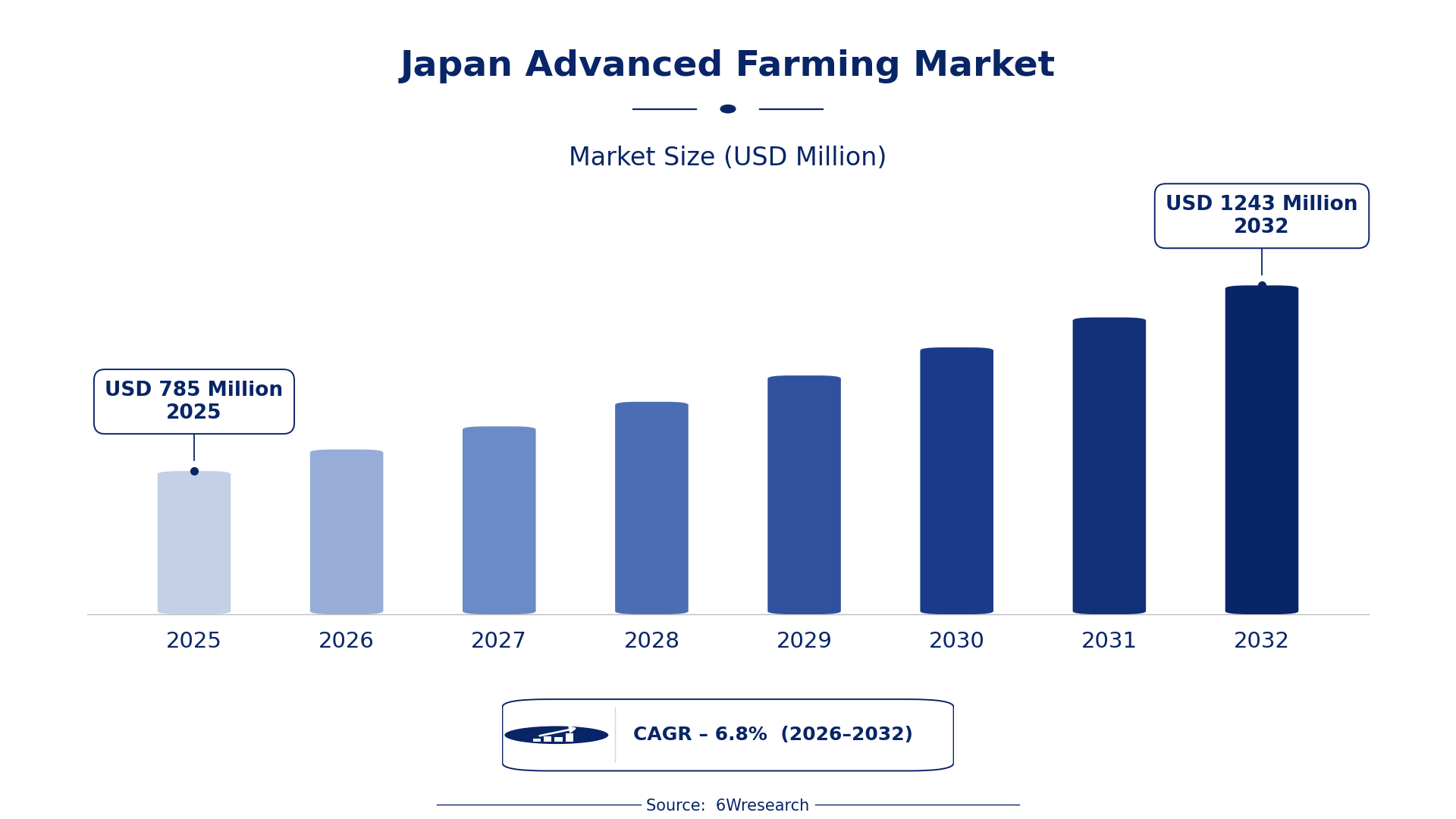
According to 6Wresearch internal database and industry insights, the Japan Advanced Farming Market was valued at USD 785 Million in 2025 and is projected to reach USD 1,243 Million by 2032, growing at a CAGR of approximately 6.8% during 2026–2032.
Japan Advanced Farming Market Highlights
| Report Metric | Details |
| Report Name | Japan Advanced Farming Market (2026-2032) |
| Market Size 2025 | USD 785 Million |
| Market Size 2032 | USD 1,243 Million |
| Absolute Growth 2025–2032 | USD 458 Million |
| CAGR 2026–2032 | 6.8% |
| Peak Annual Growth | 8.1% in 2026 |
| Forecast Period | 2026–2032 |
| Historical Data | 2022–2025 |
| Base Year | 2025 |
| Leading Product Type, 2025 | Precision Sensors (54% share) |
| Leading Functionality, 2025 | Soil Analysis (41% share) |
| Leading Application Area, 2025 | Crop Monitoring (42% share) |
| Leading Distribution Channel, 2025 | Direct Sales (40% share) |
| Leading End User, 2025 | Farmers (41% share) |
| Fastest-Growing Product Type | Drones (9.8% CAGR) |
| Fastest-Growing Application Area | Irrigation Planning (8.2% CAGR) |
| Fastest-Growing Distribution Channel | Online Platforms (8.7% CAGR) |
| Fastest-Growing End User | Agribusiness Firms (8.5% CAGR) |
| Growing Sector | Irrigation Planning |
| Key End Users | Crop Monitoring, Irrigation Planning, Field Operations, Greenhouse Management |
Japan Advanced Farming Market Year-wise Growth Rate and Key Drivers (2022–2032)
This graph illustrates the annual growth rates of the market from 2022 to 2032, highlighting a steady upward trajectory and projected market expansion over the forecast period.
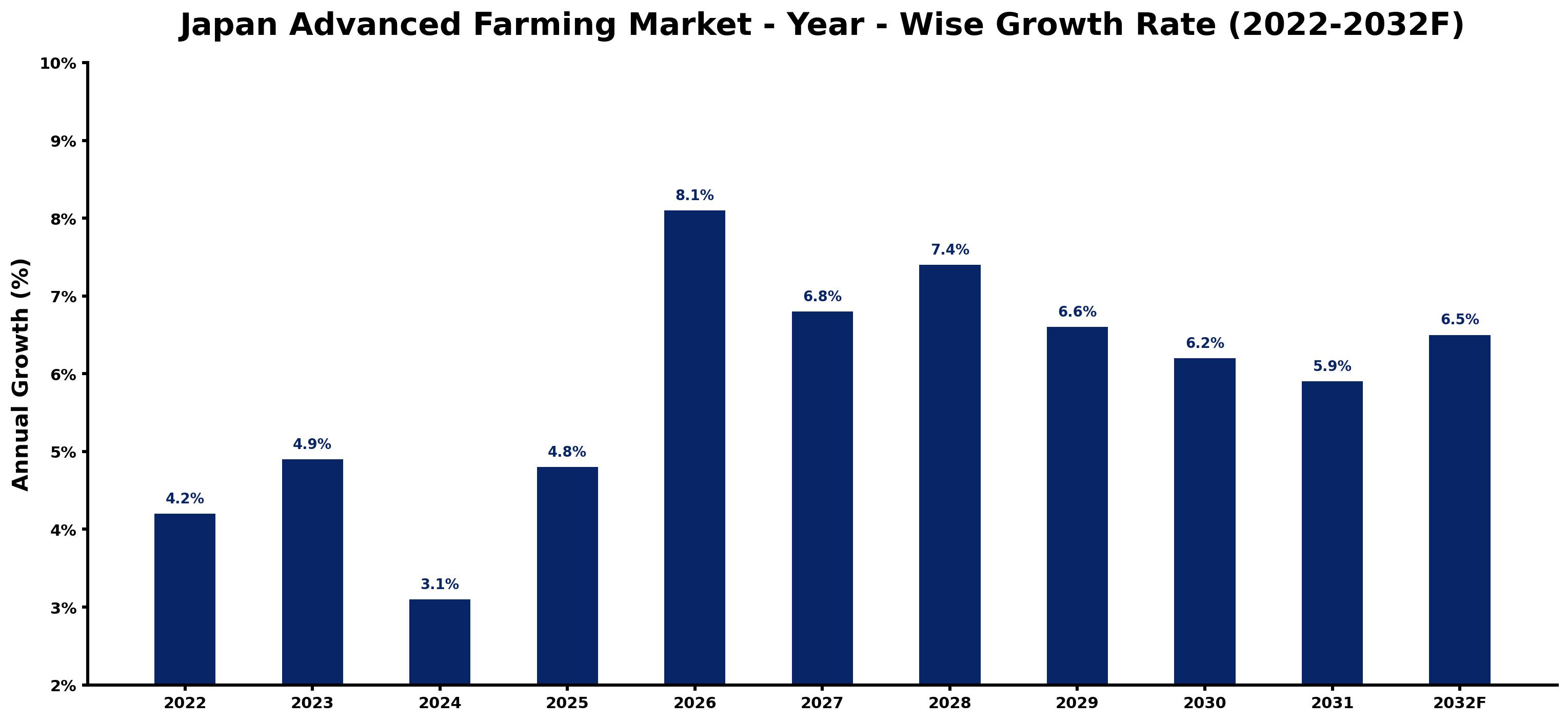
Each row of the following table gives one year's estimated growth and the event or demand shift that explains it.
| Year | Estimated Annual Growth (%) | Market Rationale |
| 2022 | 4.2 | The agricultural sector showed steady growth, supported by ongoing technology adoption. |
| 2023 | 4.9 | Demand for advanced farming technologies grew faster due to increased awareness and investment. |
| 2024 | 3.1 | Growth slowed as market adjustments occurred following rapid previous expansion. |
| 2025 | 4.8 | The market rebounded with renewed interest in precision agriculture technologies. |
| 2026 | 8.1 | A surge in adoption of automated systems drove growth in the market. |
| 2027 | 6.8 | Growth slowed slightly as market saturation began to affect new technology uptake. |
| 2028 | 7.4 | Increased investment in smart agriculture technologies led to a rise in demand. |
| 2029 | 6.6 | Market growth decelerated as competition intensified among technology providers. |
| 2030 | 6.2 | Demand remained strong, although growth rates moderated due to market maturity. |
| 2031 | 5.9 | The market continued to grow, driven by ongoing technological advancements. |
| 2032 | 6.5 | A renewed focus on sustainability and efficiency boosted market expansion. |
Note: Market size estimations and growth projections presented in this report are based on 6Wresearch's proprietary forecasting methodology, utilizing the latest available industry data, government publications, and primary research inputs.
Japan Advanced Farming Market Synopsis
Advanced farming integrates technology and agricultural practices to improve productivity and sustainability in Japan. Key technologies include precision sensors, drones, and automated irrigation systems, which are critical for crop monitoring and resource management. The Japan Advanced Farming Market is expanding as domestic agribusiness firms and farmers invest in these technologies, supported by government initiatives such as the subsidy program for precision agriculture launched in 2023 and the goal to increase agricultural productivity by 20% by 2030.
Market Dynamics Impact Analysis (2026–2032)
| Factor | Type | Impact | Primary Segment Affected |
| Growing adoption of precision sensors for soil and crop monitoring | Driver | High | Precision Sensors |
| Increased use of drones for aerial surveillance and crop monitoring | Driver | High | Drones |
| Rising demand for automated irrigation systems in rice fields | Opportunity | Medium | Automated Irrigation Systems |
| Expansion of online platforms for technology distribution | Opportunity | Medium | Online Platforms |
| High average age of farmers leading to a need for automation | Restraint | High | Farmers |
| Limited awareness of advanced farming technologies among smaller farms | Restraint | Medium | Agribusiness Firms |
| Challenges in integrating new technologies into traditional farming practices | Challenge | High | Agricultural Enterprises |
| Competition from lower-cost agricultural technologies in the market | Challenge | Medium | Large Farms |
Evaluation of Drivers in Japan Advanced Farming Market (2026–2032)
Below are the drivers that matter most for revenue growth, with supporting evidence.
| Drivers | Primary Segment Affected | Why It Matters (Evidence) |
| Increased investment in precision agriculture technologies | Precision Sensors | The precision farming market is expected to reach notable adoption levels by 2025, prompting more farmers to invest in sensors. |
| Growing adoption of drones for crop monitoring | Drones | Drones are increasingly used in over 30% of large-scale farms in Japan, improving monitoring capabilities. |
| Adoption of automated irrigation systems in rice fields | Automated Irrigation Systems | Automated irrigation systems are being adopted in 25% of rice fields, optimizing water usage. |
| Rising demand for crop monitoring solutions | Crop Monitoring | Crop monitoring technologies are essential for tracking growth, leading to increased purchases by farmers. |
| Expansion of direct sales channels for advanced farming technologies | Direct Sales | Direct sales remain the primary channel, with a 40% share, facilitating access for farmers. |
Much of the new demand traces back to Tokyo and Hokkaido, where advanced farming technologies are increasingly adopted. Approximately 25% of rice fields now use automated irrigation systems, which optimises water usage. The precision farming market is expected to grow by 2025, driven by rising investments from agribusiness firms. Drones are now employed in over 30% of large-scale farms, improving crop monitoring capabilities. Direct sales channels account for 40% of technology distribution, ensuring farmers have access to essential tools for productivity improvement.
Evaluation of Restraints in Japan Advanced Farming Market
These restraints slow adoption and weigh on supplier margins.
| Market Restraint | Primary Segment Affected | Why It Matters (Evidence) |
| High average age of farmers affecting technology adoption | Farmers | With an average age of 67 years, many farmers are reluctant to adopt new technologies, delaying market growth. |
| Limited awareness of advanced farming technologies among smaller farms | Agribusiness Firms | Many smaller agribusiness firms lack knowledge about available technologies, hindering their adoption. |
| Integration challenges with traditional farming practices | Agricultural Enterprises | Integrating advanced technologies into established practices proves difficult, slowing uptake among larger enterprises. |
| Competition from lower-cost alternatives in the market | Large Farms | Lower-cost agricultural technologies are appealing to large farms, impacting the demand for advanced solutions. |
| Insufficient infrastructure for technology support in rural areas | Farmers | Rural areas often lack the necessary infrastructure to support advanced farming technologies, limiting their effectiveness. |
Japan Advanced Farming Market Challenges
Japan's agricultural sector employs approximately 2 million people, yet many farmers still rely on outdated technology, resulting in inefficiencies that can lead to a 30% reduction in crop yields. Local producers face intense competition from imported advanced farming technologies, compelling them to lower prices and squeezing profit margins for domestic suppliers. Buyers encounter rising costs due to limited access to effective solutions, which delays their efforts to improve productivity and sustainability, potentially costing them up to 1 trillion yen in lost exports. With the average age of farmers around 67 years, a skills gap persists that obstructs the adoption of new technologies, ultimately hindering the sector's growth.
Trends in the Japan Advanced Farming Market
Below are the shifts with the largest effect on the Japan Advanced Farming Market.
- Shift from Traditional to Precision Farming: Japan is transitioning towards precision farming, with a notable increase in the use of precision sensors. By 2025, the precision farming market is expected to reach high adoption levels, indicating a shift in farming practices.
- Emergence of Drones in Large-Scale Farming: Drones are becoming increasingly prevalent in large-scale farming operations, with over 30% adoption in Japan. This trend reflects a growing recognition of their benefits for crop monitoring and management.
- Growth of Automated Irrigation Systems: Automated irrigation systems are being increasingly adopted, particularly in rice fields where 25% have implemented such technologies. This trend highlights a move towards more efficient water management practices.
- Rise of Online Platforms for Technology Distribution: Online platforms are gaining traction as a distribution channel for advanced farming technologies, with notable growth expected. This shift allows farmers to access effective solutions more easily.
Investment Opportunities in the Japan Advanced Farming Market
Several openings in the Japan Advanced Farming Market merit attention from investors.
- Farmers Seeking Efficient Water Management Solutions: Farmers are increasingly looking for automated irrigation systems to improve water efficiency, with 25% of rice fields adopting such technologies. Collaborating with local agribusiness firms can facilitate market entry.
- Growing Demand for Crop Monitoring Technologies: The demand for crop monitoring solutions is rising as farmers seek to improve yields. Investing in precision sensors can meet this need, particularly in regions like Hokkaido.
- Investment in Agricultural Robotics: With the government's funding for research in agricultural robotics, there is a growing opportunity for suppliers to provide effective solutions. Engaging with research institutions can enhance market presence.
- Expansion of Online Sales Channels: As online platforms for technology distribution grow, suppliers can invest in digital marketing strategies to reach farmers more effectively. Partnering with local distributors can streamline access.
Government Initiatives in the Japan Advanced Farming Market
In 2023, Japan launched a subsidy program for precision agriculture technologies, building on previous initiatives to support technology adoption in farming. This measure encourages farmers to invest in modern tools, improving productivity and sustainability in the sector.
The Smart Agriculture Promotion Council oversees the implementation of various agricultural support programs, including funding for research in agricultural robotics. In 2023, the government allocated substantial funds to enhance technology integration, benefiting farmers and agribusiness firms.
Future Insight of the Japan Advanced Farming Market
By 2032, government initiatives will drive a shift towards smart agriculture, aiming to boost productivity by 20% by 2030. Subsidy programs for precision agriculture technologies will motivate investment in advanced tools, leading to greater operational efficiency. The integration of robotics will streamline farming processes, reducing reliance on manual labour. Buyers will benefit from improved resource management, while suppliers will see increased demand for advanced farming technologies, particularly in regions like Hokkaido.
Market Segmentation Analysis
Japan Advanced Farming Market report covers a detailed analysis of the following market segments:
By Product Type – Precision Sensors Lead, Drones Expected to Grow Fastest
According to Itika Upadhyaya, Senior Research Analyst at 6Wresearch, the largest product type category in 2025 was Precision Sensors, at 54% of revenue. Precision sensors are vital for monitoring soil and crop conditions, which is crucial for farmers aiming to maximise yields. Their extensive application is particularly notable in regions like Tokyo and Hokkaido, where advanced farming practices are being embraced. Over 2026–2032, Drones are expected to post the fastest growth, at a CAGR of 9.8%. Drones are gaining traction due to their effectiveness in aerial surveillance and crop monitoring, with over 30% of large-scale farms in Japan employing them. This trend is expected to persist as farmers seek to improve operational efficiency. Suppliers should focus on advancing drone technology to align with the growing demand from farmers.
By Functionality – Soil Analysis Leads and Records the Fastest Growth
Soil Analysis held 41% of the Japan Advanced Farming Market by functionality in 2025. Soil analysis is essential for understanding soil health and fertility, directly impacting crop yields and farming success. Government initiatives promoting smart agriculture further highlight the importance of this functionality. Its lead should widen, with a projected CAGR of 9.0% during 2026–2032, the highest in this split. Soil analysis is also the fastest-growing functionality, driven by its critical role in optimising agricultural productivity. As farmers increasingly rely on data-driven insights, demand for this technology will likely continue to rise. Buyers will gain substantial benefits by investing in soil analysis technologies to enhance their farming outcomes.
By Application Area – Crop Monitoring Leads, Irrigation Planning Expected to Grow Fastest
In 2025, Crop Monitoring led the application area split with a 42% share. Crop monitoring is crucial for tracking crop growth and health, making it a primary focus for farmers aiming to improve yields. The government's emphasis on precision farming technologies underscores its role in enhancing agricultural productivity. Irrigation Planning is set to record the highest CAGR in this split, 8.2% over 2026–2032. Irrigation planning is experiencing rapid growth as it is vital for effective water resource management, especially in regions facing water scarcity. The increasing adoption of automated irrigation systems is driving this segment's expansion. Suppliers should prioritise developing irrigation planning solutions to meet the changing needs of farmers.
By Distribution Channel – Direct Sales Leads, Online Platforms Expected to Grow Fastest
With 40% of distribution channel revenue in 2025, Direct Sales was the largest category. Direct sales serve as the primary channel for reaching end users, ensuring that farmers acquire necessary technologies directly. This approach is particularly effective in Japan's agricultural sector, where personal relationships are key. Online Platforms are projected to grow fastest, at a CAGR of 8.7% during 2026–2032. Online platforms are emerging as the fastest-growing distribution channel, propelled by the increasing digitalisation of the agricultural sector. Farmers are progressively turning to online avenues for purchasing advanced farming technologies. Suppliers must enhance their online presence to capture the expanding market segment of tech-savvy farmers.
By End User – Farmers Lead, Agribusiness Firms Expected to Grow Fastest
Farmers took 41% of end user revenue in 2025, more than any other category. Farmers are the primary end users of advanced farming solutions, directly benefiting from improved productivity and operational efficiency. Their significant presence in Japan's agricultural sector highlights the strong demand for these technologies. Over 2026–2032, Agribusiness Firms are expected to post the fastest growth, at a CAGR of 8.5%. Agribusiness firms are increasingly adopting advanced farming technologies to streamline operations and enhance profitability, indicating a shift towards more professionalised agricultural practices. This trend is expected to accelerate as firms seek competitive advantages. Suppliers should tailor their offerings to meet the specific needs of agribusiness firms to remain relevant in a competitive market.
Key Attractiveness of the Report
- 10 Years of Market Numbers
- Historical Data Starting from 2022 to 2025
- Base Year 2025
- Forecast Data until 2032
- Key Performance Indicators Impacting the Market
- Major Upcoming Developments and Projects
Key Highlights of the Report:
- Japan Advanced Farming Market Outlook
- Market Size of Japan Advanced Farming Market, 2025
- Forecast of Japan Advanced Farming Market, 2032
- Historical Data and Forecast of Japan Advanced Farming Market Revenues & Volume for the Period 2022-2032F
- Japan Advanced Farming Market Trend Evolution
- Japan Advanced Farming Market Drivers and Challenges
- Japan Advanced Farming Market Price Trends
- Japan Advanced Farming Market Porter's Five Forces
- Japan Advanced Farming Market Industry Life Cycle
- Historical Data and Forecast of Japan Advanced Farming Market Revenues & Volume By Product Type for the Period 2022-2032F
- Historical Data and Forecast of Japan Advanced Farming Market Revenues & Volume By Precision Sensors for the Period 2022-2032F
- Historical Data and Forecast of Japan Advanced Farming Market Revenues & Volume By Drones for the Period 2022-2032F
- Historical Data and Forecast of Japan Advanced Farming Market Revenues & Volume By Automated Irrigation Systems for the Period 2022-2032F
- Historical Data and Forecast of Japan Advanced Farming Market Revenues & Volume By Smart Tractors for the Period 2022-2032F
- Historical Data and Forecast of Japan Advanced Farming Market Revenues & Volume By Functionality for the Period 2022-2032F
- Historical Data and Forecast of Japan Advanced Farming Market Revenues & Volume By Soil Analysis for the Period 2022-2032F
- Historical Data and Forecast of Japan Advanced Farming Market Revenues & Volume By Aerial Surveillance for the Period 2022-2032F
- Historical Data and Forecast of Japan Advanced Farming Market Revenues & Volume By Water Efficiency for the Period 2022-2032F
- Historical Data and Forecast of Japan Advanced Farming Market Revenues & Volume By Automated Plowing for the Period 2022-2032F
- Historical Data and Forecast of Japan Advanced Farming Market Revenues & Volume By Application Area for the Period 2022-2032F
- Historical Data and Forecast of Japan Advanced Farming Market Revenues & Volume By Crop Monitoring for the Period 2022-2032F
- Historical Data and Forecast of Japan Advanced Farming Market Revenues & Volume By Irrigation Planning for the Period 2022-2032F
- Historical Data and Forecast of Japan Advanced Farming Market Revenues & Volume By Greenhouse Management for the Period 2022-2032F
- Historical Data and Forecast of Japan Advanced Farming Market Revenues & Volume By Field Operations for the Period 2022-2032F
- Historical Data and Forecast of Japan Advanced Farming Market Revenues & Volume By Distribution Channel for the Period 2022-2032F
- Historical Data and Forecast of Japan Advanced Farming Market Revenues & Volume By Direct Sales for the Period 2022-2032F
- Historical Data and Forecast of Japan Advanced Farming Market Revenues & Volume By Online Platforms for the Period 2022-2032F
- Historical Data and Forecast of Japan Advanced Farming Market Revenues & Volume By Industrial Suppliers for the Period 2022-2032F
- Historical Data and Forecast of Japan Advanced Farming Market Revenues & Volume By Specialty Distributors for the Period 2022-2032F
- Historical Data and Forecast of Japan Advanced Farming Market Revenues & Volume By End User for the Period 2022-2032F
- Historical Data and Forecast of Japan Advanced Farming Market Revenues & Volume By Agribusiness Firms for the Period 2022-2032F
- Historical Data and Forecast of Japan Advanced Farming Market Revenues & Volume By Farmers for the Period 2022-2032F
- Historical Data and Forecast of Japan Advanced Farming Market Revenues & Volume By Agricultural Enterprises for the Period 2022-2032F
- Historical Data and Forecast of Japan Advanced Farming Market Revenues & Volume By Large Farms for the Period 2022-2032F
- Japan Advanced Farming Market Import Export Trade Statistics
- Market Opportunity Assessment By Product Type
- Market Opportunity Assessment By Functionality
- Market Opportunity Assessment By Application Area
- Market Opportunity Assessment By Distribution Channel
- Market Opportunity Assessment By End User
- Japan Advanced Farming Market Top Companies Market Share
- Japan Advanced Farming Market Competitive Benchmarking By Technical and Operational Parameters
- Japan Advanced Farming Market Company Profiles
- Japan Advanced Farming Market Key Strategic Recommendations
Market Covered
The following segment groups are covered in the report.
By Product Type
- Precision Sensors
- Drones
- Automated Irrigation Systems
- Smart Tractors
By Functionality
- Soil Analysis
- Aerial Surveillance
- Water Efficiency
- Automated Plowing
By Application Area
- Crop Monitoring
- Irrigation Planning
- Greenhouse Management
- Field Operations
By Distribution Channel
- Direct Sales
- Online Platforms
- Industrial Suppliers
- Specialty Distributors
By End User
- Agribusiness Firms
- Farmers
- Agricultural Enterprises
- Large Farms






































