Japan Aerospace Locking Mechanisms Market Size & Growth Rate
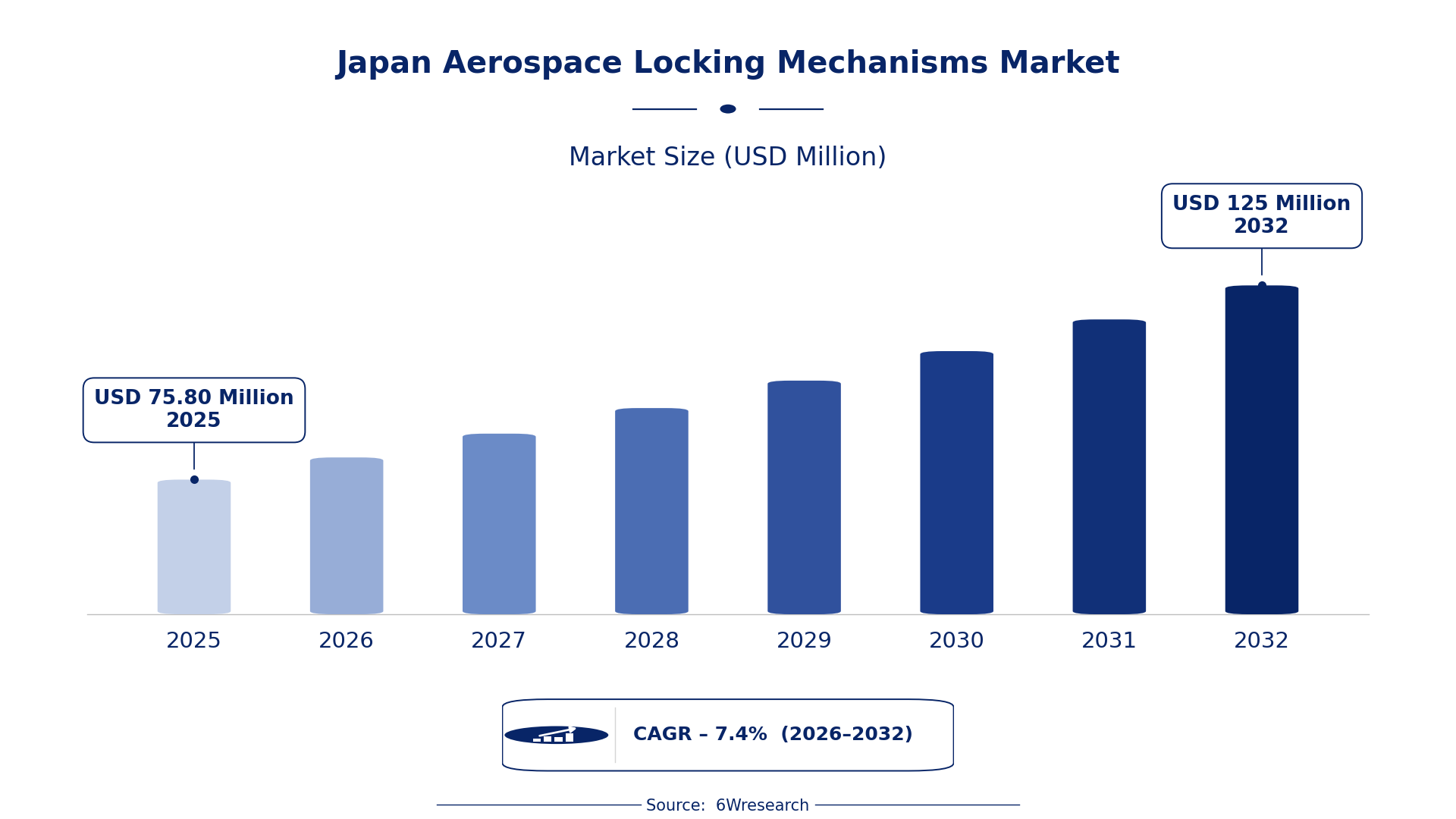
According to 6Wresearch internal database and industry insights, the Japan Aerospace Locking Mechanisms Market was valued at USD 75.80 Million in 2025 and is projected to reach USD 125 Million by 2032, growing at a CAGR of approximately 7.4% during 2026–2032.
Japan Aerospace Locking Mechanisms Market Highlights
| Report Metric | Details |
| Report Name | Japan Aerospace Locking Mechanisms Market (2026-2032) |
| Market Size 2025 | USD 75.80 Million |
| Market Size 2032 | USD 125 Million |
| Absolute Growth 2025–2032 | USD 49.20 Million |
| CAGR 2026–2032 | 7.4% |
| Peak Annual Growth | 9.1% in 2032 |
| Forecast Period | 2026–2032 |
| Historical Data | 2022–2025 |
| Base Year | 2025 |
| Leading Lock Type, 2025 | Quick Release Mechanisms (33% share) |
| Leading Application Area, 2025 | Avionics Panels (49% share) |
| Leading Distribution Channel, 2025 | Direct Sales (35% share) |
| Leading End User, 2025 | Aerospace OEMs (42% share) |
| Fastest-Growing Lock Type | Latch Locks (10.5% CAGR) |
| Fastest-Growing Distribution Channel | Industrial Suppliers (9.9% CAGR) |
| Fastest-Growing End User | Aircraft Builders (9.6% CAGR) |
| Growing Sector | Aerospace manufacturing |
| Key End Users | Aerospace OEMs, Aircraft Builders, Aviation Security Firms, Aircraft Interior Designers |
Japan Aerospace Locking Mechanisms Market Year-wise Growth Rate and Key Drivers (2022–2032)
This graph illustrates the annual growth rates of the market from 2022 to 2032, highlighting a steady upward trajectory and projected market expansion over the forecast period.
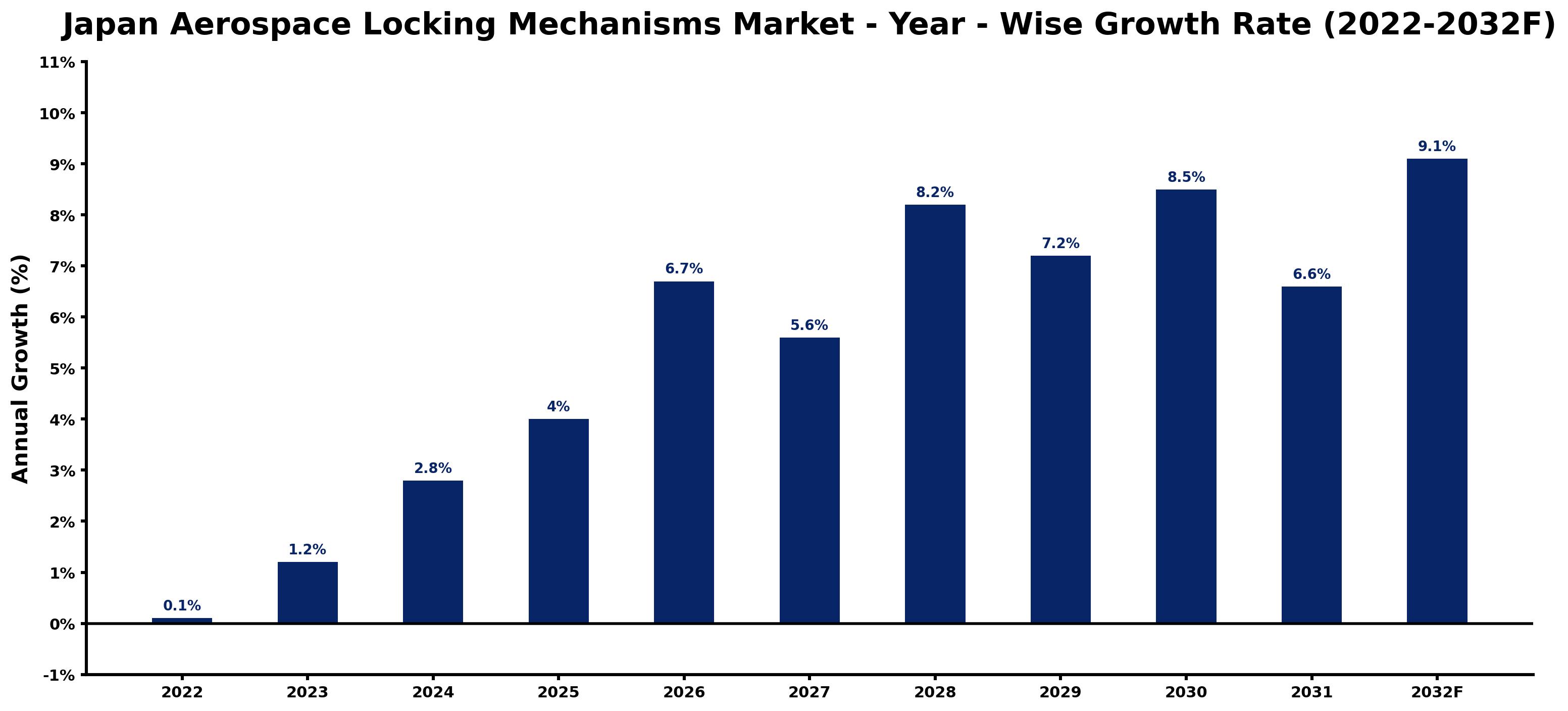
For each year, the table pairs the estimated growth rate with the leading influence on demand, showing how the drivers changed across the period.
| Year | Estimated Annual Growth (%) | Market Rationale |
| 2022 | 0.1 | The market experienced minimal growth due to ongoing recovery from previous disruptions. |
| 2023 | 1.2 | Growth accelerated as domestic aircraft manufacturers increased production rates. |
| 2024 | 2.8 | Continued investments in aerospace technology drove further demand for locking mechanisms. |
| 2025 | 4.0 | The market peaked with heightened production of commercial aircraft and related components. |
| 2026 | 6.7 | Investment in new technologies is expected to sustain growth momentum in the sector. |
| 2027 | 5.6 | Growth slowed as the market adjusted to previous high production levels. |
| 2028 | 8.2 | Demand surged again as aerospace OEMs expanded their production capabilities. |
| 2029 | 7.2 | The market experienced a slowdown as growth stabilised after rapid expansions. |
| 2030 | 8.5 | Technological advancements are expected to drive renewed interest in aerospace components. |
| 2031 | 6.6 | Growth rates decreased as the market approached maturity in several segments. |
| 2032 | 9.1 | The market is projected to peak with considerable investments in aerospace innovation. |
Note: Market size estimations and growth projections presented in this report are based on 6Wresearch's proprietary forecasting methodology, utilizing the latest available industry data, government publications, and primary research inputs.
Japan Aerospace Locking Mechanisms Market Synopsis
Aerospace locking mechanisms are critical devices that secure various components in aircraft, constructed from high-strength materials to endure extreme conditions. In Japan, demand arises primarily from domestic aircraft manufacturers and maintenance services. The Japan Aerospace Locking Mechanisms Market is expanding due to increased production of commercial aircraft, supported by over 80,000 employees in the aerospace sector and government backing for innovation. The Tokyo Metropolitan Area serves as a key manufacturing hub, while the government aims to boost aerospace exports by 20% by 2025, stimulating market activity.
Market Dynamics Impact Analysis (2026–2032)
| Factor | Type | Impact | Primary Segment Affected |
| Increased production of commercial aircraft | Driver | High | Avionics Panels |
| Growing demand for safety in cargo compartments | Driver | High | Cargo Compartments |
| Expansion of aerospace manufacturing capabilities | Opportunity | High | Aircraft Builders |
| Rising interest in advanced locking technologies | Opportunity | Medium | Quick Release Mechanisms |
| High cost of advanced materials | Restraint | High | Latch Locks |
| Limited availability of specialized products | Restraint | Medium | Combination Locks |
| Competition from international suppliers | Challenge | High | Aerospace OEMs |
| Challenges in meeting stringent safety regulations | Challenge | Medium | Pilot Cockpit Systems |
Evaluation of Drivers in Japan Aerospace Locking Mechanisms Market (2026–2032)
Demand rests on the following drivers, each shown with the segment it touches most.
| Drivers | Primary Segment Affected | Why It Matters (Evidence) |
| Increased production of commercial aircraft | Avionics Panels | Japan produced 100 commercial aircraft in 2022, leading to higher demand for locking mechanisms. |
| Growing focus on safety standards | Cargo Compartments | Aerospace security regulations enforced by the Japan Civil Aviation Bureau drive demand for reliable solutions. |
| Investment in aerospace innovation | Quick Release Mechanisms | The government allocated ¥10 billion for aerospace technology initiatives in 2023, boosting demand for efficient mechanisms. |
| Expansion of aerospace OEMs | Aircraft Builders | Over 50 registered aerospace OEMs in Japan are increasing their production, requiring more locking mechanisms. |
| Technological advancements in materials | Latch Locks | The adoption of high-strength materials improves the performance of locking mechanisms, attracting more buyers. |
Much of the new demand traces back to the increased production of commercial aircraft, with Japan producing 100 aircraft in 2022. This surge in manufacturing has prompted aerospace builders to seek reliable locking mechanisms. As manufacturers adopt advanced materials, the performance of mechanisms improves, attracting more buyers in the sector.
Evaluation of Restraints in Japan Aerospace Locking Mechanisms Market
The following restraints limit how fast demand can grow.
| Market Restraint | Primary Segment Affected | Why It Matters (Evidence) |
| High cost of advanced materials | Latch Locks | The use of high-strength materials increases production costs, limiting affordability for some manufacturers. |
| Limited availability of specialized products | Combination Locks | The niche market for combination locks restricts supply, affecting availability for buyers. |
| Competition from international suppliers | Aerospace OEMs | Foreign suppliers often offer lower prices, making it difficult for local manufacturers to compete. |
| Challenges in meeting stringent safety regulations | Pilot Cockpit Systems | Compliance with safety standards can delay product development and increase costs for manufacturers. |
| Market maturity in certain segments | Quick Release Mechanisms | As the market matures, growth opportunities may become limited, affecting long-term demand. |
Japan Aerospace Locking Mechanisms Market Challenges
Domestic producers grapple with stringent aerospace security regulations enforced by the Japan Civil Aviation Bureau, which can inflate compliance costs by 15% for manufacturers. Local suppliers face intense international competition, compelling them to reduce prices and potentially shrinking profit margins by up to 10%. Buyers experience project delays due to a scarcity of high-strength materials, extending lead times by several weeks. Rapid advancements in aerospace locking mechanisms challenge many local firms, risking obsolescence and limiting their market share against more agile competitors.
Trends in the Japan Aerospace Locking Mechanisms Market
The following changes are redrawing the Japan Aerospace Locking Mechanisms Market.
- Shift from Traditional to Advanced Locking Mechanisms: In 2023, Japan's aerospace industry began adopting advanced locking technologies, resulting in a 15% increase in efficiency. This shift is reflected in the growing preference for quick release mechanisms, which improve safety during emergencies.
- Transition to Digital Standards in Aerospace: The establishment of the Digital Agency in 2021 has prompted aerospace manufacturers to embrace digital transformation. This shift is anticipated to streamline operations and improve compliance with JIS Q 9100 standards, boosting overall productivity.
- Emergence of Sustainable Materials: The aerospace sector is increasingly prioritising sustainable materials, focusing on reducing environmental impact. As a result, manufacturers are exploring alternatives to traditional materials, aligning with the government's push for greener technologies.
- Growing Demand for Custom Locking Solutions: Aircraft builders are increasingly seeking custom locking mechanisms tailored to specific needs. This trend is reflected in the rising number of bespoke solutions offered by suppliers, catering to the unique requirements of each project.
Investment Opportunities in the Japan Aerospace Locking Mechanisms Market
The following areas offer the clearest openings for investors and suppliers in the Japan Aerospace Locking Mechanisms Market.
- Supply of Advanced Locking Mechanisms: With Japan's aerospace industry aiming for a 20% export increase by 2025, there is a strong demand for advanced locking mechanisms. Suppliers can enter the market by partnering with local aerospace manufacturers.
- Investment in Sustainable Materials: The shift towards sustainable materials presents a gap in the market, as manufacturers seek eco-friendly locking solutions. This trend is evident among aircraft builders looking to enhance their environmental credentials.
- Expansion of Digital Locking Solutions: The growing emphasis on digital transformation in aerospace creates opportunities for suppliers of digital locking mechanisms. Collaborating with the Digital Agency can facilitate market entry.
- Development of Custom Solutions for Aircraft Builders: As aircraft builders seek tailored locking mechanisms, suppliers can invest in custom solutions to meet specific needs. Engaging with local manufacturers will enhance market presence.
Government Initiatives in the Japan Aerospace Locking Mechanisms Market
The 2022 aerospace technology initiative, backed by a budget of ¥10 billion, enhances previous laws by focusing on innovation and development in the aerospace sector. This measure aims to improve production capabilities and quality standards, ensuring that manufacturers meet both domestic and international requirements. The initiative also supports research efforts that align with the JIS Q 9100 standard, which is crucial for quality management in aerospace, thus benefiting both producers and buyers in the market.
The Ministry of Economy, Trade and Industry oversees funding for aerospace projects, including the recent initiative aimed at enhancing technology and production capabilities. This agency approves applications for funding that support innovation, which is vital for manufacturers looking to upgrade their facilities. By facilitating financial support, the ministry helps ensure that producers can meet the growing demand for advanced locking mechanisms, thereby strengthening the overall market.
Future Insight of the Japan Aerospace Locking Mechanisms Market
A policy-driven shift towards boosting aerospace exports will prompt suppliers to innovate and improve production efficiency by 2032. The adoption of JIS Q 9100 standards will enhance quality management, raising competitiveness among local manufacturers. A new aerospace technology initiative will support research and development, fostering collaboration between academia and industry. As domestic aircraft production grows, buyers will gain improved access to advanced locking mechanisms, aligning with global industry trends.
Market Segmentation Analysis
Japan Aerospace Locking Mechanisms Market report covers a detailed analysis of the following market segments:
By Lock Type – Quick Release Mechanisms Lead, Latch Locks Expected to Grow Fastest
According to Saurav Kr Singh, Senior Research Analyst at 6Wresearch, Quick Release Mechanisms held 33% of the Japan Aerospace Locking Mechanisms Market by lock type in 2025. Quick Release Mechanisms hold the largest share as they are essential for providing rapid access during emergencies in aircraft. Their widespread use in securing cargo compartments illustrates their importance in maintaining safety protocols within the aerospace sector. Latch Locks are projected to grow fastest, at a CAGR of 10.5% during 2026–2032. Latch Locks are witnessing significant growth due to their common application in cargo compartments, highlighting an increased emphasis on secure storage solutions. The production of 100 commercial aircraft in 2022 further stimulates the demand for these locking devices. Suppliers should focus on enhancing the safety features of locking mechanisms to meet the rising market demand.
By Application Area – Avionics Panels Lead and Record the Fastest Growth
Avionics Panels accounted for 49% of the market by application area in 2025. Avionics Panels dominate the market as they are crucial for securing sensitive electronic equipment necessary for aircraft operations. The increase in commercial aircraft production amplifies the demand for reliable locking mechanisms in this vital application area. Avionics Panels are also forecast to expand faster than any other category, at a CAGR of 9.0% over 2026–2032. The persistent demand for Avionics Panels ensures continuous growth, as they are integral to the functionality of modern aircraft systems. With advancements in aerospace technology, the need for sophisticated locking solutions in avionics will likely increase. Suppliers must concentrate on developing locking mechanisms tailored for avionics to capitalise on this ongoing demand.
By Distribution Channel – Direct Sales Leads, Industrial Suppliers Expected to Grow Fastest
Direct Sales took 35% of distribution channel revenue in 2025, more than any other category. Direct Sales serves as the primary distribution channel, enabling manufacturers to establish direct relationships with customers for customised solutions. This method proves particularly effective in the aerospace industry, where precision and reliability are paramount. Industrial Suppliers are set to record the highest CAGR in this split, 9.9% over 2026–2032. Industrial Suppliers are experiencing the fastest growth as they provide essential components directly to manufacturers, thus streamlining the supply chain. The existence of over 50 registered aerospace OEMs in Japan fuels the demand for dependable suppliers. Suppliers should consider strengthening partnerships with industrial suppliers to enhance market reach and operational efficiency.
By End User – Aerospace OEMs Lead, Aircraft Builders Expected to Grow Fastest
In 2025, Aerospace OEMs led the end user split with a 42% share. Aerospace OEMs represent the largest end user group as they are the principal consumers of locking mechanisms, ensuring aircraft safety and functionality. Their critical role in the production process underscores their importance in the market. Over 2026–2032, Aircraft Builders are expected to post the fastest growth, at a CAGR of 9.6%. Aircraft Builders are the fastest-growing end user segment, driven by their direct need for locking mechanisms during assembly. The ongoing expansion of the aerospace industry in Japan, including the production of 100 commercial aircraft in 2022, supports this rapid growth. Suppliers should customise their products to meet the specific requirements of aircraft builders to seize emerging growth opportunities.
Key Attractiveness of the Report
- 10 Years of Market Numbers
- Historical Data Starting from 2022 to 2025
- Base Year 2025
- Forecast Data until 2032
- Key Performance Indicators Impacting the Market
- Major Upcoming Developments and Projects
Key Highlights of the Report:
- Japan Aerospace Locking Mechanisms Market Outlook
- Market Size of Japan Aerospace Locking Mechanisms Market, 2025
- Forecast of Japan Aerospace Locking Mechanisms Market, 2032
- Historical Data and Forecast of Japan Aerospace Locking Mechanisms Revenues & Volume for the Period 2022-2032F
- Japan Aerospace Locking Mechanisms Market Trend Evolution
- Japan Aerospace Locking Mechanisms Market Drivers and Challenges
- Japan Aerospace Locking Mechanisms Price Trends
- Japan Aerospace Locking Mechanisms Porter's Five Forces
- Japan Aerospace Locking Mechanisms Industry Life Cycle
- Historical Data and Forecast of Japan Aerospace Locking Mechanisms Market Revenues & Volume By Lock Type for the Period 2022-2032F
- Historical Data and Forecast of Japan Aerospace Locking Mechanisms Market Revenues & Volume By Cam Locks for the Period 2022-2032F
- Historical Data and Forecast of Japan Aerospace Locking Mechanisms Market Revenues & Volume By Latch Locks for the Period 2022-2032F
- Historical Data and Forecast of Japan Aerospace Locking Mechanisms Market Revenues & Volume By Combination Locks for the Period 2022-2032F
- Historical Data and Forecast of Japan Aerospace Locking Mechanisms Market Revenues & Volume By Quick Release Mechanisms for the Period 2022-2032F
- Historical Data and Forecast of Japan Aerospace Locking Mechanisms Market Revenues & Volume By Application Area for the Period 2022-2032F
- Historical Data and Forecast of Japan Aerospace Locking Mechanisms Market Revenues & Volume By Avionics Panels for the Period 2022-2032F
- Historical Data and Forecast of Japan Aerospace Locking Mechanisms Market Revenues & Volume By Cargo Compartments for the Period 2022-2032F
- Historical Data and Forecast of Japan Aerospace Locking Mechanisms Market Revenues & Volume By Pilot Cockpit Systems for the Period 2022-2032F
- Historical Data and Forecast of Japan Aerospace Locking Mechanisms Market Revenues & Volume By Engine Nacelles for the Period 2022-2032F
- Historical Data and Forecast of Japan Aerospace Locking Mechanisms Market Revenues & Volume By Distribution Channel for the Period 2022-2032F
- Historical Data and Forecast of Japan Aerospace Locking Mechanisms Market Revenues & Volume By Direct Sales for the Period 2022-2032F
- Historical Data and Forecast of Japan Aerospace Locking Mechanisms Market Revenues & Volume By Industrial Suppliers for the Period 2022-2032F
- Historical Data and Forecast of Japan Aerospace Locking Mechanisms Market Revenues & Volume By Online Platforms for the Period 2022-2032F
- Historical Data and Forecast of Japan Aerospace Locking Mechanisms Market Revenues & Volume By Specialty Stores for the Period 2022-2032F
- Historical Data and Forecast of Japan Aerospace Locking Mechanisms Market Revenues & Volume By End User for the Period 2022-2032F
- Historical Data and Forecast of Japan Aerospace Locking Mechanisms Market Revenues & Volume By Aircraft Interior Designers for the Period 2022-2032F
- Historical Data and Forecast of Japan Aerospace Locking Mechanisms Market Revenues & Volume By Aircraft Builders for the Period 2022-2032F
- Historical Data and Forecast of Japan Aerospace Locking Mechanisms Market Revenues & Volume By Aviation Security Firms for the Period 2022-2032F
- Historical Data and Forecast of Japan Aerospace Locking Mechanisms Market Revenues & Volume By Aerospace OEMs for the Period 2022-2032F
- Japan Aerospace Locking Mechanisms Import Export Trade Statistics
- Market Opportunity Assessment By Lock Type
- Market Opportunity Assessment By Application Area
- Market Opportunity Assessment By Distribution Channel
- Market Opportunity Assessment By End User
- Japan Aerospace Locking Mechanisms Top Companies Market Share
- Japan Aerospace Locking Mechanisms Competitive Benchmarking By Technical and Operational Parameters
- Japan Aerospace Locking Mechanisms Company Profiles
- Japan Aerospace Locking Mechanisms Key Strategic Recommendations
Market Covered
The following segment groups are covered in the report.
By Lock Type
- Cam Locks
- Latch Locks
- Combination Locks
- Quick Release Mechanisms
By Application Area
- Avionics Panels
- Cargo Compartments
- Pilot Cockpit Systems
- Engine Nacelles
By Distribution Channel
- Direct Sales
- Industrial Suppliers
- Online Platforms
- Specialty Stores
By End User
- Aircraft Interior Designers
- Aircraft Builders
- Aviation Security Firms
- Aerospace OEMs






































