Japan Aerospace Maintenance Fluids Market Size & Growth Rate
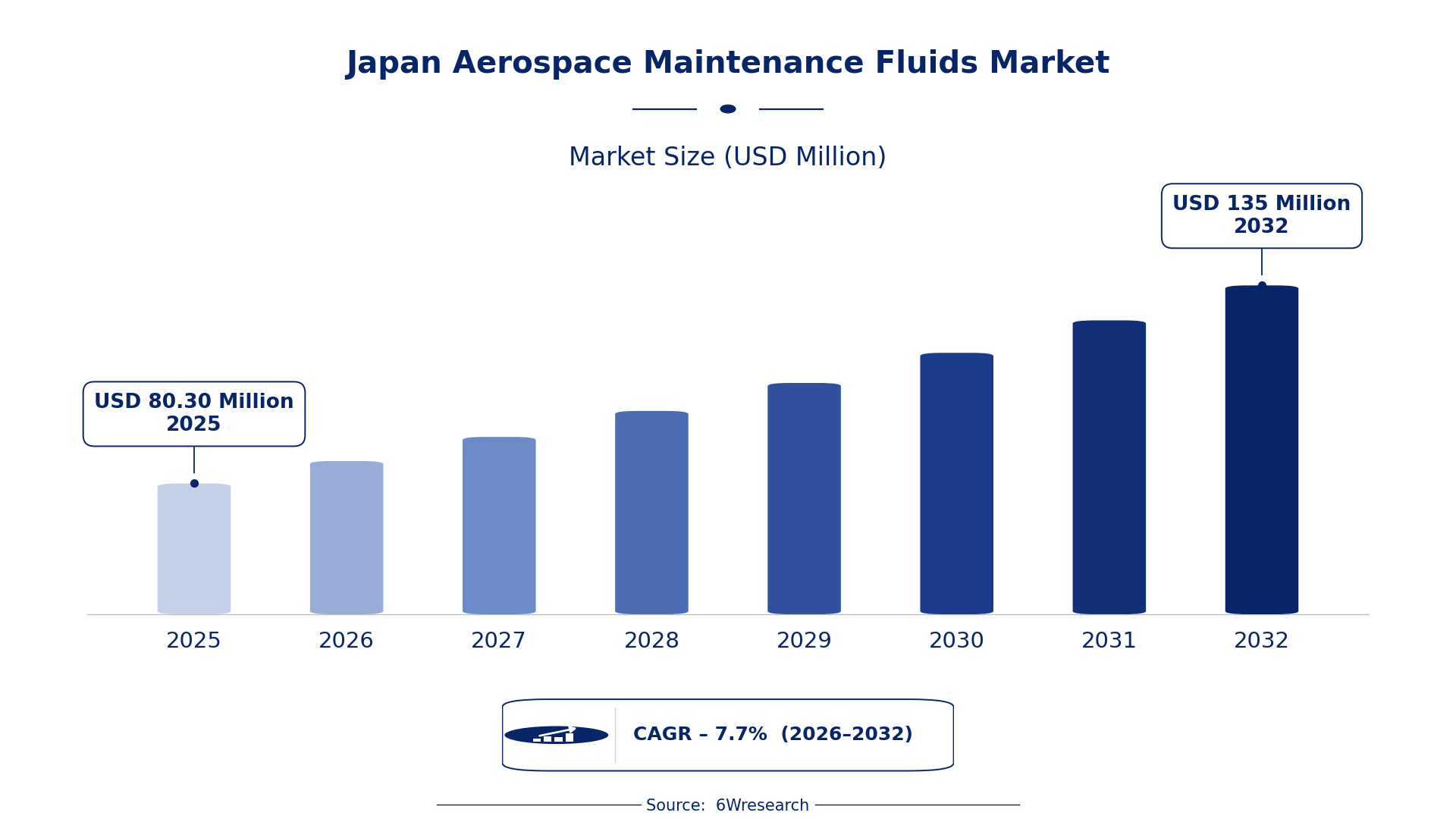
According to 6Wresearch internal database and industry insights, the Japan Aerospace Maintenance Fluids Market was valued at USD 80.30 Million in 2025 and is projected to reach USD 135 Million by 2032, growing at a CAGR of approximately 7.7% during 2026–2032.
Japan Aerospace Maintenance Fluids Market Highlights
| Report Metric | Details |
| Report Name | Japan Aerospace Maintenance Fluids Market (2026-2032) |
| Market Size 2025 | USD 80.30 Million |
| Market Size 2032 | USD 135 Million |
| Absolute Growth 2025–2032 | USD 54.70 Million |
| CAGR 2026–2032 | 7.7% |
| Peak Annual Growth | 8.7% in 2032 |
| Forecast Period | 2026–2032 |
| Historical Data | 2022–2025 |
| Base Year | 2025 |
| Leading Fluid Type, 2025 | Hydraulic Fluids (40% share) |
| Leading Application Area, 2025 | Landing Gear (38% share) |
| Leading Distribution Channel, 2025 | Direct Sales (47% share) |
| Leading End User, 2025 | Aircraft Maintenance Units (49% share) |
| Fastest-Growing Fluid Type | Lubricants (10.6% CAGR) |
| Fastest-Growing Application Area | Engine Systems (9.1% CAGR) |
| Fastest-Growing Distribution Channel | Online Platforms (10.1% CAGR) |
| Fastest-Growing End User | Commercial Airlines (9.8% CAGR) |
| Growing Sector | Engine Systems |
| Key End Users | Landing Gear, Engine Systems, Wing Surfaces, Avionics |
Japan Aerospace Maintenance Fluids Market Year-wise Growth Rate and Key Drivers (2022–2032)
This graph illustrates the annual growth rates of the market from 2022 to 2032, highlighting a steady upward trajectory and projected market expansion over the forecast period.
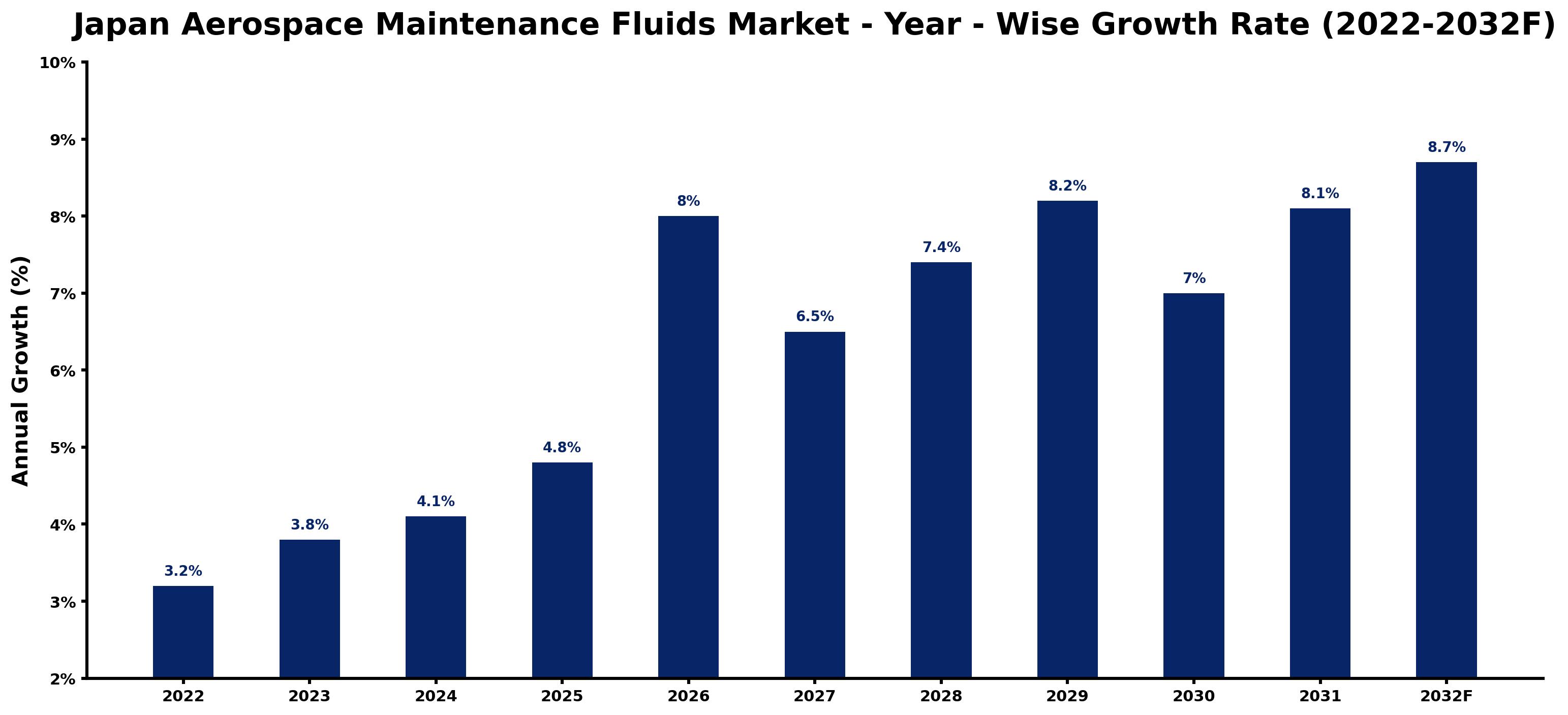
Year by year, the estimates below pair each growth rate with the development that shaped it.
| Year | Estimated Annual Growth (%) | Market Rationale |
| 2022 | 3.2 | The market showed steady activity, driven by ongoing maintenance needs across the aviation sector. |
| 2023 | 3.8 | Growth accelerated as commercial airlines increased their fleet maintenance schedules. |
| 2024 | 4.1 | Demand continued to rise, supported by improved efficiency in maintenance operations. |
| 2025 | 4.8 | The market reached a historical peak, reflecting strong investments in aviation safety. |
| 2026 | 8.0 | Growth surged due to heightened investments in aerospace maintenance capabilities. |
| 2027 | 6.5 | A slowdown occurred as the market adjusted to previous high levels of demand. |
| 2028 | 7.4 | Demand rebounded, driven by advancements in maintenance fluid technologies. |
| 2029 | 8.2 | Growth picked up again, supported by increased aircraft operations and maintenance. |
| 2030 | 7.0 | The market experienced a slowdown as growth stabilised after a peak period. |
| 2031 | 8.1 | Demand rose again, reflecting ongoing investments in aircraft maintenance. |
| 2032 | 8.7 | The market peaked as new technologies and standards were widely adopted. |
Note: Market size estimations and growth projections presented in this report are based on 6Wresearch's proprietary forecasting methodology, utilizing the latest available industry data, government publications, and primary research inputs.
Japan Aerospace Maintenance Fluids Market Synopsis
Aerospace maintenance fluids are specialized chemical formulations essential for the upkeep of aircraft systems, including lubrication, hydraulic functions, de-icing, and cooling. The Japan Aerospace Maintenance Fluids Market is expanding due to increased demand from domestic aircraft maintenance units and commercial airlines, which operate over 300 aircraft. The Tokyo region serves as a major hub for aerospace activities, while government support for innovation through funding programs is driving market growth. This growth is further supported by advancements in technology and a strong focus on safety and efficiency in aviation maintenance.
Market Dynamics Impact Analysis (2026–2032)
| Factor | Type | Impact | Primary Segment Affected |
| Growing demand for maintenance fluids due to increased aircraft operations | Driver | High | Hydraulic Fluids |
| Technological advancements in fluid formulations enhancing performance | Driver | High | Lubricants |
| Emerging opportunities in the online distribution channel | Opportunity | Medium | Online Platforms |
| Investment in maintenance capabilities by commercial airlines | Opportunity | High | Commercial Airlines |
| Regulatory compliance costs for producers of maintenance fluids | Restraint | High | Hydraulic Fluids |
| Limited availability of certified suppliers for aerospace fluids | Restraint | Medium | Lubricants |
| Rising costs of raw materials impacting pricing strategies | Challenge | High | De-icing Fluids |
| Capacity constraints in production facilities limiting supply | Challenge | Medium | Coolants |
Evaluation of Drivers in Japan Aerospace Maintenance Fluids Market (2026–2032)
The factors lifting demand, and the evidence behind each, are summarised below.
| Drivers | Primary Segment Affected | Why It Matters (Evidence) |
| Increased aircraft operations leading to higher maintenance fluid demand | Hydraulic Fluids | Commercial airlines in Japan operate over 300 aircraft, necessitating regular maintenance. |
| Technological advancements improving fluid performance and efficiency | Lubricants | ISO 9001 standards drive quality improvements in maintenance fluids, enhancing reliability. |
| Growing focus on safety and efficiency in aviation maintenance | De-icing Fluids | The Japanese government prioritises safety, influencing procurement decisions for maintenance fluids. |
| Expansion of online sales channels for maintenance fluids | Online Platforms | The Tokyo Metropolitan Government promotes digital transformation in aerospace, increasing access. |
| Increased investments in aviation maintenance capabilities | Commercial Airlines | The Ministry of Defense has a program to improve aviation maintenance capabilities. |
A wider customer base explains much of the growth, as increased aircraft operations drive demand for hydraulic fluids, with over 300 aircraft maintained by commercial airlines. Technological advancements in lubricants are improving performance, supported by ISO 9001 standards. The focus on safety and efficiency in aviation maintenance is prompting procurement of de-icing fluids, while online platforms are expanding access to maintenance fluids.
Evaluation of Restraints in Japan Aerospace Maintenance Fluids Market
The main factors holding the market back are set out below.
| Market Restraint | Primary Segment Affected | Why It Matters (Evidence) |
| Compliance costs associated with regulatory standards for maintenance fluids | Hydraulic Fluids | Producers must adhere to stringent regulations, increasing operational costs. |
| Limited availability of certified suppliers for maintenance fluids | Lubricants | A shortage of certified suppliers affects the reliability of procurement. |
| Rising raw material costs impacting pricing strategies | De-icing Fluids | Increased costs of raw materials squeeze profit margins for suppliers. |
| Production capacity constraints limiting supply | Coolants | Existing facilities struggle to meet the growing demand for maintenance fluids. |
| Complexity in meeting multiple regulatory compliance requirements | Engine Systems | Navigating various regulations can delay product availability. |
Japan Aerospace Maintenance Fluids Market Challenges
Aerospace maintenance units struggle with a shortage of skilled workers due to an ageing workforce and insufficient training programmes, which delays service delivery for maintenance operations. Buyers face escalating costs as they compete for this limited talent, resulting in operational expenses that can rise by 15% each year. Supply chain issues arise since producers rely on imported raw materials, causing lead times to extend by 30% for maintenance operations needing timely access to fluids. Competition intensifies as new entrants attempt to gain market share, forcing established producers to lower prices, which can compromise quality and service for maintenance units.
Trends in the Japan Aerospace Maintenance Fluids Market
Four trends stand out in the Japan Aerospace Maintenance Fluids Market.
- Shift from Traditional to Digital Sales Channels: The Tokyo region is seeing a shift towards online platforms for aerospace maintenance fluids, with a 10.1% growth in this distribution channel. This transition enables buyers to conveniently access a broader range of products.
- Transition to Advanced Lubricant Formulations: A movement towards advanced lubricant formulations is underway, driven by the need for enhanced performance. The adoption of ISO 9001 standards is anticipated to improve product quality and reliability in the market.
- Emergence of Eco-Friendly Maintenance Fluids: The introduction of eco-friendly maintenance fluids commenced in 2023, addressing environmental concerns within the aerospace sector. This shift is supported by government initiatives that promote sustainable practices in aviation.
- Increased Focus on Safety Standards: Japan's aviation industry is prioritising safety, with over 100,000 employees involved in aerospace maintenance. This focus has resulted in heightened demand for compliant maintenance fluids.
Investment Opportunities in the Japan Aerospace Maintenance Fluids Market
Investors looking at the Japan Aerospace Maintenance Fluids Market should consider the following areas.
- Timing for Investment in Online Platforms: Now is an optimal time to invest in online sales channels as the market for maintenance fluids expands. The Tokyo Metropolitan Government supports digital transformation, creating opportunities for suppliers.
- Supply of Advanced Lubricants: The demand for advanced lubricants is on the rise, with a projected CAGR of 10.6%. Suppliers can enter this market by collaborating with aircraft maintenance units to provide tailored solutions.
- Expansion in the Tokyo Aerospace Hub: The Tokyo region is an ideal location for investment in aerospace maintenance fluids, given its infrastructure and workforce. Suppliers can form local partnerships to effectively enter the market.
- Gap in Eco-Friendly Fluid Offerings: With a growing focus on sustainability, there is a gap in eco-friendly maintenance fluids. Suppliers can address this demand by developing products that comply with new environmental standards.
Government Initiatives in the Japan Aerospace Maintenance Fluids Market
The GX Promotion Act of 2023 establishes a legal framework for sustainable practices in aerospace maintenance, building on previous regulations. This act encourages producers to adopt eco-friendly technologies and practices, aligning with national sustainability goals. The act aims to increase the adoption of sustainable materials by 20% by 2025, benefiting the aerospace sector.
The Fire and Disaster Management Agency oversees the safe handling of hazardous materials, including aerospace maintenance fluids. This agency ensures compliance with safety standards and provides funding for training programmes for personnel involved in handling these materials. In 2023, the agency approved 50 training programmes to improve safety protocols.
Future Insight of the Japan Aerospace Maintenance Fluids Market
Investment in aerospace maintenance capabilities will rise by 2032, creating demand for advanced maintenance fluids that meet JIS standards. The Tokyo region will become a hub for aerospace technology development, promoting innovation in maintenance practices. Government funding will support research and development initiatives, leading to more efficient maintenance solutions. Producers must adapt their offerings to comply with new safety regulations, while maintenance units will benefit from improved product performance and reliability.
Market Segmentation Analysis
Japan Aerospace Maintenance Fluids Market report covers a detailed analysis of the following market segments:
By Fluid Type – Hydraulic Fluids Lead, Lubricants Expected to Grow Fastest
According to Saurav Kr Singh, Senior Research Analyst at 6Wresearch, the largest fluid type category in 2025 was Hydraulic Fluids, at 40% of revenue. Hydraulic fluids hold the largest share in the market as they are essential for the operation of hydraulic systems in aircraft, which are crucial for safe flight. Their extensive use in Japan's commercial aircraft maintenance units reinforces their leading position. Lubricants are set to record the highest CAGR in this split, 10.6% over 2026–2032. Lubricants are experiencing rapid growth due to their critical role in reducing friction in moving parts, which is increasingly recognised in maintenance practices. The rising number of aircraft in operation, exceeding 300, significantly boosts the demand for effective lubrication solutions. Suppliers should focus on enhancing lubricant offerings to capitalise on the growing demand from maintenance units.
By Application Area – Landing Gear Leads, Engine Systems Expected to Grow Fastest
Landing Gear accounted for 38% of the market by application area in 2025. Landing gear maintenance is vital for safety, making it the leading application area for aerospace maintenance fluids. The high frequency of inspections and maintenance required for landing systems in Japan's busy aviation sector solidifies this dominance. The quickest growth will come from Engine Systems, forecast to expand at a CAGR of 9.1% between 2026 and 2032. Engine systems are witnessing the fastest growth due to their crucial importance for performance and reliability, especially as aircraft technology advances. The increasing focus on engine efficiency in Japan's aviation industry significantly contributes to this trend. Buyers will need to prioritise engine system maintenance to ensure optimal performance and compliance with safety standards.
By Distribution Channel – Direct Sales Leads, Online Platforms Expected to Grow Fastest
With 47% of distribution channel revenue in 2025, Direct Sales was the largest category. Direct sales serve as the primary method for B2B transactions in the aerospace maintenance fluids market, allowing suppliers to maintain close relationships with maintenance units. This channel facilitates tailored solutions and immediate support, which are essential in the aerospace sector. Over 2026–2032, Online Platforms are expected to post the fastest growth, at a CAGR of 10.1%. Online platforms are growing rapidly as they provide a supportive channel for information and orders, catering to the tech-savvy nature of the industry. The increasing shift towards digitalisation in procurement processes among maintenance units drives this growth. Suppliers must enhance their online presence to meet the evolving purchasing preferences of maintenance units.
By End User – Aircraft Maintenance Units Lead, Commercial Airlines Expected to Grow Fastest
Aircraft Maintenance Units held 49% of the Japan Aerospace Maintenance Fluids Market by end user in 2025. Aircraft maintenance units are the largest consumers of aerospace maintenance fluids, as they are primarily responsible for the upkeep of various aircraft systems. Their essential role in ensuring safety and compliance drives consistent demand for these fluids. Commercial Airlines are projected to grow fastest, at a CAGR of 9.8% during 2026–2032. Commercial airlines are the fastest-growing end user segment, largely due to their significant need for fleet upkeep and maintenance. The expansion of commercial aviation in Japan, with over 300 aircraft in operation, propels this growth. Suppliers should align their strategies to meet the increasing demands of commercial airlines for maintenance solutions.
Key Attractiveness of the Report
- 10 Years of Market Numbers
- Historical Data Starting from 2022 to 2025
- Base Year 2025
- Forecast Data until 2032
- Key Performance Indicators Impacting the Market
- Major Upcoming Developments and Projects
Key Highlights of the Report:
- Japan Aerospace Maintenance Fluids Market Outlook
- Market Size of Japan Aerospace Maintenance Fluids Market, 2025
- Forecast of Japan Aerospace Maintenance Fluids Market, 2032
- Historical Data and Forecast of Japan Aerospace Maintenance Fluids Revenues & Volume for the Period 2022-2032F
- Japan Aerospace Maintenance Fluids Market Trend Evolution
- Japan Aerospace Maintenance Fluids Market Drivers and Challenges
- Japan Aerospace Maintenance Fluids Price Trends
- Japan Aerospace Maintenance Fluids Porter's Five Forces
- Japan Aerospace Maintenance Fluids Industry Life Cycle
- Historical Data and Forecast of Japan Aerospace Maintenance Fluids Market Revenues & Volume By Fluid Type for the Period 2022-2032F
- Historical Data and Forecast of Japan Aerospace Maintenance Fluids Market Revenues & Volume By Hydraulic Fluids for the Period 2022-2032F
- Historical Data and Forecast of Japan Aerospace Maintenance Fluids Market Revenues & Volume By Lubricants for the Period 2022-2032F
- Historical Data and Forecast of Japan Aerospace Maintenance Fluids Market Revenues & Volume By De-icing Fluids for the Period 2022-2032F
- Historical Data and Forecast of Japan Aerospace Maintenance Fluids Market Revenues & Volume By Coolants for the Period 2022-2032F
- Historical Data and Forecast of Japan Aerospace Maintenance Fluids Market Revenues & Volume By Application Area for the Period 2022-2032F
- Historical Data and Forecast of Japan Aerospace Maintenance Fluids Market Revenues & Volume By Landing Gear for the Period 2022-2032F
- Historical Data and Forecast of Japan Aerospace Maintenance Fluids Market Revenues & Volume By Engine Systems for the Period 2022-2032F
- Historical Data and Forecast of Japan Aerospace Maintenance Fluids Market Revenues & Volume By Wing Surfaces for the Period 2022-2032F
- Historical Data and Forecast of Japan Aerospace Maintenance Fluids Market Revenues & Volume By Avionics for the Period 2022-2032F
- Historical Data and Forecast of Japan Aerospace Maintenance Fluids Market Revenues & Volume By Distribution Channel for the Period 2022-2032F
- Historical Data and Forecast of Japan Aerospace Maintenance Fluids Market Revenues & Volume By Direct Sales for the Period 2022-2032F
- Historical Data and Forecast of Japan Aerospace Maintenance Fluids Market Revenues & Volume By Online Platforms for the Period 2022-2032F
- Historical Data and Forecast of Japan Aerospace Maintenance Fluids Market Revenues & Volume By Industrial Suppliers for the Period 2022-2032F
- Historical Data and Forecast of Japan Aerospace Maintenance Fluids Market Revenues & Volume By Specialty Stores for the Period 2022-2032F
- Historical Data and Forecast of Japan Aerospace Maintenance Fluids Market Revenues & Volume By End User for the Period 2022-2032F
- Historical Data and Forecast of Japan Aerospace Maintenance Fluids Market Revenues & Volume By Aircraft Maintenance Units for the Period 2022-2032F
- Historical Data and Forecast of Japan Aerospace Maintenance Fluids Market Revenues & Volume By Commercial Airlines for the Period 2022-2032F
- Historical Data and Forecast of Japan Aerospace Maintenance Fluids Market Revenues & Volume By Airport Ground Staff for the Period 2022-2032F
- Historical Data and Forecast of Japan Aerospace Maintenance Fluids Market Revenues & Volume By Defense Aviation Teams for the Period 2022-2032F
- Japan Aerospace Maintenance Fluids Import Export Trade Statistics
- Market Opportunity Assessment By Fluid Type
- Market Opportunity Assessment By Application Area
- Market Opportunity Assessment By Distribution Channel
- Market Opportunity Assessment By End User
- Japan Aerospace Maintenance Fluids Top Companies Market Share
- Japan Aerospace Maintenance Fluids Competitive Benchmarking By Technical and Operational Parameters
- Japan Aerospace Maintenance Fluids Company Profiles
- Japan Aerospace Maintenance Fluids Key Strategic Recommendations
Market Covered
Segments analysed in this report are listed below.
By Fluid Type
- Hydraulic Fluids
- Lubricants
- De-icing Fluids
- Coolants
By Application Area
- Landing Gear
- Engine Systems
- Wing Surfaces
- Avionics
By Distribution Channel
- Direct Sales
- Online Platforms
- Industrial Suppliers
- Specialty Stores
By End User
- Aircraft Maintenance Units
- Commercial Airlines
- Airport Ground Staff
- Defense Aviation Teams






































