Japan Aerospace Repair Services Market Size & Growth Rate
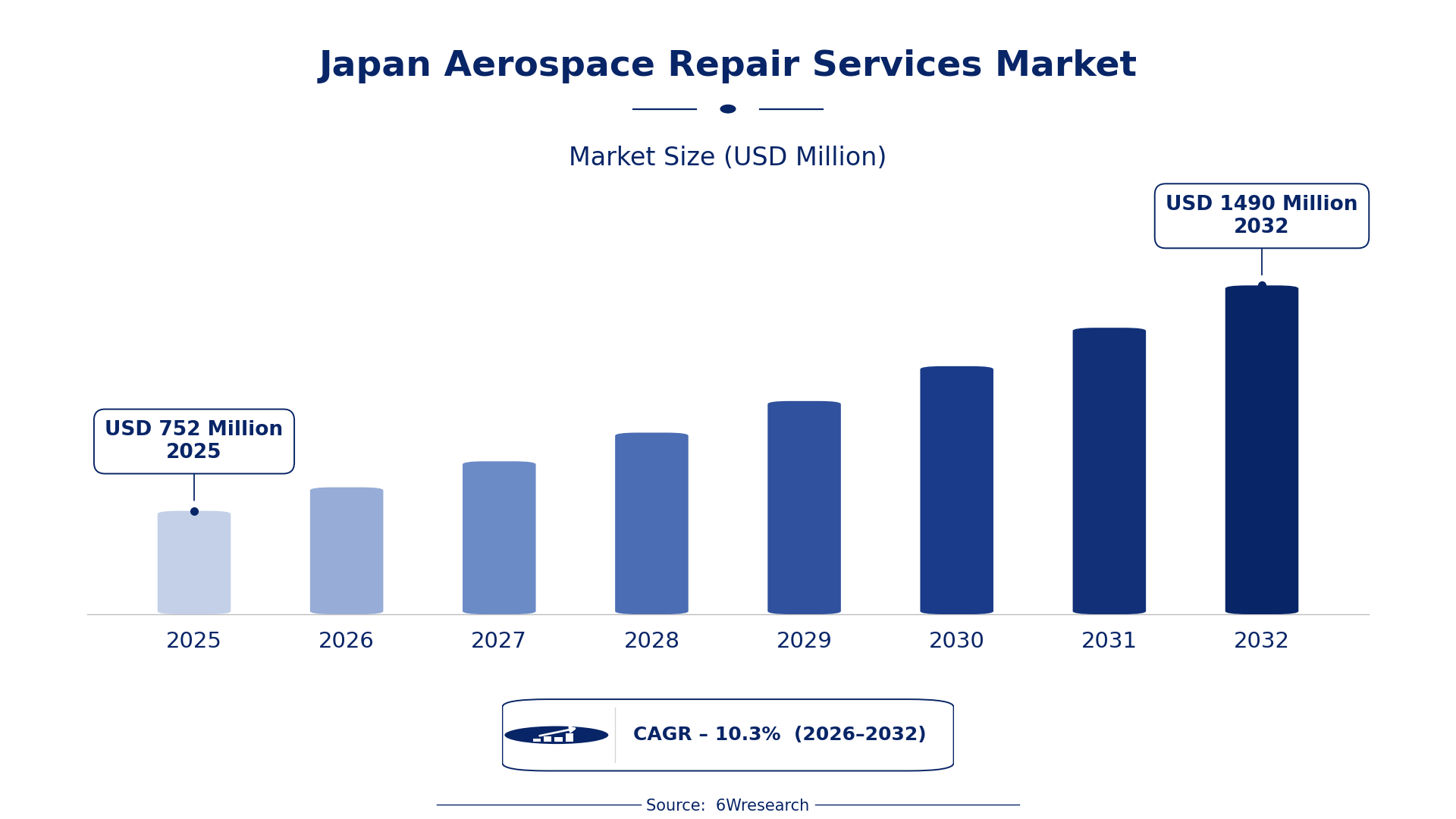
According to 6Wresearch internal database and industry insights, the Japan Aerospace Repair Services Market was valued at USD 752 Million in 2025 and is projected to reach USD 1,490 Million by 2032, growing at a CAGR of approximately 10.3% during 2026–2032.
Japan Aerospace Repair Services Market Highlights
| Report Metric | Details |
| Report Name | Japan Aerospace Repair Services Market (2026-2032) |
| Market Size 2025 | USD 752 Million |
| Market Size 2032 | USD 1,490 Million |
| Absolute Growth 2025–2032 | USD 738 Million |
| CAGR 2026–2032 | 10.3% |
| Peak Annual Growth | 11.3% in 2028 |
| Forecast Period | 2026–2032 |
| Historical Data | 2022–2025 |
| Base Year | 2025 |
| Leading Repair Type, 2025 | Avionics Repair (35% share) |
| Leading System Repaired, 2025 | Navigation Systems (43% share) |
| Leading Distribution Channel, 2025 | Direct Sales (37% share) |
| Leading End User, 2025 | Defense Forces (41% share) |
| Fastest-Growing Repair Type | Structural Repair (14.0% CAGR) |
| Fastest-Growing System Repaired | Fuselage & Wings (14.2% CAGR) |
| Fastest-Growing Distribution Channel | Industrial Suppliers (13.2% CAGR) |
| Fastest-Growing End User | Commercial Airline MROs (12.8% CAGR) |
| Growing Sector | Aerospace Repair Services |
| Key End Users | Defense Forces, Commercial Airline MROs, Helicopter Operators |
Japan Aerospace Repair Services Market Year-wise Growth Rate and Key Drivers (2022–2032)
This graph illustrates the annual growth rates of the market from 2022 to 2032, highlighting a steady upward trajectory and projected market expansion over the forecast period.
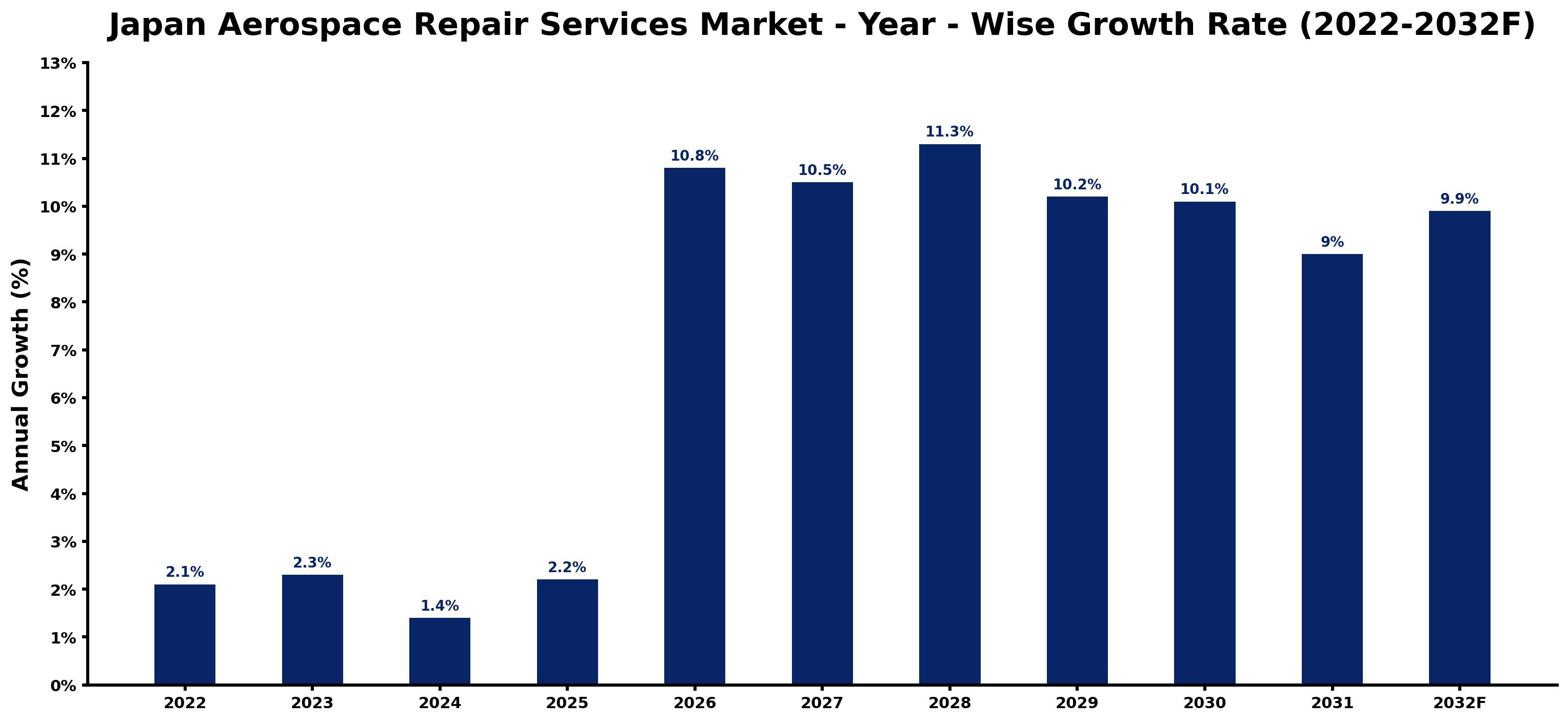
Below, each year's estimated growth is shown next to the factor that most influenced it.
| Year | Estimated Annual Growth (%) | Market Rationale |
| 2022 | 2.1 | The market experienced steady growth due to ongoing maintenance needs. |
| 2023 | 2.3 | Growth accelerated as demand from commercial airline MROs increased. |
| 2024 | 1.4 | Growth slowed as the market adjusted to prior expansions in capacity. |
| 2025 | 2.2 | Demand rose again as defense spending and airline operations improved. |
| 2026 | 10.8 | The market is expected to surge due to increased defense budgets. |
| 2027 | 10.5 | Growth is projected to slow slightly as the market stabilises. |
| 2028 | 11.3 | The peak year will see a spike in demand from military contracts. |
| 2029 | 10.2 | Growth will decelerate as market conditions normalise after the peak. |
| 2030 | 10.1 | The market is anticipated to continue growing steadily as regulations tighten. |
| 2031 | 9.0 | Growth is expected to slow as the market matures and consolidates. |
| 2032 | 9.9 | Demand is projected to rise again as new technologies are adopted. |
Note: Market size estimations and growth projections presented in this report are based on 6Wresearch's proprietary forecasting methodology, utilizing the latest available industry data, government publications, and primary research inputs.
Japan Aerospace Repair Services Market Synopsis
Aerospace repair services cover the maintenance and repair of aircraft systems, structures, and components, ensuring adherence to safety regulations and airworthiness. The Japan Aerospace Repair Services Market is growing due to increasing demand from domestic commercial airline MROs and defence forces. In 2023, Japan's defence budget allocated ¥5 trillion for military aircraft maintenance, while the average age of commercial aircraft is approximately 12 years, creating a need for regular repairs and services. This growth is driven by advancements in repair technologies and a growing network of MRO facilities.
Market Dynamics Impact Analysis (2026–2032)
| Factor | Type | Impact | Primary Segment Affected |
| Increased defense spending drives demand for military aircraft maintenance. | Driver | High | Engine Repair |
| The rising average age of commercial aircraft necessitates regular maintenance. | Driver | High | Structural Repair |
| Growing defense budgets create opportunities for specialized service providers. | Opportunity | High | Avionics Repair |
| The Tokyo region's aerospace hubs are expanding service capacities. | Opportunity | Medium | Fuselage & Wings |
| High operational costs can limit service providers' competitiveness. | Restraint | High | Cabin Repair |
| Strict compliance with aviation regulations can slow service delivery. | Restraint | Medium | Navigation Systems |
| Limited skilled workforce affects service capacity. | Challenge | High | Engine Repair |
| Technological advancements require continuous investment in training. | Challenge | Medium | Structural Repair |
Evaluation of Drivers in Japan Aerospace Repair Services Market (2026–2032)
The following drivers explain most of the expected growth.
| Drivers | Primary Segment Affected | Why It Matters (Evidence) |
| Increased defense budgets drive demand for military aircraft maintenance. | Engine Repair | Japan's defense budget allocated ¥5 trillion for military aircraft maintenance in 2023. |
| The rising average age of commercial aircraft necessitates regular maintenance. | Structural Repair | The average age of commercial aircraft in Japan is around 12 years. |
| Growing demand for air travel boosts maintenance contracts for airlines. | Avionics Repair | The Tokyo region has seen a 15% increase in aerospace repair service contracts in 2023. |
| Technological advancements in repair techniques improve service efficiency. | Cabin Repair | ISO 9001 certification is commonly pursued by aerospace repair service providers. |
| Expansion of MRO facilities enhances service availability. | Fuselage & Wings | The Aerospace MRO market is supported by over 200 certified repair stations. |
A wider customer base explains much of the growth, as increased defense budgets drive demand for military aircraft maintenance, with ¥5 trillion allocated in 2023. The average age of commercial aircraft, approximately 12 years, necessitates regular maintenance, leading to a 15% increase in aerospace repair service contracts in the Tokyo region. Advances in repair techniques improve service efficiency, while the expansion of MRO facilities supports service availability, with over 200 certified repair stations across Japan. These factors boost demand for avionics and structural repair services, enhancing overall market growth.
Evaluation of Restraints in Japan Aerospace Repair Services Market
The table below lists the restraints and the evidence behind each.
| Market Restraint | Primary Segment Affected | Why It Matters (Evidence) |
| High operational costs can limit service providers' competitiveness. | Cabin Repair | The average turnaround time for aircraft repairs is approximately 30 days. |
| Strict compliance with aviation regulations can slow service delivery. | Navigation Systems | The Japan Civil Aviation Bureau enforces strict guidelines for aircraft maintenance. |
| Limited skilled workforce affects service capacity. | Engine Repair | Japan's aerospace sector employs over 80,000 individuals in maintenance roles. |
| Technological advancements require continuous investment in training. | Structural Repair | The Japan Aerospace Industry Association provides guidelines for aerospace maintenance practices. |
| Market consolidation may limit competition among service providers. | Fuselage & Wings | The Tokyo Metropolitan Government supports aerospace innovation through funding programs. |
Japan Aerospace Repair Services Market Challenges
Intense competition among aerospace repair service providers forces prices down, which pressures suppliers to reduce their profit margins. Buyers experience delays due to a shortage of skilled technicians, resulting in repair times that can extend to 30 days. Many suppliers struggle to invest in technological advancements, leading to reliance on outdated methods that hinder efficiency. Increased operational costs driven by a 1% annual rise in defence spending can elevate service prices, affecting budget-conscious buyers who require cost-effective maintenance solutions.
Trends in the Japan Aerospace Repair Services Market
The shifts below are changing how Japan Aerospace Repair Services Market products are bought and supplied.
- Shift towards Advanced Repair Technologies: The Tokyo region is adopting advanced repair technologies to improve efficiency, with a 15% increase in aerospace repair service contracts in 2023. This trend enables service providers to reduce turnaround times and improve service quality.
- Transition from Traditional to Digital Maintenance Solutions: In 2023, the Digital Agency initiated a strategy to promote digital transformation in aerospace maintenance. This shift is expected to streamline operations and improve data management for service providers.
- Emergence of Sustainable Repair Practices: The GX Promotion Act, established in 2023, encourages aerospace repair services to adopt sustainable practices. This initiative is important for meeting environmental standards and attracting eco-conscious clients.
- Growing Focus on Compliance and Certification: The Japan Aerospace Industry Association is promoting ISO 9001 certification among repair service providers. This focus on compliance is essential for maintaining safety standards and gaining client trust.
Investment Opportunities in the Japan Aerospace Repair Services Market
The following areas offer the clearest openings for investors and suppliers in the Japan Aerospace Repair Services Market.
- Tokyo Region Expansion: The Tokyo region, a hub for aerospace repair services, is seeing a 15% increase in service contracts. Investing in MRO facilities here can capture strong demand from commercial airline MROs.
- Defense Budget Growth: Japan's defense budget is projected to increase by 1% annually, creating opportunities for specialized service providers. Focusing on military aircraft maintenance can yield substantial returns.
- Investment in Training Programs: With a skilled workforce shortage, investing in training programs is essential. Collaborating with local educational institutions can help develop the necessary talent for aerospace repair services.
- Certification and Compliance Services: As regulations tighten, offering certification and compliance services can meet the needs of repair providers. Engaging with the Japan Civil Aviation Bureau can facilitate market entry.
Government Initiatives in the Japan Aerospace Repair Services Market
The Japan Civil Aviation Bureau sets strict guidelines for aircraft maintenance and repair, impacting aerospace repair service providers. Compliance with these regulations is essential for ensuring safety and airworthiness, as well as maintaining operational licenses for repair stations. The Digital Agency, established in 2021, also influences the sector by promoting digital transformation and common system standards, which can improve operational efficiencies and service delivery.
In 2023, the Ministry of Defense allocated ¥5 trillion for military aircraft maintenance, impacting demand for aerospace repair services. The Japan Aerospace Exploration Agency (JAXA) oversees aerospace standards and regulations, ensuring that repair providers meet necessary compliance requirements. This oversight is vital for maintaining safety and operational efficiency in the aerospace sector.
Future Insight of the Japan Aerospace Repair Services Market
By 2032, buyers will gain from improved military aircraft maintenance capabilities through government programmes aimed at elevating service quality. The Tokyo region will experience a rise in advanced repair technologies, encouraging suppliers to innovate and upgrade their offerings. The average age of commercial aircraft, currently around 12 years, will require more frequent maintenance, ensuring sustained service demand. Stricter aviation safety standards will compel suppliers to adopt rigorous compliance measures, ultimately enhancing safety levels across the sector.
Market Segmentation Analysis
Japan Aerospace Repair Services Market report covers a detailed analysis of the following market segments:
By Repair Type – Avionics Repair Leads, Structural Repair Expected to Grow Fastest
According to Saurav Kr Singh, Senior Research Analyst at 6Wresearch, Avionics Repair accounted for 35% of the market by repair type in 2025. Avionics Repair holds the largest share because it is critical for ensuring aircraft safety and functionality. Facilities in the Tokyo region prioritise avionics to meet stringent aviation safety regulations. Over 2026–2032, Structural Repair is expected to post the fastest growth, at a CAGR of 14.0%. Structural Repair is experiencing rapid growth as it is essential for maintaining airframe integrity, evidenced by a 15% increase in service contracts in the Tokyo region in 2023. This trend will likely widen the lead of Avionics Repair since both segments are vital for aircraft safety. Suppliers should focus on enhancing their capabilities in avionics and structural repair to meet the rising market demands.
By System Repaired – Navigation Systems Lead, Fuselage & Wings Expected to Grow Fastest
In 2025, Navigation Systems led the system repaired split with a 43% share. Navigation Systems lead the market as they are crucial for flight operations, ensuring compliance with safety regulations. The extensive network of certified repair stations in Japan reinforces this segment's dominance. Fuselage & Wings are projected to grow fastest, at a CAGR of 14.2% during 2026–2032. Fuselage & Wings are growing rapidly due to their critical role in aircraft structure, with the average age of commercial aircraft necessitating regular repairs. This trend may further strengthen the position of Navigation Systems as they are vital for safe operations. Buyers must secure reliable repair services for navigation systems while suppliers should enhance their offerings for fuselage and wing repairs.
By Distribution Channel – Direct Sales Leads, Industrial Suppliers Expected to Grow Fastest
With 37% of distribution channel revenue in 2025, Direct Sales was the largest category. Direct Sales is the primary channel for service contracts, allowing for direct relationships between service providers and clients. This method is prevalent among MRO facilities in the Tokyo region, facilitating efficient communication and service delivery. The quickest growth will come from Industrial Suppliers, forecast to expand at a CAGR of 13.2% between 2026 and 2032. Industrial Suppliers are seeing rapid growth as they play a supporting role in parts supply, particularly as the aerospace sector expands. This trend will likely reinforce the importance of Direct Sales as suppliers seek to streamline their operations. Suppliers should consider strengthening partnerships with industrial suppliers to optimise parts availability and service efficiency.
By End User – Defense Forces Lead, Commercial Airline MROs Expected to Grow Fastest
The largest end user category in 2025 was Defense Forces, at 41% of revenue. Defense Forces represent the largest user group of aerospace repair services, supported by substantial government investment in military aircraft maintenance. The ¥5 trillion allocated in 2023 underscores the urgent need for reliable repair services. Commercial Airline MROs are set to record the highest CAGR in this split, 12.8% over 2026–2032. Commercial Airline MROs are witnessing the fastest growth as they constitute the largest segment for repair services, driven by the ageing fleet of commercial aircraft. This trend is likely to increase the overall demand for aerospace repair services across all user groups. Suppliers must adapt their strategies to address the rising needs of commercial airline MROs while ensuring robust support for defense forces.
Key Attractiveness of the Report
- 10 Years of Market Numbers
- Historical Data Starting from 2022 to 2025
- Base Year 2025
- Forecast Data until 2032
- Key Performance Indicators Impacting the Market
- Major Upcoming Developments and Projects
Key Highlights of the Report:
- Japan Aerospace Repair Services Market Outlook
- Market Size of Japan Aerospace Repair Services Market, 2025
- Forecast of Japan Aerospace Repair Services Market, 2032
- Historical Data and Forecast of Japan Aerospace Repair Services Revenues & Volume for the Period 2022-2032F
- Japan Aerospace Repair Services Market Trend Evolution
- Japan Aerospace Repair Services Market Drivers and Challenges
- Japan Aerospace Repair Services Price Trends
- Japan Aerospace Repair Services Porter's Five Forces
- Japan Aerospace Repair Services Industry Life Cycle
- Historical Data and Forecast of Japan Aerospace Repair Services Market Revenues & Volume By Repair Type for the Period 2022-2032F
- Historical Data and Forecast of Japan Aerospace Repair Services Market Revenues & Volume By Avionics Repair for the Period 2022-2032F
- Historical Data and Forecast of Japan Aerospace Repair Services Market Revenues & Volume By Structural Repair for the Period 2022-2032F
- Historical Data and Forecast of Japan Aerospace Repair Services Market Revenues & Volume By Engine Repair for the Period 2022-2032F
- Historical Data and Forecast of Japan Aerospace Repair Services Market Revenues & Volume By Cabin Repair for the Period 2022-2032F
- Historical Data and Forecast of Japan Aerospace Repair Services Market Revenues & Volume By System Repaired for the Period 2022-2032F
- Historical Data and Forecast of Japan Aerospace Repair Services Market Revenues & Volume By Navigation Systems for the Period 2022-2032F
- Historical Data and Forecast of Japan Aerospace Repair Services Market Revenues & Volume By Fuselage & Wings for the Period 2022-2032F
- Historical Data and Forecast of Japan Aerospace Repair Services Market Revenues & Volume By Turbines for the Period 2022-2032F
- Historical Data and Forecast of Japan Aerospace Repair Services Market Revenues & Volume By Interior Fixtures for the Period 2022-2032F
- Historical Data and Forecast of Japan Aerospace Repair Services Market Revenues & Volume By Distribution Channel for the Period 2022-2032F
- Historical Data and Forecast of Japan Aerospace Repair Services Market Revenues & Volume By Direct Sales for the Period 2022-2032F
- Historical Data and Forecast of Japan Aerospace Repair Services Market Revenues & Volume By Industrial Suppliers for the Period 2022-2032F
- Historical Data and Forecast of Japan Aerospace Repair Services Market Revenues & Volume By Online Platforms for the Period 2022-2032F
- Historical Data and Forecast of Japan Aerospace Repair Services Market Revenues & Volume By Specialty Stores for the Period 2022-2032F
- Historical Data and Forecast of Japan Aerospace Repair Services Market Revenues & Volume By End User for the Period 2022-2032F
- Historical Data and Forecast of Japan Aerospace Repair Services Market Revenues & Volume By Defense Forces for the Period 2022-2032F
- Historical Data and Forecast of Japan Aerospace Repair Services Market Revenues & Volume By Commercial Airline MROs for the Period 2022-2032F
- Historical Data and Forecast of Japan Aerospace Repair Services Market Revenues & Volume By Helicopter Operators for the Period 2022-2032F
- Historical Data and Forecast of Japan Aerospace Repair Services Market Revenues & Volume By Charter Jet Providers for the Period 2022-2032F
- Japan Aerospace Repair Services Import Export Trade Statistics
- Market Opportunity Assessment By Repair Type
- Market Opportunity Assessment By System Repaired
- Market Opportunity Assessment By Distribution Channel
- Market Opportunity Assessment By End User
- Japan Aerospace Repair Services Top Companies Market Share
- Japan Aerospace Repair Services Competitive Benchmarking By Technical and Operational Parameters
- Japan Aerospace Repair Services Company Profiles
- Japan Aerospace Repair Services Key Strategic Recommendations
Market Covered
The report covers the following segments.
By Repair Type
- Avionics Repair
- Structural Repair
- Engine Repair
- Cabin Repair
By System Repaired
- Navigation Systems
- Fuselage & Wings
- Turbines
- Interior Fixtures
By Distribution Channel
- Direct Sales
- Industrial Suppliers
- Online Platforms
- Specialty Stores
By End User
- Defense Forces
- Commercial Airline MROs
- Helicopter Operators
- Charter Jet Providers






































