Japan Aerospace Structural Materials Market Size & Growth Rate
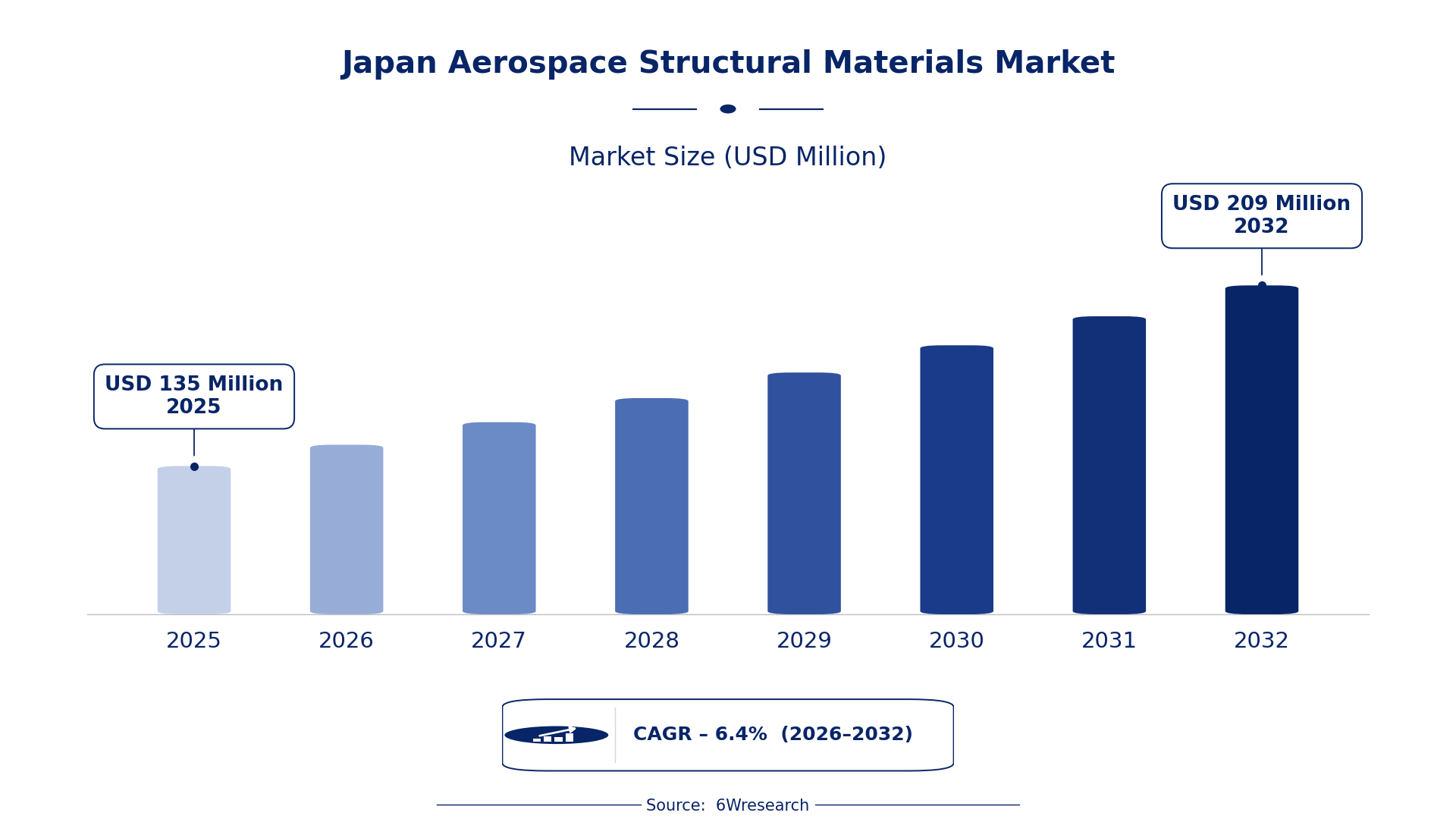
According to 6Wresearch internal database and industry insights, the Japan Aerospace Structural Materials Market was valued at USD 135 Million in 2025 and is projected to reach USD 209 Million by 2032, growing at a CAGR of approximately 6.4% during 2026–2032.
Japan Aerospace Structural Materials Market Highlights
| Report Metric | Details |
| Report Name | Japan Aerospace Structural Materials Market (2026-2032) |
| Market Size 2025 | USD 135 Million |
| Market Size 2032 | USD 209 Million |
| Absolute Growth 2025–2032 | USD 74 Million |
| CAGR 2026–2032 | 6.4% |
| Peak Annual Growth | 7.1% in 2028 |
| Forecast Period | 2026–2032 |
| Historical Data | 2022–2025 |
| Base Year | 2025 |
| Leading Aerospace Structural Materials, 2025 | Aluminum Alloys (40% share) |
| Leading Material Type, 2025 | Aluminum (39% share) |
| Leading Application, 2025 | Aircraft Frames (43% share) |
| Leading Distribution Channel, 2025 | OEMs (38% share) |
| Leading End User, 2025 | Commercial Aviation (33% share) |
| Fastest-Growing Aerospace Structural Materials | Composite Materials (8.9% CAGR) |
| Fastest-Growing Material Type | Carbon Composite (9.4% CAGR) |
| Fastest-Growing Application | Fuselage & Wings (8.6% CAGR) |
| Fastest-Growing Distribution Channel | Direct Sales (8.4% CAGR) |
| Fastest-Growing End User | Space Exploration (8.2% CAGR) |
| Growing Sector | Aerospace |
| Key End Users | OEMs, Commercial Aviation, Defense Aircraft, Space Exploration |
Japan Aerospace Structural Materials Market Year-wise Growth Rate and Key Drivers (2022–2032)
This graph illustrates the annual growth rates of the market from 2022 to 2032, highlighting a steady upward trajectory and projected market expansion over the forecast period.
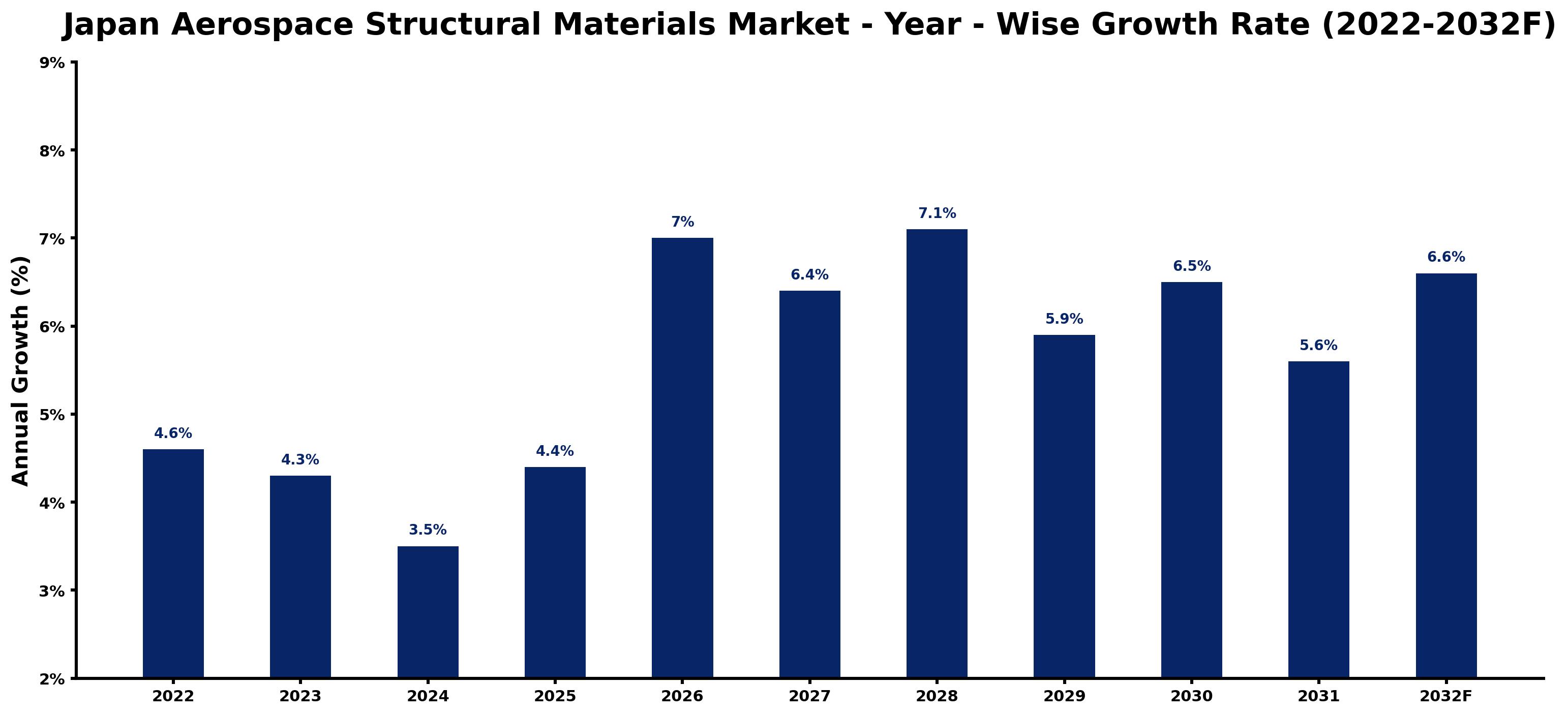
Below, each year's estimated growth is shown next to the factor that most influenced it.
| Year | Estimated Annual Growth (%) | Market Rationale |
| 2022 | 4.6 | Demand was driven by a strong aerospace sector, with significant domestic production. |
| 2023 | 4.3 | Growth slowed slightly due to market adjustments and supply chain challenges. |
| 2024 | 3.5 | A continued slowdown occurred as manufacturers adapted to evolving material requirements. |
| 2025 | 4.4 | Increased investments in aerospace innovation led to a rebound in growth. |
| 2026 | 7.0 | Demand is expected to surge as new aircraft designs require advanced materials for improved efficiency. |
| 2027 | 6.4 | Growth is projected to moderate as the market stabilises after rapid expansions in previous years. |
| 2028 | 7.1 | A peak in growth is anticipated due to heightened defense spending and increased exports. |
| 2029 | 5.9 | Demand is expected to slow as market saturation begins to affect purchasing patterns. |
| 2030 | 6.5 | Growth will accelerate again as new aerospace projects commence across the sector. |
| 2031 | 5.6 | A slight slowdown is projected as manufacturers face rising material costs. |
| 2032 | 6.6 | Growth is expected to rebound as technological advancements in materials gain traction. |
Note: Market size estimations and growth projections presented in this report are based on 6Wresearch's proprietary forecasting methodology, utilizing the latest available industry data, government publications, and primary research inputs.
Japan Aerospace Structural Materials Market Synopsis
Aerospace structural materials are advanced materials essential for constructing aircraft and spacecraft, offering lightweight properties and strength. The Japan Aerospace Structural Materials Market is expanding, driven by a thriving aerospace sector valued at approximately 1 trillion yen, with aluminum alloys accounting for about 70% of aircraft material usage. Factors such as rising defense budgets, increased aerospace exports, and substantial investments in decarbonisation are propelling demand, creating opportunities for innovation and expansion in the industry.
Market Dynamics Impact Analysis (2026–2032)
| Factor | Type | Impact | Primary Segment Affected |
| Rising defense budgets are increasing demand for advanced aerospace materials. | Driver | High | Titanium Alloys |
| Growing focus on lightweight materials for fuel efficiency is driving innovation. | Driver | High | Composite Materials |
| The need for advanced materials in new aircraft designs presents opportunities. | Opportunity | High | Aluminum Alloys |
| Investments in aerospace innovation create demand for new material solutions. | Opportunity | High | Carbon Composite |
| High production costs are limiting the affordability of advanced materials. | Restraint | High | Titanium Alloys |
| Supply chain disruptions are impacting material availability. | Restraint | High | Aluminum Alloys |
| Limited domestic production capacity for specialized materials constrains supply. | Challenge | High | Carbon Composite |
| Market saturation in certain segments is affecting growth potential. | Challenge | High | Titanium Alloys |
Evaluation of Drivers in Japan Aerospace Structural Materials Market (2026–2032)
The main growth drivers and the segments they affect most are set out below.
| Drivers | Primary Segment Affected | Why It Matters (Evidence) |
| Increased defense spending is driving demand for high-strength materials. | Titanium Alloys | Japan's defense budget has been rising, resulting in more procurement of advanced materials for military aircraft. |
| The push for fuel-efficient aircraft is boosting the use of lightweight materials. | Composite Materials | With a focus on reducing emissions, manufacturers are increasingly adopting composites for new aircraft designs. |
| A growing number of aircraft being produced is increasing material requirements. | Aluminum Alloys | The installed base of over 400 commercial aircraft in Japan drives consistent demand for aluminum in manufacturing. |
| Technological advancements in materials are improving performance and safety. | Carbon Composite | Research initiatives by the Japan Aerospace Exploration Agency are leading to new applications of carbon composites. |
| Domestic manufacturers are expanding their production capabilities. | Titanium Alloys | Japan produces various grades of titanium alloys, meeting the rising demand for specialized aerospace applications. |
Much of the new demand traces back to increased defense budgets, which have risen sharply, resulting in greater procurement of advanced materials for military aircraft. The installed base of over 400 commercial aircraft in Japan drives consistent demand for aluminum alloys, which account for about 70% of aircraft material usage. The Tokyo region is becoming a hub for aerospace material research, with substantial investments in innovation. The push for fuel-efficient aircraft is boosting the adoption of lightweight materials, as manufacturers aim to reduce emissions and improve efficiency. Local manufacturers are expanding production capabilities to meet the growing demand for high-strength titanium alloys.
Evaluation of Restraints in Japan Aerospace Structural Materials Market
The table below lists the restraints and the evidence behind each.
| Market Restraint | Primary Segment Affected | Why It Matters (Evidence) |
| High production costs are limiting the affordability of advanced materials. | Titanium Alloys | The cost of raw materials and manufacturing processes for titanium alloys remains high, affecting pricing. |
| Supply chain disruptions are impacting material availability. | Aluminum Alloys | Global supply chain issues have led to delays in sourcing essential materials for aerospace production. |
| Regulatory compliance can increase operational complexities for producers. | Composite Materials | Adhering to stringent JIS standards requires substantial investment in testing and certification. |
| Limited domestic production capacity for specialized materials constrains supply. | Carbon Composite | The need for advanced composites is growing, but local production capabilities are still developing. |
| Market saturation in certain segments is affecting growth potential. | Stainless Steel | As the market matures, the demand for traditional materials may plateau. |
Japan Aerospace Structural Materials Market Challenges
Japan's aerospace industry, valued at approximately 1 trillion yen, faces challenges in sourcing advanced materials, resulting in higher costs for buyers dependent on imports. A workforce of over 100,000 encounters skills shortages, as the demand for specialised expertise in aerospace materials outstrips available talent, causing delays in project timelines for manufacturers. Compliance with JIS standards requires costly investments in testing and certification, which particularly burdens smaller producers. Increasing expenses related to decarbonisation initiatives compel buyers and suppliers to reallocate funds for facility upgrades, straining their financial resources and limiting operational flexibility.
Trends in the Japan Aerospace Structural Materials Market
Four trends stand out in the Japan Aerospace Structural Materials Market.
- Increase in Lightweight Materials Usage: In 2023, Japan is transitioning towards lightweight materials in aerospace design, with composite materials gaining traction. This reflects a 9.4% CAGR in the carbon composite segment, highlighting its growing adoption in new aircraft designs.
- Shift Towards Sustainable Manufacturing Practices: The aerospace sector is prioritising sustainable practices, as Japan targets a 46% reduction in greenhouse gas emissions by 2030. This initiative encourages manufacturers to embrace eco-friendly materials and processes.
- Focus on Advanced Research and Development: The Tokyo region is becoming a centre for aerospace material research, with substantial investments in innovation. In 2023, the government initiated a programme to boost aerospace material research, aiming to enhance industry competitiveness.
- Expansion of Aerospace Exports: Japan's aerospace sector aims to increase exports by 20% by 2025, reflecting a rising global demand for advanced aerospace materials. This target aligns with the country's strategic focus on strengthening its aerospace manufacturing capabilities.
Investment Opportunities in the Japan Aerospace Structural Materials Market
Several openings in the Japan Aerospace Structural Materials Market merit attention from investors.
- Partnerships for Advanced Material Development: Collaborating with local manufacturers can facilitate entry into the aerospace materials market. The demand for new materials is rising, especially in the Tokyo region, where aerospace innovation is a priority.
- Supply of Lightweight Composite Materials: Investing in the production of lightweight composite materials is essential, as they are critical for new aircraft designs. The commercial aviation sector is a key buyer group, driving demand for these materials.
- Expansion into Defense Applications: The defense sector is increasingly seeking advanced materials, presenting opportunities for suppliers. With a projected increase in defense budgets, suppliers can enter through partnerships with military contractors.
- Investment in Sustainable Manufacturing Technologies: The push for sustainable practices in aerospace manufacturing creates a gap for new solutions. Suppliers can target the aerospace sector, which is focusing on eco-friendly materials and processes.
Government Initiatives in the Japan Aerospace Structural Materials Market
The Industrial Safety and Health Act of 1972 requires employers to ensure safety regarding hazardous substances and machinery, impacting producers of aerospace materials. Compliance demands substantial investment in safety protocols and training, ensuring that materials meet safety standards for aviation applications. Additionally, the Chemical Substances Control Law of 1973 mandates thorough evaluation and control of chemical substances used in manufacturing, influencing material selection and production processes.
In 2023, the government launched a programme aimed at achieving carbon neutrality by 2050, identifying aerospace as a growth sector. The Ministry of Economy, Trade and Industry oversees funding for research and development in advanced materials, targeting JPY 150 trillion in decarbonisation investment over the next decade, benefiting producers and innovators in the aerospace materials market.
Future Insight of the Japan Aerospace Structural Materials Market
Japan's ambitious decarbonisation investment pipeline of JPY 150 trillion will stimulate demand for advanced aerospace structural materials. By 2032, a focus on lightweight materials will drive innovation, supported by government programmes that advance research capabilities. Continuous upgrades for the installed base of commercial aircraft will create opportunities for suppliers to deliver structural materials. Increased defense budgets will further promote investment in aerospace capabilities, encouraging suppliers to develop solutions that meet evolving industry standards.
Market Segmentation Analysis
Japan Aerospace Structural Materials Market report covers a detailed analysis of the following market segments:
By Aerospace Structural Materials – Aluminum Alloys Lead, Composite Materials Expected to Grow Fastest
According to Saurav Kr Singh, Senior Research Analyst at 6Wresearch, Aluminum Alloys accounted for 40% of the market by aerospace structural materials in 2025. Aluminum alloys hold the largest share due to their widespread use in lightweight structures essential for aviation. The installed base of over 400 commercial aircraft in Japan relies heavily on aluminum for their construction. Over 2026–2032, Composite Materials are expected to post the fastest growth, at a CAGR of 8.9%. The growth of composite materials is propelled by their critical role in reducing weight and improving fuel efficiency in modern aircraft designs. Japan's strong focus on composite materials for future aircraft ensures this segment's rapid expansion. Suppliers should prioritise aluminium and composite materials to meet the growing demands of the aerospace sector.
By Material Type – Aluminum Leads, Carbon Composite Expected to Grow Fastest
Aluminum held 39% of the Japan Aerospace Structural Materials Market by material type in 2025. Aluminum is the leading material type as it is fundamental to aircraft construction, providing the necessary strength-to-weight ratio. The aerospace industry in Japan, valued at approximately 1 trillion yen, heavily utilises aluminium for various applications. The quickest growth will come from Carbon Composite, forecast to expand at a CAGR of 9.4% between 2026 and 2032. Carbon composites are experiencing the fastest growth due to their increasing use in fuselage and wings, where weight reduction is critical. The government's investment in aerospace material research will further accelerate the adoption of carbon composites. Buyers will benefit from a broader range of lightweight materials as suppliers innovate in carbon composites.
By Application – Aircraft Frames Lead, Fuselage & Wings Expected to Grow Fastest
In 2025, Aircraft Frames led the application split with a 43% share. Aircraft frames hold the largest share of structural materials due to their critical role in ensuring aircraft safety and performance. The extensive installed base of over 400 commercial aircraft in Japan underscores the ongoing demand for these essential materials. Fuselage & Wings are set to record the highest CAGR in this split, 8.6% over 2026–2032. Fuselage and wings are experiencing the fastest growth as advancements in composite materials aim to improve aircraft efficiency and reduce weight. The increasing focus on fuel-efficient designs is propelling the demand for materials in these vital areas. Suppliers must prioritise the development of materials tailored for aircraft frames and fuselage applications to meet rising demand.
By Distribution Channel – OEMs Lead, Direct Sales Expected to Grow Fastest
OEMs took 38% of distribution channel revenue in 2025, more than any other category. OEMs hold the largest share in the distribution channel for aerospace structural materials, as they are the main buyers involved in the manufacturing of aircraft. Their established partnerships with material suppliers ensure consistent demand for high-quality aerospace components. Direct Sales is projected to grow fastest, at a CAGR of 8.4% during 2026–2032. Direct sales are experiencing rapid growth as manufacturers aim to streamline their procurement processes and reduce costs. This trend is indicative of the industry's overall movement towards operational efficiency and simplified supply chains. Suppliers need to enhance their direct sales approaches to better meet the requirements of OEMs and improve their market positioning.
By End User – Commercial Aviation Leads, Space Exploration Expected to Grow Fastest
The largest end user category in 2025 was Commercial Aviation, at 33% of revenue. Commercial aviation is the dominant end user of aerospace structural materials, extensively utilising them in aircraft construction to guarantee safety and performance. The sector's strong growth trajectory continually fuels demand for these advanced materials. Over 2026–2032, Space Exploration is expected to post the fastest growth, at a CAGR of 8.2%. Space exploration is the fastest-growing end user, propelled by technological advancements and increased government funding for aerospace projects. Japan's commitment to advancing its capabilities in this domain further accelerates this growth. Suppliers should pursue collaborations within the space exploration sector to capitalise on its expanding opportunities.
Key Attractiveness of the Report
- 10 Years of Market Numbers
- Historical Data Starting from 2022 to 2025
- Base Year 2025
- Forecast Data until 2032
- Key Performance Indicators Impacting the Market
- Major Upcoming Developments and Projects
Key Highlights of the Report:
- Japan Aerospace Structural Materials Market Outlook
- Market Size of Japan Aerospace Structural Materials Market, 2025
- Forecast of Japan Aerospace Structural Materials Market, 2032
- Historical Data and Forecast of Japan Aerospace Structural Materials Revenues & Volume for the Period 2022-2032F
- Japan Aerospace Structural Materials Market Trend Evolution
- Japan Aerospace Structural Materials Market Drivers and Challenges
- Japan Aerospace Structural Materials Price Trends
- Japan Aerospace Structural Materials Porter's Five Forces
- Japan Aerospace Structural Materials Industry Life Cycle
- Historical Data and Forecast of Japan Aerospace Structural Materials Market Revenues & Volume By Aerospace Structural Materials for the Period 2022-2032F
- Historical Data and Forecast of Japan Aerospace Structural Materials Market Revenues & Volume By Titanium Alloys for the Period 2022-2032F
- Historical Data and Forecast of Japan Aerospace Structural Materials Market Revenues & Volume By Aluminum Alloys for the Period 2022-2032F
- Historical Data and Forecast of Japan Aerospace Structural Materials Market Revenues & Volume By Composite Materials for the Period 2022-2032F
- Historical Data and Forecast of Japan Aerospace Structural Materials Market Revenues & Volume By Stainless Steel for the Period 2022-2032F
- Historical Data and Forecast of Japan Aerospace Structural Materials Market Revenues & Volume By Material Type for the Period 2022-2032F
- Historical Data and Forecast of Japan Aerospace Structural Materials Market Revenues & Volume By Titanium for the Period 2022-2032F
- Historical Data and Forecast of Japan Aerospace Structural Materials Market Revenues & Volume By Aluminum for the Period 2022-2032F
- Historical Data and Forecast of Japan Aerospace Structural Materials Market Revenues & Volume By Carbon Composite for the Period 2022-2032F
- Historical Data and Forecast of Japan Aerospace Structural Materials Market Revenues & Volume By Steel for the Period 2022-2032F
- Historical Data and Forecast of Japan Aerospace Structural Materials Market Revenues & Volume By Application for the Period 2022-2032F
- Historical Data and Forecast of Japan Aerospace Structural Materials Market Revenues & Volume By Aircraft Frames for the Period 2022-2032F
- Historical Data and Forecast of Japan Aerospace Structural Materials Market Revenues & Volume By Fuselage & Wings for the Period 2022-2032F
- Historical Data and Forecast of Japan Aerospace Structural Materials Market Revenues & Volume By Interiors for the Period 2022-2032F
- Historical Data and Forecast of Japan Aerospace Structural Materials Market Revenues & Volume By Landing Gear for the Period 2022-2032F
- Historical Data and Forecast of Japan Aerospace Structural Materials Market Revenues & Volume By Distribution Channel for the Period 2022-2032F
- Historical Data and Forecast of Japan Aerospace Structural Materials Market Revenues & Volume By Direct Sales for the Period 2022-2032F
- Historical Data and Forecast of Japan Aerospace Structural Materials Market Revenues & Volume By OEMs for the Period 2022-2032F
- Historical Data and Forecast of Japan Aerospace Structural Materials Market Revenues & Volume By Distributors for the Period 2022-2032F
- Historical Data and Forecast of Japan Aerospace Structural Materials Market Revenues & Volume By Online Platforms for the Period 2022-2032F
- Historical Data and Forecast of Japan Aerospace Structural Materials Market Revenues & Volume By End User for the Period 2022-2032F
- Historical Data and Forecast of Japan Aerospace Structural Materials Market Revenues & Volume By Commercial Aviation for the Period 2022-2032F
- Historical Data and Forecast of Japan Aerospace Structural Materials Market Revenues & Volume By Defense Aircraft for the Period 2022-2032F
- Historical Data and Forecast of Japan Aerospace Structural Materials Market Revenues & Volume By Space Exploration for the Period 2022-2032F
- Historical Data and Forecast of Japan Aerospace Structural Materials Market Revenues & Volume By Civil Aviation for the Period 2022-2032F
- Japan Aerospace Structural Materials Import Export Trade Statistics
- Market Opportunity Assessment By Aerospace Structural Materials
- Market Opportunity Assessment By Material Type
- Market Opportunity Assessment By Application
- Market Opportunity Assessment By Distribution Channel
- Market Opportunity Assessment By End User
- Japan Aerospace Structural Materials Top Companies Market Share
- Japan Aerospace Structural Materials Competitive Benchmarking By Technical and Operational Parameters
- Japan Aerospace Structural Materials Company Profiles
- Japan Aerospace Structural Materials Key Strategic Recommendations
Market Covered
The study includes the following segmentation.
By Aerospace Structural Materials
- Titanium Alloys
- Aluminum Alloys
- Composite Materials
- Stainless Steel
By Material Type
- Titanium
- Aluminum
- Carbon Composite
- Steel
By Application
- Aircraft Frames
- Fuselage & Wings
- Interiors
- Landing Gear
By Distribution Channel
- Direct Sales
- OEMs
- Distributors
- Online Platforms
By End User
- Commercial Aviation
- Defense Aircraft
- Space Exploration
- Civil Aviation






































