Japan Aerospace Subsystems Market Size & Growth Rate
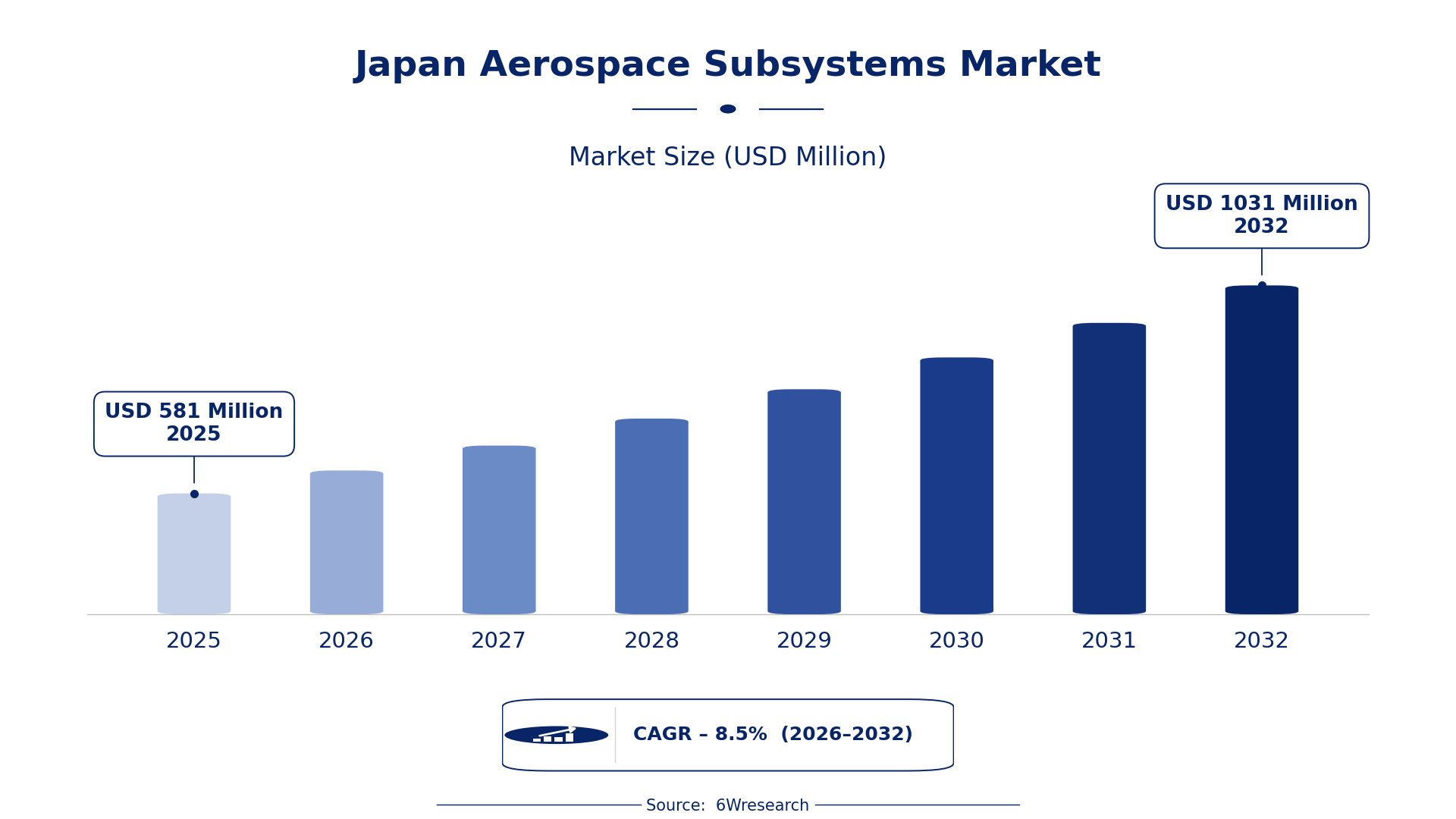
According to 6Wresearch internal database and industry insights, the Japan Aerospace Subsystems Market was valued at USD 581 Million in 2025 and is projected to reach USD 1,031 Million by 2032, growing at a CAGR of approximately 8.5% during 2026–2032.
Japan Aerospace Subsystems Market Highlights
| Report Metric | Details |
| Report Name | Japan Aerospace Subsystems Market (2026-2032) |
| Market Size 2025 | USD 581 Million |
| Market Size 2032 | USD 1,031 Million |
| Absolute Growth 2025–2032 | USD 450 Million |
| CAGR 2026–2032 | 8.5% |
| Peak Annual Growth | 10.2% in 2032 |
| Forecast Period | 2026–2032 |
| Historical Data | 2022–2025 |
| Base Year | 2025 |
| Leading Aerospace Subsystems, 2025 | Flight Control (45% share) |
| Leading Subsystem Type, 2025 | Mechanical (47% share) |
| Leading Technology Type, 2025 | Hydraulic (42% share) |
| Leading Distribution Channel, 2025 | OEMs (42% share) |
| Leading End User, 2025 | Commercial Aviation (38% share) |
| Fastest-Growing Aerospace Subsystems | Navigation Systems (11.9% CAGR) |
| Fastest-Growing Subsystem Type | Digital (12.4% CAGR) |
| Fastest-Growing Technology Type | Power Electronics (12.1% CAGR) |
| Fastest-Growing Distribution Channel | Tier-1 Suppliers (11.2% CAGR) |
| Fastest-Growing End User | UAVs (11.0% CAGR) |
| Growing Sector | UAVs |
| Key End Users | OEMs, Tier-1 Suppliers, Commercial Aviation, Military Aircraft |
Japan Aerospace Subsystems Market Year-wise Growth Rate and Key Drivers (2022–2032)
This graph illustrates the annual growth rates of the market from 2022 to 2032, highlighting a steady upward trajectory and projected market expansion over the forecast period.
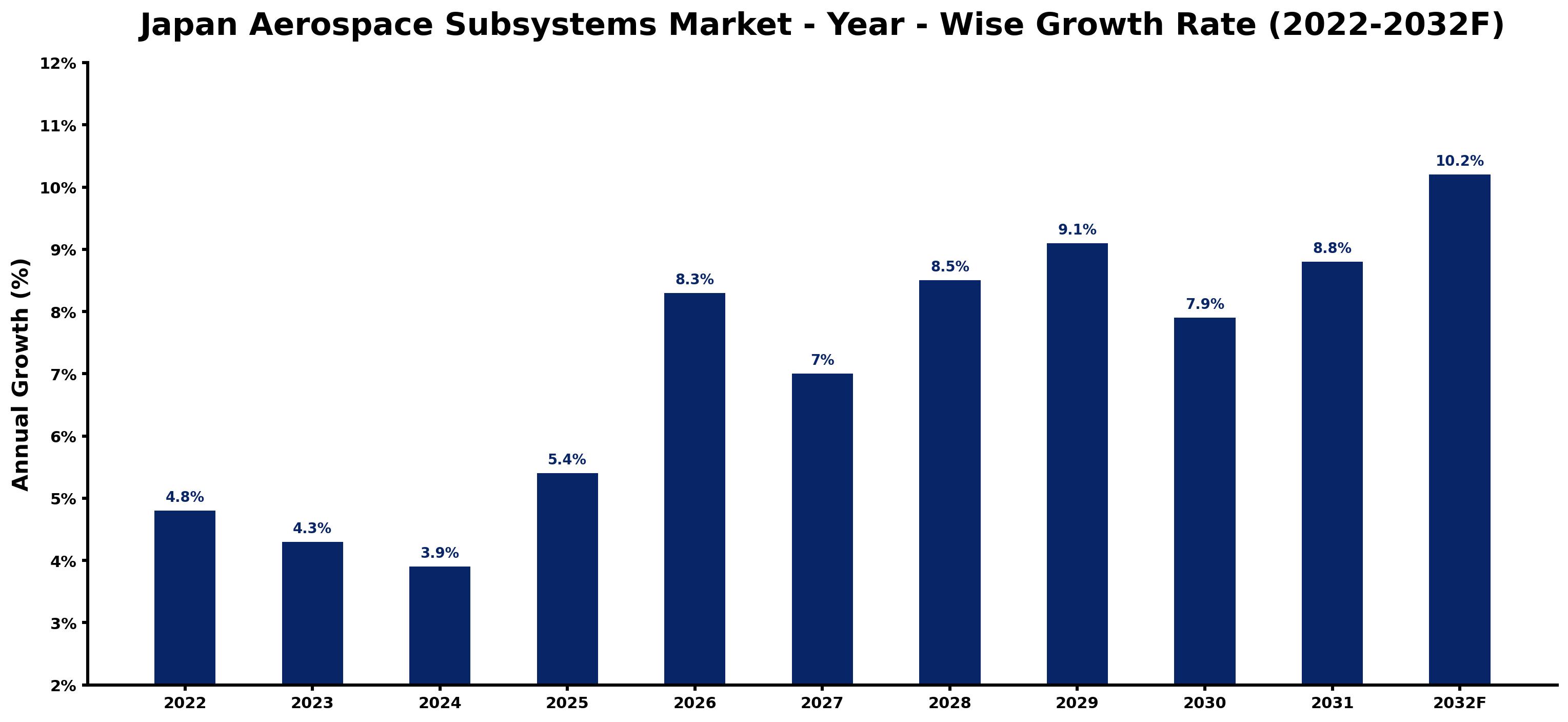
For each year, the table pairs the estimated growth rate with the leading influence on demand, showing how the drivers changed across the period.
| Year | Estimated Annual Growth (%) | Market Rationale |
| 2022 | 4.8 | The market experienced steady growth, driven by ongoing aerospace projects and demand from manufacturers. |
| 2023 | 4.3 | Growth slowed as supply chain challenges affected production timelines and delivery schedules. |
| 2024 | 3.9 | The market continued to grow, albeit at a slower pace, as manufacturers adapted to supply constraints. |
| 2025 | 5.4 | An increase in aircraft production and innovation initiatives boosted market growth. |
| 2026 | 8.3 | Demand is expected to accelerate as investments in aerospace technology and infrastructure expand. |
| 2027 | 7.0 | Growth is projected to slow slightly due to market saturation in certain segments and increased competition. |
| 2028 | 8.5 | A surge in UAV technology adoption is expected to contribute to a faster growth rate in the market. |
| 2029 | 9.1 | The market is projected to see strong growth as demand for advanced aerospace subsystems increases. |
| 2030 | 7.9 | Growth is expected to moderate as the market begins to stabilise after rapid expansions in previous years. |
| 2031 | 8.8 | An uptick in military spending and commercial aviation projects will drive demand higher again. |
| 2032 | 10.2 | The market is projected to peak with substantial investments in next-generation aerospace technologies. |
Note: Market size estimations and growth projections presented in this report are based on 6Wresearch's proprietary forecasting methodology, utilizing the latest available industry data, government publications, and primary research inputs.
Japan Aerospace Subsystems Market Synopsis
Aerospace subsystems are critical components of aircraft and spacecraft, encompassing technologies such as navigation and power systems. The Japan Aerospace Subsystems Market is valued at approximately 1.5 trillion yen, driven by demand from domestic manufacturers and international collaborations. Increased aircraft production, government support for innovation, and advancements in UAV technology are propelling the market forward, with a projected size of USD 1,031 million by 2032.
Market Dynamics Impact Analysis (2026–2032)
| Factor | Type | Impact | Primary Segment Affected |
| Growing demand for UAV technology in disaster response applications | Driver | High | UAVs |
| Investment in advanced materials for aerospace applications | Driver | High | Flight Control |
| Emerging opportunities in green aerospace technologies | Opportunity | High | Environmental Control |
| Increased collaboration with international aerospace agencies | Opportunity | High | Navigation Systems |
| Supply chain disruptions affecting component availability | Restraint | High | Power Subsystems |
| High costs associated with advanced manufacturing processes | Restraint | High | Mechanical |
| Competition from international manufacturers in the aerospace sector | Challenge | Medium | Commercial Aviation |
| Technological advancements requiring continuous investment | Challenge | Medium | Electrical |
Evaluation of Drivers in Japan Aerospace Subsystems Market (2026–2032)
These are the developments adding the most demand over the forecast period.
| Drivers | Primary Segment Affected | Why It Matters (Evidence) |
| Increased aircraft production | Commercial Aviation | Japan produced over 100 commercial aircraft in 2022, leading to higher subsystem demand. |
| Rising investments in UAV technology | UAVs | The government initiated a program to boost UAV technology for disaster response, increasing market interest. |
| Growing focus on green technologies | Environmental Control | Japan is investing in green aerospace technologies to reduce emissions, increasing subsystem requirements. |
| Support from innovation programs | Flight Control | Government initiatives drive demand for advanced aerospace subsystems, improving production capabilities. |
| Collaboration with international aerospace agencies | Navigation Systems | Partnerships with international agencies facilitate technology transfer and subsystem development. |
A wider customer base explains much of the growth, as the aerospace industry produced over 100 commercial aircraft in 2022, driving demand for subsystems. Investments in UAV technology, particularly for disaster response, have further stimulated market interest. The focus on green aerospace technologies is prompting manufacturers to adopt new solutions, increasing subsystem requirements.
Evaluation of Restraints in Japan Aerospace Subsystems Market
The key brakes on demand, and where they bite hardest, are shown below.
| Market Restraint | Primary Segment Affected | Why It Matters (Evidence) |
| Supply chain disruptions affecting component availability | Power Subsystems | Supply chain challenges have delayed deliveries, impacting production schedules and subsystem availability. |
| High costs associated with advanced manufacturing processes | Mechanical | The precision machining and assembly required for aerospace subsystems incur high costs, limiting some manufacturers. |
| Pressure from international manufacturers in the aerospace sector | Commercial Aviation | Local manufacturers face competition from global players, affecting market share and pricing strategies. |
| Technological advancements requiring continuous investment | Electrical | Rapid technological changes demand ongoing investment, straining resources for smaller manufacturers. |
| Regulatory compliance costs impacting profitability | Navigation Systems | Adhering to ISO 9001 standards increases operational costs for producers, affecting overall profitability. |
Japan Aerospace Subsystems Market Challenges
High production costs arise from the advanced engineering processes required for aerospace subsystems. This situation raises component prices, straining budgets for manufacturers and limiting their ability to invest in new technologies. Supply chain disruptions are prevalent in the Tokyo region, where reliance on local suppliers can delay production schedules, forcing buyers to extend lead times by up to three months. Competition intensifies as Japan aims to capture an additional 10% of the global aerospace market by 2030, pressuring suppliers to innovate rapidly. Skills shortages in the aerospace workforce, with around 70,000 professionals, hinder suppliers' ability to meet increasing demand, resulting in potential project delays.
Trends in the Japan Aerospace Subsystems Market
Buyers and suppliers in the Japan Aerospace Subsystems Market are adjusting to the following trends.
- Shift towards UAV Technology: Japan's government has initiated a program to boost UAV technology for disaster response, with funding of 1 billion yen. This shift is increasing demand for advanced subsystems in the UAV segment.
- Transition to Green Aerospace Technologies: In 2023, Japan launched a new satellite focusing on green technologies. This initiative is driving demand for subsystems that support environmentally friendly aerospace applications.
- Emergence of Advanced Materials in Aerospace: Japan is investing in advanced materials for aerospace applications, aiming to increase its global market share by 10% by 2030. This trend encourages suppliers to innovate in subsystem production.
- Prioritisation of International Collaborations: Japan has established partnerships with international aerospace agencies for collaborative projects, enhancing subsystem development. This trend is expected to boost market growth over the coming years.
Investment Opportunities in the Japan Aerospace Subsystems Market
Investors looking at the Japan Aerospace Subsystems Market should consider the following areas.
- Gap in UAV Technology Supply: With the government's 1 billion yen investment in UAV technology, there is a gap in subsystem supply. Tier-1 suppliers can enter this market by forming partnerships with local manufacturers.
- Growing Demand for Green Technologies: The focus on green aerospace technologies presents an opportunity for suppliers to provide new solutions. Companies in the Tokyo region can capitalise on this trend by investing in advanced materials.
- Expansion of Aerospace Manufacturing: Japan's aerospace industry aims to increase its global market share by 10% by 2030, creating opportunities for subsystem suppliers. Collaborating with local OEMs can facilitate market entry.
- Investment in Advanced Research and Development: The Aerospace Research and Development Program aims to drive innovation, providing opportunities for investment in new technologies. Suppliers can partner with research institutions to develop advanced subsystems.
Government Initiatives in the Japan Aerospace Subsystems Market
The Electrical Appliance and Material Safety Act (1961) ensures that aerospace subsystems meet necessary safety standards, influencing production practices and ensuring compliance with regulations. This law has laid the foundation for quality assurance in the aerospace sector, impacting manufacturers and their operational protocols.
The Japan Aerospace Exploration Agency (JAXA) oversees space missions and research, providing funding and support for aerospace projects. JAXA's initiatives promote collaboration among stakeholders, driving the development of advanced aerospace subsystems.
Future Insight of the Japan Aerospace Subsystems Market
Technological advancements in materials will reshape aerospace subsystems, enhancing performance and efficiency by 2032. The government's commitment to green aerospace technologies will drive demand for sustainable solutions, appealing to environmentally conscious buyers. The Aerospace Research and Development Program will catalyse innovation, producing more competitive offerings. Japan's annual defense budget of approximately 1 trillion yen will strengthen aerospace capabilities, equipping suppliers to meet both domestic and international needs effectively.
Market Segmentation Analysis
Japan Aerospace Subsystems Market report covers a detailed analysis of the following market segments:
By Aerospace Subsystems – Flight Control Leads, Navigation Systems Expected to Grow Fastest
According to Saurav Kr Singh, Senior Research Analyst at 6Wresearch, with 45% of aerospace subsystems revenue in 2025, Flight Control was the largest category. Flight control systems dominate the market because they are essential for ensuring aircraft safety and manoeuvrability. Given that Japan produced over 100 commercial aircraft in 2022, the demand for these subsystems remains critical for operational efficiency. Over 2026–2032, Navigation Systems are expected to post the fastest growth, at a CAGR of 11.9%. Navigation systems are experiencing rapid growth as the need for accurate positioning becomes vital in modern aviation. The government's initiatives to enhance UAV technology for disaster response are significantly driving this segment's expansion. Suppliers must prioritise advancements in navigation technologies to meet the rising market demand.
By Subsystem Type – Mechanical Leads, Digital Expected to Grow Fastest
Mechanical accounted for 47% of the market by subsystem type in 2025. Mechanical subsystems hold the largest share due to their fundamental role in the physical operations of various aerospace components. Their importance in systems such as flight control and landing gear solidifies their market leadership. Digital is set to record the highest CAGR in this split, 12.4% over 2026–2032. Digital subsystems are growing quickly because of their importance in data processing and communication within aerospace systems. The increasing reliance on advanced technologies for improved operational efficiency is propelling this segment's rapid development. Buyers should invest in digital solutions to optimise system capabilities and enhance performance.
By Technology Type – Hydraulic Leads, Power Electronics Expected to Grow Fastest
Hydraulic took 42% of technology type revenue in 2025, more than any other category. Hydraulic technology leads the market as it is essential for controlling flight surfaces and landing gear, which are critical for aircraft operation. Its established presence in the industry ensures a steady demand from manufacturers. The quickest growth will come from Power Electronics, forecast to expand at a CAGR of 12.1% between 2026 and 2032. Power electronics are growing quickly as they are necessary for efficient power management in modern aerospace systems. The push for greener technologies in aviation is accelerating the adoption of power electronic solutions. Suppliers must focus on developing advanced power electronic systems to cater to the evolving market needs.
By Distribution Channel – OEMs Lead, Tier-1 Suppliers Expected to Grow Fastest
The largest distribution channel category in 2025 was OEMs, at 42% of revenue. OEMs are the leading distribution channel as they are the primary manufacturers of aerospace subsystems. Their crucial role in the production process ensures a consistent demand for a wide range of subsystems across the industry. Tier-1 Suppliers are projected to grow fastest, at a CAGR of 11.2% during 2026–2032. Tier-1 suppliers are experiencing accelerated growth as they provide essential components directly to OEMs, facilitating quicker production cycles. The rising complexity of aerospace systems is prompting OEMs to depend more on these suppliers for efficiency. Suppliers should build strong partnerships with Tier-1 suppliers to enhance market access and collaboration opportunities.
By End User – Commercial Aviation Leads, UAVs Expected to Grow Fastest
In 2025, Commercial Aviation led the end user split with a 38% share. Commercial aviation is the largest segment of end users for aerospace subsystems, significantly impacting the demand for various technologies. As this sector continues to expand, the need for reliable subsystems remains crucial for operational success. Over 2026–2032, UAVs are expected to post the fastest growth, at a CAGR of 11.0%. UAVs are the fastest-growing end user segment as their applications broaden across multiple industries, including disaster response and surveillance. Government initiatives aimed at enhancing UAV capabilities are further accelerating this growth trajectory. Suppliers should explore opportunities in the UAV market to capitalise on its rapid growth potential.
Key Attractiveness of the Report
- 10 Years of Market Numbers
- Historical Data Starting from 2022 to 2025
- Base Year 2025
- Forecast Data until 2032
- Key Performance Indicators Impacting the Market
- Major Upcoming Developments and Projects
Key Highlights of the Report:
- Japan Aerospace Subsystems Market Outlook
- Market Size of Japan Aerospace Subsystems Market, 2025
- Forecast of Japan Aerospace Subsystems Market, 2032
- Historical Data and Forecast of Japan Aerospace Subsystems Revenues & Volume for the Period 2022-2032F
- Japan Aerospace Subsystems Market Trend Evolution
- Japan Aerospace Subsystems Market Drivers and Challenges
- Japan Aerospace Subsystems Price Trends
- Japan Aerospace Subsystems Porter's Five Forces
- Japan Aerospace Subsystems Industry Life Cycle
- Historical Data and Forecast of Japan Aerospace Subsystems Market Revenues & Volume By Aerospace Subsystems for the Period 2022-2032F
- Historical Data and Forecast of Japan Aerospace Subsystems Market Revenues & Volume By Flight Control for the Period 2022-2032F
- Historical Data and Forecast of Japan Aerospace Subsystems Market Revenues & Volume By Power Subsystems for the Period 2022-2032F
- Historical Data and Forecast of Japan Aerospace Subsystems Market Revenues & Volume By Navigation Systems for the Period 2022-2032F
- Historical Data and Forecast of Japan Aerospace Subsystems Market Revenues & Volume By Environmental Control for the Period 2022-2032F
- Historical Data and Forecast of Japan Aerospace Subsystems Market Revenues & Volume By Subsystem Type for the Period 2022-2032F
- Historical Data and Forecast of Japan Aerospace Subsystems Market Revenues & Volume By Mechanical for the Period 2022-2032F
- Historical Data and Forecast of Japan Aerospace Subsystems Market Revenues & Volume By Electrical for the Period 2022-2032F
- Historical Data and Forecast of Japan Aerospace Subsystems Market Revenues & Volume By Digital for the Period 2022-2032F
- Historical Data and Forecast of Japan Aerospace Subsystems Market Revenues & Volume By Pneumatic for the Period 2022-2032F
- Historical Data and Forecast of Japan Aerospace Subsystems Market Revenues & Volume By Technology Type for the Period 2022-2032F
- Historical Data and Forecast of Japan Aerospace Subsystems Market Revenues & Volume By Hydraulic for the Period 2022-2032F
- Historical Data and Forecast of Japan Aerospace Subsystems Market Revenues & Volume By Power Electronics for the Period 2022-2032F
- Historical Data and Forecast of Japan Aerospace Subsystems Market Revenues & Volume By GPS/INS for the Period 2022-2032F
- Historical Data and Forecast of Japan Aerospace Subsystems Market Revenues & Volume By HVAC Systems for the Period 2022-2032F
- Historical Data and Forecast of Japan Aerospace Subsystems Market Revenues & Volume By Distribution Channel for the Period 2022-2032F
- Historical Data and Forecast of Japan Aerospace Subsystems Market Revenues & Volume By OEMs for the Period 2022-2032F
- Historical Data and Forecast of Japan Aerospace Subsystems Market Revenues & Volume By Tier-1 Suppliers for the Period 2022-2032F
- Historical Data and Forecast of Japan Aerospace Subsystems Market Revenues & Volume By Online Platforms for the Period 2022-2032F
- Historical Data and Forecast of Japan Aerospace Subsystems Market Revenues & Volume By Direct Sales for the Period 2022-2032F
- Historical Data and Forecast of Japan Aerospace Subsystems Market Revenues & Volume By End User for the Period 2022-2032F
- Historical Data and Forecast of Japan Aerospace Subsystems Market Revenues & Volume By Commercial Aviation for the Period 2022-2032F
- Historical Data and Forecast of Japan Aerospace Subsystems Market Revenues & Volume By Military Aircraft for the Period 2022-2032F
- Historical Data and Forecast of Japan Aerospace Subsystems Market Revenues & Volume By UAVs for the Period 2022-2032F
- Historical Data and Forecast of Japan Aerospace Subsystems Market Revenues & Volume By Spacecraft for the Period 2022-2032F
- Japan Aerospace Subsystems Import Export Trade Statistics
- Market Opportunity Assessment By Aerospace Subsystems
- Market Opportunity Assessment By Subsystem Type
- Market Opportunity Assessment By Technology Type
- Market Opportunity Assessment By Distribution Channel
- Market Opportunity Assessment By End User
- Japan Aerospace Subsystems Top Companies Market Share
- Japan Aerospace Subsystems Competitive Benchmarking By Technical and Operational Parameters
- Japan Aerospace Subsystems Company Profiles
- Japan Aerospace Subsystems Key Strategic Recommendations
Market Covered
Segments analysed in this report are listed below.
By Aerospace Subsystems
- Flight Control
- Power Subsystems
- Navigation Systems
- Environmental Control
By Subsystem Type
- Mechanical
- Electrical
- Digital
- Pneumatic
By Technology Type
- Hydraulic
- Power Electronics
- GPS/INS
- HVAC Systems
By Distribution Channel
- OEMs
- Tier-1 Suppliers
- Online Platforms
- Direct Sales
By End User
- Commercial Aviation
- Military Aircraft
- UAVs
- Spacecraft






































