Japan Aerospace Surveillance Systems Market Size & Growth Rate
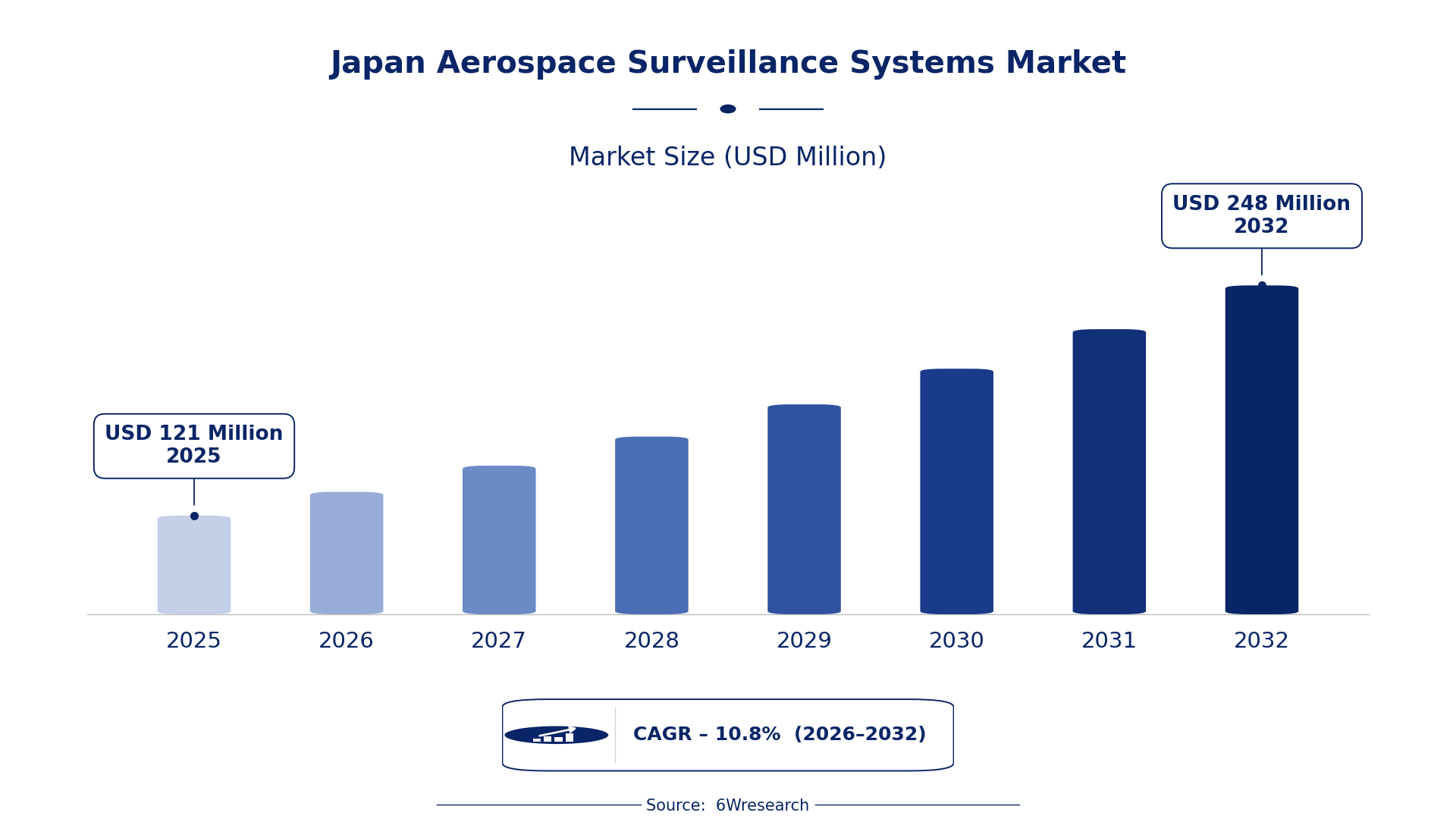
According to 6Wresearch internal database and industry insights, the Japan Aerospace Surveillance Systems Market was valued at USD 121 Million in 2025 and is projected to reach USD 248 Million by 2032, growing at a CAGR of approximately 10.8% during 2026–2032.
Japan Aerospace Surveillance Systems Market Highlights
| Report Metric | Details |
| Report Name | Japan Aerospace Surveillance Systems Market (2026-2032) |
| Market Size 2025 | USD 121 Million |
| Market Size 2032 | USD 248 Million |
| Absolute Growth 2025–2032 | USD 127 Million |
| CAGR 2026–2032 | 10.8% |
| Peak Annual Growth | 12.9% in 2029 |
| Forecast Period | 2026–2032 |
| Historical Data | 2022–2025 |
| Base Year | 2025 |
| Leading Surveillance Systems, 2025 | Radar Systems (46% share) |
| Leading System Type, 2025 | Ground-based (39% share) |
| Leading Technology Used, 2025 | Doppler (35% share) |
| Leading Distribution Channel, 2025 | Government Contracts (52% share) |
| Leading End User, 2025 | Air Traffic Control (50% share) |
| Fastest-Growing Surveillance Systems | EO/IR Systems (15.4% CAGR) |
| Fastest-Growing System Type | Satellite-based (14.9% CAGR) |
| Fastest-Growing Technology Used | Infrared/Optical (15.9% CAGR) |
| Fastest-Growing End User | Military Surveillance (13.8% CAGR) |
| Growing Sector | Aerospace Surveillance Systems |
| Key End Users | Air Traffic Control, Military Surveillance, Civil Aviation, Defense Agencies |
Japan Aerospace Surveillance Systems Market Year-wise Growth Rate and Key Drivers (2022–2032)
This graph illustrates the annual growth rates of the market from 2022 to 2032, highlighting a steady upward trajectory and projected market expansion over the forecast period.
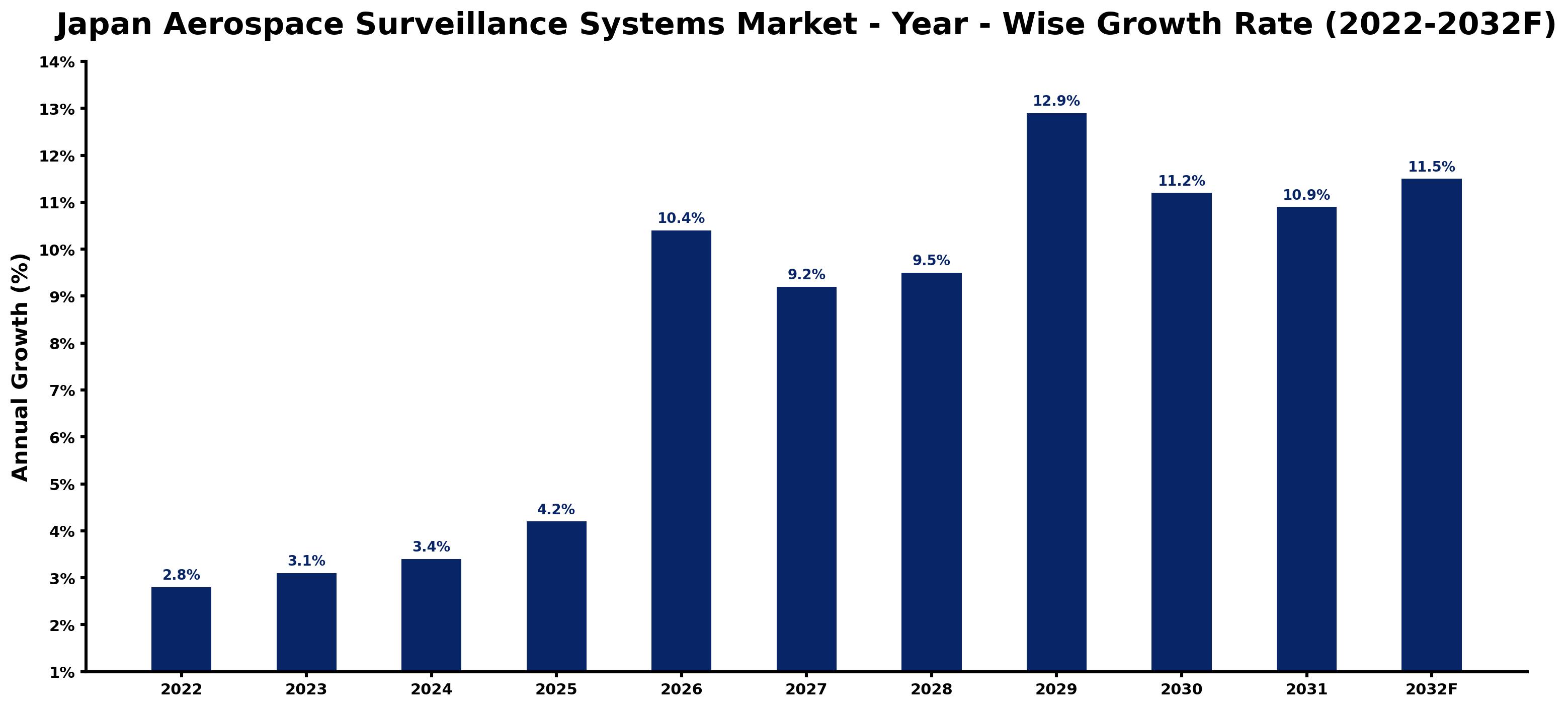
The yearly estimates that follow link every growth rate to its principal driver, so readers can see why the pace changed in each period.
| Year | Estimated Annual Growth (%) | Market Rationale |
| 2022 | 2.8 | The market experienced steady growth due to increased air traffic management needs. |
| 2023 | 3.1 | Demand rose as the Ministry of Defense allocated more funds for surveillance technology. |
| 2024 | 3.4 | Growth continued with advancements in radar and optical sensor technologies. |
| 2025 | 4.2 | The market peaked historically as air traffic control systems expanded. |
| 2026 | 10.4 | Growth accelerated as military surveillance requirements intensified ahead of strategic plans. |
| 2027 | 9.2 | A slight slowdown occurred as the market adjusted to rapid previous growth rates. |
| 2028 | 9.5 | Demand increased again, driven by technological upgrades in air traffic management. |
| 2029 | 12.9 | The market reached peak growth, spurred by new military contracts and technology adoption. |
| 2030 | 11.2 | Growth moderated as the market stabilised after peak demand in the previous year. |
| 2031 | 10.9 | A continued slowdown reflected market saturation in certain surveillance technologies. |
| 2032 | 11.5 | Growth rebounded as new regulations increased the need for advanced systems. |
Note: Market size estimations and growth projections presented in this report are based on 6Wresearch's proprietary forecasting methodology, utilizing the latest available industry data, government publications, and primary research inputs.
Japan Aerospace Surveillance Systems Market Synopsis
Aerospace Surveillance Systems are advanced technologies used for monitoring airspace, employing radar, optical sensors, and GPS for applications like air traffic control and military operations. The Japan Aerospace Surveillance Systems Market is growing due to rising air traffic, military investments, and government contracts, with the aerospace sector valued at over 4 trillion JPY. The Ministry of Defense's 5 billion JPY allocation for surveillance technology in 2023 underscores the increasing demand from civil and military sectors, driving market expansion.
Market Dynamics Impact Analysis (2026–2032)
| Factor | Type | Impact | Primary Segment Affected |
| Increased air traffic management needs are pushing demand for advanced surveillance systems. | Driver | High | Air Traffic Control |
| Growing military surveillance requirements are driving investments in advanced technologies. | Driver | High | Military Surveillance |
| The need for enhanced air traffic safety creates opportunities for new system implementations. | Opportunity | High | Civil Aviation |
| Technological advancements in surveillance systems present new market entry points. | Opportunity | Medium | Radar Systems |
| High costs associated with advanced surveillance technology can limit market access for smaller players. | Restraint | High | Radar Systems |
| Regulatory compliance requirements can slow down the deployment of new systems. | Restraint | Medium | Air Traffic Control |
| Talent shortages in aerospace technology development may hinder innovation. | Challenge | High | Radar Systems |
| Supply chain disruptions can delay the availability of critical components. | Challenge | Medium | Military Surveillance |
Evaluation of Drivers in Japan Aerospace Surveillance Systems Market (2026–2032)
Demand rests on the following drivers, each shown with the segment it touches most.
| Drivers | Primary Segment Affected | Why It Matters (Evidence) |
| Increased air traffic management needs drive demand for surveillance systems. | Air Traffic Control | The Air Traffic Management System in Japan handles over 1 million flights annually, necessitating advanced monitoring technologies. |
| Growing military surveillance requirements push investments in advanced technologies. | Military Surveillance | The Defense Agency has a strategic plan to enhance military surveillance by 2026, leading to increased procurement. |
| Government contracts are a significant source of demand for aerospace systems. | Government Contracts | With a 52% share in 2025, government contracts sustain market growth. |
| Technological advancements improve system capabilities and attract buyers. | Radar Systems | The Japan Aerospace Industry Association promotes technology advancements, driving demand for modern systems. |
| The need for improved air traffic safety creates opportunities for new implementations. | Civil Aviation | The government aims to improve air traffic safety by 2025 with new systems, increasing demand. |
Buyers are adding capacity as the Air Traffic Management System in Japan manages over 1 million flights annually, creating a need for advanced monitoring technologies. Military surveillance requirements are prompting increased procurement of sophisticated systems. The focus on technology advancements is further stimulating interest in modern solutions.
Evaluation of Restraints in Japan Aerospace Surveillance Systems Market
The main factors holding the market back are set out below.
| Market Restraint | Primary Segment Affected | Why It Matters (Evidence) |
| High costs associated with advanced surveillance technology limit access for smaller players. | Radar Systems | The aerospace sector is valued at over 4 trillion JPY, making entry challenging for less established firms. |
| Regulatory compliance requirements slow down the deployment of new systems. | Air Traffic Control | The Japan Civil Aviation Bureau regulates civil aviation surveillance standards, necessitating thorough compliance. |
| Talent shortages in aerospace technology development hinder innovation. | Radar Systems | Japan's aerospace sector faces challenges in recruiting skilled professionals, affecting development timelines. |
| Supply chain disruptions delay the availability of critical components. | Military Surveillance | Global supply chain issues have impacted the timely delivery of essential surveillance technologies. |
| Market saturation in certain surveillance technologies limits growth potential. | Radar Systems | As systems mature, the demand for upgrades may decline, affecting overall market growth. |
Japan Aerospace Surveillance Systems Market Challenges
Producers encounter high compliance costs due to regulations from the Japan Civil Aviation Bureau, which can reach up to 500 million JPY annually, squeezing profit margins. Limited availability of advanced surveillance systems arises as the government prioritises military contracts, causing delays in civil aviation projects that can extend timelines by over six months for producers. A shortage of skilled workers in aerospace technology development restricts innovation capabilities, leading to project overruns that may cost buyers an estimated 200 million JPY. Increased competition from international suppliers pressures local producers to lower prices, potentially compromising quality and reliability for buyers.
Trends in the Japan Aerospace Surveillance Systems Market
Several trends are reshaping the Japan Aerospace Surveillance Systems Market; the most important are set out below.
- Shift from Ground-based to Satellite-based Systems: Japan is increasingly adopting satellite-based surveillance systems for airspace monitoring. The Japan Aerospace Exploration Agency (JAXA) oversees satellite surveillance projects, reflecting a growing need for global monitoring and data collection.
- Transition from Traditional to Advanced Surveillance Technologies: Tokyo is experiencing a transition to advanced surveillance technologies, particularly in air traffic control. Upgrades to the Air Traffic Management System are expected to handle more complex flight operations, improving safety and efficiency.
- Military Surveillance Prioritised over Civil Applications: Military surveillance is becoming a priority in Japan's aerospace sector, with substantial investments from the Defense Agency. This focus is clear as military surveillance systems are projected to grow at a CAGR of 13.8% by 2032.
- Emergence of Infrared/Optical Technologies: Infrared/Optical technologies are gaining traction in Japan's aerospace surveillance market. The increasing demand for night vision capabilities in military applications is driving this trend, with a projected CAGR of 15.9%.
Investment Opportunities in the Japan Aerospace Surveillance Systems Market
Where to invest in the Japan Aerospace Surveillance Systems Market: the main openings are set out below.
- Partner with Local Firms for Technology Development: Now is the time to invest in partnerships with local firms to develop advanced surveillance technologies. The Tokyo Metropolitan Area is a key region for aerospace technology development, presenting opportunities for collaboration.
- Invest in Satellite-based Surveillance Systems: Satellite-based systems represent a promising growth opportunity. The Japan Aerospace Exploration Agency (JAXA) is actively involved in these projects, making it a prime area for investment.
- Utilise Government Contracts for Market Entry: The government contracts sector, holding a 52% market share, offers a strong entry point. Engaging with defense agencies can facilitate access to this critical market segment.
- Focus on Military Surveillance Technologies: The military surveillance segment is expanding rapidly, driven by increased defense budgets. Investing in technologies that meet the needs of defense agencies can yield substantial returns.
Government Initiatives in the Japan Aerospace Surveillance Systems Market
The Electrical Appliance and Material Safety Act regulates the safety standards for electrical appliances and materials in Japan, ensuring that aerospace surveillance systems meet stringent requirements. Compliance with this act is essential for manufacturers, as it affects their ability to market products effectively and ensures consumer safety.
The Digital Agency leads government digital transformation efforts, including the implementation of common system standards. This agency's initiatives support the development of advanced aerospace surveillance systems, benefiting both producers and buyers.
Future Insight of the Japan Aerospace Surveillance Systems Market
By 2032, the air traffic management system will see transformative advancements, supported by the government's 5 billion JPY investment in surveillance technology. Satellite surveillance projects overseen by the Japan Aerospace Exploration Agency will significantly improve monitoring capabilities for both military and civil aviation sectors. The widespread adoption of the ISO 9001 standard will elevate quality in aerospace manufacturing, resulting in superior products for buyers. New systems aimed at enhancing air traffic safety will become operational, ensuring a safer environment for the 1 million flights managed annually.
Market Segmentation Analysis
Japan Aerospace Surveillance Systems Market report covers a detailed analysis of the following market segments:
By Surveillance Systems – Radar Systems Lead, EO/IR Systems Expected to Grow Fastest
According to Saurav Kr Singh, Senior Research Analyst at 6Wresearch, Radar Systems accounted for 46% of the market by surveillance systems in 2025. Radar Systems are essential for tracking aircraft and ensuring safety, which secures their leading position in Japan's aerospace surveillance market. The Air Traffic Management System, managing over 1 million flights annually, heavily relies on radar technology for operational efficiency. Over 2026–2032, EO/IR Systems are expected to post the fastest growth, at a CAGR of 15.4%. EO/IR Systems are gaining traction due to heightened military demand for advanced surveillance and reconnaissance capabilities. The Defense Agency's strategic plan for military surveillance enhancement by 2026 is a key factor in this segment's rapid growth. Suppliers should focus on developing advanced EO/IR technologies to meet increasing military requirements.
By System Type – Ground-based Leads, Satellite-based Expected to Grow Fastest
In 2025, Ground-based led the system type split with a 39% share. Ground-based systems are extensively used for monitoring local airspace, providing vital support for air traffic control operations. With over 400 airports in Japan, the demand for these systems remains consistently robust. Satellite-based is set to record the highest CAGR in this split, 14.9% over 2026–2032. Satellite-based systems are becoming increasingly crucial for global monitoring and data collection, driving their rapid growth. Initiatives by the Japan Aerospace Exploration Agency for satellite surveillance significantly contribute to this upward trend. Buyers may increasingly prefer satellite-based solutions for comprehensive airspace oversight.
By Technology Used – Doppler Leads, Infrared/Optical Expected to Grow Fastest
Doppler took 35% of technology used revenue in 2025, more than any other category. Doppler technology is crucial for detecting moving objects in airspace, making it the preferred choice for various surveillance applications. Its effectiveness in tracking aircraft solidifies its leading position in the market. The quickest growth will come from Infrared/Optical, forecast to expand at a CAGR of 15.9% between 2026 and 2032. Infrared/Optical technology is advancing rapidly, particularly for night vision and surveillance applications. The growing need for enhanced surveillance in military operations propels this segment's swift expansion. Suppliers should concentrate on advancing infrared and optical technologies to capture emerging market opportunities.
By Distribution Channel – Government Contracts Lead and Record the Fastest Growth
With 52% of distribution channel revenue in 2025, Government Contracts was the largest category. Government Contracts are a primary source of demand for aerospace systems, particularly in Japan's well-funded defence sector. The Ministry of Defense's allocation of 5 billion JPY for surveillance technology in 2023 underscores this trend. The same category are also set to grow fastest, at a CAGR of 12.4% during 2026–2032. Government Contracts are also the fastest-growing distribution channel due to rising investments in surveillance technologies. The government's commitment to improving air traffic safety by 2025 further accelerates this growth. Suppliers must align their strategies to secure government contracts for sustained market presence.
By End User – Air Traffic Control Leads, Military Surveillance Expected to Grow Fastest
Air Traffic Control held 50% of the Japan Aerospace Surveillance Systems Market by end user in 2025. Air Traffic Control is the main user of surveillance systems, necessitating reliable technologies to manage Japan's busy airspace effectively. The high traffic volume in the Tokyo Metropolitan Area highlights the critical need for these systems. Over 2026–2032, Military Surveillance is expected to post the fastest growth, at a CAGR of 13.8%. Military Surveillance is experiencing rapid growth as advanced technologies become essential for national security. The Defense Agency's initiatives for enhanced military surveillance capabilities by 2026 are driving this segment's expansion. Buyers in the military sector should prioritise acquiring advanced surveillance technologies to maintain a competitive edge.
Key Attractiveness of the Report
- 10 Years of Market Numbers
- Historical Data Starting from 2022 to 2025
- Base Year 2025
- Forecast Data until 2032
- Key Performance Indicators Impacting the Market
- Major Upcoming Developments and Projects
Key Highlights of the Report:
- Japan Aerospace Surveillance Systems Market Outlook
- Market Size of Japan Aerospace Surveillance Systems Market, 2025
- Forecast of Japan Aerospace Surveillance Systems Market, 2032
- Historical Data and Forecast of Japan Aerospace Surveillance Systems Revenues & Volume for the Period 2022-2032F
- Japan Aerospace Surveillance Systems Market Trend Evolution
- Japan Aerospace Surveillance Systems Market Drivers and Challenges
- Japan Aerospace Surveillance Systems Price Trends
- Japan Aerospace Surveillance Systems Porter's Five Forces
- Japan Aerospace Surveillance Systems Industry Life Cycle
- Historical Data and Forecast of Japan Aerospace Surveillance Systems Market Revenues & Volume By Surveillance Systems for the Period 2022-2032F
- Historical Data and Forecast of Japan Aerospace Surveillance Systems Market Revenues & Volume By Radar Systems for the Period 2022-2032F
- Historical Data and Forecast of Japan Aerospace Surveillance Systems Market Revenues & Volume By EO/IR Systems for the Period 2022-2032F
- Historical Data and Forecast of Japan Aerospace Surveillance Systems Market Revenues & Volume By AIS & ADS-B for the Period 2022-2032F
- Historical Data and Forecast of Japan Aerospace Surveillance Systems Market Revenues & Volume By Signal Intelligence for the Period 2022-2032F
- Historical Data and Forecast of Japan Aerospace Surveillance Systems Market Revenues & Volume By System Type for the Period 2022-2032F
- Historical Data and Forecast of Japan Aerospace Surveillance Systems Market Revenues & Volume By Ground-based for the Period 2022-2032F
- Historical Data and Forecast of Japan Aerospace Surveillance Systems Market Revenues & Volume By Airborne for the Period 2022-2032F
- Historical Data and Forecast of Japan Aerospace Surveillance Systems Market Revenues & Volume By Satellite-based for the Period 2022-2032F
- Historical Data and Forecast of Japan Aerospace Surveillance Systems Market Revenues & Volume By Tactical Systems for the Period 2022-2032F
- Historical Data and Forecast of Japan Aerospace Surveillance Systems Market Revenues & Volume By Technology Used for the Period 2022-2032F
- Historical Data and Forecast of Japan Aerospace Surveillance Systems Market Revenues & Volume By Doppler for the Period 2022-2032F
- Historical Data and Forecast of Japan Aerospace Surveillance Systems Market Revenues & Volume By Infrared/Optical for the Period 2022-2032F
- Historical Data and Forecast of Japan Aerospace Surveillance Systems Market Revenues & Volume By GPS & Beacon Tech for the Period 2022-2032F
- Historical Data and Forecast of Japan Aerospace Surveillance Systems Market Revenues & Volume By RF Capture for the Period 2022-2032F
- Historical Data and Forecast of Japan Aerospace Surveillance Systems Market Revenues & Volume By Distribution Channel for the Period 2022-2032F
- Historical Data and Forecast of Japan Aerospace Surveillance Systems Market Revenues & Volume By OEMs for the Period 2022-2032F
- Historical Data and Forecast of Japan Aerospace Surveillance Systems Market Revenues & Volume By Direct Sales for the Period 2022-2032F
- Historical Data and Forecast of Japan Aerospace Surveillance Systems Market Revenues & Volume By Online Platforms for the Period 2022-2032F
- Historical Data and Forecast of Japan Aerospace Surveillance Systems Market Revenues & Volume By Government Contracts for the Period 2022-2032F
- Historical Data and Forecast of Japan Aerospace Surveillance Systems Market Revenues & Volume By End User for the Period 2022-2032F
- Historical Data and Forecast of Japan Aerospace Surveillance Systems Market Revenues & Volume By Air Traffic Control for the Period 2022-2032F
- Historical Data and Forecast of Japan Aerospace Surveillance Systems Market Revenues & Volume By Military Surveillance for the Period 2022-2032F
- Historical Data and Forecast of Japan Aerospace Surveillance Systems Market Revenues & Volume By Civil Aviation for the Period 2022-2032F
- Historical Data and Forecast of Japan Aerospace Surveillance Systems Market Revenues & Volume By Defense Agencies for the Period 2022-2032F
- Japan Aerospace Surveillance Systems Import Export Trade Statistics
- Market Opportunity Assessment By Surveillance Systems
- Market Opportunity Assessment By System Type
- Market Opportunity Assessment By Technology Used
- Market Opportunity Assessment By Distribution Channel
- Market Opportunity Assessment By End User
- Japan Aerospace Surveillance Systems Top Companies Market Share
- Japan Aerospace Surveillance Systems Competitive Benchmarking By Technical and Operational Parameters
- Japan Aerospace Surveillance Systems Company Profiles
- Japan Aerospace Surveillance Systems Key Strategic Recommendations
Market Covered
The following segment groups are covered in the report.
By Surveillance Systems
- Radar Systems
- EO/IR Systems
- AIS & ADS-B
- Signal Intelligence
By System Type
- Ground-based
- Airborne
- Satellite-based
- Tactical Systems
By Technology Used
- Doppler
- Infrared/Optical
- GPS & Beacon Tech
- RF Capture
By Distribution Channel
- OEMs
- Direct Sales
- Online Platforms
- Government Contracts
By End User
- Air Traffic Control
- Military Surveillance
- Civil Aviation
- Defense Agencies































