Japan Aerospace Tooling Market Size & Growth Rate
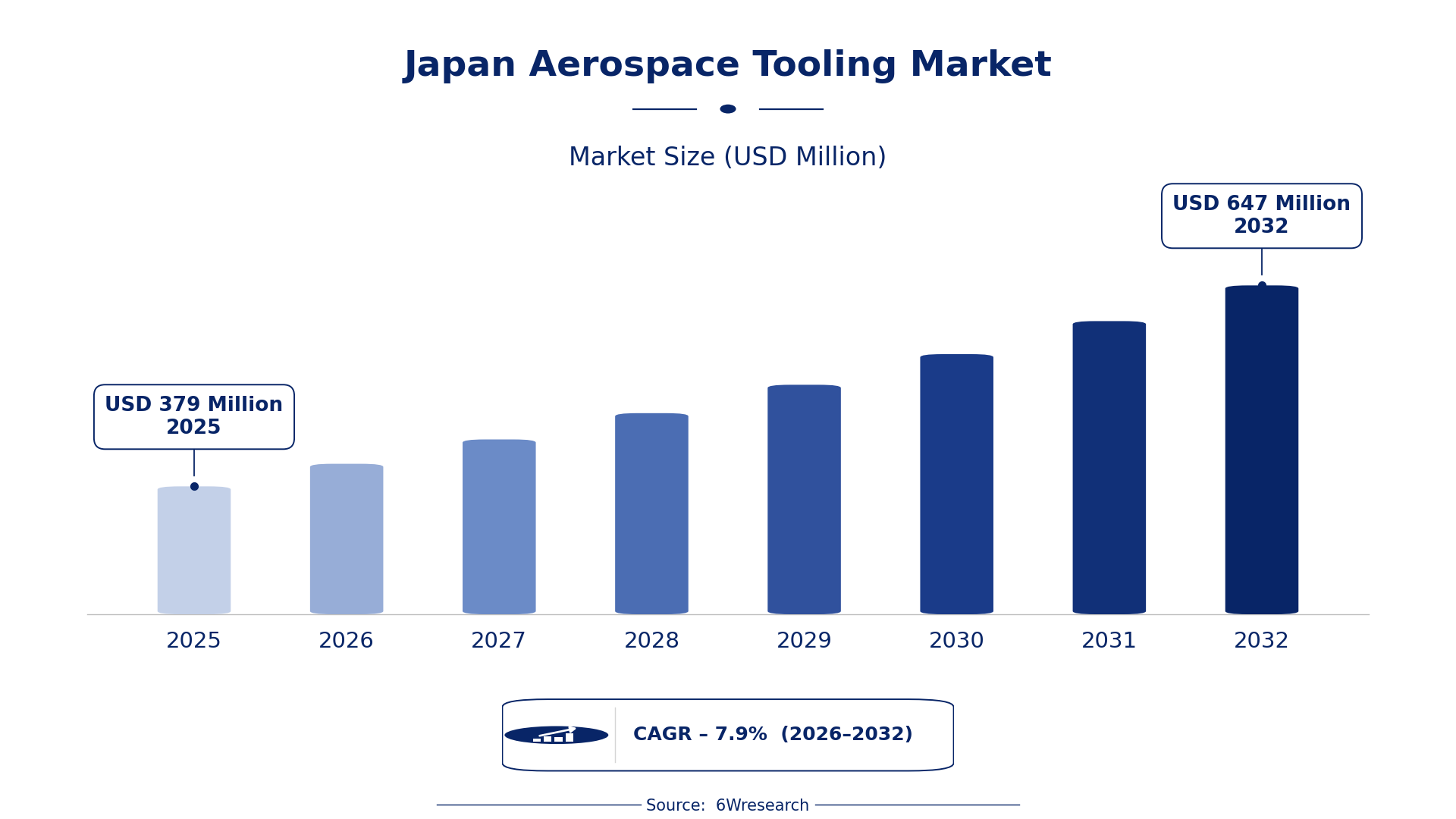
According to 6Wresearch internal database and industry insights, the Japan Aerospace Tooling Market was valued at USD 379 Million in 2025 and is projected to reach USD 647 Million by 2032, growing at a CAGR of approximately 7.9% during 2026–2032.
Japan Aerospace Tooling Market Highlights
| Report Metric | Details |
| Report Name | Japan Aerospace Tooling Market (2026-2032) |
| Market Size 2025 | USD 379 Million |
| Market Size 2032 | USD 647 Million |
| Absolute Growth 2025–2032 | USD 268 Million |
| CAGR 2026–2032 | 7.9% |
| Peak Annual Growth | 8.9% in 2032 |
| Forecast Period | 2026–2032 |
| Historical Data | 2022–2025 |
| Base Year | 2025 |
| Leading Aerospace Tooling, 2025 | Assembly Fixtures (42% share) |
| Leading Tool Type, 2025 | CNC Tools (35% share) |
| Leading Material Used, 2025 | Alloy Steel (34% share) |
| Leading Distribution Channel, 2025 | OEMs (40% share) |
| Leading End User, 2025 | Aircraft Assembly Plants (56% share) |
| Fastest-Growing Aerospace Tooling | Molding Tools (10.2% CAGR) |
| Fastest-Growing Tool Type | Composite Molds (11.3% CAGR) |
| Fastest-Growing Material Used | Carbide (11.6% CAGR) |
| Fastest-Growing Distribution Channel | Online Platforms (10.3% CAGR) |
| Fastest-Growing End User | Aerospace Suppliers (10.4% CAGR) |
| Growing Sector | Aerospace Suppliers |
| Key End Users | Aircraft Assembly Plants, Engine Manufacturers, Aerospace Suppliers, QA/QC Teams |
Japan Aerospace Tooling Market Year-wise Growth Rate and Key Drivers (2022–2032)
This graph illustrates the annual growth rates of the market from 2022 to 2032, highlighting a steady upward trajectory and projected market expansion over the forecast period.
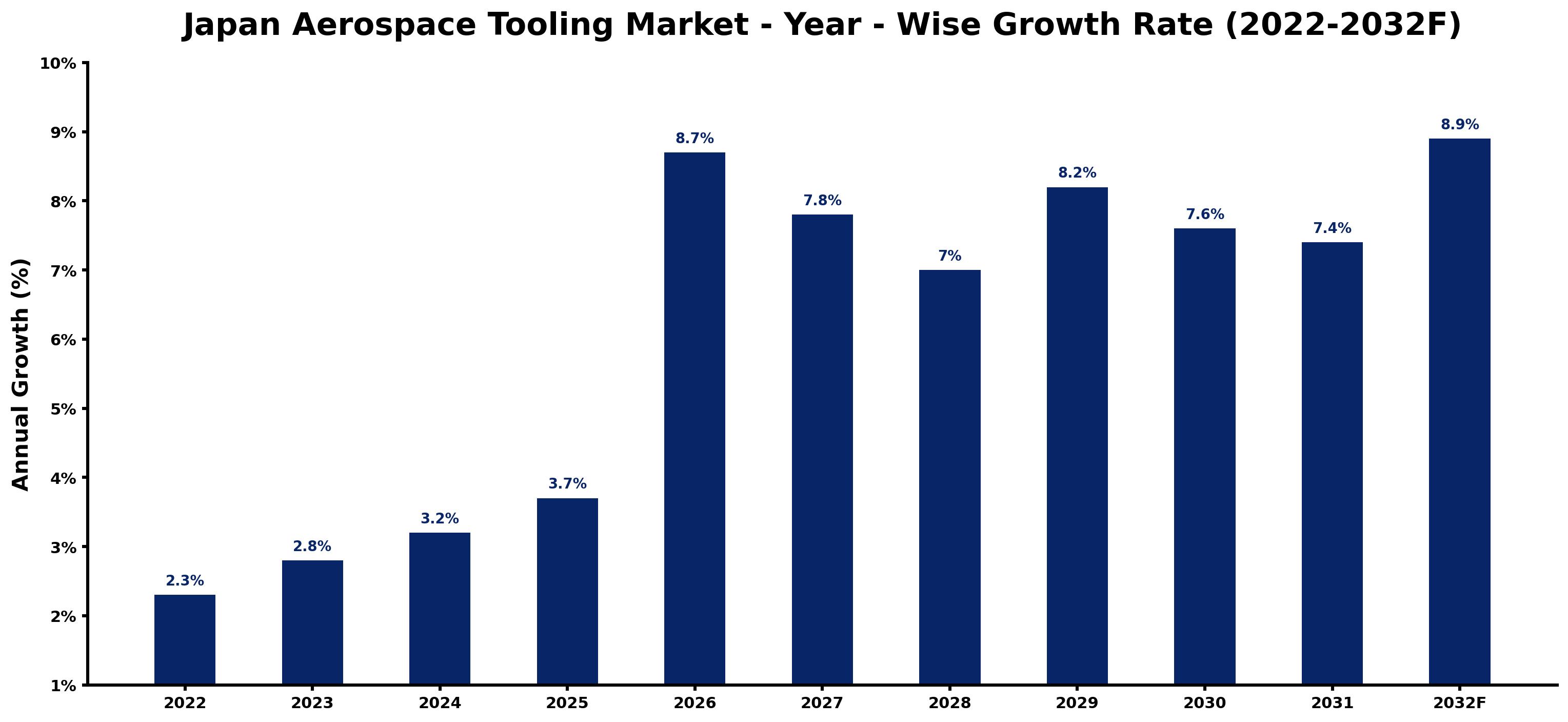
The yearly estimates that follow link every growth rate to its principal driver, so readers can see why the pace changed in each period.
| Year | Estimated Annual Growth (%) | Market Rationale |
| 2022 | 2.3 | The aerospace tooling market showed steady demand from domestic manufacturers. |
| 2023 | 2.8 | Growth accelerated as production increased in key regions like Tokyo. |
| 2024 | 3.2 | Demand continued to rise, driven by new aircraft assembly projects. |
| 2025 | 3.7 | The market reached a peak as exports surged due to global demand. |
| 2026 | 8.7 | Growth is expected to rise sharply due to new innovation programs. |
| 2027 | 7.8 | A slowdown is anticipated as growth stabilises after rapid expansion. |
| 2028 | 7.0 | The market will continue to grow, albeit at a slower pace than before. |
| 2029 | 8.2 | Demand is projected to increase again as new technologies are adopted. |
| 2030 | 7.6 | Growth will slow further as the market adjusts to previous peaks. |
| 2031 | 7.4 | A slight slowdown is expected as market conditions normalise. |
| 2032 | 8.9 | The market is expected to experience a resurgence in growth driven by innovation. |
Note: Market size estimations and growth projections presented in this report are based on 6Wresearch's proprietary forecasting methodology, utilizing the latest available industry data, government publications, and primary research inputs.
Japan Aerospace Tooling Market Synopsis
Aerospace tooling includes specialized tools essential for manufacturing and assembling aircraft components, utilizing advanced materials and precision engineering techniques. Japan's aerospace market is valued at over 4 trillion JPY, with demand primarily driven by domestic manufacturers and exports. The introduction of a new innovation program with a budget of 10 billion JPY in 2023 is set to boost investment and technology development, further supporting the growth of the tooling market.
Market Dynamics Impact Analysis (2026–2032)
| Factor | Type | Impact | Primary Segment Affected |
| Increased domestic aircraft production | Driver | High | Machining Tools |
| Growing demand for lightweight components | Driver | High | Molding Tools |
| Investment in aerospace innovation programs | Opportunity | High | Assembly Fixtures |
| Expansion of aerospace manufacturing hubs | Opportunity | Medium | Assembly Fixtures |
| High costs of precision tooling | Restraint | High | Inspection Tools |
| Limited availability of skilled labor | Restraint | Medium | CNC Tools |
| Fluctuating material costs | Challenge | High | Machining Tools |
| Technological advancements outpacing current tooling | Challenge | Medium | Molding Tools |
Evaluation of Drivers in Japan Aerospace Tooling Market (2026–2032)
The factors lifting demand, and the evidence behind each, are summarised below.
| Drivers | Primary Segment Affected | Why It Matters (Evidence) |
| Rising aircraft production | Machining Tools | Japan's aerospace market, valued at over 4 trillion JPY, drives demand for precision manufacturing tools. |
| Increased focus on lightweight materials | Molding Tools | The shift towards composite materials in aircraft design boosts demand for advanced molding tools. |
| Government funding for aerospace innovation | Assembly Fixtures | The 10 billion JPY budget for aerospace innovation in 2023 encourages investment in tooling technologies. |
| Expansion of manufacturing capabilities | Assembly Fixtures | Tokyo and Nagoya's aerospace hubs support increased production capacity, driving demand for assembly tools. |
| Growing export opportunities | Inspection Tools | Aerospace tooling exports from Japan reached 200 billion JPY in 2022, reflecting rising global demand. |
Rising aircraft production is the primary driver of demand, necessitating precision manufacturing tools as Japan's aerospace market surpasses 4 trillion JPY. The increasing emphasis on lightweight materials is boosting the need for advanced moulding tools, especially as the shift towards composites accelerates. Funding for aerospace innovation, featuring a 10 billion JPY budget in 2023, promotes investment in tooling technologies. Manufacturing capabilities in key regions are expanding, which in turn raises demand for assembly fixtures. Tooling exports reached 200 billion JPY in 2022, underscoring the expanding global market.
Evaluation of Restraints in Japan Aerospace Tooling Market
These are the pressures that could keep growth below its potential.
| Market Restraint | Primary Segment Affected | Why It Matters (Evidence) |
| Skills shortage in aerospace engineering | Machining Tools | Over 40% of aerospace companies report difficulty in finding qualified engineers, delaying production timelines. |
| High material costs | Molding Tools | Aerospace tooling expenses are rising by 15% annually due to increased material prices, impacting profit margins. |
| Supply chain disruptions | Assembly Fixtures | 30% of suppliers experience delays in receiving raw materials, leading to longer lead times for buyers. |
| Fluctuating export demands | Inspection Tools | 20% of aerospace tooling exports fell in 2022, forcing manufacturers to adjust their production volumes unpredictably. |
| Regulatory compliance costs | Machining Tools | Compliance with ISO 9001 standards increases operational costs for manufacturers. |
Japan Aerospace Tooling Market Challenges
In 2023, over 40% of companies report challenges in finding qualified engineers, a consequence of an ageing workforce and inadequate training programmes, which delays production timelines for manufacturers. Tooling costs are escalating by 15% annually due to rising material prices, squeezing profit margins for suppliers. Supply chain disruptions affect 30% of suppliers who face delays in receiving raw materials, resulting in longer lead times for buyers. Buyers are confronted with unpredictable production volumes, as 15% of tooling exports declined in 2022, complicating inventory management and planning.
Trends in the Japan Aerospace Tooling Market
The shifts below are changing how Japan Aerospace Tooling Market products are bought and supplied.
- Shift in Material Usage: Aircraft manufacturers are increasingly adopting composite materials to improve fuel efficiency. This trend is particularly noticeable in Tokyo, where composite tooling usage has increased by 15% since 2021.
- Transition to Automation in Tooling: The aerospace sector is progressing towards automated machining processes, with CNC tools becoming more common. In Nagoya, the installed base of CNC machines has reached around 5,000 units.
- Emergence of Lightweight Components: The demand for lightweight components is transforming tooling requirements, especially in engine manufacturing. The introduction of new lightweight aircraft models has led to a 20% rise in tooling needs.
- Prioritisation of Quality Assurance: Quality assurance processes are gaining more focus, resulting in heightened demand for inspection tools. In 2022, precision jigs were crucial in 80% of assembly processes.
Investment Opportunities in the Japan Aerospace Tooling Market
Several openings in the Japan Aerospace Tooling Market merit attention from investors.
- Timing for Investment: With Japan's aerospace market expected to grow, there is an opportunity to invest in advanced tooling solutions. The 10 billion JPY budget for innovation in 2023 supports this growth.
- Supply of CNC Tools: Investing in CNC tools is critical as demand for precision manufacturing rises. Aerospace suppliers in Tokyo are actively pursuing advanced CNC solutions to fulfil production requirements.
- Focus on Aerospace Startups: The Tokyo Metropolitan Government is backing aerospace startups through funding programmes, creating opportunities for new entrants in the tooling market. This initiative aligns with the increasing innovation budget.
- Entry through Partnerships: Establishing joint ventures with local aerospace manufacturers can ease market entry. Collaborating with established OEMs in Nagoya can improve distribution channels.
Government Initiatives in the Japan Aerospace Tooling Market
The Economic Security Promotion Act, enacted in 2022, bolsters supply-chain resilience for critical aerospace products and materials, enabling manufacturers to sustain production levels. The Act encourages investment in local tooling capabilities, which is crucial for meeting the rising demand in Japan's aerospace sector. Additionally, the PRTR Law, established in 1999, requires businesses to report chemical substance releases, promoting environmental responsibility in tooling production. Compliance with these regulations is essential for manufacturers to strengthen their market position and ensure sustainability in operations.
Buyers benefit from funding programmes by the Tokyo Metropolitan Government that support aerospace startups. These initiatives offer financial assistance to new companies developing innovative tooling solutions, facilitating their market entry. The government has allocated substantial resources to promote technological advancements, focusing on enhancing the competitiveness of domestic manufacturers. This funding is anticipated to stimulate growth in the aerospace tooling sector, enabling buyers to access cutting-edge products and services that meet evolving industry standards.
Future Insight of the Japan Aerospace Tooling Market
Advancements in precision engineering will transform demand for tooling by 2032, particularly through new manufacturing technologies. The Japan Aerospace Exploration Agency's innovation programme will propel the development of advanced tooling solutions. By 2025, the government aims to boost aerospace exports by 20%, creating additional opportunities for suppliers. Adoption of ISO 9001 will standardise quality across the industry, ensuring buyers receive reliable products and compelling suppliers to invest in R&D to meet these new standards.
Market Segmentation Analysis
Japan Aerospace Tooling Market report covers a detailed analysis of the following market segments:
By Aerospace Tooling – Assembly Fixtures Lead, Molding Tools Expected to Grow Fastest
According to Saurav Kr Singh, Senior Research Analyst at 6Wresearch, Assembly Fixtures took 42% of aerospace tooling revenue in 2025, more than any other category. Assembly fixtures play a vital role in the assembly of aircraft components, particularly in key manufacturing regions such as Tokyo and Nagoya. Their importance in ensuring production efficiency contributes to their leading market share. Molding Tools are projected to grow fastest, at a CAGR of 10.2% during 2026–2032. Molding tools are experiencing rapid growth due to their ability to produce complex shapes needed for advanced aircraft designs. The recent launch of a 10 billion JPY aerospace innovation programme is expected to further increase their demand. Suppliers must focus on advancing molding tool technologies to align with the growing needs of the aerospace industry.
By Tool Type – CNC Tools Lead, Composite Molds Expected to Grow Fastest
The largest tool type category in 2025 was CNC Tools, at 35% of revenue. CNC tools hold the largest market share as they are indispensable for automated machining processes, ensuring high precision in aerospace manufacturing. The installed base of approximately 5,000 CNC machines underscores their widespread adoption among manufacturers. Over 2026–2032, Composite Molds are expected to post the fastest growth, at a CAGR of 11.3%. Composite molds are witnessing significant growth as they are increasingly favoured for lightweight components that enhance aircraft fuel efficiency. This trend is likely to be amplified by the industry's ongoing shift towards advanced materials. Buyers should consider investing in composite molds to stay competitive in the evolving aerospace market.
By Material Used – Alloy Steel Leads, Carbide Expected to Grow Fastest
Alloy Steel accounted for 34% of the market by material used in 2025. Alloy steel is the predominant material in aerospace tooling because of its durability, making it suitable for the demanding conditions of manufacturing. Its extensive use across various tooling applications ensures a strong installed base within the industry. Carbide is set to record the highest CAGR in this split, 11.6% over 2026–2032. Carbide is experiencing the fastest growth as it is favoured for its hardness in machining tools, which improves performance and durability. The industry's increasing emphasis on precision engineering is propelling this shift towards carbide materials. Suppliers should expand their offerings to include carbide options to cater to the rising demand for high-performance materials.
By Distribution Channel – OEMs Lead, Online Platforms Expected to Grow Fastest
With 40% of distribution channel revenue in 2025, OEMs was the largest category. OEMs lead the distribution channel as they are key players in the aerospace manufacturing supply chain, ensuring that tooling solutions meet specific industry standards. Their established relationships with manufacturers facilitate a steady demand for aerospace tooling. The quickest growth will come from Online Platforms, forecast to expand at a CAGR of 10.3% between 2026 and 2032. Online platforms are growing rapidly as a distribution channel, providing easier access to a wider range of tooling solutions for manufacturers. The increasing digitalisation of procurement processes in the aerospace sector is likely to further boost this channel's growth. Suppliers must optimise their online presence to capture the growing market of buyers seeking tools through digital platforms.
By End User – Aircraft Assembly Plants Lead, Aerospace Suppliers Expected to Grow Fastest
Aircraft Assembly Plants held 56% of the Japan Aerospace Tooling Market by end user in 2025. Aircraft assembly plants are the largest end user group, being the primary consumers of aerospace tooling for the assembly of aircraft components. Their concentration in key aerospace regions like Tokyo and Nagoya ensures steady demand for these tools. Aerospace Suppliers are projected to grow fastest, at a CAGR of 10.4% during 2026–2032. Aerospace suppliers are the fastest-growing end user segment as they provide essential tooling solutions to various manufacturers, reflecting the increasing complexity of aerospace projects. Their expanding role in the supply chain highlights their importance in the industry. Suppliers should create customised solutions for aerospace suppliers to capitalise on the growing opportunities in this segment.
Key Attractiveness of the Report
- 10 Years of Market Numbers
- Historical Data Starting from 2022 to 2025
- Base Year 2025
- Forecast Data until 2032
- Key Performance Indicators Impacting the Market
- Major Upcoming Developments and Projects
Key Highlights of the Report:
- Japan Aerospace Tooling Market Outlook
- Market Size of Japan Aerospace Tooling Market, 2025
- Forecast of Japan Aerospace Tooling Market, 2032
- Historical Data and Forecast of Japan Aerospace Tooling Revenues & Volume for the Period 2022-2032F
- Japan Aerospace Tooling Market Trend Evolution
- Japan Aerospace Tooling Market Drivers and Challenges
- Japan Aerospace Tooling Price Trends
- Japan Aerospace Tooling Porter's Five Forces
- Japan Aerospace Tooling Industry Life Cycle
- Historical Data and Forecast of Japan Aerospace Tooling Market Revenues & Volume By Aerospace Tooling for the Period 2022-2032F
- Historical Data and Forecast of Japan Aerospace Tooling Market Revenues & Volume By Assembly Fixtures for the Period 2022-2032F
- Historical Data and Forecast of Japan Aerospace Tooling Market Revenues & Volume By Molding Tools for the Period 2022-2032F
- Historical Data and Forecast of Japan Aerospace Tooling Market Revenues & Volume By Machining Tools for the Period 2022-2032F
- Historical Data and Forecast of Japan Aerospace Tooling Market Revenues & Volume By Inspection Tools for the Period 2022-2032F
- Historical Data and Forecast of Japan Aerospace Tooling Market Revenues & Volume By Tool Type for the Period 2022-2032F
- Historical Data and Forecast of Japan Aerospace Tooling Market Revenues & Volume By Steel/Aluminum for the Period 2022-2032F
- Historical Data and Forecast of Japan Aerospace Tooling Market Revenues & Volume By Composite Molds for the Period 2022-2032F
- Historical Data and Forecast of Japan Aerospace Tooling Market Revenues & Volume By CNC Tools for the Period 2022-2032F
- Historical Data and Forecast of Japan Aerospace Tooling Market Revenues & Volume By Gauges, Templates for the Period 2022-2032F
- Historical Data and Forecast of Japan Aerospace Tooling Market Revenues & Volume By Material Used for the Period 2022-2032F
- Historical Data and Forecast of Japan Aerospace Tooling Market Revenues & Volume By Precision Jigs for the Period 2022-2032F
- Historical Data and Forecast of Japan Aerospace Tooling Market Revenues & Volume By Graphite, Resin for the Period 2022-2032F
- Historical Data and Forecast of Japan Aerospace Tooling Market Revenues & Volume By Carbide, Titanium for the Period 2022-2032F
- Historical Data and Forecast of Japan Aerospace Tooling Market Revenues & Volume By Alloy Steel for the Period 2022-2032F
- Historical Data and Forecast of Japan Aerospace Tooling Market Revenues & Volume By Distribution Channel for the Period 2022-2032F
- Historical Data and Forecast of Japan Aerospace Tooling Market Revenues & Volume By Direct Sales for the Period 2022-2032F
- Historical Data and Forecast of Japan Aerospace Tooling Market Revenues & Volume By OEMs for the Period 2022-2032F
- Historical Data and Forecast of Japan Aerospace Tooling Market Revenues & Volume By Online Platforms for the Period 2022-2032F
- Historical Data and Forecast of Japan Aerospace Tooling Market Revenues & Volume By Industrial Distributors for the Period 2022-2032F
- Historical Data and Forecast of Japan Aerospace Tooling Market Revenues & Volume By End User for the Period 2022-2032F
- Historical Data and Forecast of Japan Aerospace Tooling Market Revenues & Volume By Aircraft Assembly Plants for the Period 2022-2032F
- Historical Data and Forecast of Japan Aerospace Tooling Market Revenues & Volume By Engine Manufacturers for the Period 2022-2032F
- Historical Data and Forecast of Japan Aerospace Tooling Market Revenues & Volume By Aerospace Suppliers for the Period 2022-2032F
- Historical Data and Forecast of Japan Aerospace Tooling Market Revenues & Volume By QA/QC Teams for the Period 2022-2032F
- Japan Aerospace Tooling Import Export Trade Statistics
- Market Opportunity Assessment By Aerospace Tooling
- Market Opportunity Assessment By Tool Type
- Market Opportunity Assessment By Material Used
- Market Opportunity Assessment By Distribution Channel
- Market Opportunity Assessment By End User
- Japan Aerospace Tooling Top Companies Market Share
- Japan Aerospace Tooling Competitive Benchmarking By Technical and Operational Parameters
- Japan Aerospace Tooling Company Profiles
- Japan Aerospace Tooling Key Strategic Recommendations
Market Covered
The study includes the following segmentation.
By Aerospace Tooling
- Assembly Fixtures
- Molding Tools
- Machining Tools
- Inspection Tools
By Tool Type
- Steel/Aluminum
- Composite Molds
- CNC Tools
- Gauges
- Templates
By Material Used
- Precision Jigs
- Graphite
- Resin
- Carbide
- Titanium
- Alloy Steel
By Distribution Channel
- Direct Sales
- OEMs
- Online Platforms
- Industrial Distributors
By End User
- Aircraft Assembly Plants
- Engine Manufacturers
- Aerospace Suppliers
- QA/QC Teams































