Japan Aerospace Vibration Control Market Size & Growth Rate
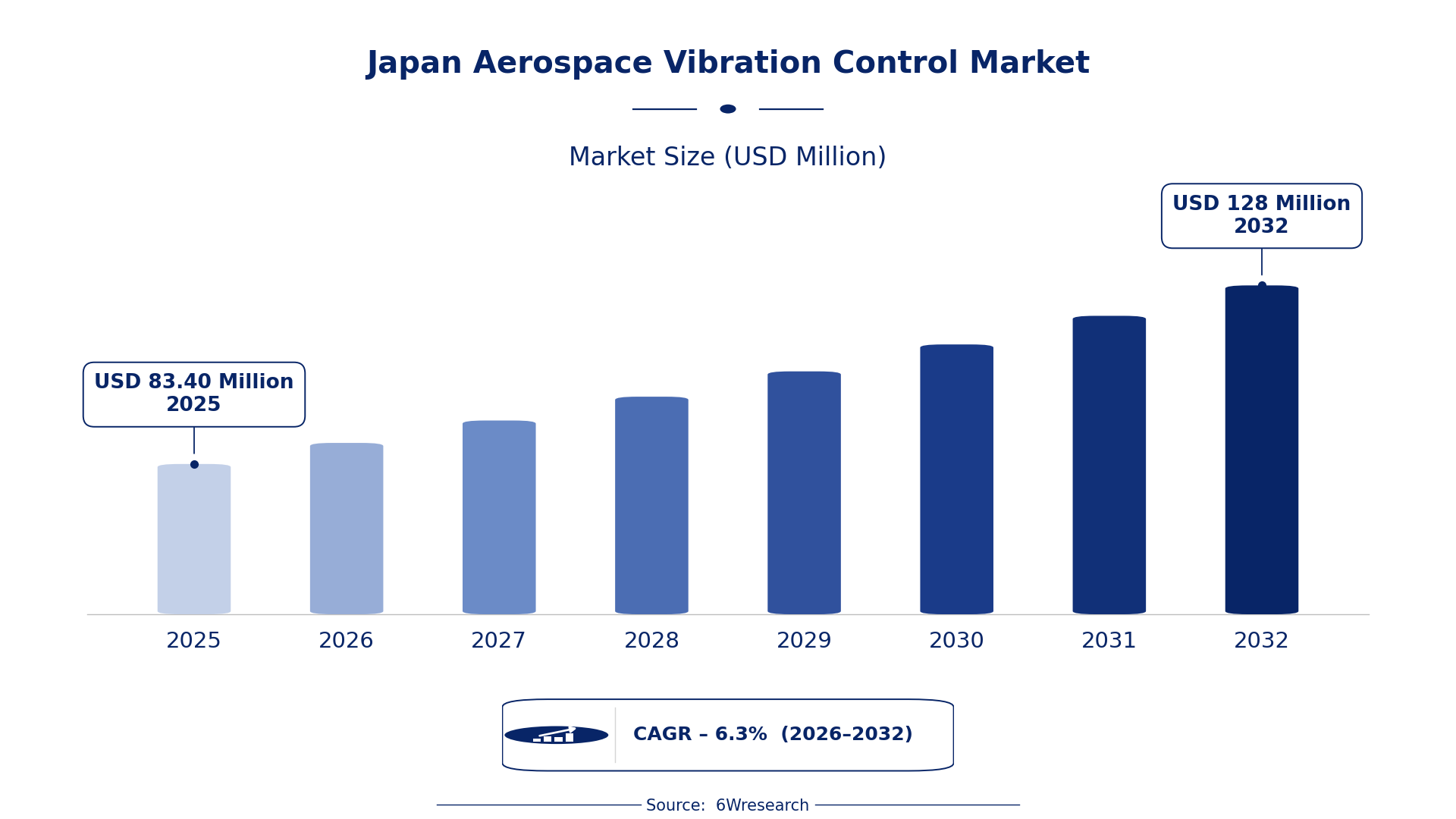
According to 6Wresearch internal database and industry insights, the Japan Aerospace Vibration Control Market was valued at USD 83.40 Million in 2025 and is projected to reach USD 128 Million by 2032, growing at a CAGR of approximately 6.3% during 2026–2032.
Japan Aerospace Vibration Control Market Highlights
| Report Metric | Details |
| Report Name | Japan Aerospace Vibration Control Market (2026-2032) |
| Market Size 2025 | USD 83.40 Million |
| Market Size 2032 | USD 128 Million |
| Absolute Growth 2025–2032 | USD 44.60 Million |
| CAGR 2026–2032 | 6.3% |
| Peak Annual Growth | 7.3% in 2026 |
| Forecast Period | 2026–2032 |
| Historical Data | 2022–2025 |
| Base Year | 2025 |
| Leading Vibration Control, 2025 | Dampers (37% share) |
| Leading Product Type, 2025 | Hydraulic (41% share) |
| Leading Technology, 2025 | Active Control (45% share) |
| Leading Distribution Channel, 2025 | Direct Sales (42% share) |
| Leading End User, 2025 | Aircraft Engines (41% share) |
| Fastest-Growing Vibration Control | Pads & Bushings (8.2% CAGR) |
| Fastest-Growing Product Type | Composite Materials (8.9% CAGR) |
| Fastest-Growing Distribution Channel | Distributors (8.0% CAGR) |
| Fastest-Growing End User | Spacecraft Components (8.1% CAGR) |
| Growing Sector | Aerospace |
| Key End Users | Aircraft Manufacturers, Defense Contractors, Aerospace Component Suppliers |
Japan Aerospace Vibration Control Market Year-wise Growth Rate and Key Drivers (2022–2032)
This graph illustrates the annual growth rates of the market from 2022 to 2032, highlighting a steady upward trajectory and projected market expansion over the forecast period.
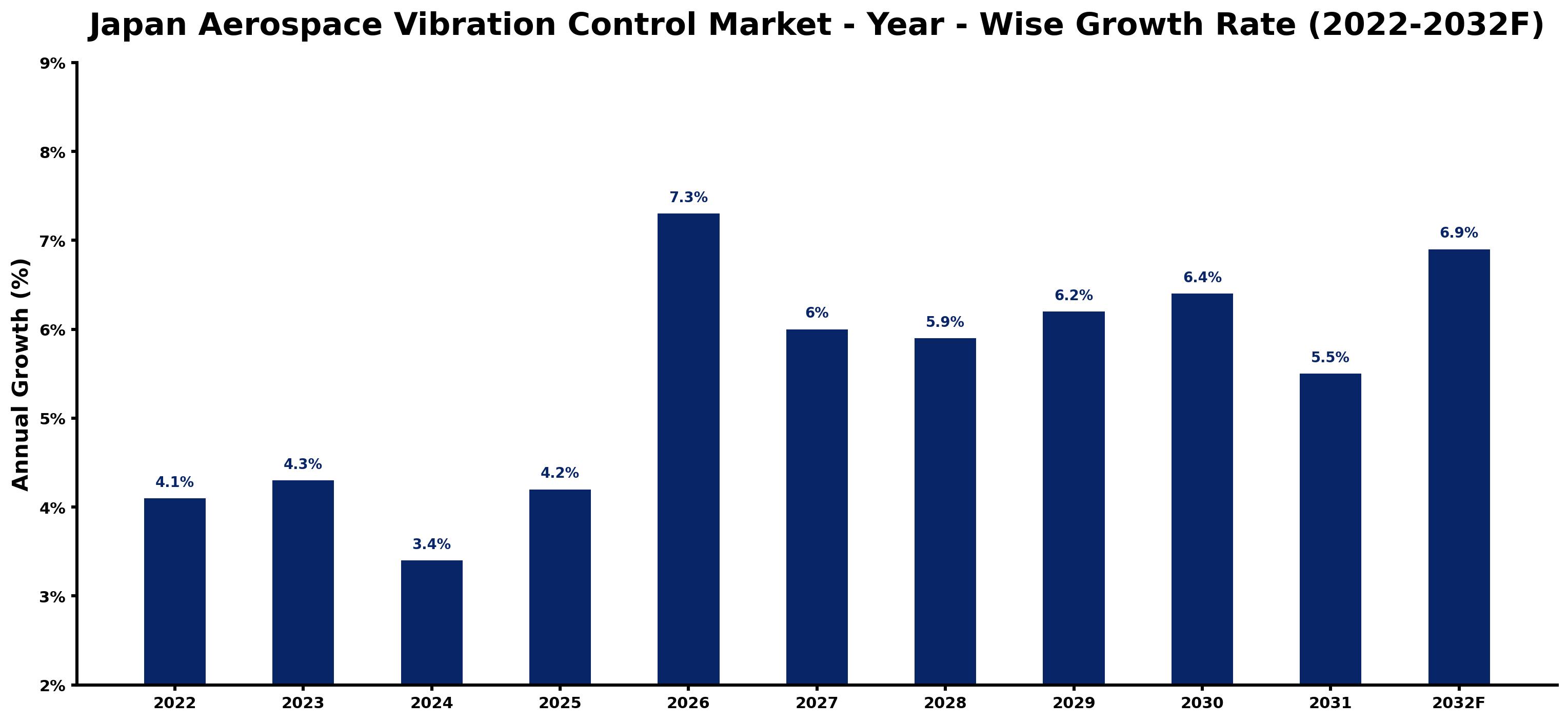
The following figures match every annual growth estimate with the main market development of that year, giving the reasoning behind each rise or slowdown.
| Year | Estimated Annual Growth (%) | Market Rationale |
| 2022 | 4.1 | The market showed steady growth, reflecting ongoing aerospace projects and investments. |
| 2023 | 4.3 | Growth was supported by increased demand for advanced vibration control technologies. |
| 2024 | 3.4 | Growth slowed as some projects faced delays and budget adjustments. |
| 2025 | 4.2 | Demand rose again due to renewed investments in aerospace innovation. |
| 2026 | 7.3 | Growth is expected to peak as major defense contracts are awarded, boosting vibration control needs. |
| 2027 | 6.0 | A slowdown is projected as the market stabilises following rapid expansion in 2026. |
| 2028 | 5.9 | The market is expected to continue growing, driven by ongoing aerospace development initiatives. |
| 2029 | 6.2 | Growth is projected to accelerate as new aircraft designs incorporate advanced vibration control. |
| 2030 | 6.4 | Demand is expected to increase further with rising investments in defense aircraft projects. |
| 2031 | 5.5 | Growth is projected to slow as the market adjusts to previous peaks in demand. |
| 2032 | 6.9 | The market is expected to grow as new technologies gain traction and funding increases. |
Note: Market size estimations and growth projections presented in this report are based on 6Wresearch's proprietary forecasting methodology, utilizing the latest available industry data, government publications, and primary research inputs.
Japan Aerospace Vibration Control Market Synopsis
Aerospace vibration control products are critical technologies that reduce vibrations in aircraft and spacecraft, ensuring safety and comfort during flight. The Japan Aerospace Vibration Control Market is growing due to increased defence spending and ongoing advancements in aerospace technology. With over 80,000 employees in the aerospace sector and robust support from the Ministry of Economy, Trade and Industry, demand is fuelled by both domestic manufacturers and international collaborations, particularly in active vibration control systems, which feature in over 60% of new aircraft designs and improve overall performance.
Market Dynamics Impact Analysis (2026–2032)
| Factor | Type | Impact | Primary Segment Affected |
| Increased defense spending drives demand for advanced vibration control solutions. | Driver | High | Dampers |
| The rise in new aircraft designs necessitates effective vibration management technologies. | Driver | High | Active Control |
| Growing interest in lightweight materials opens opportunities for innovative vibration control solutions. | Opportunity | High | Composite Materials |
| The expansion of aerospace startups in the Tokyo region creates demand for specialized vibration control products. | Opportunity | Medium | Pads & Bushings |
| High production costs limit the profitability of vibration control technologies. | Restraint | High | Hydraulic |
| The complexity of integrating new technologies can delay project timelines. | Restraint | Medium | Isolators |
| Limited skilled workforce affects production capacity in the aerospace sector. | Challenge | High | Mounts |
| Stringent regulatory requirements can complicate product certification processes. | Challenge | Medium | Noise & Vibration Reduction |
Evaluation of Drivers in Japan Aerospace Vibration Control Market (2026–2032)
Demand rests on the following drivers, each shown with the segment it touches most.
| Drivers | Primary Segment Affected | Why It Matters (Evidence) |
| Increased defense contracts boost demand for vibration control technologies. | Dampers | The Japanese government allocated ¥10 billion for aerospace technology development in 2023, increasing procurement for military aircraft. |
| The adoption of advanced materials is reshaping vibration control applications. | Composite Materials | Composite materials are increasingly used in lightweight aircraft applications, improving fuel efficiency and performance in new designs. |
| Growing aerospace projects in the Tokyo region drive innovation. | Active Control | The Tokyo Aerospace and Defense Industry Association promotes technology advancements, leading to higher demand for active systems in new aircraft. |
| Rising passenger expectations for comfort necessitate better vibration solutions. | Noise & Vibration Reduction | Active vibration control systems are used in over 60% of new aircraft designs, enhancing passenger experience and safety. |
| Investment in research and development fuels technology advancements. | Hydraulic | Hydraulic systems are prevalent in 75% of aircraft vibration control applications, driving ongoing innovation and efficiency. |
Several shifts outside the market lift sales. The aerospace sector is seeing a rise in projects that promote active control systems, which are present in over 60% of new aircraft designs. The growing use of composite materials in lightweight aircraft applications is improving fuel efficiency, while rising passenger expectations for comfort are increasing the need for effective noise and vibration reduction technologies.
Evaluation of Restraints in Japan Aerospace Vibration Control Market
Several factors work against faster growth; the main ones are summarised below.
| Market Restraint | Primary Segment Affected | Why It Matters (Evidence) |
| High production costs limit the profitability of vibration control technologies. | Hydraulic | Production costs for hydraulic systems are elevated, impacting pricing strategies for manufacturers. |
| The complexity of integrating new technologies can delay project timelines. | Isolators | Integrating advanced isolators into existing designs often requires extensive testing and validation, leading to longer project durations. |
| Limited skilled workforce affects production capacity in the aerospace sector. | Mounts | A shortage of qualified personnel in the aerospace industry restricts the ability to scale production, delaying project completions. |
| Regulatory requirements can complicate product certification processes. | Noise & Vibration Reduction | Compliance with JIS standards for aerospace products can lead to extended certification timelines, impacting market entry for new technologies. |
| Market fluctuations can impact investment in new technologies. | Pads & Bushings | Economic uncertainties may cause delays in funding for new vibration control projects, affecting innovation. |
Japan Aerospace Vibration Control Market Challenges
Active vibration control systems are essential in new aircraft designs, but fierce competition among local manufacturers drives down prices, limiting profit margins and hindering innovation for buyers. A shortage of skilled aerospace engineers constrains the workforce's ability to meet increasing demand, causing project delays for producers. Rapid technological advancements require frequent updates to existing systems, leading to additional costs for suppliers who must invest in new materials and training. Supply chain disruptions in sourcing silicone materials for vibration isolation products can delay production schedules, impacting delivery times for manufacturers and clinics.
Trends in the Japan Aerospace Vibration Control Market
The trends below show where the Japan Aerospace Vibration Control Market is heading.
- Shift from Passive to Active Vibration Control: The trend towards active vibration control systems began in 2023, with over 60% of new aircraft designs adopting this technology. This shift improves safety and comfort, prompting manufacturers to invest in advanced solutions that enhance overall performance.
- Increased Use of Composite Materials: Since 2020, the aerospace industry has seen a rise in the use of composite materials for lightweight applications. This change improves fuel efficiency and performance, with composite materials now prevalent in many new designs, reflecting a move towards sustainability.
- Expansion of Aerospace Startups in Tokyo: The Tokyo region has experienced a 15% increase in aerospace startups since 2020, driving innovation in vibration control technologies. This growth indicates a vibrant environment for new product development, boosting competition and technological advancement.
- Growing Focus on Noise Reduction Technologies: From 2023, there has been a notable emphasis on noise and vibration reduction technologies in aircraft design. This focus is driven by rising passenger expectations for comfort and safety, leading to increased investments in advanced solutions.
Investment Opportunities in the Japan Aerospace Vibration Control Market
The opportunities below stand out in the Japan Aerospace Vibration Control Market for new entrants and existing suppliers.
- Partnerships with Aerospace Startups: Now is an ideal time to collaborate with emerging aerospace startups in Tokyo, where a 15% increase has been noted. Partnering can lead to effective vibration control solutions that meet new market demands and enhance competitive advantage.
- Investment in Lightweight Technologies: With the aerospace market projected to grow, investing in composite materials for vibration control is timely. The demand from aircraft manufacturers for lightweight solutions is increasing, presenting a strong opportunity for suppliers.
- Expansion into Defense Projects: The increase in defence aircraft projects presents opportunities for suppliers to provide advanced vibration control solutions. Engaging with military procurement channels can yield substantial contracts and enhance market presence.
- Development of Online Sales Channels: As online sales of aerospace components are growing, establishing a strong online presence can capture new customers. This approach is particularly relevant for specialised vibration control products, offering a direct sales avenue.
Government Initiatives in the Japan Aerospace Vibration Control Market
The Electrical Appliance and Material Safety Act of 1961 regulates the safety of materials used in aerospace applications. This law ensures that all vibration control products meet strict safety standards, protecting manufacturers and consumers alike. Additionally, the Industrial Safety and Health Act of 1972 mandates employer responsibilities regarding hazardous materials, influencing production practices in the aerospace sector and ensuring compliance with safety regulations.
The Aerospace Research and Development Agency focuses on funding projects related to vibration control technologies. This agency supports initiatives that improve the safety and performance of aerospace products, approving grants for research and development efforts that enhance the capabilities of vibration control systems.
Future Insight of the Japan Aerospace Vibration Control Market
By 2032, new aerospace research facilities will emerge, backed by ¥10 billion in government funding and industry partnerships. The Aerospace Research and Development Agency will prioritise advancements in vibration control technologies, improving safety and reliability in aircraft. Japan's aerospace market will see a 20% increase in investment in vibration control systems, underscoring the importance of these technologies. The Tokyo region will continue to support aerospace startups, creating a dynamic environment for technological collaboration and growth.
Market Segmentation Analysis
Japan Aerospace Vibration Control Market report covers a detailed analysis of the following market segments:
By Vibration Control – Dampers Lead, Pads & Bushings Expected to Grow Fastest
According to Saurav Kr Singh, Senior Research Analyst at 6Wresearch, the largest vibration control category in 2025 was Dampers, at 37% of revenue. Dampers dominate the market due to their essential role in absorbing vibrations within aircraft structures, which significantly enhances flight safety and performance. Their integration in over 60% of new aircraft designs underscores their critical importance in aerospace vibration control technologies. Pads & Bushings are set to record the highest CAGR in this split, 8.2% over 2026–2032. Pads and bushings are rapidly gaining traction as they are increasingly utilised to cushion and isolate vibrations across various applications, reflecting a shift towards versatile vibration control solutions. The 20% increase in investment for defense aircraft projects has further accelerated the demand for these components. Suppliers should consider expanding their product lines to include pads and bushings to capitalise on the growing market demand.
By Product Type – Hydraulic Leads, Composite Materials Expected to Grow Fastest
Hydraulic took 41% of product type revenue in 2025, more than any other category. Hydraulic systems lead the market owing to their extensive use in active vibration control systems, ensuring dependable performance in aerospace applications. Their prevalence in 75% of aircraft vibration control applications highlights their fundamental role in the industry. Composite Materials are projected to grow fastest, at a CAGR of 8.9% during 2026–2032. Composite materials are witnessing rapid growth as they are increasingly employed in lightweight aircraft designs, which are becoming more popular. The ongoing trend towards reducing aircraft weight is driving the demand for these advanced materials. Buyers should explore the potential benefits of incorporating composite materials to enhance the efficiency of their aerospace projects.
By Technology – Active Control Leads and Records the Fastest Growth
Active Control accounted for 45% of the market by technology in 2025. Active control technology leads the market as it is employed for real-time vibration management in aircraft, ensuring optimal performance and safety. Its integration into modern aircraft designs has become a standard, reflecting its importance in the industry. The same category is also set to grow fastest, at a CAGR of 8.8% during 2026–2032. The continued focus on active control technology for vibration management ensures that its growth rate remains strong, as it meets the evolving demands of aerospace applications. As the leader, its advancements will likely widen its market share further. Suppliers should prioritise innovation in active control technologies to maintain competitiveness in the market.
By Distribution Channel – Direct Sales Leads, Distributors Expected to Grow Fastest
With 42% of distribution channel revenue in 2025, Direct Sales was the largest category. Direct sales are the primary channel for specialised aerospace products, allowing manufacturers to cultivate strong relationships with clients and tailor solutions effectively. This channel's ability to reach niche markets solidifies its leading role in the distribution framework. The quickest growth will come from Distributors, forecast to expand at a CAGR of 8.0% between 2026 and 2032. Distributors are becoming increasingly vital as they provide access to a broader range of aerospace manufacturers, thereby enhancing market reach. This trend is exemplified by the growing number of aerospace startups in the Tokyo region. Suppliers should focus on building strategic partnerships with distributors to improve their market access.
By End User – Aircraft Engines Lead, Spacecraft Components Expected to Grow Fastest
In 2025, Aircraft Engines led the end user split with a 41% share. Aircraft engines constitute the largest application area for vibration control technologies, necessitating robust solutions to ensure operational safety and efficiency. This segment's critical role within the aerospace industry reinforces its leading position in the market. Spacecraft Components are set to record the highest CAGR in this split, 8.1% over 2026–2032. Spacecraft components are experiencing the fastest growth as they are crucial for ensuring functionality and safety during space missions. Increased funding for aerospace technology development is supporting this upward trend. Buyers should prioritise sourcing vibration control solutions specifically tailored for spacecraft components to ensure mission reliability.
Key Attractiveness of the Report
- 10 Years of Market Numbers
- Historical Data Starting from 2022 to 2025
- Base Year 2025
- Forecast Data until 2032
- Key Performance Indicators Impacting the Market
- Major Upcoming Developments and Projects
Key Highlights of the Report:
- Japan Aerospace Vibration Control Market Outlook
- Market Size of Japan Aerospace Vibration Control Market, 2025
- Forecast of Japan Aerospace Vibration Control Market, 2032
- Historical Data and Forecast of Japan Aerospace Vibration Control Revenues & Volume for the Period 2022-2032F
- Japan Aerospace Vibration Control Market Trend Evolution
- Japan Aerospace Vibration Control Market Drivers and Challenges
- Japan Aerospace Vibration Control Price Trends
- Japan Aerospace Vibration Control Porter's Five Forces
- Japan Aerospace Vibration Control Industry Life Cycle
- Historical Data and Forecast of Japan Aerospace Vibration Control Market Revenues & Volume By Vibration Control for the Period 2022-2032F
- Historical Data and Forecast of Japan Aerospace Vibration Control Market Revenues & Volume By Dampers for the Period 2022-2032F
- Historical Data and Forecast of Japan Aerospace Vibration Control Market Revenues & Volume By Isolators for the Period 2022-2032F
- Historical Data and Forecast of Japan Aerospace Vibration Control Market Revenues & Volume By Mounts for the Period 2022-2032F
- Historical Data and Forecast of Japan Aerospace Vibration Control Market Revenues & Volume By Pads & Bushings for the Period 2022-2032F
- Historical Data and Forecast of Japan Aerospace Vibration Control Market Revenues & Volume By Product Type for the Period 2022-2032F
- Historical Data and Forecast of Japan Aerospace Vibration Control Market Revenues & Volume By Hydraulic for the Period 2022-2032F
- Historical Data and Forecast of Japan Aerospace Vibration Control Market Revenues & Volume By Rubber/Metallic for the Period 2022-2032F
- Historical Data and Forecast of Japan Aerospace Vibration Control Market Revenues & Volume By Composite Materials for the Period 2022-2032F
- Historical Data and Forecast of Japan Aerospace Vibration Control Market Revenues & Volume By Silicone/Polymer for the Period 2022-2032F
- Historical Data and Forecast of Japan Aerospace Vibration Control Market Revenues & Volume By Technology for the Period 2022-2032F
- Historical Data and Forecast of Japan Aerospace Vibration Control Market Revenues & Volume By Active Control for the Period 2022-2032F
- Historical Data and Forecast of Japan Aerospace Vibration Control Market Revenues & Volume By Passive Vibration Tech for the Period 2022-2032F
- Historical Data and Forecast of Japan Aerospace Vibration Control Market Revenues & Volume By Shock Absorbing for the Period 2022-2032F
- Historical Data and Forecast of Japan Aerospace Vibration Control Market Revenues & Volume By Noise & Vibration Reduction for the Period 2022-2032F
- Historical Data and Forecast of Japan Aerospace Vibration Control Market Revenues & Volume By Distribution Channel for the Period 2022-2032F
- Historical Data and Forecast of Japan Aerospace Vibration Control Market Revenues & Volume By Direct Sales for the Period 2022-2032F
- Historical Data and Forecast of Japan Aerospace Vibration Control Market Revenues & Volume By Online Platforms for the Period 2022-2032F
- Historical Data and Forecast of Japan Aerospace Vibration Control Market Revenues & Volume By Distributors for the Period 2022-2032F
- Historical Data and Forecast of Japan Aerospace Vibration Control Market Revenues & Volume By OEMs for the Period 2022-2032F
- Historical Data and Forecast of Japan Aerospace Vibration Control Market Revenues & Volume By End User for the Period 2022-2032F
- Historical Data and Forecast of Japan Aerospace Vibration Control Market Revenues & Volume By Aircraft Engines for the Period 2022-2032F
- Historical Data and Forecast of Japan Aerospace Vibration Control Market Revenues & Volume By Spacecraft Components for the Period 2022-2032F
- Historical Data and Forecast of Japan Aerospace Vibration Control Market Revenues & Volume By Defense Aircraft for the Period 2022-2032F
- Historical Data and Forecast of Japan Aerospace Vibration Control Market Revenues & Volume By Rotorcraft for the Period 2022-2032F
- Japan Aerospace Vibration Control Import Export Trade Statistics
- Market Opportunity Assessment By Vibration Control
- Market Opportunity Assessment By Product Type
- Market Opportunity Assessment By Technology
- Market Opportunity Assessment By Distribution Channel
- Market Opportunity Assessment By End User
- Japan Aerospace Vibration Control Top Companies Market Share
- Japan Aerospace Vibration Control Competitive Benchmarking By Technical and Operational Parameters
- Japan Aerospace Vibration Control Company Profiles
- Japan Aerospace Vibration Control Key Strategic Recommendations
Market Covered
Coverage by segment is as follows.
By Vibration Control
- Dampers
- Isolators
- Mounts
- Pads & Bushings
By Product Type
- Hydraulic
- Rubber/Metallic
- Composite Materials
- Silicone/Polymer
By Technology
- Active Control
- Passive Vibration Tech
- Shock Absorbing
- Noise & Vibration Reduction
By Distribution Channel
- Direct Sales
- Online Platforms
- Distributors
- OEMs
By End User
- Aircraft Engines
- Spacecraft Components
- Defense Aircraft
- Rotorcraft






































