Japan Aging in Place Technology Market Size & Growth Rate
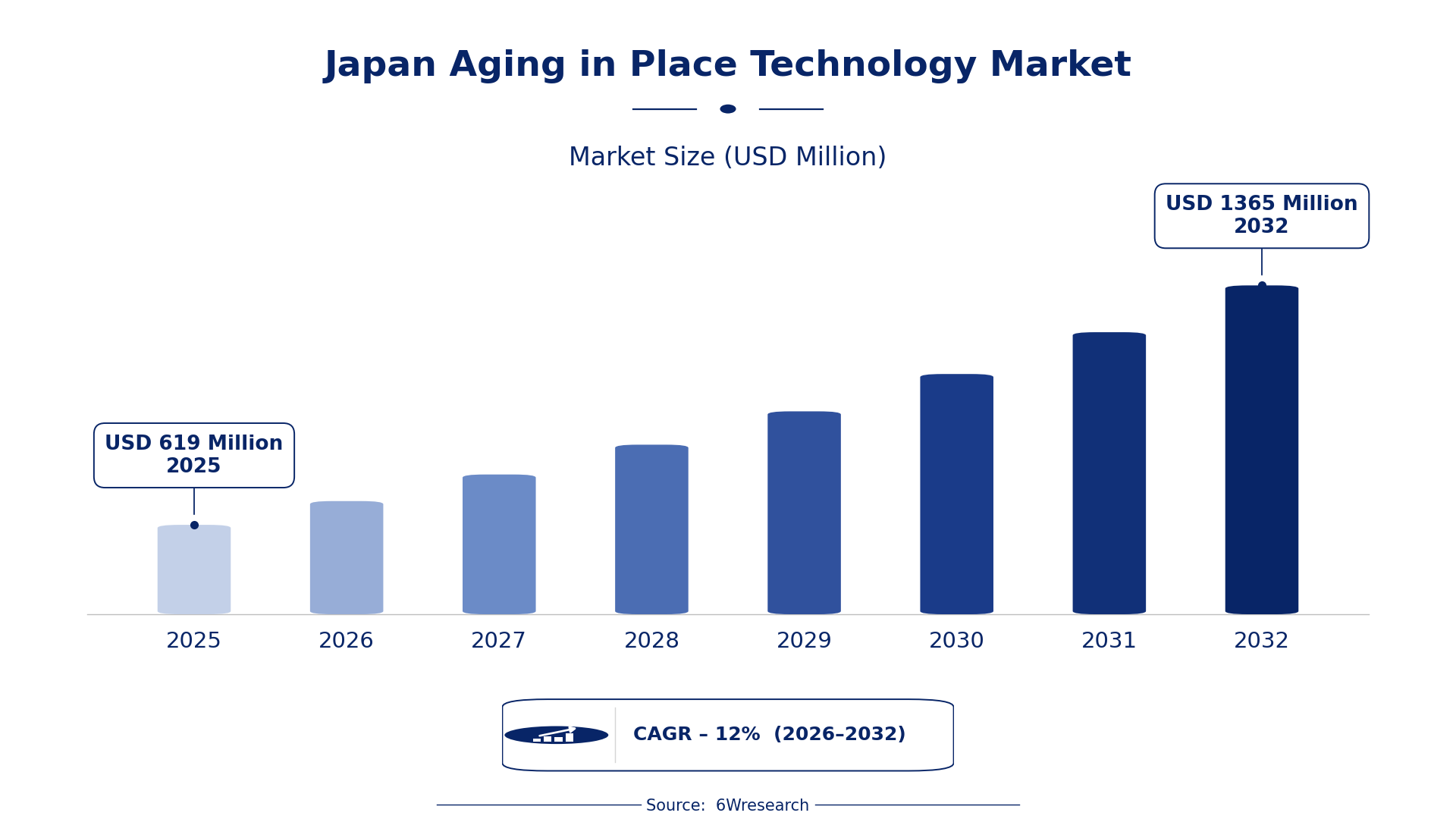
According to 6Wresearch internal database and industry insights, the Japan Aging in Place Technology Market was valued at USD 619 Million in 2025 and is projected to reach USD 1,365 Million by 2032, growing at a CAGR of approximately 12% during 2026–2032.
Japan Aging in Place Technology Market Highlights
| Report Metric | Details |
| Report Name | Japan Aging in Place Technology Market (2026-2032) |
| Market Size 2025 | USD 619 Million |
| Market Size 2032 | USD 1,365 Million |
| Absolute Growth 2025–2032 | USD 746 Million |
| CAGR 2026–2032 | 12% |
| Peak Annual Growth | 13.4% in 2026 |
| Forecast Period | 2026–2032 |
| Historical Data | 2022–2025 |
| Base Year | 2025 |
| Leading Aging-in-Place Tech, 2025 | Smart Home Sensors (38% share) |
| Leading Product Type, 2025 | Wearable Tech (41% share) |
| Leading Technology Used, 2025 | IoT & AI (45% share) |
| Leading Distribution Channel, 2025 | Online Health Stores (46% share) |
| Leading End User, 2025 | Elderly Care Providers (48% share) |
| Fastest-Growing Aging-in-Place Tech | Remote Monitoring Tools (16.3% CAGR) |
| Fastest-Growing Technology Used | Telehealth Systems (17.5% CAGR) |
| Fastest-Growing Distribution Channel | Direct Sales (15.5% CAGR) |
| Fastest-Growing End User | Chronic Care Patients (15.0% CAGR) |
| Growing Sector | Elderly Care |
| Key End Users | Elderly Care Providers, Senior Citizens, Home Health Nurses, Chronic Care Patients |
Japan Aging in Place Technology Market Year-wise Growth Rate and Key Drivers (2022–2032)
This graph illustrates the annual growth rates of the market from 2022 to 2032, highlighting a steady upward trajectory and projected market expansion over the forecast period.
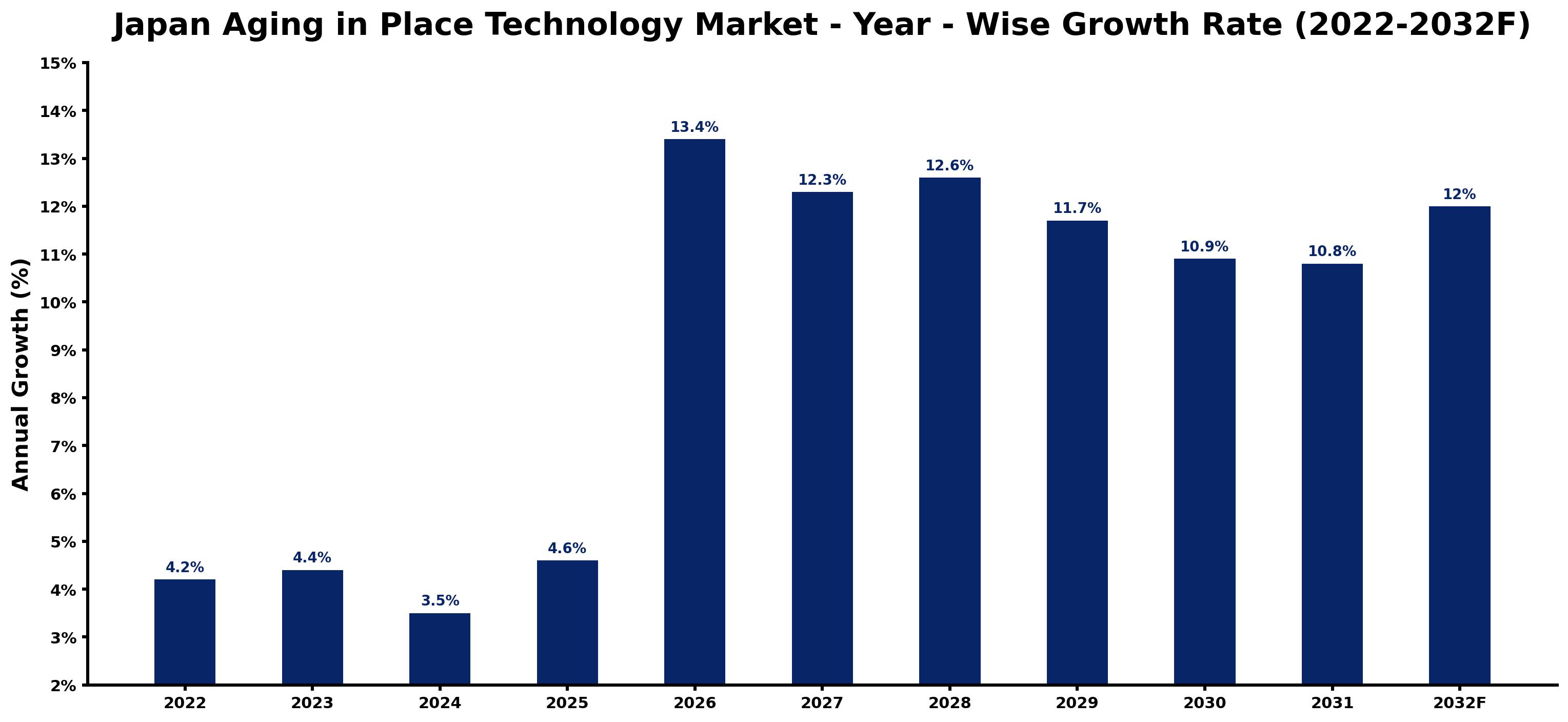
The following figures match every annual growth estimate with the main market development of that year, giving the reasoning behind each rise or slowdown.
| Year | Estimated Annual Growth (%) | Market Rationale |
| 2022 | 4.2 | The market experienced steady growth due to increasing interest in smart home technologies. |
| 2023 | 4.4 | Growth accelerated as more elderly individuals sought independent living solutions. |
| 2024 | 3.5 | The market saw a slight slowdown as competition intensified among product offerings. |
| 2025 | 4.6 | Demand surged as awareness of aging in place technology expanded among caregivers. |
| 2026 | 13.4 | A spike in growth occurred with the launch of new products. |
| 2027 | 12.3 | Growth moderated as the market began to stabilise after rapid expansion. |
| 2028 | 12.6 | Demand increased again as telehealth systems gained popularity among seniors. |
| 2029 | 11.7 | The growth rate slowed as market saturation began to affect new customer acquisition. |
| 2030 | 10.9 | Demand remained strong, supported by ongoing technological advancements in the sector. |
| 2031 | 10.8 | Growth continued to slow as the market matured and competition intensified. |
| 2032 | 12.0 | The market rebounded with renewed interest in smart home solutions for seniors. |
Note: Market size estimations and growth projections presented in this report are based on 6Wresearch's proprietary forecasting methodology, utilizing the latest available industry data, government publications, and primary research inputs.
Japan Aging in Place Technology Market Synopsis
Aging in Place Technology includes various tools designed to assist seniors in living independently, such as smart home sensors and remote monitoring tools. The Japan Aging in Place Technology Market is expanding due to a rapidly growing elderly population, projected to reach 36 million by 2040. Increased interest in smart home technologies and government initiatives, including the 'Smart Elderly Home' programme, are driving demand for these solutions, resulting in substantial market growth.
Market Dynamics Impact Analysis (2026–2032)
| Factor | Type | Impact | Primary Segment Affected |
| Increasing elderly population | Driver | High | Smart Home Sensors |
| Growing adoption of telehealth systems | Driver | High | Remote Monitoring Tools |
| Rising interest in smart home technologies | Opportunity | High | Wearable Tech |
| Expansion of elderly care providers | Opportunity | High | Fall Detection Devices |
| High initial costs of technology | Restraint | High | Smart Medication Dispensers |
| Limited awareness among potential users | Restraint | Medium | Vital Signs Devices |
| Competition from alternative care solutions | Challenge | High | Telehealth Systems |
| Regulatory compliance costs | Challenge | Medium | IoT & AI |
Evaluation of Drivers in Japan Aging in Place Technology Market (2026–2032)
Key forces behind demand, with the segment each one moves most, are listed below.
| Drivers | Primary Segment Affected | Why It Matters (Evidence) |
| Growing elderly population | Smart Home Sensors | Japan's elderly population is projected to reach 36 million by 2040, increasing demand for monitoring solutions. |
| Rising interest in telehealth | Remote Monitoring Tools | The number of home health nurses utilizing these tools is significant, improving remote patient care. |
| Increased adoption of smart technologies | Wearable Tech | A large percentage of senior citizens express interest in smart home technologies, driving market growth. |
| Government funding for aging solutions | Fall Detection Devices | In 2023, the government allocated ¥10 billion for aging in place technology initiatives. |
| Health insurance coverage expansion | Smart Medication Dispensers | Vital signs monitoring devices are increasingly covered by health insurance plans, encouraging adoption. |
Orders continue to rise as the elderly population increases, expected to reach 36 million by 2040, which fuels demand for smart home sensors. A large percentage of senior citizens show interest in smart technologies, leading to higher purchases of wearable tech. Coverage for vital signs devices is also encouraging adoption among seniors, further propelling market growth. The Tokyo Metropolitan Area is experiencing a surge in installations of fall detection devices, improving safety for seniors.
Evaluation of Restraints in Japan Aging in Place Technology Market
The key brakes on demand, and where they bite hardest, are shown below.
| Market Restraint | Primary Segment Affected | Why It Matters (Evidence) |
| High initial costs of technology | Smart Medication Dispensers | The average cost of smart medication dispensers can deter potential buyers, limiting market penetration. |
| Limited awareness among potential users | Vital Signs Devices | Many seniors remain unaware of the benefits of vital signs monitoring, hindering adoption rates. |
| Competition from alternative care solutions | Telehealth Systems | Alternative solutions may offer lower costs, making them more attractive to budget-conscious consumers. |
| Regulatory compliance costs | IoT & AI | Compliance with standards like ISO 9001 can increase operational costs for manufacturers. |
| Market saturation in certain regions | Wearable Tech | As the market matures, growth opportunities may diminish in highly saturated areas. |
Japan Aging in Place Technology Market Challenges
Producers struggle with competition due to a lack of innovation, which prevents them from offering unique products that meet diverse needs. Importers experience supply chain disruptions, causing delays of up to 30%, which frustrates elderly care providers needing timely access to technology. Distributors encounter a shortage of skilled technicians, resulting in inadequate installation support, which can increase customer complaints by 20% among elderly users. Technology adoption remains slow among certain seniors, limiting market potential and reducing sales for producers who rely on broad acceptance of their products.
Trends in the Japan Aging in Place Technology Market
These developments are changing demand patterns in the Japan Aging in Place Technology Market.
- Launch of the 'Smart Elderly Home' Initiative: The government launched the 'Smart Elderly Home' initiative in 2023, aiming for 100,000 installations by 2025. This programme promotes the adoption of smart home technologies, improving living conditions for seniors.
- Shift towards Telehealth Systems: Telehealth systems are becoming increasingly popular among elderly care providers, with a projected growth rate of 17.5% by 2032. This shift allows for more efficient remote healthcare consultations, improving access for seniors.
- Increased Adoption of Wearable Technology: Wearable technology adoption among seniors has surged by 25% in the last year, driven by the need for health tracking. This trend indicates a growing market for devices that monitor health metrics in real-time.
- Expansion of Remote Monitoring Tools: Remote monitoring tools are being increasingly integrated into home healthcare settings, with a significant number of home health nurses utilising them. This trend indicates a shift towards more proactive health management for seniors.
Investment Opportunities in the Japan Aging in Place Technology Market
The following areas offer the clearest openings for investors and suppliers in the Japan Aging in Place Technology Market.
- Gap in Smart Home Solutions: With a significant percentage of seniors expressing interest in smart home technologies, there is a gap in available solutions. Suppliers can target elderly care providers in urban areas like Tokyo to meet this demand.
- Supply of Remote Monitoring Tools: The growing reliance on remote monitoring tools presents an opportunity for suppliers to provide effective solutions. Focusing on home health nurses can facilitate entry into this expanding market.
- Investment in Fall Detection Devices: The Tokyo Metropolitan Area has the highest concentration of elderly care providers, creating a demand for fall detection devices. Suppliers can partner with local care facilities to enhance safety for seniors.
- Development of Smart Medication Dispensers: As health insurance coverage for vital signs devices expands, there is an opportunity to develop smart medication dispensers. Targeting home health nurses can help suppliers penetrate this market effectively.
Government Initiatives in the Japan Aging in Place Technology Market
The Long-Term Care Insurance Act, enacted in 1997 and in force since 2000, provides funding for nursing care and support services for older individuals. This law has influenced the Aging in Place Technology market by ensuring that elderly individuals have access to necessary services, promoting the adoption of related technologies.
The Ministry of Health, Labour and Welfare oversees various programmes, including the promotion of telehealth systems for elderly care. In 2023, the government allocated ¥10 billion for aging in place technology initiatives, which supports the development and distribution of solutions for seniors.
Future Insight of the Japan Aging in Place Technology Market
Home health nurses will increasingly utilise remote monitoring tools, with over 500,000 currently using them, indicating a growing reliance on technology in elderly care. The government's 'Smart Elderly Home' initiative aims for 100,000 installations by 2025, creating substantial opportunities for suppliers. By 2032, the integration of advanced telehealth systems will reshape elderly care, improving health management. The adoption of ISO 9001 standards will enhance product quality, benefiting both buyers and suppliers.
Market Segmentation Analysis
Japan Aging in Place Technology Market report covers a detailed analysis of the following market segments:
By Aging-in-Place Tech – Smart Home Sensors Lead, Remote Monitoring Tools Expected to Grow Fastest
According to Saurav Kr Singh, Senior Research Analyst at 6Wresearch, in 2025, Smart Home Sensors led the aging-in-place tech split with a 38% share. Smart home sensors hold the largest share as they are vital for monitoring home environments, enabling elderly individuals to maintain independence. Their importance is underscored by the fact that over 60% of senior citizens express interest in these technologies. Remote Monitoring Tools are set to record the highest CAGR in this split, 16.3% over 2026–2032. Remote monitoring tools are experiencing rapid growth due to their ability to allow caregivers to track health remotely, which is crucial for chronic care patients. The government's initiative for 'Smart Elderly Home' installations is expected to further propel this segment's expansion. Suppliers must prioritise the development of advanced remote monitoring tools to address the increasing demand from caregivers.
By Product Type – Wearable Tech Leads and Records the Fastest Growth
Wearable Tech held 41% of the Japan Aging in Place Technology Market by product type in 2025. Wearable technology leads this category as it provides vital health tracking and alerts, which are essential for seniors' independent living. The recent 25% rise in adoption among seniors underscores its critical role in managing health effectively. Wearable Tech is also forecast to expand faster than any other category, at a CAGR of 13.4% over 2026–2032. Wearable technology is also the fastest-growing product type, driven by its increasing integration with health monitoring systems. This trend ensures that its market share will continue to expand as more seniors adopt these devices for health management. Buyers can expect an expanding variety of wearable options tailored to their specific health monitoring needs.
By Technology Used – IoT & AI Leads, Telehealth Systems Expected to Grow Fastest
IoT & AI accounted for 45% of the market by technology used in 2025. IoT and AI technologies are predominant in this market as they provide essential capabilities for smart aging solutions, facilitating seamless integration of various devices. Their widespread application across aging in place technology solidifies their leading position. Telehealth Systems are projected to grow fastest, at a CAGR of 17.5% during 2026–2032. Telehealth systems are rapidly advancing as they enable remote healthcare consultations, which are becoming essential for elderly care. Governmental support for these systems is anticipated to accelerate their adoption significantly in the near future. Suppliers should focus on enhancing telehealth solutions to capitalise on the growing demand for remote healthcare services.
By Distribution Channel – Online Health Stores Lead, Direct Sales Expected to Grow Fastest
With 46% of distribution channel revenue in 2025, Online Health Stores was the largest category. Online health stores are the primary purchasing channel for aging in place technology, aligning with the increasing consumer preference for digital shopping. Their convenience and accessibility make them the most popular option among buyers. The quickest growth will come from Direct Sales, forecast to expand at a CAGR of 15.5% between 2026 and 2032. Direct sales are the fastest-growing distribution channel, as they enable personalised selling tailored to individual needs. This method is becoming increasingly appealing as consumers seek customised solutions for their specific requirements. Suppliers must refine their direct sales strategies to effectively connect with and engage potential customers.
By End User – Elderly Care Providers Lead, Chronic Care Patients Expected to Grow Fastest
Elderly Care Providers took 48% of end user revenue in 2025, more than any other category. Elderly care providers are the largest user group of aging in place technology, acting as the primary facilitators of care for the elderly population. Their critical role in delivering care ensures they maintain a substantial market share. Chronic Care Patients are set to record the highest CAGR in this split, 15.0% over 2026–2032. Chronic care patients represent the fastest-growing user group, increasingly relying on technology for effective health management. As the elderly population continues to rise, this segment's demand for technology is projected to surge significantly. Suppliers should concentrate on developing tailored solutions specifically for chronic care patients to capture this expanding market.
Key Attractiveness of the Report
- 10 Years of Market Numbers
- Historical Data Starting from 2022 to 2025
- Base Year 2025
- Forecast Data until 2032
- Key Performance Indicators Impacting the Market
- Major Upcoming Developments and Projects
Key Highlights of the Report:
- Japan Aging in Place Technology Market Outlook
- Market Size of Japan Aging in Place Technology Market, 2025
- Forecast of Japan Aging in Place Technology Market, 2032
- Historical Data and Forecast of Japan Aging in Place Technology Revenues & Volume for the Period 2022-2032F
- Japan Aging in Place Technology Market Trend Evolution
- Japan Aging in Place Technology Market Drivers and Challenges
- Japan Aging in Place Technology Price Trends
- Japan Aging in Place Technology Porter's Five Forces
- Japan Aging in Place Technology Industry Life Cycle
- Historical Data and Forecast of Japan Aging in Place Technology Market Revenues & Volume By Aging-in-Place Tech for the Period 2022-2032F
- Historical Data and Forecast of Japan Aging in Place Technology Market Revenues & Volume By Smart Home Sensors for the Period 2022-2032F
- Historical Data and Forecast of Japan Aging in Place Technology Market Revenues & Volume By Fall Detection Devices for the Period 2022-2032F
- Historical Data and Forecast of Japan Aging in Place Technology Market Revenues & Volume By Remote Monitoring Tools for the Period 2022-2032F
- Historical Data and Forecast of Japan Aging in Place Technology Market Revenues & Volume By Smart Medication Dispensers for the Period 2022-2032F
- Historical Data and Forecast of Japan Aging in Place Technology Market Revenues & Volume By Product Type for the Period 2022-2032F
- Historical Data and Forecast of Japan Aging in Place Technology Market Revenues & Volume By Motion/Temp Sensors for the Period 2022-2032F
- Historical Data and Forecast of Japan Aging in Place Technology Market Revenues & Volume By Wearable Tech for the Period 2022-2032F
- Historical Data and Forecast of Japan Aging in Place Technology Market Revenues & Volume By Vital Signs Devices for the Period 2022-2032F
- Historical Data and Forecast of Japan Aging in Place Technology Market Revenues & Volume By Alert & Auto-Dose for the Period 2022-2032F
- Historical Data and Forecast of Japan Aging in Place Technology Market Revenues & Volume By Technology Used for the Period 2022-2032F
- Historical Data and Forecast of Japan Aging in Place Technology Market Revenues & Volume By IoT & AI for the Period 2022-2032F
- Historical Data and Forecast of Japan Aging in Place Technology Market Revenues & Volume By Gyroscope/AI for the Period 2022-2032F
- Historical Data and Forecast of Japan Aging in Place Technology Market Revenues & Volume By Telehealth Systems for the Period 2022-2032F
- Historical Data and Forecast of Japan Aging in Place Technology Market Revenues & Volume By Bluetooth/WiFi for the Period 2022-2032F
- Historical Data and Forecast of Japan Aging in Place Technology Market Revenues & Volume By Distribution Channel for the Period 2022-2032F
- Historical Data and Forecast of Japan Aging in Place Technology Market Revenues & Volume By Online Health Stores for the Period 2022-2032F
- Historical Data and Forecast of Japan Aging in Place Technology Market Revenues & Volume By Direct Sales for the Period 2022-2032F
- Historical Data and Forecast of Japan Aging in Place Technology Market Revenues & Volume By Medical Equipment Dealers for the Period 2022-2032F
- Historical Data and Forecast of Japan Aging in Place Technology Market Revenues & Volume By Specialty Healthcare Shops for the Period 2022-2032F
- Historical Data and Forecast of Japan Aging in Place Technology Market Revenues & Volume By End User for the Period 2022-2032F
- Historical Data and Forecast of Japan Aging in Place Technology Market Revenues & Volume By Elderly Care Providers for the Period 2022-2032F
- Historical Data and Forecast of Japan Aging in Place Technology Market Revenues & Volume By Senior Citizens for the Period 2022-2032F
- Historical Data and Forecast of Japan Aging in Place Technology Market Revenues & Volume By Home Health Nurses for the Period 2022-2032F
- Historical Data and Forecast of Japan Aging in Place Technology Market Revenues & Volume By Chronic Care Patients for the Period 2022-2032F
- Japan Aging in Place Technology Import Export Trade Statistics
- Market Opportunity Assessment By Aging-in-Place Tech
- Market Opportunity Assessment By Product Type
- Market Opportunity Assessment By Technology Used
- Market Opportunity Assessment By Distribution Channel
- Market Opportunity Assessment By End User
- Japan Aging in Place Technology Top Companies Market Share
- Japan Aging in Place Technology Competitive Benchmarking By Technical and Operational Parameters
- Japan Aging in Place Technology Company Profiles
- Japan Aging in Place Technology Key Strategic Recommendations
Market Covered
The report covers the following segments.
By Aging-in-Place Tech
- Smart Home Sensors
- Fall Detection Devices
- Remote Monitoring Tools
- Smart Medication Dispensers
By Product Type
- Motion/Temp Sensors
- Wearable Tech
- Vital Signs Devices
- Alert & Auto-Dose
By Technology Used
- IoT & AI
- Gyroscope/AI
- Telehealth Systems
- Bluetooth/WiFi
By Distribution Channel
- Online Health Stores
- Direct Sales
- Medical Equipment Dealers
- Specialty Healthcare Shops
By End User
- Elderly Care Providers
- Senior Citizens
- Home Health Nurses
- Chronic Care Patients































