Japan Agri ERP Systems Market Size & Growth Rate
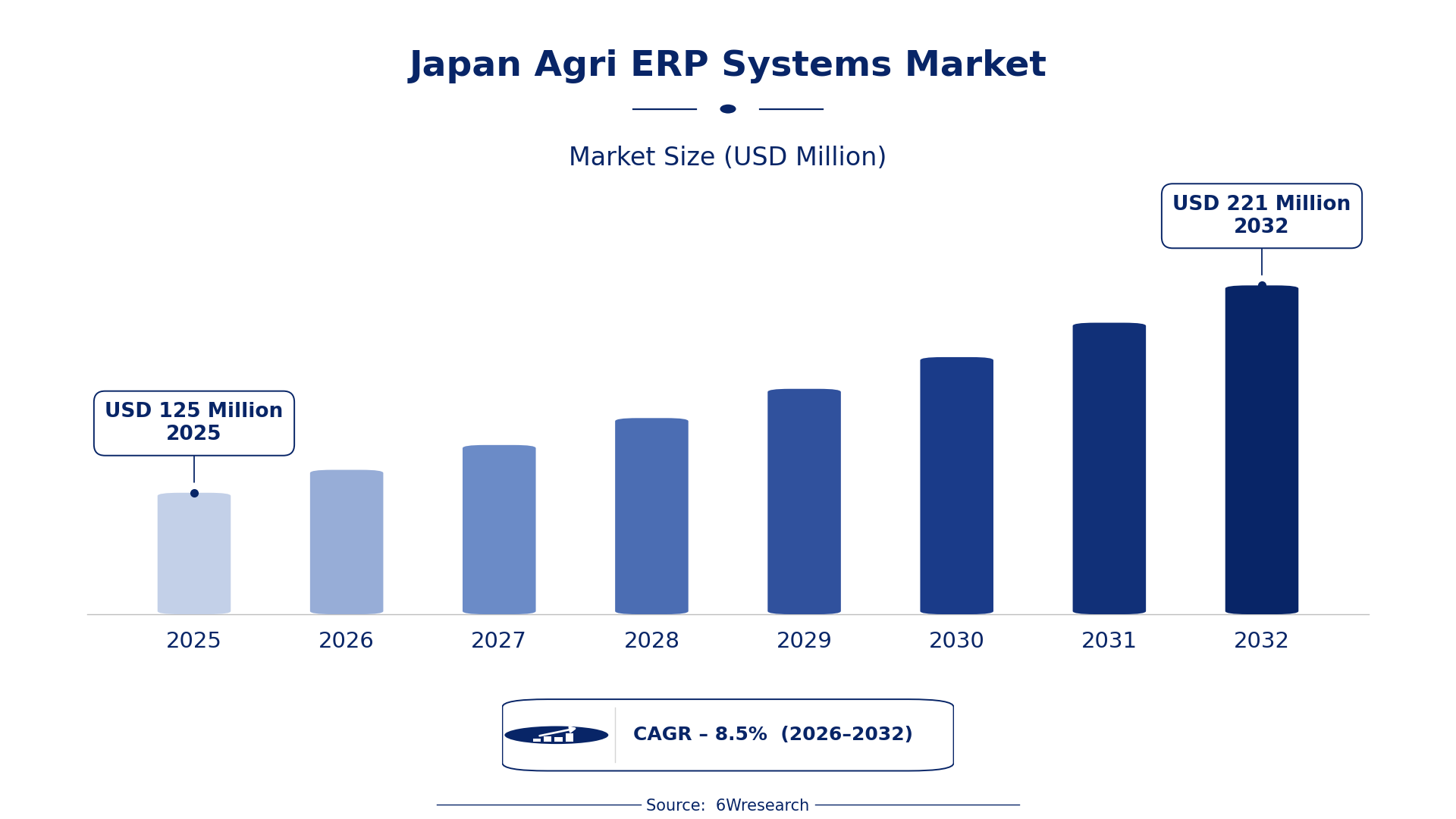
According to 6Wresearch internal database and industry insights, the Japan Agri ERP Systems Market was valued at USD 125 Million in 2025 and is projected to reach USD 221 Million by 2032, growing at a CAGR of approximately 8.5% during 2026–2032.
Japan Agri ERP Systems Market Highlights
| Report Metric | Details |
| Report Name | Japan Agri ERP Systems Market (2026-2032) |
| Market Size 2025 | USD 125 Million |
| Market Size 2032 | USD 221 Million |
| Absolute Growth 2025–2032 | USD 96 Million |
| CAGR 2026–2032 | 8.5% |
| Peak Annual Growth | 9.7% in 2026 |
| Forecast Period | 2026–2032 |
| Historical Data | 2022–2025 |
| Base Year | 2025 |
| Leading Agri ERP Systems Market, 2025 | Farm Management Software (34% share) |
| Leading Software Type, 2025 | Cloud-Based (39% share) |
| Leading Deployment Type, 2025 | SaaS Providers (40% share) |
| Leading Distribution Channel, 2025 | Contract Farmers (39% share) |
| Fastest-Growing Agri ERP Systems Market | Supply Chain ERP (11.6% CAGR) |
| Fastest-Growing Software Type | On-Premises (11.8% CAGR) |
| Fastest-Growing Deployment Type | Direct Sales (12.0% CAGR) |
| Fastest-Growing Distribution Channel | Agri Businesses (10.2% CAGR) |
| Growing Sector | Agricultural Technology |
| Key End Users | Agri Businesses, Contract Farmers, Large Farms, Agricultural Cooperatives |
Japan Agri ERP Systems Market Year-wise Growth Rate and Key Drivers (2022–2032)
This graph illustrates the annual growth rates of the market from 2022 to 2032, highlighting a steady upward trajectory and projected market expansion over the forecast period.
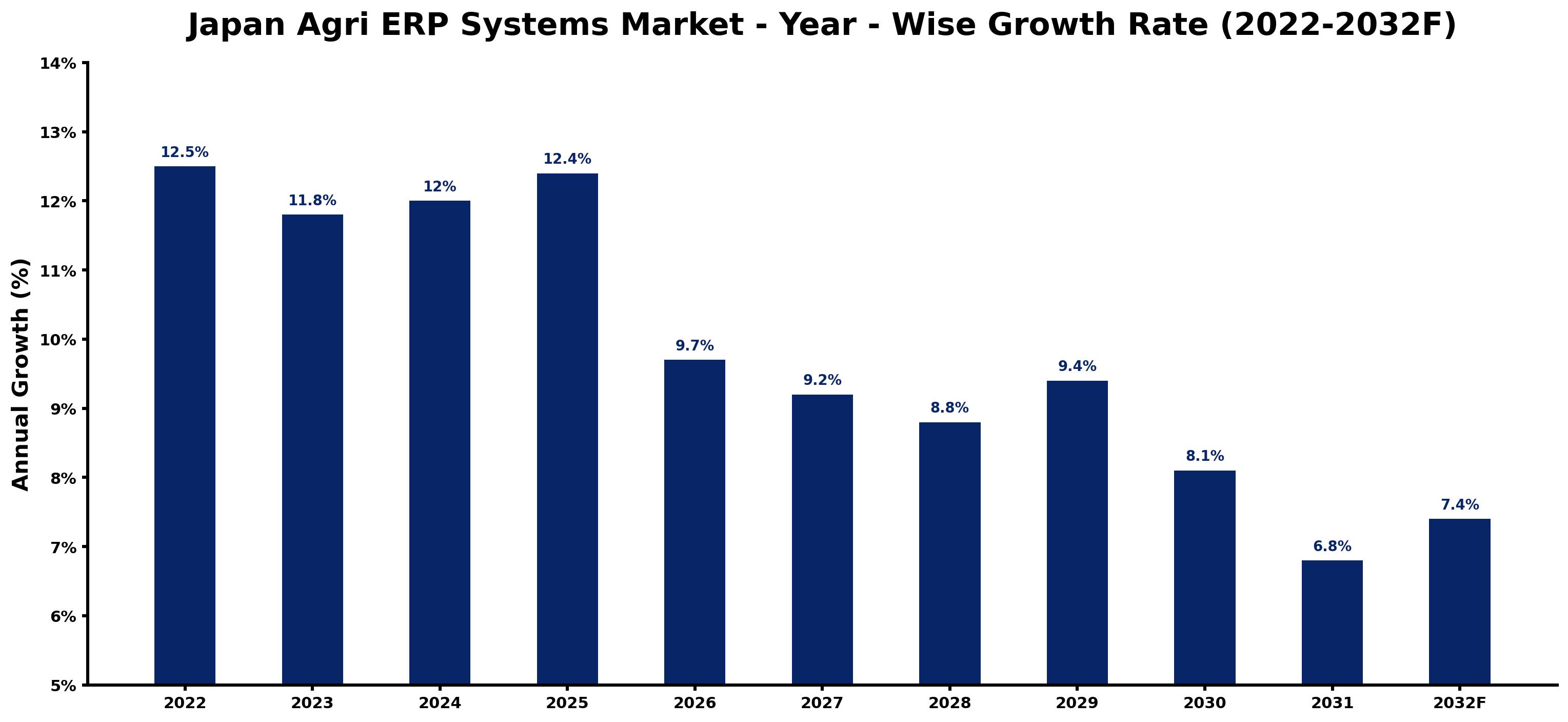
Year by year, the estimates below pair each growth rate with the development that shaped it.
| Year | Estimated Annual Growth (%) | Market Rationale |
| 2022 | 12.5 | The agricultural sector experienced strong technology adoption, boosting ERP system demand. |
| 2023 | 11.8 | Demand growth slowed as the market adjusted to previous high adoption rates. |
| 2024 | 12.0 | Increased investment in agricultural technology spurred a rebound in ERP system purchases. |
| 2025 | 12.4 | Continued emphasis on efficiency in farming operations drove further ERP adoption. |
| 2026 | 9.7 | Growth is expected to slow as the market matures, but demand will remain steady. |
| 2027 | 9.2 | A slowdown in growth is projected as market saturation occurs among larger farms. |
| 2028 | 8.8 | Technological advancements are expected to support steady demand for ERP systems. |
| 2029 | 9.4 | Renewed interest in supply chain management is projected to lead to faster growth in ERP systems. |
| 2030 | 8.1 | Market growth is expected to slow as competition intensifies among software providers. |
| 2031 | 6.8 | Demand is projected to stabilise as farmers adjust to existing ERP solutions. |
| 2032 | 7.4 | A rise in younger farmers is expected to drive new ERP system investments. |
Note: Market size estimations and growth projections presented in this report are based on 6Wresearch's proprietary forecasting methodology, utilizing the latest available industry data, government publications, and primary research inputs.
Japan Agri ERP Systems Market Synopsis
Agri ERP Systems are integrated software solutions that streamline agricultural operations, including farm management, supply chain, inventory, and accounting. The Japan Agri ERP Systems Market is expanding due to rising demand from agri businesses and contract farmers, driven by digital agriculture and precision farming initiatives. With the agricultural sector employing approximately 1.5 million people and around 1.2 million farms, investment in technology reached $1 billion in 2023, reflecting a strong trend towards modernisation and efficiency in operations.
Market Dynamics Impact Analysis (2026–2032)
| Factor | Type | Impact | Primary Segment Affected |
| Growing investment in agricultural technology is enhancing operational efficiency. | Driver | High | Farm Management Software |
| Increased adoption of Cloud-Based ERP systems is improving accessibility for users. | Driver | High | Cloud-Based |
| The ageing farmer population is creating a demand for user-friendly ERP solutions. | Opportunity | Medium | Agri Businesses |
| Rising interest in precision farming technologies is driving ERP system adoption. | Opportunity | High | Supply Chain ERP |
| High average age of farmers limits rapid technology adoption. | Restraint | High | Accounting ERP |
| Limited awareness of ERP benefits among smaller farms hampers market growth. | Restraint | Medium | Inventory ERP |
| Competition among software providers is intensifying, affecting pricing strategies. | Challenge | High | SaaS Providers |
| The need for compliance with JIS standards can delay implementation. | Challenge | Medium | Hybrid |
Evaluation of Drivers in Japan Agri ERP Systems Market (2026–2032)
The main growth drivers and the segments they affect most are set out below.
| Drivers | Primary Segment Affected | Why It Matters (Evidence) |
| Investment in agricultural technology is rising, leading to increased demand for ERP systems. | Farm Management Software | Japan's agricultural technology investment reached $1 billion in 2023, prompting more purchases. |
| Cloud-Based solutions are becoming more popular among agri businesses, improving flexibility. | Cloud-Based | Approximately 40% of agri businesses are utilising Cloud-Based ERP systems for better access. |
| The push for digital agriculture is encouraging farmers to adopt ERP systems for efficiency. | Supply Chain ERP | Digital agriculture strategies are driving demand for modern farming solutions. |
| Growing interest in precision farming technologies is driving ERP system integration. | Inventory ERP | The 2023 programme to enhance precision farming is increasing demand for inventory management solutions. |
| The need for compliance with industry standards is driving ERP system adoption. | Accounting ERP | Agri ERP systems are essential for compliance with JIS standards, ensuring operational integrity. |
What keeps demand rising is the increasing investment in agricultural technology, which reached $1 billion in 2023. This funding has led to a higher adoption rate of ERP systems, with 40% of agri businesses utilising Cloud-Based solutions for improved accessibility. Digital agriculture strategies are promoting the integration of ERP systems into farming practices, enhancing operational efficiency. The push for precision farming technologies is driving farmers to adopt advanced systems for better resource management and productivity. Compliance with JIS standards necessitates the use of Accounting ERP systems, ensuring that agricultural operations remain efficient and regulated.
Evaluation of Restraints in Japan Agri ERP Systems Market
These restraints slow adoption and weigh on supplier margins.
| Market Restraint | Primary Segment Affected | Why It Matters (Evidence) |
| The average age of farmers in Japan is 67 years, impacting technology adoption. | Accounting ERP | Older farmers may resist adopting new technology, delaying ERP implementation. |
| Limited awareness of ERP benefits among smaller farms hampers market growth. | Inventory ERP | Many small farms do not recognise the advantages of ERP systems, reducing demand. |
| Intensifying competition among software providers affects pricing strategies. | SaaS Providers | Increased competition may lead to price wars, impacting profitability for providers. |
| The need for compliance with JIS standards can delay implementation. | Hybrid | Farmers must ensure their systems meet standards, which can prolong the adoption process. |
| High costs associated with initial implementation deter some potential users. | Cloud-Based | Smaller farms may find the upfront investment in ERP systems prohibitive. |
Japan Agri ERP Systems Market Challenges
Compliance with JIS standards complicates software implementation for producers, potentially delaying project timelines by six months and disrupting farm operations. The average age of farmers at 67 years contributes to low technology adoption, with only 30% of large farms using Farm Management Software, resulting in inefficient resource management. Local producers face pressure from international agri ERP solutions, forcing price reductions that risk profit margins by 15%. Skills shortages in digital agriculture hinder the effective use of advanced technologies, leading to lower productivity for 1.5 million agricultural workers.
Trends in the Japan Agri ERP Systems Market
The following changes are redrawing the Japan Agri ERP Systems Market.
- Shift towards Precision Farming: In 2023, Japan launched a programme to enhance precision farming technologies, resulting in a notable rise in demand for ERP systems that support these advancements.
- Increasing Adoption of Cloud-Based Solutions: The trend towards Cloud-Based ERP systems is evident, with 40% of agri businesses adopting these solutions for improved flexibility and accessibility in operations.
- Growing Interest in Digital Agriculture: Digital agriculture strategies are gaining traction, resulting in a marked increase in ERP system integration among farms across Japan.
- Emphasis on Compliance with JIS Standards: As compliance with JIS standards becomes more critical, farmers are increasingly investing in ERP systems to ensure they meet regulatory requirements.
Investment Opportunities in the Japan Agri ERP Systems Market
The openings below show where demand in the Japan Agri ERP Systems Market is visible and how suppliers can enter.
- Agri Businesses Seeking Modern Solutions: Agri businesses are increasingly looking for modern ERP solutions to improve efficiency, with 40% currently utilising Cloud-Based systems, indicating a strong market for new entrants.
- Partnerships with Local Farmers: Collaborating with local farmers can facilitate the adoption of ERP systems, particularly in regions like Tokyo, where agricultural technology is advancing rapidly.
- Supply Chain Management Solutions: There is a growing need for advanced supply chain management ERP systems, particularly among agri businesses, which can lead to substantial investment opportunities.
- Investment in Training and Support Services: Investing in training and support services for ERP users can improve adoption rates, particularly among the ageing farmer population in Japan.
Government Initiatives in the Japan Agri ERP Systems Market
The Building Energy Efficiency Act (2015, amended 2022) requires all new agricultural buildings to meet energy standards, which impacts producers by necessitating compliance with modern energy-efficient practices. This law encourages the adoption of technologies, including Agri ERP systems, that can help farmers manage their operations more effectively.
The Digital Agency, established in September 2021, leads the government's digital transformation efforts, approving funding for projects that support agricultural technology. This agency provides resources for digital initiatives that improve operational efficiency and facilitate the implementation of Agri ERP systems.
Future Insight of the Japan Agri ERP Systems Market
Buyers in Japan's agricultural sector will see improved efficiency as precision farming technologies gain traction by 2032, driven by a $1 billion investment in agricultural technology. The adoption of ERP systems will rise, enhancing data accessibility for domestic users. Digital agriculture initiatives from the Ministry of Agriculture, Forestry and Fisheries will support the integration of advanced analytics into operations. As younger farmers enter the industry, technology adoption will accelerate, resulting in better financial oversight and resource management.
Market Segmentation Analysis
Japan Agri ERP Systems Market report covers a detailed analysis of the following market segments:
By Agri ERP Systems Market – Farm Management Software Leads, Supply Chain ERP Expected to Grow Fastest
According to Saurav Kr Singh, Senior Research Analyst at 6Wresearch, Farm Management Software accounted for 34% of the market by agri erp systems market in 2025. Farm Management Software holds the largest share as it is crucial for managing operations across Japan's 1.2 million farms. This software's role in optimising productivity and resource management makes it indispensable for agricultural stakeholders. Supply Chain ERP is projected to grow fastest, at a CAGR of 11.6% during 2026–2032. The Supply Chain ERP segment is experiencing rapid growth as agri businesses increasingly seek to enhance operational efficiency. The $1 billion investment in agricultural technology in Japan indicates a strong demand for integrated supply chain solutions. Suppliers should focus on developing tailored solutions for agri businesses to capitalise on this growing market.
By Software Type – Cloud-Based Leads, On-Premises Expected to Grow Fastest
Cloud-Based took 39% of software type revenue in 2025, more than any other category. Cloud-Based systems dominate the market because they offer flexibility and accessibility, appealing to a broad spectrum of agricultural users. With 40% of agri businesses adopting this model, its significance in contemporary agricultural practices is clear. On-Premises are set to record the highest CAGR in this split, 11.8% over 2026–2032. On-Premises software is experiencing swift growth as traditional farms look for dependable solutions that do not rely on internet connectivity. This trend suggests a movement among specific user groups towards more stable, localised systems. Buyers may gain advantages by considering both Cloud-Based and On-Premises options to identify the most suitable solutions for their operational requirements.
By Deployment Type – SaaS Providers Lead, Direct Sales Expected to Grow Fastest
SaaS Providers held 40% of the Japan Agri ERP Systems Market by deployment type in 2025. SaaS Providers dominate the market due to their popularity for subscription-based services that offer flexibility and cost-effectiveness. This model aligns with the needs of many agri businesses looking for scalable software solutions. The quickest growth will come from Direct Sales, forecast to expand at a CAGR of 12.0% between 2026 and 2032. Direct Sales are gaining traction as software solutions are marketed directly to end-users, improving customer engagement and support. This trend reflects a rising demand for personalised service during the purchasing process. Suppliers should refine their direct sales approaches to better meet customer needs and enhance service quality.
By Distribution Channel – Contract Farmers Lead, Agri Businesses Expected to Grow Fastest
In 2025, Contract Farmers led the distribution channel split with a 39% share. Contract Farmers represent the largest share as they are key users of ERP systems for efficient operation management. Their significant presence in Japan's agricultural sector ensures a steady demand for these solutions. Over 2026–2032, Agri Businesses are expected to post the fastest growth, at a CAGR of 10.2%. Agri Businesses are quickly adopting ERP systems to improve operational efficiency, driven by the need for competitive advantages. This trend is likely to accelerate as technology adoption continues to rise. Suppliers should aim to establish partnerships with agri businesses to broaden their market presence and support operational improvements.
Key Attractiveness of the Report
- 10 Years of Market Numbers
- Historical Data Starting from 2022 to 2025
- Base Year 2025
- Forecast Data until 2032
- Key Performance Indicators Impacting the Market
- Major Upcoming Developments and Projects
Key Highlights of the Report:
- Japan Agri ERP Systems Market Outlook
- Market Size of Japan Agri ERP Systems Market, 2025
- Forecast of Japan Agri ERP Systems Market, 2032
- Historical Data and Forecast of Japan Agri ERP Systems Revenues & Volume for the Period 2022-2032F
- Japan Agri ERP Systems Market Trend Evolution
- Japan Agri ERP Systems Market Drivers and Challenges
- Japan Agri ERP Systems Price Trends
- Japan Agri ERP Systems Porter's Five Forces
- Japan Agri ERP Systems Industry Life Cycle
- Historical Data and Forecast of Japan Agri ERP Systems Market Revenues & Volume By Agri ERP Systems Market for the Period 2022-2032F
- Historical Data and Forecast of Japan Agri ERP Systems Market Revenues & Volume By Farm Management Software for the Period 2022-2032F
- Historical Data and Forecast of Japan Agri ERP Systems Market Revenues & Volume By Supply Chain ERP for the Period 2022-2032F
- Historical Data and Forecast of Japan Agri ERP Systems Market Revenues & Volume By Inventory ERP for the Period 2022-2032F
- Historical Data and Forecast of Japan Agri ERP Systems Market Revenues & Volume By Accounting ERP for the Period 2022-2032F
- Historical Data and Forecast of Japan Agri ERP Systems Market Revenues & Volume By Software Type for the Period 2022-2032F
- Historical Data and Forecast of Japan Agri ERP Systems Market Revenues & Volume By Cloud-Based for the Period 2022-2032F
- Historical Data and Forecast of Japan Agri ERP Systems Market Revenues & Volume By On-Premises for the Period 2022-2032F
- Historical Data and Forecast of Japan Agri ERP Systems Market Revenues & Volume By Hybrid for the Period 2022-2032F
- Historical Data and Forecast of Japan Agri ERP Systems Market Revenues & Volume By Modular for the Period 2022-2032F
- Historical Data and Forecast of Japan Agri ERP Systems Market Revenues & Volume By Deployment Type for the Period 2022-2032F
- Historical Data and Forecast of Japan Agri ERP Systems Market Revenues & Volume By SaaS Providers for the Period 2022-2032F
- Historical Data and Forecast of Japan Agri ERP Systems Market Revenues & Volume By Direct Sales for the Period 2022-2032F
- Historical Data and Forecast of Japan Agri ERP Systems Market Revenues & Volume By Channel Partners for the Period 2022-2032F
- Historical Data and Forecast of Japan Agri ERP Systems Market Revenues & Volume By Online Platforms for the Period 2022-2032F
- Historical Data and Forecast of Japan Agri ERP Systems Market Revenues & Volume By Distribution Channel for the Period 2022-2032F
- Historical Data and Forecast of Japan Agri ERP Systems Market Revenues & Volume By Contract Farmers for the Period 2022-2032F
- Historical Data and Forecast of Japan Agri ERP Systems Market Revenues & Volume By Agri Businesses for the Period 2022-2032F
- Historical Data and Forecast of Japan Agri ERP Systems Market Revenues & Volume By Warehousing Units for the Period 2022-2032F
- Historical Data and Forecast of Japan Agri ERP Systems Market Revenues & Volume By Agri Retail Chains for the Period 2022-2032F
- Japan Agri ERP Systems Import Export Trade Statistics
- Market Opportunity Assessment By Agri ERP Systems Market
- Market Opportunity Assessment By Software Type
- Market Opportunity Assessment By Deployment Type
- Market Opportunity Assessment By Distribution Channel
- Japan Agri ERP Systems Top Companies Market Share
- Japan Agri ERP Systems Competitive Benchmarking By Technical and Operational Parameters
- Japan Agri ERP Systems Company Profiles
- Japan Agri ERP Systems Key Strategic Recommendations
Market Covered
Coverage by segment is as follows.
By Agri ERP Systems Market
- Farm Management Software
- Supply Chain ERP
- Inventory ERP
- Accounting ERP
By Software Type
- Cloud-Based
- On-Premises
- Hybrid
- Modular
By Deployment Type
- SaaS Providers
- Direct Sales
- Channel Partners
- Online Platforms
By Distribution Channel
- Contract Farmers
- Agri Businesses
- Warehousing Units
- Agri Retail Chains































