Japan Agri Transportation Market Size & Growth Rate
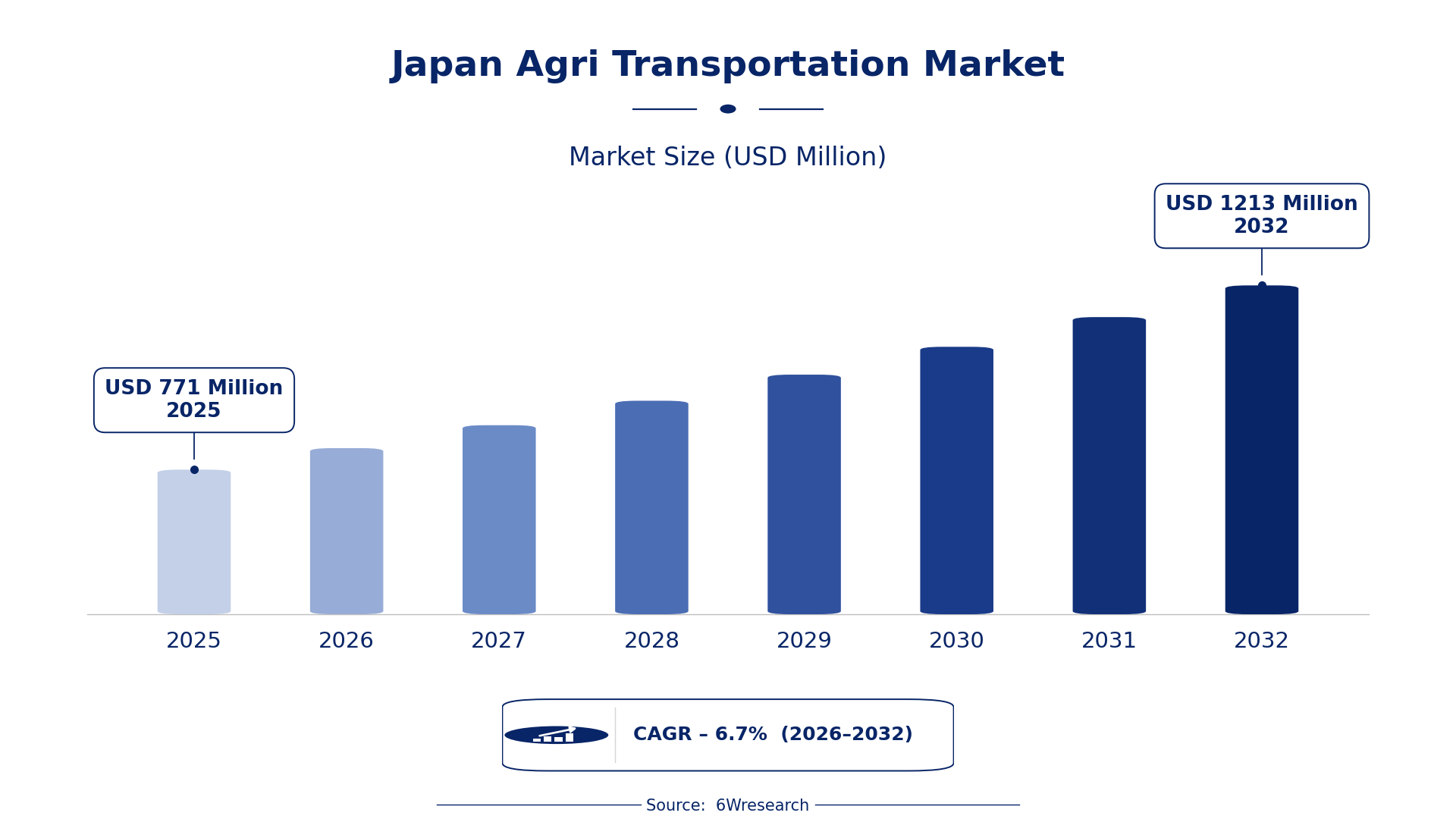
According to 6Wresearch internal database and industry insights, the Japan Agri Transportation Market was valued at USD 771 Million in 2025 and is projected to reach USD 1,213 Million by 2032, growing at a CAGR of approximately 6.7% during 2026–2032.
Japan Agri Transportation Market Highlights
| Report Metric | Details |
| Report Name | Japan Agri Transportation Market (2026-2032) |
| Market Size 2025 | USD 771 Million |
| Market Size 2032 | USD 1,213 Million |
| Absolute Growth 2025–2032 | USD 442 Million |
| CAGR 2026–2032 | 6.7% |
| Peak Annual Growth | 7.3% in 2028 |
| Forecast Period | 2026–2032 |
| Historical Data | 2022–2025 |
| Base Year | 2025 |
| Leading Agri Transportation Market, 2025 | Tractors (47% share) |
| Leading Vehicle Type, 2025 | Refrigerated Units (43% share) |
| Leading Product Type, 2025 | Direct Sales (37% share) |
| Leading Distribution Channel, 2025 | Farm Owners (42% share) |
| Fastest-Growing Agri Transportation Market | Electric Utility Vehicles (9.0% CAGR) |
| Fastest-Growing Product Type | Online Platforms (9.6% CAGR) |
| Fastest-Growing Distribution Channel | Agri Exporters (8.8% CAGR) |
| Growing Sector | agriculture |
| Key End Users | farm owners, agri exporters, cooperatives |
Japan Agri Transportation Market Year-wise Growth Rate and Key Drivers (2022–2032)
This graph illustrates the annual growth rates of the market from 2022 to 2032, highlighting a steady upward trajectory and projected market expansion over the forecast period.
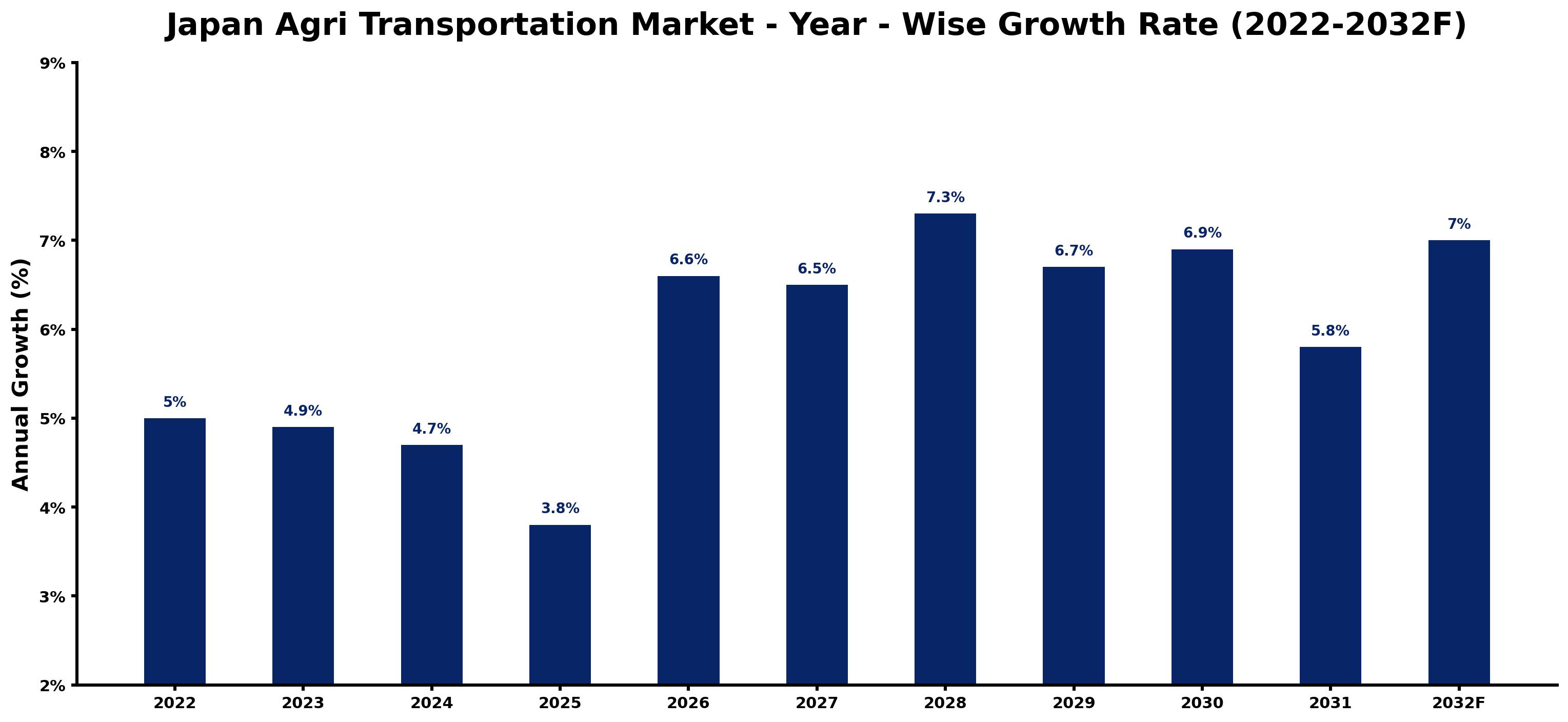
Annual growth estimates for each year appear below with the principal reason behind them, explaining the shifts that set the pace of the market.
| Year | Estimated Annual Growth (%) | Market Rationale |
| 2022 | 5.0 | Demand from over 4 million farms supported growth in agricultural transport. |
| 2023 | 4.9 | Export activities remained strong, sustaining the market despite slower growth. |
| 2024 | 4.7 | Reliance on traditional transport methods limited the pace of expansion. |
| 2025 | 3.8 | Farmers faced challenges in modernising transport, slowing market growth. |
| 2026 | 6.6 | Investment in electric vehicles is expected to boost demand for agri transport. |
| 2027 | 6.5 | Interest in sustainability will maintain market expansion, though at a slower pace. |
| 2028 | 7.3 | The introduction of new transport technologies is projected to spur growth. |
| 2029 | 6.7 | Demand from agri exporters is expected to continue rising, maintaining market momentum. |
| 2030 | 6.9 | Urbanisation trends will increase the need for efficient transport solutions. |
| 2031 | 5.8 | A shift towards modern transport methods is projected to result in slower growth rates. |
| 2032 | 7.0 | Rising demand for refrigerated units will drive further market expansion. |
Note: Market size estimations and growth projections presented in this report are based on 6Wresearch's proprietary forecasting methodology, utilizing the latest available industry data, government publications, and primary research inputs.
Japan Agri Transportation Market Synopsis
Agri transportation involves the movement of agricultural products using vehicles like tractors and mini trucks, essential for transporting goods from farms to markets. The Japan Agri Transportation Market is expanding due to increasing demand from over 4 million farms, alongside export activities valued at approximately 1 trillion yen in 2022. Investments in electric vehicles and advancements in technology are driving this growth, particularly in regions like Tohoku, known for its agricultural output and transport needs.
Market Dynamics Impact Analysis (2026–2032)
| Factor | Type | Impact | Primary Segment Affected |
| Increasing demand for refrigerated units due to the need for transporting fresh produce. | Driver | High | Refrigerated Units |
| The rise in agri exports is creating a need for efficient transport solutions. | Driver | High | Cargo Vans |
| The shift towards electric utility vehicles presents a growing market opportunity. | Opportunity | Medium | Electric Utility Vehicles |
| The Tokyo metropolitan area is experiencing a surge in demand for agri transport solutions. | Opportunity | High | Mini Trucks |
| The aging farmer population is impacting the supply of transport solutions. | Restraint | High | Tractors |
| High costs associated with modernising transport fleets can limit investment. | Restraint | Medium | Cargo Vans |
| The need for compliance with JIS standards can delay vehicle approvals. | Challenge | High | Refrigerated Units |
| Limited infrastructure in rural areas poses challenges for efficient transport. | Challenge | Medium | Mini Trucks |
Evaluation of Drivers in Japan Agri Transportation Market (2026–2032)
The main growth drivers and the segments they affect most are set out below.
| Drivers | Primary Segment Affected | Why It Matters (Evidence) |
| Rising exports of agricultural products necessitate efficient transport solutions. | Cargo Vans | Japan exported agricultural products worth approximately 1 trillion yen in 2022, driving demand for efficient transport. |
| Growing consumer preference for fresh produce increases demand for refrigerated units. | Refrigerated Units | Refrigerated units are essential for transporting fresh produce, meeting market needs. |
| Investment in electric vehicles is transforming agri transport capabilities. | Electric Utility Vehicles | The government launched a program in 2023 to promote electric vehicles in agriculture, improving transport efficiency. |
| The high number of farms in Japan fuels the need for various transport vehicles. | Tractors | With over 4 million farms in Japan, the demand for tractors remains consistently high. |
| Urbanisation trends are increasing the demand for efficient agri transport solutions. | Mini Trucks | The Tokyo metropolitan area has high demand for efficient agri transport solutions, driving mini truck sales. |
A wider customer base explains much of the growth, as rising exports of agricultural products necessitate efficient transport solutions. Japan exported agricultural products worth approximately 1 trillion yen in 2022, driving demand for cargo vans. Consumer preference for fresh produce increases demand for refrigerated units, essential for transporting goods. The high number of farms in Japan fuels the need for tractors, with over 4 million farms contributing to consistent demand. Urbanisation trends in the Tokyo metropolitan area are increasing the demand for efficient agri transport solutions, further supporting market growth.
Evaluation of Restraints in Japan Agri Transportation Market
The table below lists the restraints and the evidence behind each.
| Market Restraint | Primary Segment Affected | Why It Matters (Evidence) |
| The aging farmer population limits the workforce available for transport operations. | Tractors | The average age of farmers in Japan is around 67 years, impacting transport needs. |
| High costs of modernising transport fleets can deter investment in new vehicles. | Cargo Vans | Financial challenges restrict farmers' ability to invest in modern transport. |
| Compliance with JIS standards can delay the introduction of new vehicles. | Refrigerated Units | Producers must ensure their vehicles meet safety and quality standards, which can slow market entry. |
| Limited infrastructure in rural areas affects transport efficiency. | Mini Trucks | Inadequate transport infrastructure in rural Japan can hinder the movement of agricultural goods. |
| The reliance on traditional transport methods can slow modernization efforts. | Tractors | Farmers may prefer familiar methods, delaying the adoption of newer technologies. |
Japan Agri Transportation Market Challenges
High costs in Japan's agricultural sector arise from skills shortages, as the average age of farmers is around 67 years, complicating the adoption of modern transport methods. Buyers encounter increased prices, with logistics inefficiencies leading to up to 15% higher costs for fresh produce. Outdated equipment results in supply chain delays, affecting producers' ability to deliver goods to market promptly, which can lead to revenue losses. Regulatory complexities from the Ministry of Agriculture, Forestry and Fisheries create compliance delays, risking spoilage of perishable goods and adding financial strain on producers.
Trends in the Japan Agri Transportation Market
Four trends stand out in the Japan Agri Transportation Market.
- Shift towards Electric Utility Vehicles: Adoption of electric utility vehicles is increasing, especially in urban agriculture. In 2023, the government launched a program to promote electric vehicles in agriculture, improving transport efficiency.
- Growing Demand for Refrigerated Units: Refrigerated units are becoming increasingly important for transporting fresh produce. In 2025, they are expected to account for 43% of the vehicle market in Japan, reflecting rising consumer demand.
- Expansion of Online Platforms for Equipment Sales: Online platforms for agri equipment sales are gaining traction, especially post-2020. This shift is significant as online sales channels are expected to grow, driven by changing buyer preferences.
- Increased Focus on Sustainability in Transport: Farmers' cooperatives are prioritising sustainable transport solutions to reduce carbon emissions. The government aims to cut carbon emissions in agri transport by 2030, influencing cooperative strategies.
Investment Opportunities in the Japan Agri Transportation Market
Below are the investment opportunities with the strongest case in the Japan Agri Transportation Market.
- Investment in Electric Utility Vehicles: The rising interest in electric utility vehicles offers an opportunity. With government support for electric vehicles, suppliers can collaborate with cooperatives to meet this demand, particularly in urban areas.
- Expansion of Refrigerated Transport Solutions: The demand for refrigerated units is increasing, especially in urban settings. Suppliers should concentrate on the Tokyo metropolitan area, where the need for fresh produce transport is high, with substantial growth anticipated.
- Improving Online Sales Channels: The shift towards online platforms for equipment sales presents a promising opportunity. Suppliers can invest in digital marketing strategies to effectively reach farm owners and improve their sales channels.
- Modernising Transport Fleets: The current push for modernisation presents an opportunity for suppliers of advanced transport solutions. With over 4 million farms, targeting this sector can yield strong returns, particularly in rural areas.
Government Initiatives in the Japan Agri Transportation Market
The Ministry of Agriculture, Forestry and Fisheries oversees regulations affecting agri transport, including the Building Energy Efficiency Act (2015, amended 2022), which mandates energy standards for new agricultural vehicles. These regulations ensure that producers invest in energy-efficient technologies, promoting sustainability in the sector.
Farmers' cooperatives benefit from the Battery Industry Strategy (METI, August 2022), which supports the development of battery manufacturing capacity. This initiative enables cooperatives to access advanced battery technologies, improving the efficiency of electric utility vehicles used in agricultural transport and enhancing their operational capabilities.
Future Insight of the Japan Agri Transportation Market
A shift towards electric vehicles will transform agri transportation, improving urban delivery efficiency by 30% by 2032. Suppliers will adapt to market demands through advanced logistics programmes that streamline operations. Adoption of ISO 9001 standards will improve safety and quality across the sector. Innovations showcased at the annual Agri Transport Expo will introduce new technologies, providing buyers with enhanced logistics solutions.
Market Segmentation Analysis
Japan Agri Transportation Market report covers a detailed analysis of the following market segments:
By Agri Transportation Market – Tractors Lead, Electric Utility Vehicles Expected to Grow Fastest
According to Saurav Kr Singh, Senior Research Analyst at 6Wresearch, the largest agri transportation market category in 2025 was Tractors, at 47% of revenue. Tractors hold the largest share in Japan's agri transportation market as they are crucial for farm operations and transporting crops. The extensive network of over 4 million farms creates a strong demand for tractors, particularly in key agricultural regions like Hokkaido. Electric Utility Vehicles are set to record the highest CAGR in this split, 9.0% over 2026–2032. Electric utility vehicles are experiencing rapid growth due to government initiatives aimed at promoting their adoption in agriculture, particularly to reduce carbon emissions by 2030. This trend is bolstered by the increasing demand for electric vehicles in urban agri transport, ensuring ongoing market expansion. Suppliers should focus on developing electric utility vehicles to align with government initiatives and meet evolving market demands.
By Vehicle Type – Refrigerated Units Lead and Record the Fastest Growth
With 43% of vehicle type revenue in 2025, Refrigerated Units was the largest category. Refrigerated units dominate the vehicle type segment as they are essential for transporting perishable goods, ensuring quality during transit. The high export value of agricultural products, approximately 1 trillion yen in 2022, underscores the critical need for effective refrigerated transport solutions. The same category are also set to grow fastest, at a CAGR of 9.2% during 2026–2032. The growth of refrigerated units is propelled by rising demand for fresh produce, especially in urban areas like Tokyo, where efficient transport is vital. As the agricultural sector continues to expand, reliance on refrigerated transport will remain strong. Investing in advanced refrigerated transport technologies will be crucial for suppliers to capitalise on emerging market opportunities.
By Product Type – Direct Sales Leads, Online Platforms Expected to Grow Fastest
In 2025, Direct Sales led the product type split with a 37% share. Direct sales lead the product type segment as they represent the primary channel for acquiring agricultural vehicles. This method allows buyers to engage directly with manufacturers, ensuring they receive suitable equipment tailored to their specific requirements. The quickest growth will come from Online Platforms, forecast to expand at a CAGR of 9.6% between 2026 and 2032. Online platforms are rapidly gaining traction as a sales channel, particularly following the increase in digital commerce since 2020. This shift reflects changing purchasing behaviours among farmers, who are placing greater value on convenience and accessibility. Suppliers must enhance their online strategies to effectively connect with customers and adapt to shifting purchasing preferences.
By Distribution Channel – Farm Owners Lead, Agri Exporters Expected to Grow Fastest
Farm Owners accounted for 42% of the market by distribution channel in 2025. Farm owners are the primary users of agri transportation vehicles, establishing their dominance as the leading distribution channel. Their direct involvement in agriculture necessitates reliable transport solutions for efficient operations. Over 2026–2032, Agri Exporters are expected to post the fastest growth, at a CAGR of 8.8%. Agri exporters are witnessing a notable increase in demand for transport solutions as Japan's agricultural exports expand. This trend highlights a shift towards more specialised transport services to cater to international market needs. Suppliers should concentrate on developing tailored transport solutions for agri exporters to leverage this growing market segment.
Key Attractiveness of the Report
- 10 Years of Market Numbers
- Historical Data Starting from 2022 to 2025
- Base Year 2025
- Forecast Data until 2032
- Key Performance Indicators Impacting the Market
- Major Upcoming Developments and Projects
Key Highlights of the Report:
- Japan Agri Transportation Market Outlook
- Market Size of Japan Agri Transportation Market, 2025
- Forecast of Japan Agri Transportation Market, 2032
- Historical Data and Forecast of Japan Agri Transportation Revenues & Volume for the Period 2022-2032F
- Japan Agri Transportation Market Trend Evolution
- Japan Agri Transportation Market Drivers and Challenges
- Japan Agri Transportation Price Trends
- Japan Agri Transportation Porter's Five Forces
- Japan Agri Transportation Industry Life Cycle
- Historical Data and Forecast of Japan Agri Transportation Market Revenues & Volume By Agri Transportation Market for the Period 2022-2032F
- Historical Data and Forecast of Japan Agri Transportation Market Revenues & Volume By Tractors for the Period 2022-2032F
- Historical Data and Forecast of Japan Agri Transportation Market Revenues & Volume By Mini Trucks for the Period 2022-2032F
- Historical Data and Forecast of Japan Agri Transportation Market Revenues & Volume By Cargo Vans for the Period 2022-2032F
- Historical Data and Forecast of Japan Agri Transportation Market Revenues & Volume By Electric Utility Vehicles for the Period 2022-2032F
- Historical Data and Forecast of Japan Agri Transportation Market Revenues & Volume By Vehicle Type for the Period 2022-2032F
- Historical Data and Forecast of Japan Agri Transportation Market Revenues & Volume By Open Trailers for the Period 2022-2032F
- Historical Data and Forecast of Japan Agri Transportation Market Revenues & Volume By Refrigerated Units for the Period 2022-2032F
- Historical Data and Forecast of Japan Agri Transportation Market Revenues & Volume By Insulated Containers for the Period 2022-2032F
- Historical Data and Forecast of Japan Agri Transportation Market Revenues & Volume By Loaders for the Period 2022-2032F
- Historical Data and Forecast of Japan Agri Transportation Market Revenues & Volume By Product Type for the Period 2022-2032F
- Historical Data and Forecast of Japan Agri Transportation Market Revenues & Volume By Direct Sales for the Period 2022-2032F
- Historical Data and Forecast of Japan Agri Transportation Market Revenues & Volume By Equipment Dealers for the Period 2022-2032F
- Historical Data and Forecast of Japan Agri Transportation Market Revenues & Volume By Online Platforms for the Period 2022-2032F
- Historical Data and Forecast of Japan Agri Transportation Market Revenues & Volume By Specialized Distributors for the Period 2022-2032F
- Historical Data and Forecast of Japan Agri Transportation Market Revenues & Volume By Distribution Channel for the Period 2022-2032F
- Historical Data and Forecast of Japan Agri Transportation Market Revenues & Volume By Farm Owners for the Period 2022-2032F
- Historical Data and Forecast of Japan Agri Transportation Market Revenues & Volume By Agri Exporters for the Period 2022-2032F
- Historical Data and Forecast of Japan Agri Transportation Market Revenues & Volume By Co-operatives for the Period 2022-2032F
- Historical Data and Forecast of Japan Agri Transportation Market Revenues & Volume By Greenhouse Operators for the Period 2022-2032F
- Japan Agri Transportation Import Export Trade Statistics
- Market Opportunity Assessment By Agri Transportation Market
- Market Opportunity Assessment By Vehicle Type
- Market Opportunity Assessment By Product Type
- Market Opportunity Assessment By Distribution Channel
- Japan Agri Transportation Top Companies Market Share
- Japan Agri Transportation Competitive Benchmarking By Technical and Operational Parameters
- Japan Agri Transportation Company Profiles
- Japan Agri Transportation Key Strategic Recommendations
Market Covered
This report examines the market across the segments below.
By Agri Transportation Market
- Tractors
- Mini Trucks
- Cargo Vans
- Electric Utility Vehicles
By Vehicle Type
- Open Trailers
- Refrigerated Units
- Insulated Containers
- Loaders
By Product Type
- Direct Sales
- Equipment Dealers
- Online Platforms
- Specialized Distributors
By Distribution Channel
- Farm Owners
- Agri Exporters
- Co-operatives
- Greenhouse Operators































