Japan Agricultural Film Market Size & Growth Rate
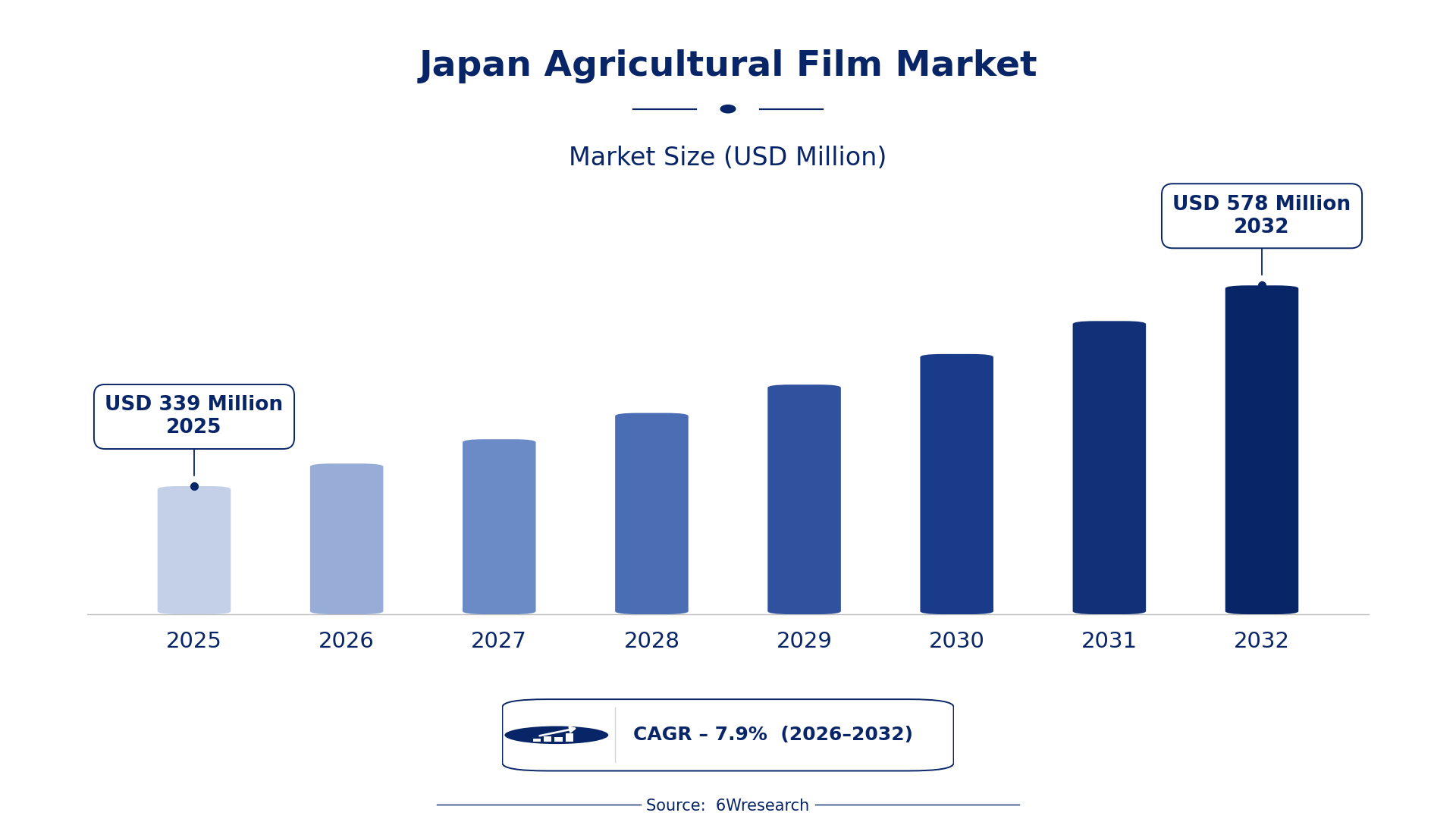
According to 6Wresearch internal database and industry insights, the Japan Agricultural Film Market was valued at USD 339 Million in 2025 and is projected to reach USD 578 Million by 2032, growing at a CAGR of approximately 7.9% during 2026–2032.
Japan Agricultural Film Market Highlights
| Report Metric | Details |
| Report Name | Japan Agricultural Film Market (2026-2032) |
| Market Size 2025 | USD 339 Million |
| Market Size 2032 | USD 578 Million |
| Absolute Growth 2025–2032 | USD 239 Million |
| CAGR 2026–2032 | 7.9% |
| Peak Annual Growth | 10.2% in 2026 |
| Forecast Period | 2026–2032 |
| Historical Data | 2022–2025 |
| Base Year | 2025 |
| Leading Product Type, 2025 | Polyethylene Films (33% share) |
| Leading Application, 2025 | Greenhouse Films (46% share) |
| Leading End User, 2025 | Farmers (45% share) |
| Fastest-Growing Product Type | Polypropylene Films (11.1% CAGR) |
| Fastest-Growing Application | Mulch Films (10.3% CAGR) |
| Fastest-Growing End User | Agricultural Contractors (9.5% CAGR) |
| Growing Sector | Greenhouse cultivation |
| Key End Users | Farmers, Agricultural Contractors, Horticulturalists |
Japan Agricultural Film Market Year-wise Growth Rate and Key Drivers (2022–2032)
This graph illustrates the annual growth rates of the market from 2022 to 2032, highlighting a steady upward trajectory and projected market expansion over the forecast period.
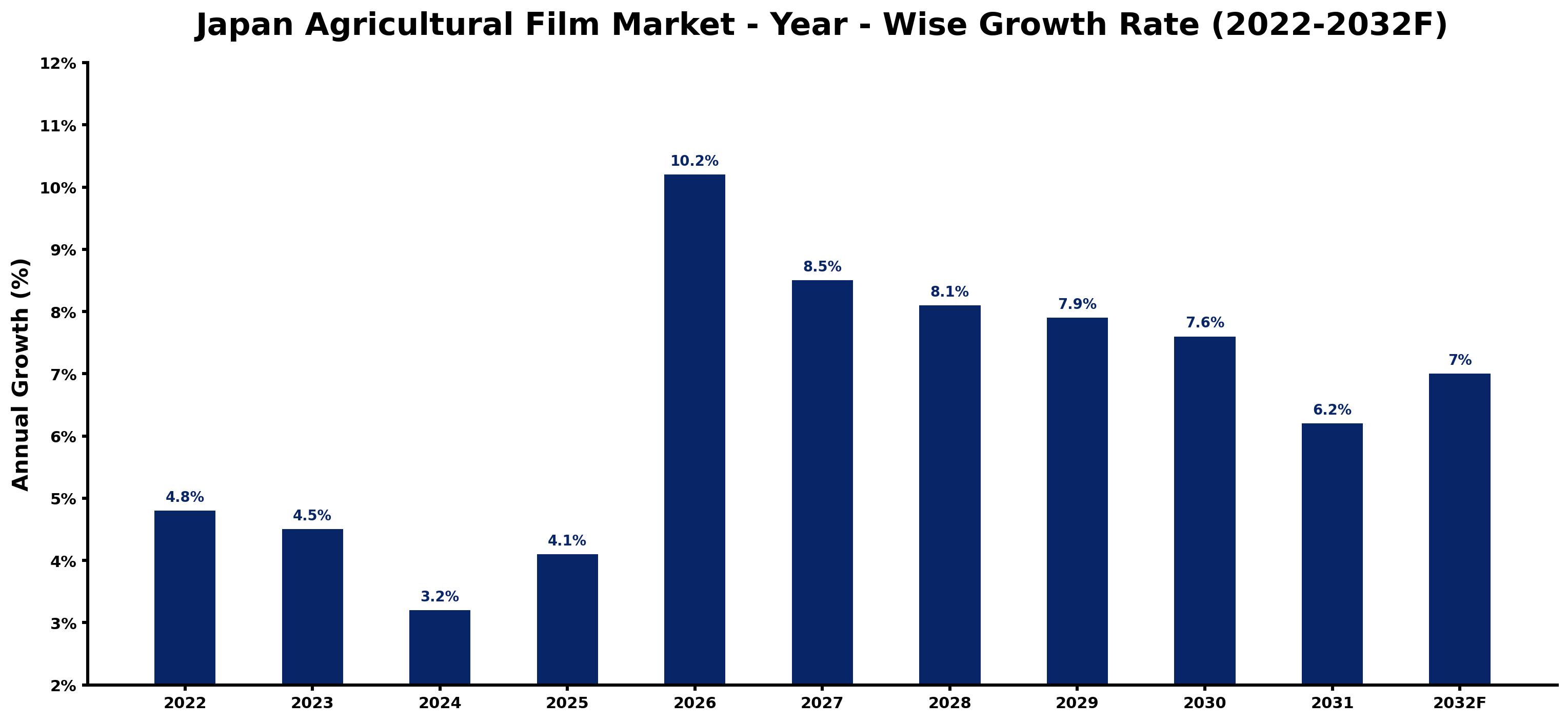
The yearly estimates that follow link every growth rate to its principal driver, so readers can see why the pace changed in each period.
| Year | Estimated Annual Growth (%) | Market Rationale |
| 2022 | 4.8 | The market showed steady growth due to consistent agricultural activity and demand for crop protection. |
| 2023 | 4.5 | Growth slowed slightly as farmers faced challenges in technology adoption amid an aging workforce. |
| 2024 | 3.2 | Market growth continued to slow as farmers adjusted to changing environmental regulations and practices. |
| 2025 | 4.1 | Growth picked up as investments in agricultural modernization began to yield results for farmers. |
| 2026 | 10.2 | A surge in demand is anticipated due to the introduction of biodegradable films and increased greenhouse cultivation. |
| 2027 | 8.5 | Growth is projected to slow as market saturation in certain film types begins to take effect. |
| 2028 | 8.1 | Demand is expected to slow as farmers become more selective in their film purchases based on sustainability. |
| 2029 | 7.9 | Growth is expected to slow further as the market experiences consolidation among suppliers and increased competition. |
| 2030 | 7.6 | Demand is projected to stabilise as farmers adapt to new technologies and practices in agricultural film usage. |
| 2031 | 6.2 | Growth will slow again as the focus shifts towards recycling and disposal regulations. |
| 2032 | 7.0 | Demand is expected to rise as new technologies emerge, improving crop yields and sustainability. |
Note: Market size estimations and growth projections presented in this report are based on 6Wresearch's proprietary forecasting methodology, utilizing the latest available industry data, government publications, and primary research inputs.
Japan Agricultural Film Market Synopsis
Agricultural film, made from polymers like polyethylene and polypropylene, protects crops and creates optimal growth conditions in Japan. The Japan Agricultural Film Market is growing due to increasing demand from farmers and agricultural contractors, driven by investments in sustainable practices and technology. The average yield increase from mulch films can reach 20%, encouraging further adoption among users. Government initiatives promote eco-friendly materials, aligning with the market's shift towards sustainability.
Market Dynamics Impact Analysis (2026–2032)
| Factor | Type | Impact | Primary Segment Affected |
| Growing interest in biodegradable films | Driver | High | Biodegradable Films |
| Increased greenhouse cultivation area | Driver | High | Greenhouse Films |
| Rising demand for eco-friendly agricultural practices | Opportunity | High | Biodegradable Films |
| Expansion of greenhouse facilities in the Tokyo region | Opportunity | High | Greenhouse Films |
| Aging farmer population affecting technology adoption | Restraint | High | Polyethylene Films |
| Strict regulations on agricultural film disposal | Restraint | Medium | Polyethylene Films |
| Competition from imported agricultural films | Challenge | Medium | Polypropylene Films |
| High initial investment for sustainable film alternatives | Challenge | Medium | Biodegradable Films |
Evaluation of Drivers in Japan Agricultural Film Market (2026–2032)
The factors lifting demand, and the evidence behind each, are summarised below.
| Drivers | Primary Segment Affected | Why It Matters (Evidence) |
| Increased adoption of greenhouse films | Greenhouse Films | With approximately 30,000 hectares of greenhouses in Japan, demand for protective films is rising. |
| Rising yield improvements from mulch films | Mulch Films | The average yield increase from using mulch films can reach 20%, encouraging farmers to invest more in these products. |
| Growing number of agricultural contractors | Agricultural Contractors | Contractors account for about 20% of the agricultural workforce, driving demand for various agricultural films. |
| Technological advancements in agricultural film production | Polyethylene Films | Advancements in production processes improve film quality, attracting more farmers to upgrade their materials. |
| Government support for sustainable practices | Biodegradable Films | The introduction of eco-friendly materials is increasing demand for biodegradable films. |
Orders keep climbing as farmers increasingly adopt greenhouse films, with approximately 30,000 hectares of greenhouses in Japan utilising these products. The average yield increase from mulch films can reach 20%, prompting farmers to invest more in these solutions. Recent advancements in production processes improve film quality, prompting more farmers to seek efficiency. Agricultural contractors, making up 20% of the workforce, are driving demand for various agricultural films. Support for eco-friendly materials is appealing to environmentally conscious buyers, further boosting market activity.
Evaluation of Restraints in Japan Agricultural Film Market
These are the pressures that could keep growth below its potential.
| Market Restraint | Primary Segment Affected | Why It Matters (Evidence) |
| Aging farmer population hindering technology adoption | Polyethylene Films | The average age of farmers in Japan is around 67 years, impacting their willingness to adopt new technologies. |
| Strict regulations on agricultural film disposal | Polyethylene Films | Japan has stringent regulations on disposal and recycling, increasing compliance costs for producers. |
| High initial investment for sustainable film alternatives | Biodegradable Films | The cost of switching to biodegradable films can deter farmers from making the transition. |
| Market saturation in certain film types | Greenhouse Films | As the market matures, demand for established film types may plateau, limiting growth opportunities. |
| Competition from imported agricultural films | Polypropylene Films | Imported films often offer lower prices, making it challenging for local producers to compete effectively. |
Japan Agricultural Film Market Challenges
Aging farmers in Japan, with an average age of 67 years, struggle to adopt new agricultural technologies, resulting in stagnant productivity for buyers. Strict regulations on agricultural film disposal and recycling create delays in supply chains, affecting timely delivery for suppliers. Limited technological advancements in film production restrict buyers from accessing improved performance and sustainability options. High costs associated with quality checks on imported films raise prices for buyers, complicating their ability to remain competitive in the market.
Trends in the Japan Agricultural Film Market
Below are the shifts with the largest effect on the Japan Agricultural Film Market.
- Farmers Shifting Towards Biodegradable Films: A growing number of farmers are adopting biodegradable films to meet sustainability goals. In 2023, the adoption rate for biodegradable films rose to 30%, reflecting a shift towards eco-friendly practices.
- Rapid Expansion of Greenhouse Cultivation: Greenhouse cultivation is expanding in Japan, with approximately 30,000 hectares now in use. This shift is driving demand for greenhouse films as farmers seek to improve crop protection and yield.
- Increased Focus on Film Recycling Initiatives: The emphasis on recycling agricultural films has intensified, driven by recent regulations. This trend is prompting producers to explore more sustainable disposal methods, influencing buyer preferences.
- Technological Advancements in Film Production: Technological advancements in agricultural film production are reshaping market practices. In 2023, new production techniques improved film quality, leading to increased adoption among farmers.
Investment Opportunities in the Japan Agricultural Film Market
The following opportunities in the Japan Agricultural Film Market pair current demand with a clear way in.
- Tokyo Region's Greenhouse Facilities: The Tokyo region is a hub for greenhouse facilities, with a growing demand for greenhouse films. In 2023, the market for these films expanded by 15%, presenting opportunities for suppliers.
- Investment in Biodegradable Film Production: The market gap for biodegradable films is significant, with increasing consumer demand. In 2023, the adoption rate rose to 30%, indicating a need for suppliers to invest in production capabilities.
- Growing Influence of Agricultural Contractors: Agricultural contractors are increasingly seeking diverse film options, especially in regions with high agricultural activity. This trend presents an opportunity for suppliers to cater to their specific needs.
- Urgent Timing for Sustainable Practices: With Japan's commitment to reducing plastic waste, there is a pressing need for sustainable agricultural films. The government's allocation of ¥10 billion for agricultural modernization in 2023 highlights the urgency.
Government Initiatives in the Japan Agricultural Film Market
The Plastic Resource Circulation Act, enacted in 2021, promotes the reduction, reuse, and recycling of plastics, including agricultural films. This law requires producers to implement sustainable practices and encourages the use of biodegradable alternatives, impacting both producers and buyers in the agricultural film market.
In 2023, the government allocated ¥10 billion for agricultural modernization initiatives, overseen by the Ministry of Agriculture, Forestry and Fisheries. This funding supports projects aimed at improving productivity and sustainability in agricultural practices, directly benefiting producers and farmers.
Future Insight of the Japan Agricultural Film Market
By 2032, advancements in greenhouse technologies will reshape demand for agricultural films, as modern climate control systems become commonplace. The 'Smart Agriculture Promotion Strategy' will facilitate the adoption of innovative practices, aligning with Japan's agricultural modernization efforts. Annual agricultural film consumption is expected to reach 250,000 tons, supported by increased usage among agricultural contractors. Enhanced production processes will allow suppliers to provide more efficient and sustainable film solutions.
Market Segmentation Analysis
Japan Agricultural Film Market report covers a detailed analysis of the following market segments:
By Product Type – Polyethylene Films Lead, Polypropylene Films Expected to Grow Fastest
According to Sumit Sagar, AM at 6Wresearch, Polyethylene Films held 33% of the Japan Agricultural Film Market by product type in 2025. Polyethylene films dominate the market due to their extensive use in greenhouse and mulch applications, which are essential for crop protection and yield enhancement. With an estimated adoption rate of 70% among farmers, they are integral to agricultural practices in Japan. Over 2026–2032, Polypropylene Films are expected to post the fastest growth, at a CAGR of 11.1%. Polypropylene films are experiencing rapid growth as they become more popular in specialised applications, driven by initiatives such as the 'Smart Agriculture Promotion Strategy'. This focus on improving productivity through technology will likely further boost their market share. Suppliers should focus on expanding their polypropylene offerings to meet the rising demand in specialised agricultural sectors.
By Application – Greenhouse Films Lead, Mulch Films Expected to Grow Fastest
Greenhouse Films accounted for 46% of the market by application in 2025. Greenhouse films hold the largest market share because they are crucial for protecting crops and ensuring optimal growth conditions, particularly in significant horticultural regions like Tokyo. The extensive greenhouse area of approximately 30,000 hectares underscores their importance in the agricultural film sector. Mulch Films are set to record the highest CAGR in this split, 10.3% over 2026–2032. Mulch films are poised for rapid growth as their effectiveness in enhancing soil conditions becomes increasingly recognised, which is vital for improving crop yields. The potential for a 20% yield increase from using mulch films highlights their effectiveness and potential for wider adoption. Buyers should consider prioritising mulch films to improve soil health and achieve higher crop productivity.
By End User – Farmers Lead, Agricultural Contractors Expected to Grow Fastest
Farmers took 45% of end user revenue in 2025, more than any other category. Farmers represent the largest group of end users as they are the primary consumers of agricultural films for various applications, including crop protection and yield improvement. With an estimated 70% adoption rate, their reliance on these films is a key factor in their market leadership. Agricultural Contractors are projected to grow fastest, at a CAGR of 9.5% during 2026–2032. Agricultural contractors are seeing the fastest growth as they increasingly utilise agricultural films for a variety of services, reflecting the broader trend towards professionalisation in the agricultural sector. Their role in modernising agricultural practices positions them for continued expansion in the market. Suppliers should tailor their products to meet the specific needs of agricultural contractors to capitalise on this growing segment.
Key Attractiveness of the Report
- 10 Years of Market Numbers
- Historical Data Starting from 2022 to 2025
- Base Year 2025
- Forecast Data until 2032
- Key Performance Indicators Impacting the Market
- Major Upcoming Developments and Projects
Key Highlights of the Report:
- Japan Agricultural Film Market Outlook
- Market Size of Japan Agricultural Film Market, 2025
- Forecast of Japan Agricultural Film Market, 2032
- Historical Data and Forecast of Japan Agricultural Film Revenues & Volume for the Period 2022-2032
- Japan Agricultural Film Market Trend Evolution
- Japan Agricultural Film Market Drivers and Challenges
- Japan Agricultural Film Price Trends
- Japan Agricultural Film Porter's Five Forces
- Japan Agricultural Film Industry Life Cycle
- Historical Data and Forecast of Japan Agricultural Film Market Revenues & Volume By Product Type for the Period 2022-2032
- Historical Data and Forecast of Japan Agricultural Film Market Revenues & Volume By Polyethylene Films for the Period 2022-2032
- Historical Data and Forecast of Japan Agricultural Film Market Revenues & Volume By Polypropylene Films for the Period 2022-2032
- Historical Data and Forecast of Japan Agricultural Film Market Revenues & Volume By EVA (Ethylene-Vinyl Acetate) Films for the Period 2022-2032
- Historical Data and Forecast of Japan Agricultural Film Market Revenues & Volume By Biodegradable Films for the Period 2022-2032
- Historical Data and Forecast of Japan Agricultural Film Market Revenues & Volume By Application for the Period 2022-2032
- Historical Data and Forecast of Japan Agricultural Film Market Revenues & Volume By Greenhouse Films for the Period 2022-2032
- Historical Data and Forecast of Japan Agricultural Film Market Revenues & Volume By Mulch Films for the Period 2022-2032
- Historical Data and Forecast of Japan Agricultural Film Market Revenues & Volume By Silage Films for the Period 2022-2032
- Historical Data and Forecast of Japan Agricultural Film Market Revenues & Volume By Shed Covers for the Period 2022-2032
- Historical Data and Forecast of Japan Agricultural Film Market Revenues & Volume By End User for the Period 2022-2032
- Historical Data and Forecast of Japan Agricultural Film Market Revenues & Volume By Farmers for the Period 2022-2032
- Historical Data and Forecast of Japan Agricultural Film Market Revenues & Volume By Agricultural Contractors for the Period 2022-2032
- Historical Data and Forecast of Japan Agricultural Film Market Revenues & Volume By Horticulturalists for the Period 2022-2032
- Japan Agricultural Film Import Export Trade Statistics
- Market Opportunity Assessment By Product Type
- Market Opportunity Assessment By Application
- Market Opportunity Assessment By End User
- Japan Agricultural Film Top Companies Market Share
- Japan Agricultural Film Competitive Benchmarking By Technical and Operational Parameters
- Japan Agricultural Film Company Profiles
- Japan Agricultural Film Key Strategic Recommendations
Market Covered
Segments analysed in this report are listed below.
By Product Type
- Polyethylene Films
- Polypropylene Films
- EVA (Ethylene-Vinyl Acetate) Films
- Biodegradable Films
By Application
- Greenhouse Films
- Mulch Films
- Silage Films
- Shed Covers
By End User
- Farmers
- Agricultural Contractors
- Horticulturalists






































